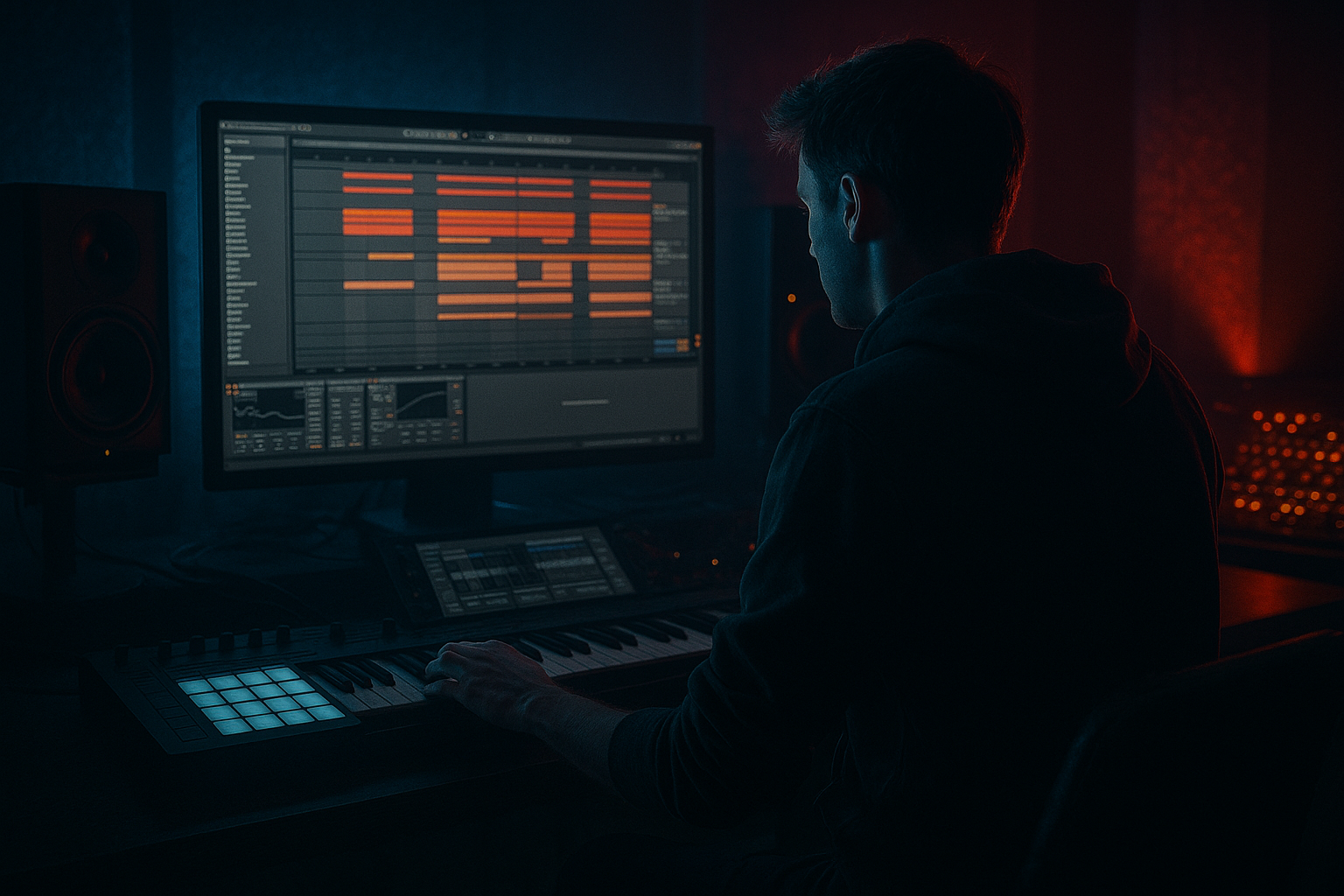
Main tutorial
Lesson Overview
An offset jungle riser is a tension-building atmosphere that doesn’t just “go up” straight on the grid. Instead, it feels slightly late, slightly broken, and more human — which is exactly why it works so well in Drum & Bass. In a roller, jungle rebuild, darkstep intro, or pre-drop switch-up, that offset timing creates a nervous pull that makes the drop feel bigger without needing a huge CPU-heavy synth stack.
In Ableton Live 12, you can build this using mostly stock devices and a smart routing approach so the sound stays light on CPU, easy to automate, and fast to reuse across tracks. The goal here is not a flashy cinematic riser. The goal is a usable DnB atmosphere: grimy, evolving, and rhythmically imperfect in a controlled way.
Why this matters in DnB: the genre lives on tension and release, and tiny timing offsets often hit harder than obvious effects. A riser that starts slightly behind the kick/snare grid, or blooms into the next bar from an awkward position, can make a drop feel like it’s being dragged open. That’s gold in jungle, rollers, neuro-intro energy, and darker bass music.
What You Will Build
You will build a minimal-CPU offset jungle riser with these characteristics:
- A short, gritty atmospheric rise that begins off the downbeat
- A rhythmic wobble or pulse that sits between straight-up FX and a musical bass movement
- A tonal center that can hint at the tune’s key without taking over the mix
- A filtered, widening top movement that feels like tape, radio, or worn-out hardware
- A clean routing setup that lets you automate one macro instead of juggling multiple tracks
- a pre-drop tension layer in a 16-bar intro
- a switch-up texture after a drum fill
- a call-and-response lead-in before a bass drop
- a jungle build element that feels old-school but still modern
- Making the riser too wide in the low mids
- Letting the riser stay too loud under the drums
- Using too many synth layers for a simple build
- Starting the riser exactly on the bar every time
- Adding harsh top-end that competes with hats and cymbals
- Ignoring phase and mono compatibility
- Use a reese-like harmonic shadow underneath the atmosphere
- Sidechain the riser lightly to the kick or main snare
- Automate less, then distort more
- Blend in broken break texture
- Use clip envelopes for tiny timing weirdness
- Keep the end of the riser slightly unresolved
- one before a drop
- one under a drum fill
- one as a switch-up transition in the middle of an 8-bar section
By the end, you’ll have a riser that can function as:
This is not a giant cinematic sweep. It’s a DJ-friendly, arrangement-ready atmosphere that supports drums and sub rather than fighting them.
Step-by-Step Walkthrough
1. Start with a lean atmospheric source
Create a new MIDI track and load Wavetable, Analog, or even Operator if you want the lowest CPU footprint. For this lesson, Operator is ideal because it’s efficient and clean for modulation.
In Operator:
- Set Oscillator A to a sine or triangle
- Tune it around 1–2 octaves above the sub range so it reads as atmosphere, not bass
- Add a small amount of Noise if you want texture, but keep it subtle
- Use Amp Envelope with:
- Attack: 50–150 ms
- Decay: 2–4 s
- Sustain: -inf or very low
- Release: 200–600 ms
The point is to create a source that can bloom, not a full melody. In DnB, this kind of source works because it leaves room for the break and bassline while still giving the intro movement.
2. Create the offset timing feel with MIDI placement and note lengths
Write a single note or two-note phrase in an 8-bar clip. Don’t place it exactly on the 1 of the bar. Offset it so the first note starts:
- 1/16 late, or
- just after the snare pickup, or
- on the “and” of beat 4 before the drop
Good starting options:
- A note starting at bar 1 beat 4.3-ish to feel like it’s being dragged in
- Or start the riser half a beat after the drum fill begins
Make the note length longer than expected so the envelope can “swell” into the next section. If you’re doing a build into a drop, a note that overlaps the bar line by 1/2 bar to 1 bar often feels better than a perfectly clipped FX shot.
Why this works in DnB: the groove of the genre is already highly syncopated. An offset riser sits naturally against breakbeat phrasing and can make the drop feel more aggressive without adding more elements.
3. Shape the movement with automation, not extra layers
Add Auto Filter after the synth. Use it as the main motion driver so you don’t need multiple sounds.
Suggested starting settings:
- Filter type: Low-pass 24
- Frequency: start around 300 Hz–800 Hz
- Resonance: 10–25%
- Drive: 5–15% if you want more edge
Automate the filter frequency upward over the riser length, but do it in a slightly uneven curve:
- First half: slow movement
- Second half: sharper lift
- Final 1/4 bar: push harder for urgency
If you want the motion to feel more “jungle tape” than clean EDM, add a subtle LFO in Wavetable or use Shifter very lightly for instability. But keep CPU and clutter low by avoiding unnecessary stacked oscillators.
4. Add rhythmic tension with a hidden pulse
Insert Gate or Auto Pan after the filter for rhythmic movement. This is where the riser starts to feel offset instead of just sweeping.
Two good options:
- Auto Pan
- Amount: 10–30%
- Rate: 1/8 or 1/16
- Phase: 0° for volume tremolo, or slightly wider for movement
- Shape: push away from perfect sine if you want a sharper chop
- Gate
- Use a sidechain-like rhythmic opening pattern from the internal clip or a MIDI-triggered device chain
- Keep it subtle so it feels like air moving, not a hard stutter
The best DnB result is usually a pulse that doesn’t scream “effect.” You want it to feel like the atmosphere is breathing with the drums.
Practical move: if your drop is dense, use a slower pulse like 1/8. If the tune is more neuro or darkstep, a tighter 1/16 tremolo can create anxiety without stealing focus.
5. Dirty it up with low-CPU grit
Add Saturator after Auto Filter. This gives the riser more density and helps it cut on smaller systems.
Suggested settings:
- Drive: 2–6 dB
- Soft Clip: On
- Base: default is fine
- Color: very subtle, if used at all
If you want a more worn jungle feel, follow with Redux very lightly:
- Downsample: enough to slightly roughen the top
- Bit reduction: keep modest, don’t destroy the sound
You can also use Erosion for a dusty edge:
- Mode: Noise
- Amount: very low, around 1–8%
Keep the grit focused on the mid/highs. The atmosphere should feel dirty, not hissy. In darker DnB, this kind of controlled distortion helps the riser feel like it belongs with your break edits and bass saturation.
6. Build the “offset” with delay or timing displacement
This is the key step. The riser should feel slightly late or displaced relative to the grid.
Use Echo or Simple Delay very lightly:
- Time: 1/8 dotted or 1/16
- Feedback: 10–25%
- Dry/Wet: 5–18%
- Filter the repeats so they don’t crowd the mix
Now automate the delay mix so it rises only near the end of the build. Another option is to duplicate the riser clip and nudge the copy later by 10–30 ms on a second track, then pan or filter it differently. That creates a subtle offset smear without needing a huge stack.
If you use Track Delay on the channel, a tiny negative or positive offset can make the atmosphere hit before or after the drums in a useful way. Be careful:
- Use only a few milliseconds
- Check against the snare and bass entry
- Don’t create phase problems if you’re layering versions
Why this works in DnB: small timing offsets create tension against the strictness of the 170–175 BPM grid. That contrast is especially effective when the drums are tight and the atmosphere feels like it’s dragging behind the groove.
7. Control the width and low-end so it doesn’t fight the drop
Add Utility after your FX chain.
- Turn Bass Mono on if needed
- Reduce width to around 70–100% depending on how busy the drop is
- Use Mono checks while arranging
Then add EQ Eight:
- High-pass around 150–300 Hz to keep sub space clear
- If the sound gets sharp, notch or gently dip around 2–5 kHz
- If it’s too thin, add a tiny shelf around 500 Hz–1.2 kHz
In DnB, atmospheres should support the bassline and break, not interfere with them. This is especially important if your drop has an aggressive reese or a sub-heavy roller bass. Keep the riser feeling wide enough to be exciting, but clean enough that the low-end punches through.
8. Freeze, flatten, and resample for even lower CPU
Once the sound is working, use Ableton’s workflow to make it lighter:
- Freeze the track
- If needed, Flatten it into audio
- Or Resample the riser into a new audio track
This is a huge workflow win for DnB, because atmosphere design can tempt you into loading too many devices. Once you’ve committed the main movement, audio editing gives you more control:
- Fade in the start slightly
- Trim the tail so it lands exactly on the drop
- Reverse a tiny section if you want a warped jungle lead-in
- Add an extra automation point on the audio clip gain for the final swell
For minimal CPU, this is the most practical route. It also makes the riser easier to rearrange in a 16-bar intro or 8-bar switch-up.
9. Place it in a real arrangement context
Try the riser in a 16-bar intro into a 32-bar drop:
- Bars 1–8: break-only or filtered drums
- Bars 9–12: bass tease and drum fill
- Bars 13–16: your offset riser enters late, under tension
- Bar 16: drop hits clean after the riser’s final filtered burst
Another strong use is in a roller switch-up:
- Main groove runs for 8 or 16 bars
- One-bar drum fill appears
- Your offset jungle riser starts just after the fill, not on the exact bar line
- Bass returns with a new pattern or extra sub hit
In jungle and darker rollers, this kind of placement helps the track breathe like a DJ tool while still feeling arranged and intentional. The atmosphere tells the listener “something is coming” without giving away the whole drop.
10. Map the whole thing to one Macro for fast control
Put your devices into an Instrument Rack or Audio Effect Rack and map key controls to Macros:
- Macro 1: Filter Frequency
- Macro 2: Resonance
- Macro 3: Saturation Drive
- Macro 4: Delay Mix
- Macro 5: Width
- Macro 6: Output Gain
Now you can quickly make variants:
- A cleaner intro version
- A grittier drop lead-in
- A more broken jungle version with extra delay and grit
- A tight neuro-style version with less width and more focus
This is the fastest way to build a reusable atmosphere palette for DnB. Once you have one good offset riser, you can repurpose it across tunes and keep your sound consistent.
Common Mistakes
Fix: high-pass more aggressively with EQ Eight and use Utility to keep the bottom centered.
Fix: automate volume down before the drop or freeze and trim the tail so the transient elements stay dominant.
Fix: get more movement from automation, filter shape, delay timing, and resampling before stacking more devices.
Fix: offset the entrance by a few ticks, a 1/16, or after a fill so it feels more alive.
Fix: soften with EQ Eight around 3–8 kHz or reduce the saturation drive.
Fix: check the riser in mono, especially if you use width tricks, duplicated layers, or delays.
Pro Tips for Darker / Heavier DnB
Duplicate the source, detune it slightly, and keep it filtered low. Even a tiny harmonically rich layer can make the riser feel heavier without turning it into a bass sound.
In a dark roller, a subtle pump can make the atmosphere breathe with the groove. Keep it gentle so it feels like motion, not EDM pumping.
Heavy DnB often sounds more powerful when the movement is simple and the tone is aggressive. A modest sweep plus saturation often beats an over-automated wash.
Try placing a chopped break ghost layer behind the riser and filtering it heavily. This can make the effect feel like part of the rhythm section rather than a separate FX sound.
Small gain or filter changes inside the MIDI clip can create a more human, old-jungle feel than sweeping global automation.
In darker music, perfection can reduce tension. Ending the riser with a tiny delay tail or a filtered cut can make the drop feel nastier.
Mini Practice Exercise
Spend 10–20 minutes making three versions of the same offset jungle riser in Ableton Live:
1. Clean version
- Operator source
- Auto Filter sweep
- Very light saturation
2. Dirty version
- Add Erosion or Redux
- Slightly stronger delay tail
- Narrower, more focused stereo image
3. Heavy version
- More resonance
- Stronger saturation
- Shorter, more aggressive rise
- Offset the start by a 1/16 late
Then place each version into a different arrangement context:
Listen for which one supports the drums and bass best. Pick the version that feels most natural against your actual track, not the one that sounds biggest on its own.
Recap
An effective offset jungle riser in Ableton Live 12 is all about timing, restraint, and texture. Build it from a light stock synth, shape it with filtering and subtle modulation, add controlled grit, and then place it slightly off-grid so it pushes against the groove. Keep the low end clean, check mono, and resample once it works so the CPU stays low. In DnB, that small timing offset can do more for tension than a huge cinematic sweep ever will.

