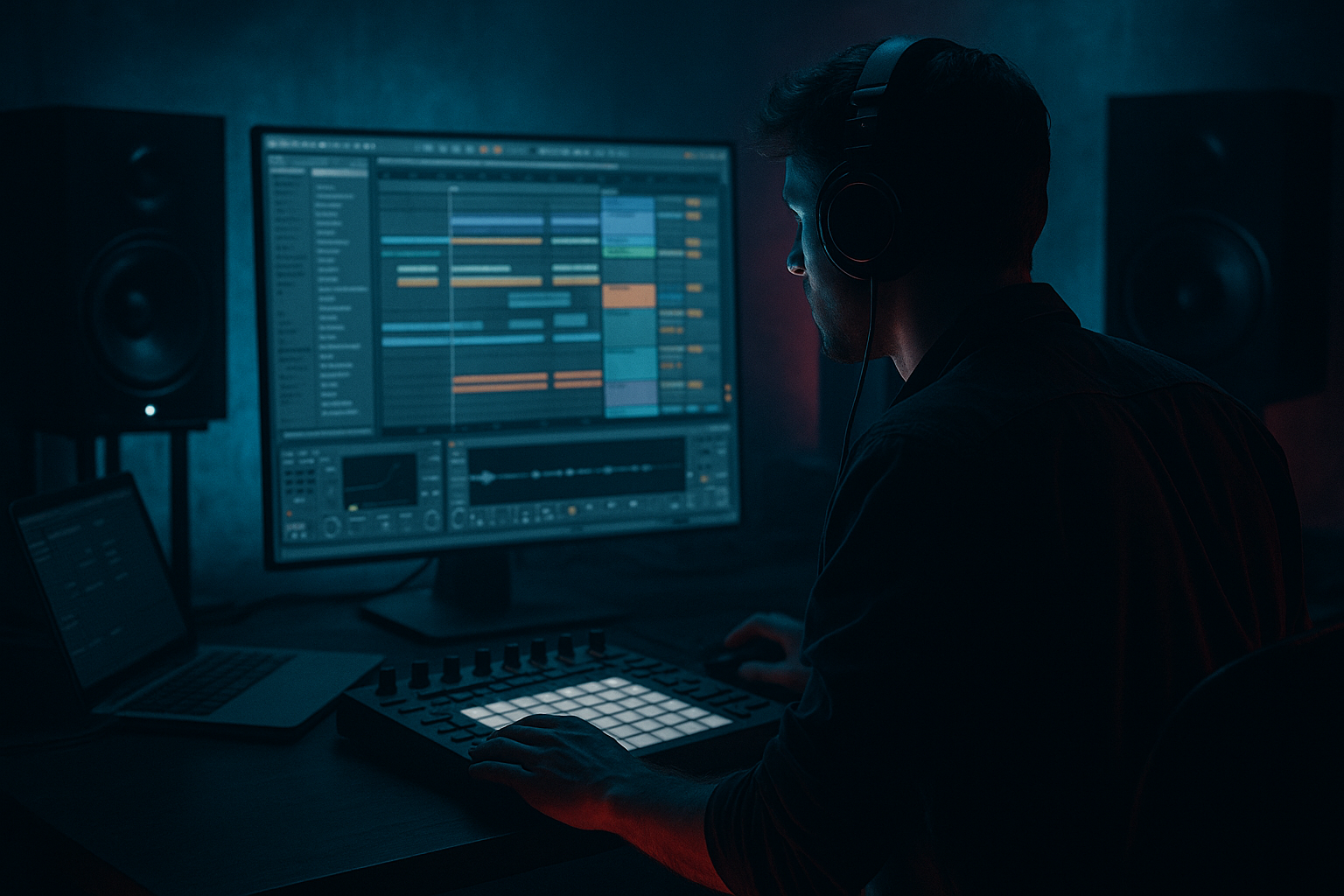
Main tutorial
```markdown
Offset Oldskool DnB Top Loop with Breakbeat Surgery in Ableton Live 12
> Advanced mixing lesson for drum & bass producers
> Goal: take a classic oldskool top loop, surgically edit it in Ableton Live 12, and offset it against your main break so it adds movement, grit, and shuffle without smearing your groove. 🥁⚡
---
1. Lesson overview
Oldskool DnB and jungle often work because the drums feel alive, layered, and slightly “wrong” in the best way. One of the most effective tricks is to use a top loop—a chopped high-frequency break layer containing hats, ghost hits, stick noise, and shuffle—and place it slightly offset from your main break pattern.
That offset creates:
- micro-groove tension
- swing and forward motion
- more perceived speed
- breakbeat complexity without clutter
- a more authentic 90s/2000s jungle / rolling DnB feel
- breakbeat surgery
- offset timing
- layering top loops with your main break
- mix control for punch and clarity
- stock Ableton devices only where possible
- Amen
- Think
- Funky Drummer
- Hot Pants
- Bongo Rock
- or a modern “amen-style” break one-shot pack
- hats
- rides
- ghost notes
- snare tails
- stick noise
- shuffles
- slightly ahead of the main break for urgency and push
- or slightly behind for laid-back, heavy pocket
- 5–20 ms offset
- or 1/64 to 1/32 note offset depending on tempo and source material
- Main break is locked to the grid.
- Top loop is shifted earlier by 8–12 ms for a “dragging forward” sensation.
- Or shifted later by 10–15 ms for a looser, swaggering swing.
- Drive: 1–4 dB
- Soft Clip: on
- Great for turning a bland top loop into a more urgent jungle layer
- Drum Buss for transient aggression
- Glue Compressor for leveling
- Compressor with fast attack if you need to tame spikes
- Transient shaping via clip envelope by trimming attack-heavy slices manually
- reduce 2–5 kHz slightly
- soften the transient with compression
- shift the loop a few ms later
- or remove the offending snare ghost slice entirely
- Top loop slightly ahead
- Top loop slightly behind
- Top loop alternating by section
- snare hits
- offbeat hats
- ghost note flams
- kick recovery space
- Saturator Drive: 4–8 dB
- Redux: very subtle, maybe bit depth 12–16 or just a touch of sample-rate reduction
- Overdrive: low-to-moderate
- Return level: keep it low, just enough to hear edge
- Utility
- EQ Eight
- Spectral Analyzer if you want to check image
- Auto Pan very subtly, if appropriate
- Keep the main break more centered
- Let the top loop sit a bit wider
- Avoid excessive stereo widening on anything with strong transients
- If the loop has phasey hats, collapse it a bit with Utility Width
- Kick + snare: mostly mono
- Top loop: moderate width
- Ambient percussion/noise: can be wider
- Main break: 10–25% groove
- Top loop: 25–50% groove
- Then offset manually by a few ms
- Bars 1–4: full top loop
- Bars 5–8: mute certain hat hits
- Bar 9: add extra ghost slice or fill
- Bar 10–12: reduce top loop density
- Bar 13–16: reintroduce with variation
- Remove the loop for the first half of the breakdown
- Bring it back filtered after the drop
- Automate high-pass cutoff to open up on transitions
- Use reverse cymbals or one-shot break edits for fill energy
- closed in the breakdown
- opening on the drop
- tiny movements every 8 bars
- saturate the top loop
- leave kick and snare cleaner
- let the grime sit above the core rhythm
- dense top loop on one bar
- sparser loop on the next
- bass growl answers the gap
- high-pass more aggressively
- low-pass some harshness if needed
- push it very low in the mix
- offset it a tiny bit differently
- one main break
- one top loop layer
- one parallel dirt return
- snare clarity
- hat definition
- groove tension
- whether the loop adds drive or just noise
- original aligned loop
- forward-offset loop
- behind-offset loop
- Use a top loop as a textured rhythmic layer
- Surgically remove low end and competing transients
- Offset it by a few milliseconds against the main break
- Shape it with EQ Eight, Drum Buss, Glue Compressor, Saturator, Utility
- Use groove and automation to keep it evolving
- Make the offset work with the bassline and snare, not against them
- a Ableton Live 12 session template
- a device chain cheat sheet
- or a bar-by-bar MIDI/audio arrangement example for a jungle/DnB drop.
In Ableton Live 12, the key is to treat the top loop like a surgical texture layer, not just a full drum loop. You’ll warp it, slice it, trim its transient content, control its stereo field, and place it rhythmically against the main drums.
This lesson focuses on:
---
2. What you will build
You’ll build a layered DnB drum bus made of:
1. Main break
Your core kick/snare pattern, either a classic break or programmed drum hits.
2. Top loop layer
A sliced or warped loop with hats, ghost notes, and texture.
3. Offset ghost layer
The top loop will be nudged slightly ahead or behind the main break to create bounce.
4. Processing chain
- EQ cleanup
- transient control
- saturation
- glue compression
- optional parallel crush
- stereo management
5. Arrangement movement
- loop variations
- fill edits
- tension/release automation
- breakdown-ready drum breakdowns
By the end, you’ll have a tight, fast, rolling drum bed suitable for oldskool, techstep-leaning, dark roller, or halftime-to-fullspeed transitions.
---
3. Step-by-step walkthrough
Step 1: Start with the main break foundation
Choose a break that already has strong character:
#### In Ableton Live 12:
1. Drag the break into an Audio Track.
2. Set Warp on.
3. In Clip View, choose a warp mode:
- Beats for percussive breaks
- Start with Transient loop mode if needed
4. Set the Seg. BPM correctly if it’s an imported loop.
5. Tighten the loop so the break sits musically at your project tempo, usually:
- 170–174 BPM for classic DnB
- 160–172 BPM for rollers
- 165–175 BPM for jungle
#### Practical move:
If the break has strong kick/snare hits, don’t over-quantize it yet. Keep some human timing. The top loop will add detail, not replace the groove.
---
Step 2: Extract the top loop from the break
You want a layer made of mostly:
#### Option A: Manual surgery in Arrangement View
1. Duplicate the break onto a second audio track.
2. Use Clip Gain Envelope or automation to lower the low-frequency-heavy sections.
3. Use EQ Eight to high-pass aggressively.
#### Option B: Slice the break in Simpler/Drum Rack
1. Right-click the break clip.
2. Choose Slice to New MIDI Track.
3. Use Transient slicing.
4. In the resulting Drum Rack, identify top-end slices.
5. Program a new loop from just the high-frequency hits.
This gives you maximum control and is often better for advanced DnB drum programming.
#### Option C: Use audio + filtering
1. Duplicate the break.
2. Insert EQ Eight.
3. Set a steep high-pass around 180–350 Hz depending on the source.
4. Notch out muddy resonances if needed.
---
Step 3: Decide the offset direction
This is the core of the lesson.
You will place the top loop:
For oldskool DnB, the sweet spot is often:
#### Try this:
#### In Ableton:
1. Turn off Snap if necessary.
2. Nudge the audio clip manually.
3. Zoom in and align visually with transients.
4. Fine-tune with clip gain and transient markers.
> Important: Don’t offset blindly. Offset should reinforce the main groove, not make the beat feel broken.
---
Step 4: Use Warp markers like a surgeon
For a top loop, warping is your precision tool.
#### Suggested warp workflow:
1. Open the top loop in Clip View.
2. Set Warp Mode to:
- Beats for punchy high-end rhythm
- Complex Pro only if the loop has tonal bleed you need to preserve
3. Edit warp markers around:
- the first hat transient
- snare ghost hits
- swing subdivisions
#### Goal:
Preserve the natural bounce while controlling the loop’s rhythmic placement.
#### Practical trick:
If a loop is slightly late in certain bars, don’t flatten it perfectly. Keep a little instability—this helps recreate the feel of chopped jungle breaks.
---
Step 5: High-pass and shape the top loop
This is mixing, so now we clean.
#### Insert this device chain on the top loop:
1. EQ Eight
- High-pass at 200–400 Hz
- Use a steeper slope if the source is muddy
- Cut harsh resonances around 2.5–5 kHz if necessary
2. Drum Buss
- Drive: very light, around 5–15%
- Crunch: subtle, especially for grit
- Boom: usually off for a top loop
- Damp: adjust to soften harsh highs
3. Glue Compressor
- Ratio: 2:1
- Attack: 10–30 ms
- Release: Auto or 0.1–0.3 s
- Aim for only 1–3 dB of gain reduction
4. Utility
- Reduce width if needed
- Mono the low end entirely if any leaked through
- Use Gain to balance against main break
#### Optional:
Use Saturator before EQ or after EQ:
---
Step 6: Add transient control if the loop fights the main break
If your top loop is too spiky or too sharp, use Ableton’s stock tools to manage it.
#### Options:
#### Practical approach:
If the top loop masks the snare:
For DnB, the snare must cut. The top loop should frame it, not compete with it.
---
Step 7: Build the main break + top loop relationship
Now combine them.
#### Test these relationships:
- feels urgent, tense, classic rave pressure
- feels deeper, groovier, more “rolling”
- verse: behind
- drop: ahead
- fills: more offset for lift
#### Check the interaction at:
If the two layers are too aligned, the groove can feel flat.
If they’re too offset, the rhythm feels sloppy.
You want controlled friction.
---
Step 8: Add parallel crush for oldskool attitude
Oldskool jungle and DnB love a bit of dirt. Use parallel processing to keep the main layer clean while the top loop gets nasty.
#### Create a Return Track:
1. Add Return A.
2. Put on it:
- Saturator
- Overdrive
- Redux if you want lo-fi crunch
- Compressor or Glue Compressor
3. Send only a little top loop into it.
#### Suggested settings:
This gives the top loop a ghostly grime layer without ruining the main punch.
---
Step 9: Stereo placement and width control
Top loops often work best when they’re slightly wider than the core drum hits, but not too wide.
#### Use:
#### Workflow:
#### Rule of thumb:
This keeps the drum mix club-safe and powerful.
---
Step 10: Groove pool and micro-swing
A great offset loop should still feel intentional with the groove.
#### In Ableton:
1. Drag a groove from the Groove Pool:
- MPC-style swing
- oldskool break swing
- lightly shuffled 16th groove
2. Apply it to the top loop only, or to both layers with different amounts.
#### Practical suggestion:
That combination often sounds more natural than trying to force both layers to the exact same swing.
---
Step 11: Edit for arrangement movement
A static top loop gets boring fast. Make the arrangement evolve.
#### In an 8- or 16-bar phrase:
#### Ideas:
This is especially effective in rolling DnB where the drums need to breathe while bass stays relentless.
---
Step 12: Final bus processing
Route your drum layers to a Drum Bus or group.
#### Suggested drum bus chain:
1. EQ Eight
- small corrective cuts if needed
2. Glue Compressor
- 1–2 dB reduction for cohesion
3. Drum Buss
- light drive, controlled crunch
4. Limiter only if absolutely necessary
5. Optional Saturator for subtle glue
#### Important:
Don’t crush the transients too early. DnB drums need attack and movement. A top loop should give energy density, not flatten the mix.
---
4. Common mistakes
1. Over-aligning the top loop to the grid
If you quantize everything perfectly, the groove loses character. DnB needs a little human friction.
2. Leaving too much low end in the top loop
Even a small amount of kick or snare body can cloud the main break. High-pass properly.
3. Too much stereo widening
Wide hats can sound exciting in headphones but collapse badly in clubs. Keep it controlled.
4. Compressing the top loop too hard
If you over-compress, it becomes a hissy blanket instead of a rhythmic layer.
5. Offset that’s too extreme
A few ms matters. A full rhythmic misplacement can wreck the pocket.
6. Not checking the snare relationship
In DnB, the snare is sacred. If the top loop masks it, the whole track loses authority.
7. Using a top loop that already has too much compression
Many sampled loops are squashed. If the source is already flat, added processing can make it brittle.
---
5. Pro tips for darker/heavier DnB
Tip 1: Use offset to create menace, not bounce
For darker rollers, place the top loop slightly behind the main break. That creates a heavier, more dragging pressure.
Tip 2: Filter automation = arrangement drama
Automate EQ Eight high-pass cutoff on the top loop:
This keeps the drums alive without adding new elements.
Tip 3: Add resonance with very selective saturation
Use Saturator or Roar if you want aggressive edge, but keep it focused:
Tip 4: Build call-and-response between top loop and bass
In dark DnB, the drums and bass should talk.
Tip 5: Use a “ghost top” layer
Duplicate the top loop, then:
This creates subtle movement and a more haunted jungle atmosphere 👻
Tip 6: Don’t be afraid of mono
A heavy dark roller often hits harder when the most important drum energy is centralized. Use width sparingly and intentionally.
---
6. Mini practice exercise
Exercise: Build a 4-bar offset top-loop groove
#### Task
Create a 4-bar DnB drum loop using:
#### Steps
1. Load a classic break at 172 BPM.
2. Duplicate it and high-pass the duplicate at 250 Hz.
3. Warp the top loop in Beats mode.
4. Shift the top loop:
- try 8 ms ahead
- then 8 ms behind
- compare which feels darker
5. Add EQ Eight, Drum Buss, and Glue Compressor to the top loop.
6. Create a return with Saturator + Redux for parallel grit.
7. Make a 4-bar variation:
- bar 1: full loop
- bar 2: remove one hat slice
- bar 3: add a ghost hit
- bar 4: filter open slightly
#### Listen for:
#### Bonus
Render the drums and compare:
Choose the one that best supports the bassline mood.
---
7. Recap
Here’s the core idea:
When done well, this technique adds that unmistakable oldskool DnB/jungle energy: fast, restless, slightly unstable, and totally alive. That’s the sound. That’s the movement. That’s the tension. 🔥
If you want, I can also turn this into:
```

