Main tutorial
Lesson Overview
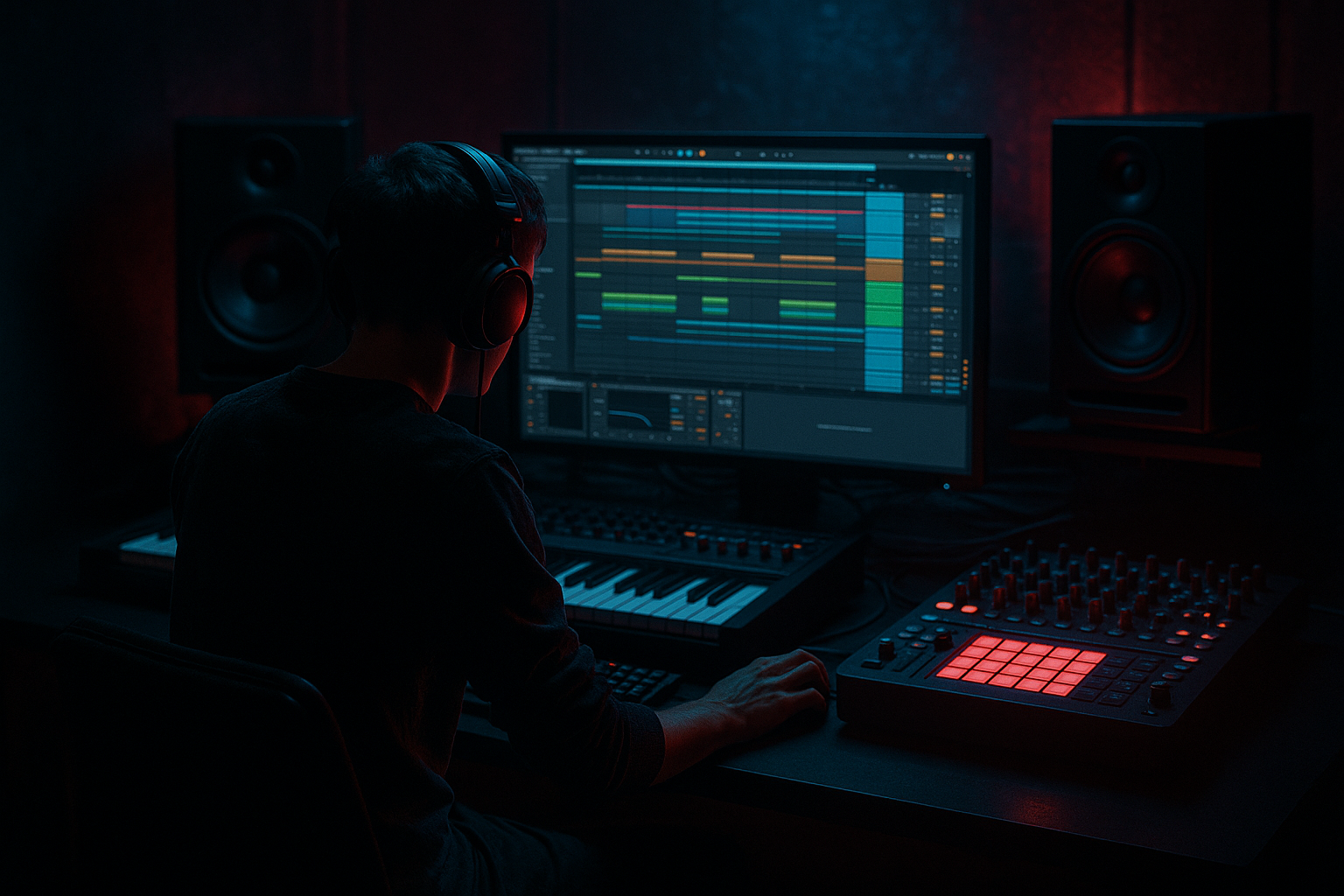
Oldskool jungle editing is where a track starts to feel like a record, not just a loop. In this lesson, you’ll build a fast, practical workflow in Ableton Live 12 for taking a raw break, coloring it with grit and movement, and arranging it into a DJ-friendly DnB section with enough tension to carry into a drop.
This matters because jungle and oldskool-inspired DnB live or die on personality. A clean 2-bar loop is not enough. You need break edits that breathe, bass that answers the drums, and arrangement changes that feel intentional rather than random. That means using Ableton’s stock tools not just for mixing, but for sound design: resampling, filtering, saturation, transient shaping, automation, and clip-level variation.
By the end, you’ll have a repeatable method for turning one drum break plus one bass idea into a proper 16-bar jungle/DnB arrangement with color, switch-ups, and energy. Think: intro tension, break mutation, bass drop, call-and-response, and a smart exit for the next section.
What You Will Build
You’ll create a short Oldskool jungle edit section in Ableton Live 12 made from:
- A chopped breakbeat with variation, ghost notes, and contrast between bars
- A sub/reese bass that stays centered and stable in the low end
- A colored drum bus with grit, glue, and controlled transient punch
- An arrangement with a DJ-friendly intro, a 2-bar build, a 16-bar drop, and a switch-up
- Automation for filter motion, delay throws, and tension moments
- A simple sound palette that feels authentic to jungle, rollers, or darker DnB
- Over-editing the break
- Letting the sub and break fight
- Using too much distortion on the whole drum bus
- Arranging without phrase logic
- Making every bar different
- Print your color
- Use controlled chaos
- Make the bass speak in phrases
- Try subtle pitch movement on the mid bass
- Darkness comes from contrast
- Use automation for tension, not just effects
- Check your intro like a DJ would
- Build oldskool jungle edits around a strong break, not endless layers.
- Use Ableton stock devices like Drum Buss, Saturator, Auto Filter, EQ Eight, Glue Compressor, Echo, Reverb, and Utility to color and control the sound.
- Keep the sub clean and mono, and let the break carry the movement.
- Arrange in clear 8-bar and 16-bar phrases with small but meaningful variations.
- In DnB, the best edits feel alive because the groove, bass phrasing, and automation are all working together.
Musically, imagine a 160–172 BPM section where the drums do the forward motion, the bass answers on the off-beats or at the ends of phrases, and the atmosphere is slightly haunted rather than glossy. The goal is not “maximal complexity.” The goal is a believable DnB edit that has movement, history, and weight.
Step-by-Step Walkthrough
1. Set the session up like a DnB arrangement lab
- Open a new Ableton Live 12 set and set the tempo between 170–174 BPM for classic jungle energy, or 172–176 BPM if you want a slightly harder modern push.
- Create these tracks:
- Drum Break
- Drum Layers
- Bass
- Atmos / FX
- Returns for Delay and Reverb
- Color-code immediately:
- Drums = red/orange
- Bass = blue
- Atmos = purple/grey
- FX = yellow
- Put all drum-related tracks into a Drum Group. This keeps your edits fast and your bus processing easy.
- Load a raw break or record from an existing drum sample pack into the Drum Break track. For a jungle feel, choose something with a clear snare, hats, and some room tone. Avoid over-processed breaks at this stage.
2. Chop the break into playable slices
- Right-click the break and choose Slice to New MIDI Track if you want a performance-based approach, or manually cut it in Arrangement View if you want more control.
- If slicing to MIDI:
- Use Transient slicing for cleaner hits
- Set the slice preset to 1/8 if the break is already tight, or Transient if it has strong peaks
- If editing in Arrangement:
- Chop at kick, snare, hat clusters, and any ghost-note hits
- Duplicate a 1-bar loop and make each repeat slightly different
- Keep one version “straight” and one version “broken.”
- The classic jungle trick is variation with familiarity: keep the snare identity, but change the lead-in hits, tail, or hat placement every 2 bars.
Why this works in DnB: the break provides micro-momentum. Small changes in ghost notes and hat placement create forward motion without needing a totally new pattern every bar.
3. Color the break with Ableton stock devices
- On the Drum Break or Drum Group, build a simple color chain:
- Drum Buss
- Saturator
- EQ Eight
- Start with Drum Buss:
- Drive: 5–12%
- Crunch: 2–8%
- Boom: keep subtle, around 0–10%, and set the frequency carefully if the break already has low end
- Transients: +5 to +20 if you need more crack
- Add Saturator after it:
- Drive: 2–6 dB
- Soft Clip: On
- Use a mild curve; don’t flatten the break
- Use EQ Eight to shape:
- High-pass only if the break is fighting the sub, usually around 25–35 Hz
- Slight dip around 300–500 Hz if it gets boxy
- Gentle shelf boost around 7–10 kHz if you want more air in hats
- If the break feels too clean, try Redux very lightly:
- Bits: 10–12
- Downsample: subtle, not extreme
- Resample the processed break to audio once you like the tone. That gives you a printed, commit-ready break you can edit like a record.
4. Build a bass that leaves space for the break
- Create a Bass track and load Wavetable, Operator, or Analog.
- For a jungle/rollers foundation, keep the low end simple:
- In Operator, use a sine or triangle sub with a low-pass feeling
- In Wavetable, choose a smoother waveform or a subtle reese-style wavetable
- Split your bass into two layers if needed:
- Sub layer: mono, clean sine/triangle
- Mid layer: detuned saw/reese, band-limited and distorted
- Suggested settings for a reese-style mid layer in Wavetable:
- Unison: 2–4 voices
- Detune: slight, around 0.05–0.15
- Filter cutoff: around 150–400 Hz if you want it darker
- Add Saturator or Roar if you want more edge:
- Drive: 3–8 dB
- Filter the high-end afterward with EQ Eight
- Keep the bass phrasing sparse and intentional:
- Let the sub hit on strong beats or between snare accents
- Use short notes for rolling pressure
- Leave gaps so the drum break can breathe
- If the bass is too wide, keep the sub in mono and only widen the mid layer with Chorus-Ensemble very lightly or by using the stereo field inside Wavetable.
5. Make the bass and drums answer each other
- Program a 2-bar loop where the bass does not constantly occupy the same space as the snare.
- A good starting point:
- Snare hits on 2 and 4
- Bass accents just after the snare or on off-beats
- One longer note at the end of bar 2 to create pull into the next phrase
- Use MIDI note lengths as a sound design tool. Short notes feel more agile; longer notes feel heavier and more ominous.
- Add velocity variation if your bass instrument responds to it. This can make repeated notes feel less robotic.
- Try a call-and-response pattern:
- Bar 1: bass answers the break lightly
- Bar 2: bass becomes more active, or introduces a lower octave hit
- If you have a Reese mid layer, automate the filter cutoff slightly over the phrase:
- Open from around 180 Hz to 450 Hz over 4 or 8 bars
- Close it again before the next section
- That motion gives the impression of “the bass coming alive” without needing new notes.
6. Arrange the oldskool edit in 8-bar and 16-bar phrases
- Switch to Arrangement View and block out a rough structure:
- Bars 1–8: intro with filtered break, atmosphere, and teasing bass
- Bars 9–16: main drop or first full groove
- Bars 17–24: variation with a fill or bass switch-up
- Bars 25–32: stripped section or transition out
- Keep the intro DJ-friendly:
- Start with drums filtered or reduced
- Introduce atmosphere or vinyl-style noise
- Let the kick/snare identity establish before full bass arrives
- In a jungle context, a useful arrangement move is:
- First 4 bars: break only
- Next 4 bars: bass tease
- Next 8 bars: full groove with a break variation in bar 8
- Use duplicate and modify, not constant reinvention. In DnB, repetition creates hypnosis; variation creates excitement.
- Add one “lift” moment every 8 bars:
- snare fill
- reversed crash
- delay throw
- break stutter
- bass dropout for half a bar
7. Add atmosphere and transitions without clutter
- Create an Atmos / FX track and add one or two textures:
- vinyl noise
- rain-like ambience
- dark room tone
- reversed break fragments
- Use Auto Filter to sweep atmospheres:
- High-pass for intro at around 150–300 Hz
- Slowly open over 4 bars
- Use Reverb sparingly on selected hits or atmos:
- Decay: 1.2–2.8 s
- Pre-delay: 10–25 ms
- Low cut: set fairly high so the reverb doesn’t muddy the sub
- For transitions, automate Delay throws on the last snare or break hit:
- Use Echo or Delay on a return track
- Keep feedback around 15–35%
- Filter the delay so it sits behind the groove
- A jungle edit works best when transitions are felt more than heard. The ear should catch a motion, not a giant effect cloud.
8. Shape the drum bus and protect the low end
- On the Drum Group, add gentle bus shaping:
- Glue Compressor with a low ratio, around 2:1
- Attack: 10–30 ms
- Release: Auto or around 100–300 ms
- Aim for only 1–3 dB of gain reduction
- Add EQ Eight after compression if needed:
- Remove rumble below 25–30 Hz
- Tame harsh hats around 6–9 kHz if they become brittle
- Check the bass and drums together in mono:
- Use Utility on the bass sub layer set to Width 0% or keep it inherently mono
- Use Utility on the master for quick mono checks
- Make sure the kick and sub are not fighting for the same exact space. If the break already contains kick energy, use note choice and bass phrasing to avoid constant overlap.
9. Automate color changes over the arrangement
- In an oldskool jungle edit, automation is part of the sound design. Use it on:
- Bass filter cutoff
- Drum break filter
- Saturator drive
- Reverb send
- Delay feedback
- Good automation ideas:
- Filter the break down in the last 2 beats before a drop
- Open the bass mid layer slightly over 4 bars
- Push saturation harder for the final 2 bars of a phrase
- Send one snare hit into a delay throw, then cut it
- Keep automation purposeful. Every movement should create either tension, release, or a textural change.
Common Mistakes
- Problem: too many slices, no groove
- Fix: keep the original rhythm identity and only change key accents or endings
- Problem: muddy low end, weak impact
- Fix: simplify bass phrasing, high-pass nonessential break lows, keep sub mono
- Problem: harsh hats, smeared transients
- Fix: reduce drive, use soft clipping, and shape before/after saturation with EQ Eight
- Problem: loop that doesn’t feel like a track
- Fix: build in 8-bar and 16-bar sections with a clear change at phrase boundaries
- Problem: no hypnosis, no identity
- Fix: repeat the core groove and vary only one or two elements at a time
Pro Tips for Darker / Heavier DnB
- Resample a processed break after Drum Buss and Saturator, then chop the new audio. Printed audio often feels more “real” and less plugin-clean.
- Add a second break layer quietly underneath the main one, but high-pass it and keep it tucked. This can add jungle density without clutter.
- Instead of constant movement, use 2-bar statements. A heavy DnB bassline often feels stronger when it leaves silence between hits.
- In Operator or Wavetable, use very small pitch envelope or modulation amounts for pressure. Keep it minimal so it doesn’t sound like a synth demo.
- Pair a gritty break with a relatively clean sub. That contrast makes the low end hit harder than if everything is equally distorted.
- A slow filter close on the break, then a sudden open on the next bar, often feels heavier than adding another crash or riser.
- If the first 16 bars can’t be mixed by a DJ, the track may not be arranged clearly enough for the genre.
Mini Practice Exercise
Spend 10–20 minutes making a one-phrase jungle edit:
1. Choose one break and one bass patch in Ableton.
2. Build a 2-bar loop at 172 BPM.
3. Process the break with Drum Buss, Saturator, and EQ Eight.
4. Create a bassline with a clean sub and a slightly gritty mid layer.
5. Duplicate the loop into 8 bars.
6. Change only one thing each 2 bars:
- a snare ghost note
- a bass note length
- a filter cutoff move
- a delay throw
7. Export or resample the result and listen once in mono.
8. Ask: does it still feel like one musical idea, or just a loop with effects?
If it feels too static, add phrasing. If it feels too busy, remove notes before adding more processing.

