Main tutorial
Lesson Overview
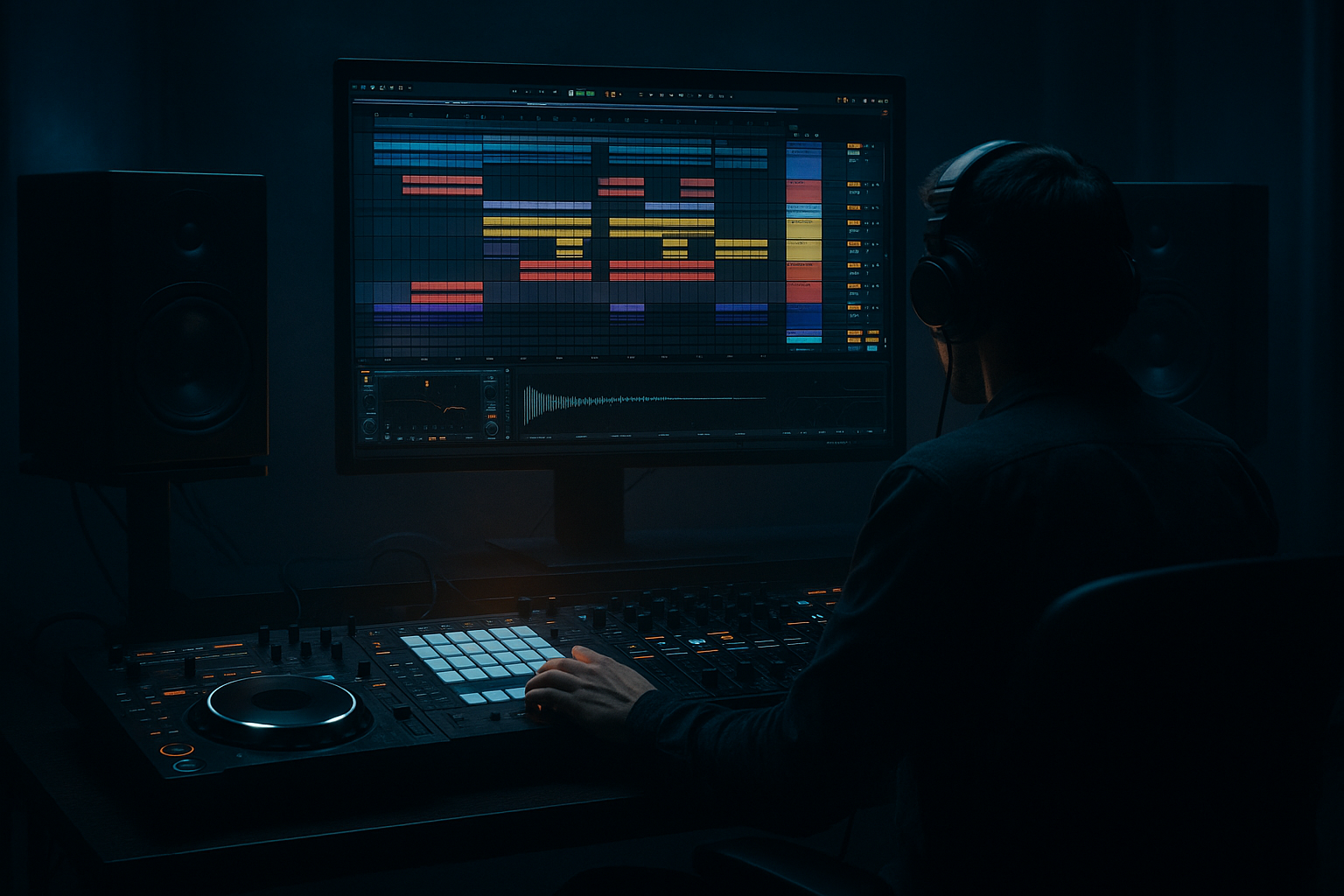
This lesson is about designing an oldskool amen variation in Ableton Live 12 and arranging it so it feels like a proper Drum & Bass record, not just a chopped break loop. The goal is to take the raw character of the amen and turn it into a musical, functional, DJ-friendly phrase that can carry a drop, answer the bassline, and evolve across the arrangement without losing impact.
This technique lives at the intersection of drums, arrangement, and sound design. In DnB, the amen is not just a drum sample — it is often the emotional engine of the track. The way you cut, resequence, process, and automate it determines whether your tune feels like a locked-in roller, a gritty jungle throwback, or a heavier modern hybrid with oldskool DNA.
Why it matters musically: the amen gives you instant momentum, shuffle, and human swing. Why it matters technically: if you don’t control the transient hierarchy, stereo width, and low-end overlaps, the break turns into mush as soon as the bass enters. By the end, you should be able to hear a tight, energetic amen variation that grooves against the bass, stays punchy in mono, and can be arranged into a believable intro/drop/variation structure.
Best suited to: jungle, oldskool-influenced rollers, darker half-step / 170 hybrid DnB, and break-led dancefloor tracks. If your track needs movement, attitude, and a sense of live drum tension, this is the right tool.
What You Will Build
You will build an 8-bar amen variation in Ableton Live 12 that feels like a finished DnB drum phrase: chopped, rearranged, slightly resampled, and processed with controlled grit. It should have:
- a strong snare-led backbeat
- ghost notes and break nudges that create forward motion
- a clear call-and-response relationship with the bassline
- enough oldskool roughness to feel alive
- enough mix discipline to sit in a modern club track
- Use contrast, not constant aggression. A stripped bar before a snare hit can feel heavier than a wall of hits. In darker DnB, space creates menace.
- Keep the snare as the authority. If you’re adding more grime, add it around the snare, not on top of it. The snare should remain the point of certainty in the phrase.
- Print a “dirty” version and a “clean” version. Resample two passes: one with more saturation and one more controlled. The dirty version can live in fills or drop 2, while the cleaner version holds the core groove.
- Use tiny reverse gestures for tension. A reversed snare crack or a short reversed break fragment before the main hit can create pressure without needing huge risers.
- Filter automation should hit the top end, not the engine room. Open hats, rides, and noisy tails; leave kick and snare fundamentals intact so the groove stays readable.
- Layer a quiet mono drum reinforcement if needed. If the amen loses punch after processing, duplicate the core snare transient into a very short centered layer and keep it subtle. This can restore authority without changing the break’s identity.
- Watch the low-mid build-up. Oldskool breaks often carry a lot of 200–500 Hz body. That can be great in a sparse arrangement, but in heavy DnB it may crowd the bass. Trim only enough to preserve the woodiness of the break, not all of it.
- Use only one amen source.
- Use only stock Ableton devices: Simpler, EQ Eight, Drum Buss, Saturator, Utility, and one automation lane.
- Keep the core kick and snare centered.
- Make exactly one A/B decision: raw jungle or controlled modern.
- Include at least one fill or turnaround in bars 7–8.
- Does the snare still dominate when the bass is playing?
- Does the groove feel alive in mono?
- Can you hear a clear difference between bars 1–4 and 5–8?
- Would this survive as the main drum part in a real DnB drop?
The final result should sound like a break that has been recomposed into a signature drum part, not just looped. It should feel urgent, slightly unpredictable, and dancefloor-ready, while still being clean enough to survive a proper mix. A successful result sounds like the drums are “running” the track, with the bass locking under them rather than fighting for space.
Step-by-Step Walkthrough
1. Start with a clean amen source and set the frame correctly
Load a high-quality amen sample into an audio track or Simpler. If you’re working from a loop, first identify the cleanest 1-bar or 2-bar section with strong kick, snare, and ghost-note detail. Warp it only if needed; for oldskool breaks, too much time-stretching can flatten the transient feel.
In Ableton, slice the amen to a new MIDI track if you want full control. For this lesson, use Simpler in Slice mode so each hit can be re-sequenced. Set slicing by transient, and keep the MIDI clip grid at 1/16 to begin with. If the source is messy, manually consolidate a clean hit library first: kick, snare, closed hat, ride wash, ghost snare, and a few character hits.
Why this works in DnB: the amen’s energy comes from the interplay of its hits, not the loop itself. Slicing lets you preserve its swing while tailoring the phrase around your bass and arrangement.
What to listen for: the original snare tone and the little “air” between hits. If the break has a great backbeat but blurry hats, you can still build a strong variation from it.
2. Build a 2-bar foundation before you get fancy
Program a simple 2-bar drum phrase first. Put the main snare on the classic backbeat feel, then add kick and ghost-note placement around it. Don’t try to make the full variation yet — just establish a stable groove.
A good starting point:
- kick accents on the downbeats and near the snare lead-in
- snare strongly on 2 and 4 feel, even if the break’s natural snare lands slightly before or after
- ghost notes around the last 1/8 or 1/16 before the snare to create lift
- a few hats or ride fragments to keep motion in the top end
If you’re working in MIDI with sliced hits, keep the first pass sparse. Leave negative space so the bass can breathe. In DnB, a great break often feels more powerful when it is not full all the time.
What to listen for: does the loop already make your head nod before processing? If it doesn’t, your note placement is wrong, not your EQ.
3. Choose your flavour: raw jungle or controlled modern
This is your first real creative decision.
A — Raw jungle flavour: keep more of the original break’s timing and dirt. Let the hits overlap slightly and preserve some unevenness. This works if you want a more authentic, loose, dusty feel.
B — Controlled modern flavour: tighten the slices, line up the snare more deliberately, and trim overlaps so the groove is cleaner and more mixable. This suits heavier rollers or hybrid neuro/DnB where the drums need to lock with precise bass design.
In Ableton, use clip gain or note placement to commit to one direction. If you choose raw jungle, avoid over-quantizing. If you choose controlled modern, nudge the key hits until the kick-snare relationship feels intentional.
Trade-off: raw feel gives character, but too much slop can make bass interaction messy. Tight control improves punch, but if you over-edit it can sound like a sterile loop.
4. Shape the hits with a simple stock-device chain
Put your amen track through a realistic stock chain. A strong starting point is:
- EQ Eight: high-pass gently around 30–40 Hz if there is sub rumble, and cut any boxy build-up around 250–500 Hz if the break sounds congested.
- Drum Buss: drive modestly, often around 5–15% depending on source, with Boom used sparingly or not at all if the bass already owns the sub.
- Saturator: a subtle drive increase, often 1–4 dB, to bring out snare texture and hat edge.
- Utility: set the width carefully; if the break has exaggerated stereo, reduce it so the core groove stays centered.
If the break is already aggressive, you may only need EQ and Utility. If it is too soft, Drum Buss can add density and snap.
Stop here if the break starts to lose transient definition. In DnB, more drive is not automatically better — once the snare stops cutting through, you’ve gone too far.
5. Recompose the phrase with ghost notes and answer hits
Now write the actual variation. Think in call-and-response. Let the main snare phrase act as the call, then place a short answer using ghost snare taps, a kick pickup, or a hat fragment. This creates the feeling that the drums are reacting to the bassline rather than sitting on top of it.
A strong 8-bar structure might look like this:
- Bars 1–2: establish the main groove
- Bars 3–4: add a small snare flam, reversed fragment, or extra kick pickup
- Bars 5–6: thin the break for contrast, then reintroduce movement
- Bars 7–8: build toward a fill or turnaround into the next section
Use tiny timing nudges instead of hard quantize when the groove needs a bit of drag. A kick landing just a hair late can feel heavier; a ghost note slightly early can create urgency. These tiny offsets matter more in oldskool breaks than in rigid programmed drums.
What to listen for: the snare should feel like the anchor. If the ghosts are louder than the main backbeat, the groove loses its spine.
6. Context-check the break against the bassline early
Don’t design the amen in isolation. Bring in your bass or a simple placeholder bass pattern now. In DnB, the break and bass are one rhythm section. If both occupy the same syncopation, the track will feel smaller, not bigger.
Play the break with a bassline that has either:
- short, percussive notes if you want the break to stay busy, or
- longer, sustained notes if you want the drums to carry most of the motion
Listen to the low-mid zone around the kick and bass overlap. If the bass is masking the kick’s punch, sidechain lightly or simplify the bass note rhythm. You don’t need heavy pumping to create space — in break-led DnB, good note placement often does the job better.
If the bassline fights the ghost notes, mute the most delicate break details and see if the groove improves. That tells you whether the issue is arrangement density, not processing.
7. Commit a resampled version once the groove is working
When the phrase is feeling strong, resample the drum part to audio. This is a major workflow advantage in Ableton: it lets you print your timing, processing, and texture, then edit the result like a record instead of endlessly tweaking the source.
Create an audio track, record the drum phrase, and then consolidate or split the printed audio into sections if needed. Once printed, you can:
- reverse small fragments
- add micro-fades
- duplicate a snare tail
- create a fill from a single accent hit
- automate filter or reverb on the printed clip
Why this works: oldskool breaks become more convincing when they feel like they’ve been “performed” into shape. Resampling also forces decisions, which is crucial when you’re trying to finish a DnB track.
Workflow efficiency tip: once your 8-bar groove works, name the printed audio clearly, e.g. “Amen_Var_Audio_8bar_v3,” and duplicate from there instead of reopening the source every time.
8. Add movement with automation, but keep the sub clean
Use automation to evolve the break over the section, especially in bars 4 and 8. Good targets:
- Auto Filter cutoff on a parallel or duplicate break layer for tension moves
- Drum Buss drive for a short lift into a fill
- Reverb Dry/Wet on a snare throw
- Utility width for a short stereo tease, then back to mono
If you want darker energy, keep most of the break centered and use automation only on selected top-end fragments. A short filter opening around 2–6 kHz on hats or a ride wash can create excitement without touching the kick/snare core.
A versus B decision:
- A: restrained automation gives you a tougher, more underground feel
- B: more obvious filter/FX motion creates a bigger, more dramatic build into the drop or turnaround
For the heaviest DnB, A is usually better. B works when you need the breakdown to be more theatrical.
9. Design the arrangement around DJ usability and payoff
Place the amen variation where it matters musically: intro tease, first drop, mid-drop switch, or second-drop evolution. In a DJ context, your break phrase needs to be readable when mixed with another tune. That means not overloading the intro with too much top-end clutter, and not throwing every variation in at once.
A strong arrangement example:
- 16-bar intro: filtered amen fragments and atmosphere
- 8-bar drop 1: full variation with the main backbeat
- 8-bar turnaround: remove one layer, add a fill, or strip to kick/snare
- 8-bar drop 2: bring in a new ghost-note pattern, alternate snare fill, or extra ride texture
The second drop should not be a copy of the first. Change the last two bars of the phrase, even if only slightly. That might mean a different pick-up kick, a reversed snare hit, or a more open hat pattern.
Successful result should feel like the drums are evolving naturally rather than looping on autopilot. The listener should sense movement without losing the identity of the groove.
10. Finish the balance with mono discipline and drum hierarchy
Check the break in mono using Utility on the drum group or master for a quick audition. The snare, kick, and main ghost-note shapes should still read clearly. If the break collapses in mono, your stereo spread is too dependent on wide hat wash or phasey processing.
Keep the core elements centered:
- kick and snare mono or near-mono
- broad stereo only on high-frequency ambience, chopped top layers, or short FX fragments
- avoid widening the whole amen just because it sounds exciting soloed
If needed, use EQ Eight to clean harshness around 3–8 kHz where brittle hats can fight the snare crack. If the break gets loud but not bigger, reduce the saturation or trim the top-end overlap rather than boosting more.
What to listen for: when the bass comes in, does the snare still hit the same way it did solo? If not, the arrangement is too crowded or the drum processing is too broad.
Common Mistakes
1. Over-quantizing the break
- Why it hurts: the amen loses its human drag and the groove stops breathing.
- Fix: keep selected ghost notes slightly off-grid, and only tighten the main snare/kick anchors.
2. Trying to make the whole break sound huge at once
- Why it hurts: all the hits compete, and the drum phrase becomes noisy instead of powerful.
- Fix: let only one or two elements carry the density. Use arrangement contrast to create size, not constant layering.
3. Ignoring the bassline while designing the amen
- Why it hurts: the groove may feel good soloed but clashes badly once the bass enters.
- Fix: audition the break against the bass early and mute or simplify hits that mask the bass rhythm.
4. Too much stereo width on the full drum loop
- Why it hurts: mono compatibility suffers and the kick/snare lose focus in a club system.
- Fix: center the core hits with Utility, and keep width for higher-frequency details only.
5. Overprocessing with saturation and compression
- Why it hurts: transients smear and the snare stops punching through the mix.
- Fix: back off the drive, compare bypass often, and preserve the initial hit shape.
6. No variation across the arrangement
- Why it hurts: the listener hears a loop, not a record.
- Fix: change the last two bars of each 8-bar phrase, even with small edits like a fill, pickup, or filtered fragment.
7. Leaving low-end rumble in the break
- Why it hurts: it steals headroom from the kick and sub, especially in denser drop sections.
- Fix: high-pass gently with EQ Eight around 30–40 Hz if needed, and remove unnecessary low-frequency content from the break layers.
Pro Tips for Darker / Heavier DnB
Mini Practice Exercise
Goal: create a playable 8-bar amen variation that can sit under a bassline without falling apart.
Time box: 15 minutes.
Constraints:
Deliverable: an 8-bar drum phrase bounced to audio, plus a second variation with one changed ending.
Quick self-check:
Recap
The key to an oldskool amen variation is not just chopping the break — it’s recomposing it into a DnB phrase with purpose. Build the groove around the snare, keep the kick/bass relationship clear, add ghost-note motion carefully, and evolve the pattern across the arrangement. Use Ableton’s stock tools to shape, commit, and automate, but keep the core hits punchy and centered.
If the result feels like a real drum performance that can carry a drop, answer the bass, and still hit hard in mono, you’ve nailed it.

