Main tutorial
Lesson Overview
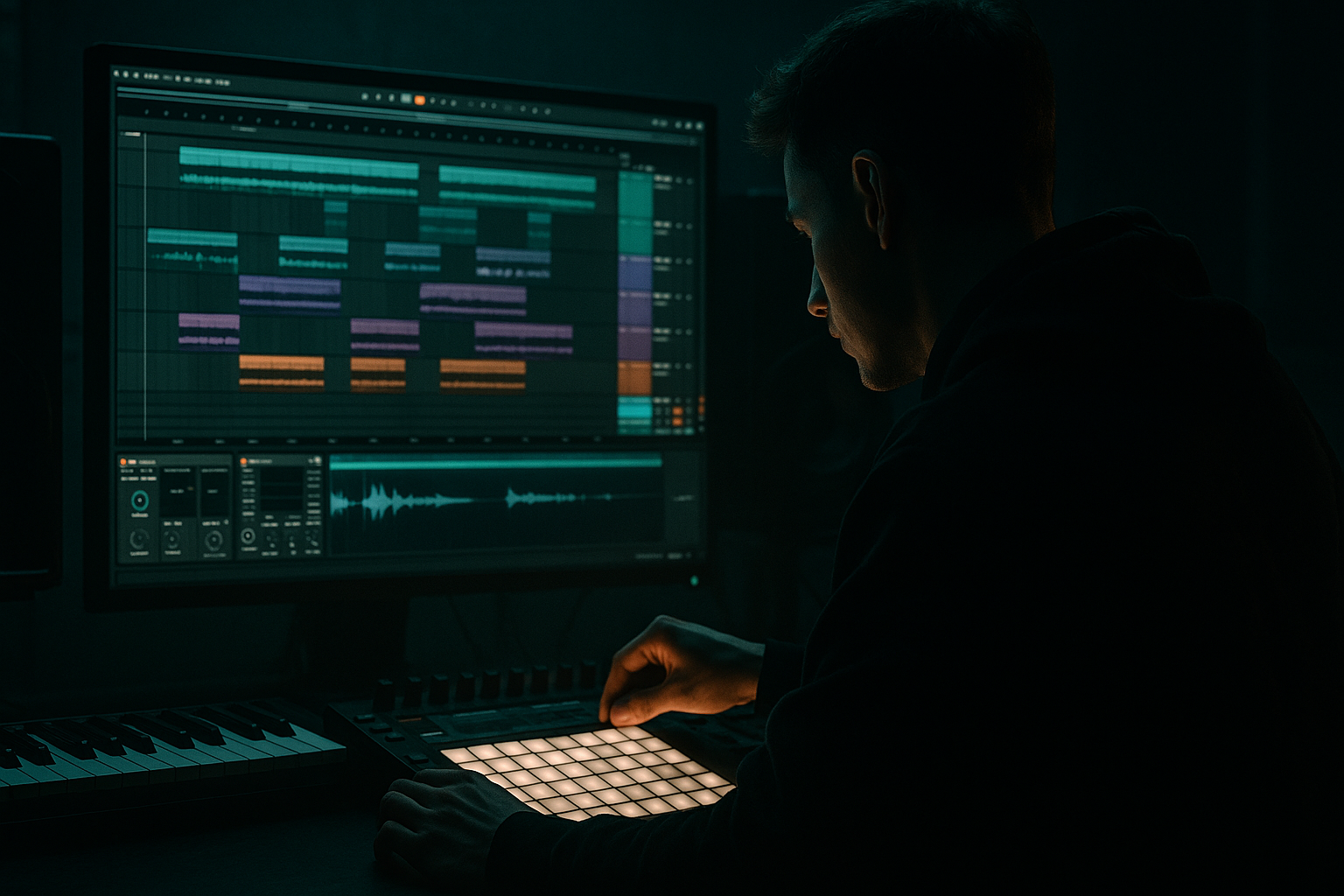
In this lesson, you’ll build an oldskool jungle-style arp in Ableton Live 12, then resample it into a gritty, usable loop that can sit inside a Drum & Bass arrangement. This is the kind of sound that brings instant movement to a track: think tense, rising synth lines, chopped rhythmic repeats, and that raw “late-night warehouse” energy that works in intros, pre-drops, breakdowns, and switch-ups.
Why this matters in DnB: oldskool jungle and early DnB often used simple melodic motifs with strong rhythmic feel rather than huge modern supersaws. The magic came from pattern, texture, and transformation. Resampling is key because it lets you take a clean synth idea and turn it into something more characterful: printed audio can be chopped, reversed, processed, and arranged like a drum break. That’s how you make an arp feel like part of the record, not just a plugin playing notes 🎛️
This lesson is beginner-friendly, but it still gives you a real production workflow:
- start with a simple synth patch
- write a classic DnB arp pattern
- resample it to audio
- slice, re-order, and process it
- place it into a DJ-friendly arrangement
- a 16-bar oldskool DnB arp phrase
- built from a simple Ableton stock synth sound
- with syncopated notes, a slightly ravey tone, and rhythmic motion
- then resampled into audio
- then edited into a tight 2-bar or 4-bar loop
- and arranged into a basic DnB structure with an intro, drop, and variation
- a bright but gritty arp line sitting above drums and sub
- a phrase that can answer the bass in a call-and-response way
- a loop that has enough movement to carry a breakdown or pre-drop section
- a sound that can be made cleaner for oldskool/jungle, or dirtier and darker for heavier DnB
- Making the arp too busy
- Leaving too much low end in the arp
- Too much reverb blurring the groove
- Not resampling early enough
- Over-widening the sound
- Ignoring arrangement
- Filter automation is your best friend
- Resample a dirty version and a clean version
- Use tiny timing offsets
- Add controlled distortion, not chaos
- Make space for snare impact
- Use short echo throws
- Try a ghost note pattern
- Build a simple oldskool-style arp with short, repetitive notes.
- Use Ableton stock devices like Analog, Wavetable, Arpeggiator, Saturator, Drum Buss, EQ Eight, Echo, and Utility.
- Resample early so you can chop, reverse, and shape the sound into something more authentic.
- Keep the sub mono and clean, and let the arp live in the midrange.
- Arrange the arp with filter movement, small variations, and clear phrase structure so it works in a proper DnB track.
- In jungle and oldskool DnB, the power is often in the repeat, the texture, and the edit — not in making everything huge all the time.
By the end, you’ll have a loop that can support oldskool jungle vibes, darker rollers, or a more neuro-influenced section if you push the processing harder.
What You Will Build
You will create:
Musically, the result should feel like:
You’re not aiming for a polished finished master here. You’re building a usable production asset: a resampled arp loop that can be dropped into arrangements and treated like a core musical element.
Step-by-Step Walkthrough
1. Set up a simple DnB session and reference the tempo
- Open Ableton Live 12 and set the tempo to 170–174 BPM. A strong starting point for oldskool jungle/DnB is 172 BPM.
- Create three MIDI tracks:
- one for drums
- one for sub
- one for the arp synth
- If you have a reference track, drag it into a separate audio lane and turn its volume down so it doesn’t dominate.
- Keep your first idea simple: a 2-bar loop is enough.
- For the arp track, load Analog, Wavetable, or Operator. For beginner speed, Analog is very immediate and easy to shape.
2. Build a raw synth tone that suits jungle/DnB
- On the arp track, start with a basic preset or init sound.
- Choose a saw wave or square/saw blend. Oldskool jungle arps often feel rich and slightly buzzy rather than super clean.
- Suggested starting settings:
- Filter cutoff: around 40–60%
- Filter resonance: low to medium, around 10–25%
- Attack: 0–10 ms
- Decay: short to medium, around 150–400 ms
- Sustain: 40–70%
- Release: 80–200 ms
- Add a touch of unison/stacking if the device supports it, but don’t widen it too much yet.
- After the synth, add Saturator and keep Drive subtle at first, around 2–5 dB.
- Add EQ Eight and high-pass gently only if needed later. Don’t thin it out too early.
- Why this works in DnB: the synth needs enough harmonic content to cut through fast drums, but it also needs controlled envelopes so it doesn’t smear the groove.
3. Write a simple oldskool-style arp pattern
- Create a 2-bar MIDI clip.
- Think in short repeating note shapes rather than long melodic phrases.
- A beginner-friendly approach:
- use 3–5 notes
- keep them within one octave
- repeat and offset them rhythmically
- Example musical context: in F minor, try a pattern based around F, Ab, C, Eb with one note repeated for pulse. That gives a classic dark DnB feel.
- Try placing notes on offbeats and sixteenth-note gaps so the arp bounces against the drums.
- Keep note lengths short, around 1/16 to 1/8 note values.
- If you want a more ravey oldskool vibe, let one note hang slightly longer at the end of bar 2 to create tension into the loop repeat.
- Don’t overcomplicate the melody yet. The rhythm is more important than the note count.
4. Use an Arpeggiator or manual MIDI phrasing for movement
- If you want quick motion, add Ableton’s Arpeggiator before the synth.
- Good starter settings:
- Rate: 1/16
- Style: Up or UpDown
- Gate: 45–65%
- Steps: leave default unless you want a longer pattern
- Distance: keep simple at first, then experiment
- If the arp feels too robotic, automate note lengths in the MIDI clip manually instead of relying only on Arpeggiator.
- A strong beginner trick is to combine both:
- let Arpeggiator create motion
- then draw a simple chord or note cluster
- This is useful in DnB because the arp becomes rhythmically active without needing advanced music theory.
5. Resample the arp into audio
- Create a new audio track and set its input to Resampling.
- Arm the track and play back your arp.
- Record at least 4 bars, even if the loop only uses 2 bars. You’ll want extra material for chopping and arrangement.
- Once recorded, zoom in and find the cleanest section of the phrase.
- Consolidate the best 2-bar segment with Cmd/Ctrl + J if needed.
- This is where the sound becomes more “real” and useful. Audio lets you:
- reverse tiny slices
- warp and time-shift
- chop to the break
- add texture with clipping and resampling layers
- Why this works in DnB: resampling turns a synth idea into a performance asset. Jungle and DnB production thrives on audio manipulation, and this gives you much more attitude than a static MIDI loop.
6. Chop the resampled audio like a drum element
- Duplicate the resampled audio clip onto a new lane or new track.
- Use Slice to New MIDI Track if you want to trigger pieces from pads, or keep it as audio if you want a faster workflow.
- Make 2–4 small edits:
- cut one note short
- reverse one tail
- remove a note to create a hole
- duplicate a single stab for emphasis
- Small edits are enough. The goal is not random glitching; it’s musical variation.
- Try shifting one slice slightly late to create a laid-back feel, or slightly early for more urgency.
- If the arp competes with drums, cut a few slices to make room for snare hits.
7. Process the audio for oldskool grit
- Add Drum Buss or Saturator on the resampled arp.
- Useful starter ideas:
- Drum Buss Drive: low to medium, around 5–15%
- Boom: very careful, only if the arp needs low-mid weight
- Saturator Drive: 2–6 dB
- Add Echo for short rhythmic depth:
- Time: 1/8 or 1/8 dotted
- Feedback: 10–25%
- Filter: roll off some top end
- Add Reverb very lightly if you want a hollow rave-space feel:
- Decay: 1.0–2.5 s
- Dry/Wet: 5–12%
- If the arp gets harsh, use EQ Eight to tame:
- a small dip around 2.5–5 kHz
- a high shelf reduction if it’s too fizzy
- Keep the sound punchy. Oldskool DnB often sounds raw, but it still needs to leave space for drums and sub.
8. Arrange the arp into a DnB structure
- Build a simple arrangement:
- Bars 1–8: drums and atmosphere only, or filtered arp intro
- Bars 9–16: arp enters gradually
- Bars 17–32: main drop with full drums, sub, and arp
- Bars 33–40: variation or breakdown
- Automation ideas:
- open the filter cutoff over 8 bars
- increase reverb send before the drop
- automate saturator drive slightly higher for the drop
- mute the arp for 1 bar before a section change to create tension
- For a DJ-friendly intro, let the arp appear filtered and sparse so the drums can be mixed in cleanly.
- For a drop, bring the arp in on bar 1 or bar 9 with a strong downbeat and a clear return point every 2 or 4 bars.
9. Lock the arp to the drums and sub
- Add a simple sub bass underneath using Operator or Wavetable with a sine wave.
- Keep the sub mono and simple. The arp should sit above it, not fight it.
- Check the groove against the drums:
- kick and snare should feel dominant
- the arp should “answer” around the gaps
- If your snare is on beat 2 and 4, try placing arp accents around the spaces before the snare hits.
- Use Utility on the arp to keep the low end tidy:
- reduce width if the sound feels too wide
- use Mono if you want to test center focus
- This is a classic DnB balance move: tight drums, clear sub, and a midrange musical layer that supports the energy without clutter.
10. Make one variation for the second half
- Duplicate the loop and change only one or two things:
- remove one note
- invert one phrase
- automate filter slightly differently
- add a reverse hit into bar 4 or bar 8
- That tiny variation is enough to stop the loop from feeling copy-pasted.
- For oldskool jungle, one bar of “answer phrase” can work brilliantly.
- For heavier DnB, the second half can be darker, more distorted, or more stripped back.
- Save both versions:
- one cleaner
- one more aggressive
- That way you can switch between intro energy and drop energy fast.
Common Mistakes
- Fix: reduce the note count. In DnB, rhythm and pocket matter more than constant activity.
- Fix: use EQ Eight or Utility to keep the arp out of sub territory. Your sub should own the bottom.
- Fix: shorten decay and lower dry/wet. Oldskool vibe does not mean washed out.
- Fix: print the idea to audio once the basic tone works. Audio gives you more control and more character.
- Fix: keep the low-mid content more focused. Check in mono so the arp doesn’t disappear.
- Fix: place the arp in sections, not just in a loop. DnB needs tension and release over time.
Pro Tips for Darker / Heavier DnB
- Start with a low-pass filter and slowly open it into the drop. Even a simple arp can feel huge when the cutoff moves over 8 or 16 bars.
- Print one pass with more saturation and one with less. Layer them or alternate them for contrast.
- Nudging one slice a few milliseconds late can create a more human, rolling feel. Great for darker rollers.
- Try Saturator, Drum Buss, or Overdrive carefully. Push midrange harmonics, but avoid wrecking the transient.
- If the arp clashes with the snare, cut its level just before the snare hit or remove a note in that spot. That’s a classic call-and-response trick.
- Automate a short delay tail on the last note of a phrase only. This adds tension without filling the whole mix.
- Add a very quiet note before a main stab to make the phrase feel more alive. This works especially well in oldskool jungle and darker rollers.
Mini Practice Exercise
Spend 10–20 minutes making one resampled arp loop:
1. Set the project to 172 BPM.
2. Create a simple 2-bar MIDI arp using only 4 notes.
3. Put it through Arpeggiator or manually program short notes.
4. Add Saturator and EQ Eight.
5. Resample it to audio.
6. Chop one note, reverse one tail, and remove one note.
7. Arrange it over 8 bars with:
- bars 1–4: filtered intro
- bars 5–8: full arp with drums
8. Do one automation move:
- filter cutoff opening
- or reverb send on the last note
Goal: make a loop that feels like it could sit in a real DnB breakdown or drop intro.

