Main tutorial
Lesson Overview
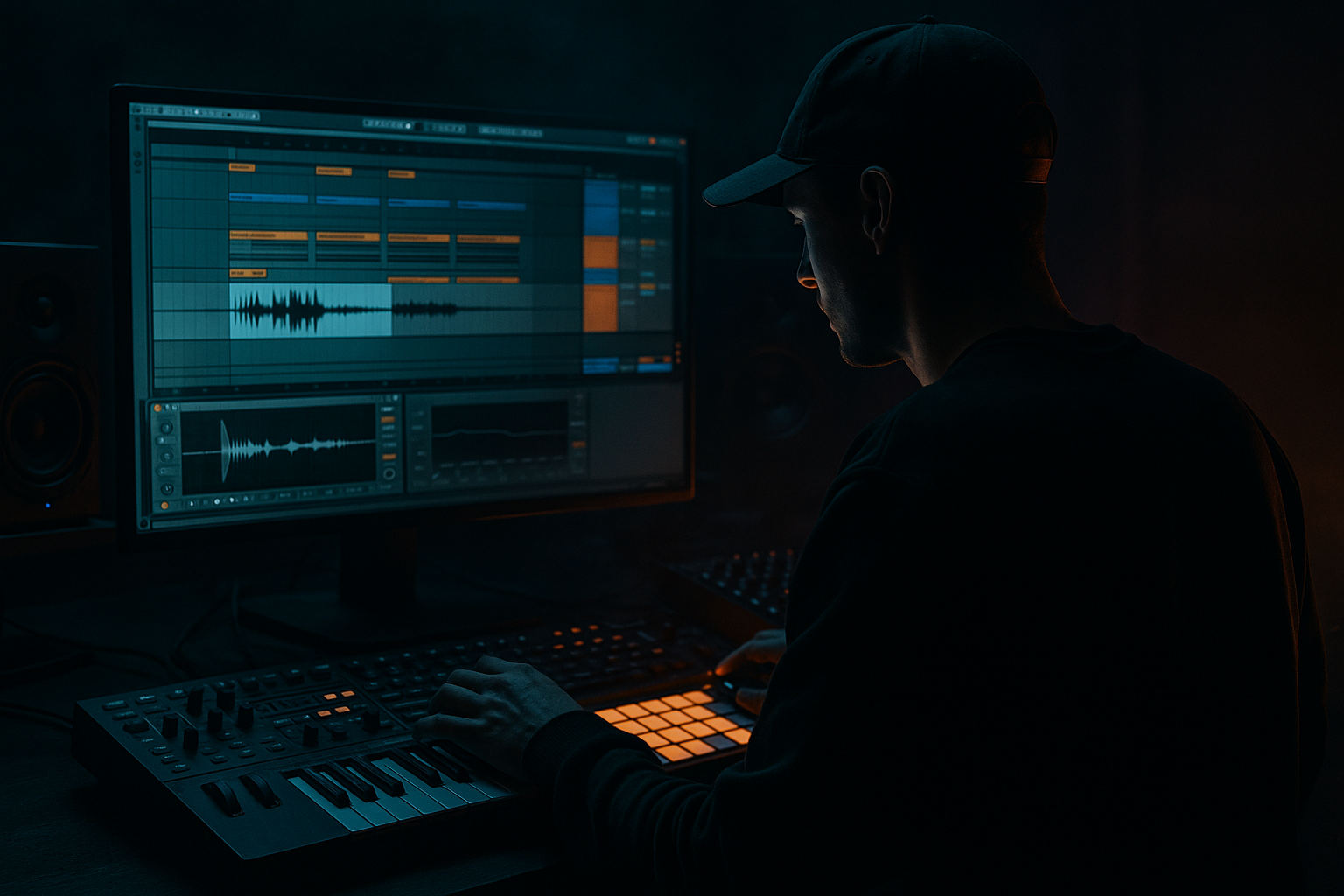
The oldskool VHS-rave stab is one of those sounds that instantly tells the listener: “this is DnB with attitude.” It sits somewhere between rave nostalgia, jungle pressure, and the more menacing side of modern rollers and darker bass music. In an Ableton Live 12 session, this lesson shows you how to design a stab that feels lo-fi, crunchy, and slightly unstable, then arrange it so it behaves like a proper dancefloor weapon rather than a random retro effect.
Why it matters: in Drum & Bass, stabs are often the hook, the tension builder, or the call-and-response answer to the drums and bass. A strong VHS-rave stab can lift a drop, keep a halftime section moving, or add personality to a breakdown without taking over the low end. It also works brilliantly as a transition tool: one stab can announce a switch-up, open space for a snare fill, or create a “rewind” feeling before a drop.
This lesson focuses on an oldskool method that feels authentic to jungle and rave culture: simple source, gritty resampling, tight MIDI phrasing, and automation that makes the sound evolve over bars. We’ll use stock Ableton devices and a practical arrangement workflow that keeps the stab musically useful in a real DnB track.
What You Will Build
You’ll build a VHS-rave stab that has:
- A short, punchy harmonic hit with a slightly detuned, ravey character
- Lo-fi coloration that suggests tape wear, sampler grit, and reduced fidelity
- A band-limited, mid-focused tone that cuts through drums without clouding the sub
- Automated filter movement, reverb throws, and pitch or warp-style movement for tension
- An arrangement role in a DnB tune: intro hook, pre-drop tension, drop accent, or breakdown response
- Enough variation to survive a whole track without sounding repetitive
- Too much low end in the stab
- Overly bright, harsh resonance
- Stab is too long and washes out the groove
- Random placement with no phrase logic
- Too much stereo width in the wrong place
- Using automation without context
- Use a minor chord or tense interval shape rather than a full lush triad. A minor 2nd, 7th, or 9th tension gives darker character.
- Layer a second stab an octave higher at very low volume for edge, but keep the main body mid-focused.
- Try Frequency Shifter very subtly for unstable, industrial movement. Small amounts can make the stab feel warped and ominous.
- Automate a very short filter dip right before the stab hits, then snap open. That pre-hit tension can feel like a rave sample being “pumped” through old hardware.
- If you want more jungle flavor, chop the stab into 2-hit phrases and place them around the break edit points rather than on every downbeat.
- For a neuro-adjacent edge, resample the stab, then layer a tiny amount of rhythmic gating or tight modulation so it locks with the drums.
- Keep checking mono. A heavy DnB stab should still speak in clubs where the center image carries the weight.
- Use the stab as a transition element into a bass re-entry: let it swell, then cut it just as the sub returns. That contrast is deadly on a drop.
Musically, think of a stab that can sit on top of a 170 BPM roller with an Am or Fm center, firing on offbeats or syncopated 1/8 patterns. In a darker track, it might answer a Reese bass phrase with short, clipped hits. In a more jungle-leaning tune, it can chase the break edits and help the groove feel “raved up” without adding extra drum layers.
Step-by-Step Walkthrough
1. Set up a clean DnB-friendly track structure first
Start with a fresh MIDI track in Ableton Live 12 and name it something clear like `VHS Stab`. Before sound design, build a practical lane for it in the arrangement: mark an intro, a 16-bar build, a drop, and an 8-bar switch-up. That keeps the stab arranged like a musical tool, not a random loop.
Set the project around 170–174 BPM if you want classic DnB pressure, or 160–170 if you’re aiming for a half-time / rollers feel. Place a basic drum loop and a simple sub or Reese reference first. Why this works in DnB: the stab must be judged against the drums and bass, because the groove and low-end balance are what make it hit properly.
Create a return track for reverb and another for delay now, so you can automate sends later without cluttering the main sound. This is a fast workflow choice that pays off during arrangement.
2. Build the core stab with stock synths
Use Wavetable or Analog for the source. For an oldskool rave stab, you want a harmonically rich but simple starting point. A good place to begin is:
- Wavetable oscillator 1: saw or square-saw blend
- Oscillator 2: slightly detuned saw, -7 to -12 cents
- Unison: 2–4 voices, but keep it modest so it doesn’t smear
- Filter: low-pass with moderate resonance
Try this starting point:
- Filter cutoff: around 500 Hz to 2 kHz depending on the brightness you want
- Resonance: 15–35%
- Amp envelope: attack 0–5 ms, decay 200–450 ms, sustain 0, release 80–180 ms
- Filter envelope amount: medium to strong, so the stab “barks” on attack
The goal is a short, punchy chord-like hit. If you want more authentic jungle/rave energy, use a minor 7th, minor 9th, or a two-note cluster instead of a plain triad. For example, in F minor, try F–Ab–Eb or F–Ab–C with one note doubled an octave up. That slightly unresolved harmony gives the oldskool “warehouse” feeling.
3. Write a MIDI pattern that behaves like a hook, not a pad
Oldskool stabs are often powerful because of phrasing, not complexity. Program a 1-bar or 2-bar MIDI clip with short notes, leaving space for the drums. In a DnB context, try syncopation rather than constant repetition.
Practical phrasing ideas:
- Place stabs on the “&” of beats 1 and 3 for a classic push
- Use a call-and-response idea: stab on bar 1, bass reply on bar 2
- In a drop, fire the stab at the end of a drum fill to mark the new phrase
- For jungle energy, let a stab answer a chopped break fill every 2 bars
Keep note lengths short, around 1/8 to 1/4 note, so the sound stays percussive. If the chord feels too big, reduce it to 2 or 3 notes. A VHS-rave stab usually lands better when it has attitude and brevity.
4. Make it feel “VHS” with resampling-style degradation
The oldskool feel comes from controlled degradation. After the synth, insert Saturator, Redux, and a light Erosion or Vinyl Distortion-style texture using Ableton stock tools only.
A reliable chain:
- Saturator: Drive 2–6 dB, Soft Clip on
- Redux: reduce bit depth gently, or use sample rate reduction subtly; don’t destroy it
- Erosion: add a little noise or tonal grit in the midrange
- Optional Drum Buss: transient shaping very lightly, Drive low, Boom off or very restrained
Good starter settings:
- Saturator Drive: 3–5 dB
- Redux bit reduction: subtle, enough to roughen edges
- Erosion amount: 5–15% depending on harshness
- Drum Buss Drive: 5–15% if you need more bite
This is where the “VHS” impression begins: slightly crushed transients, degraded highs, and a midrange that feels sampled rather than pristine. Keep the sound musical. If you overdo the reduction, it becomes novelty noise instead of a usable DnB hook.
5. Use filtering and movement to create the rave sensation
Now add automation. Create a Auto Filter after the distortion chain and map the cutoff to movement across your arrangement. Start with a low-pass or band-pass, depending on whether you want it to sound distant or focused.
Suggested automation moves:
- Intro: cutoff closed around 300–800 Hz, then slowly open over 4–8 bars
- Build-up: add resonance increase from 10% to 30% before the drop
- Drop: automate a quick cutoff snap open on the first stab
- Switch-up: close the filter slightly for 1–2 bars to create a “tape choking” effect
For extra movement, automate LFO or Shaper-style modulation via Wavetable’s internal controls or Auto Pan used as a rhythmic tremolo on a very subtle setting. Keep depth low if it fights the groove. In DnB, movement should support the break and bass, not blur the pocket.
A useful trick: automate the filter so the stab opens only on accented notes. That makes the arrangement feel intentional and keeps the hook alive across repeated 8-bar sections.
6. Shape the space with reverb throws and delay accents
Put your Reverb on a return track and keep it dark and controlled. For VHS-rave stabs, the space should feel like a warehouse tail or sampled room, not a glossy ambient wash.
Good reverb starting points:
- Decay: 1.2–2.8 s
- Pre-delay: 15–35 ms
- Low cut: 200–400 Hz
- High cut: 5–8 kHz
Add Echo or Delay on another return and automate send levels only on certain stab hits. A small echo throw before a drop can make the stab feel bigger without cluttering the entire phrase.
For DnB, this is especially useful in breakdowns and transitions. A reverb throw on the final stab before the drop creates tension, then you cut the send and let the drums hit dry. That contrast is powerful on a dancefloor.
7. Tighten the transient and keep the midrange under control
Use EQ Eight to carve the stab so it sits in the track properly. This is where intermediate judgment matters.
Practical EQ moves:
- High-pass gently around 100–180 Hz to leave room for the sub
- Cut any boxy buildup around 250–500 Hz if it clouds the mix
- Add a small presence lift around 1.5–3 kHz if the stab needs bite
- Tame harshness around 3.5–7 kHz if the VHS degradation becomes sharp
If the attack feels too soft, use Drum Buss or Transient shaping through the amp envelope rather than aggressive EQ boosts. For a stab in a dense DnB arrangement, clarity is about timing and envelope shape as much as tone.
Keep checking the sound in context with kick, snare, and bass. The stab should speak without masking the snare crack or fighting the Reese movement.
8. Automate variation across sections for arrangement life
Don’t let the stab stay identical for the whole track. Make at least 3 variations in the arrangement:
- Intro version: filtered, more reverb, less transient
- Drop version: brighter, drier, more direct
- Switch-up version: pitch-shifted, echoed, or extra crushed
In Ableton Live 12, duplicate the MIDI clip and change one or two notes, velocity values, or note lengths. Then automate:
- Filter cutoff
- Reverb send amount
- Delay feedback or send amount
- Saturator Drive
- Dry/Wet of Redux or Erosion if you want the texture to intensify into a section
Musical context example: in a 16-bar drop, let the stab hit every second bar during the first 8 bars, then increase density to every bar in the second half. That gives the listener a clear escalation without changing the core sound. This is classic DnB arrangement logic: introduce, establish, intensify, and release.
9. Glue it to the drums and bass with call-and-response
Now audition the stab against your drum programming. A lot of DnB stabs fail because they’re designed in isolation. The best ones interact with the break, snare, and bassline.
Try these interactions:
- Let the stab land just after a snare to create a “push-forward” feel
- Drop it out when the kick and sub need room, then bring it back on the offbeat
- Use it to answer a bass phrase in bars 3 and 7 of an 8-bar loop
- In a darker roller, keep the stab sparse and use it as a punctuation mark, not a lead melody
If needed, sidechain the stab lightly to the kick with Compressor or Glue Compressor so it ducks enough to preserve punch. Keep it subtle; the effect should help the groove, not create obvious pumping unless that’s part of the style.
10. Resample the best version and create an arrangement-ready audio track
Once the MIDI and automation feel right, record or freeze-and-flatten the stab to audio. This gives you a more “sampled” identity and makes it easier to edit like a real oldskool element.
After resampling:
- Chop the audio into hits, stutters, or reversed tails
- Reverse one stab for a transition
- Duplicate a hit and offset it slightly for a flam
- Bounce a long reverb tail separately for a breakdown element
This is especially useful in jungle and darker DnB where audio manipulation becomes part of the vibe. A resampled stab can be treated like an old cassette-era sample, which adds authenticity and speeds up arrangement decisions.
Common Mistakes
Fix: high-pass around 100–180 Hz and keep the sub region clean for bass and kick.
Fix: reduce filter resonance, tame 3.5–7 kHz with EQ Eight, and limit distortion drive.
Fix: shorten the amp release and reduce reverb decay. DnB stabs usually need to punch, not linger.
Fix: place the stab in 4-, 8-, or 16-bar musical cycles and use call-and-response with drums or bass.
Fix: keep the core stab relatively centered. If you add width, keep the low mids controlled and check mono.
Fix: automate only a few meaningful parameters per section. In DnB, small targeted moves often hit harder than constant motion.
Pro Tips for Darker / Heavier DnB
Mini Practice Exercise
Spend 10–20 minutes making a 16-bar DnB loop with one VHS-rave stab.
1. Set the tempo to 172 BPM.
2. Build a simple drum loop with kick, snare, and a chopped break.
3. Create a stab using Wavetable or Analog with a short amp envelope.
4. Write a 2-bar MIDI phrase using only 2–3 notes in a minor key.
5. Add Saturator, Redux, and EQ Eight.
6. Automate the filter cutoff over 8 bars.
7. Add one reverb throw at the end of bar 8.
8. Duplicate the stab into a drop version with more brightness and less reverb.
9. Resample one phrase to audio and reverse one hit.
10. Listen in context and make one decision: either simplify the harmony, reduce distortion, or tighten the rhythm.
Goal: finish with a stab that can act as an intro hook, a drop accent, or a switch-up cue in a real DnB arrangement.
Recap
The oldskool VHS-rave stab works in DnB because it combines simple harmonic identity, gritty texture, and tight arrangement logic. Build it from a strong synth source, degrade it tastefully with stock Ableton devices, and automate only the movements that matter: filter, space, and texture. Keep it short, mid-focused, and rhythmically useful. If it locks with the drums and leaves room for the sub, it becomes a proper DnB weapon rather than just a nostalgic sound.

