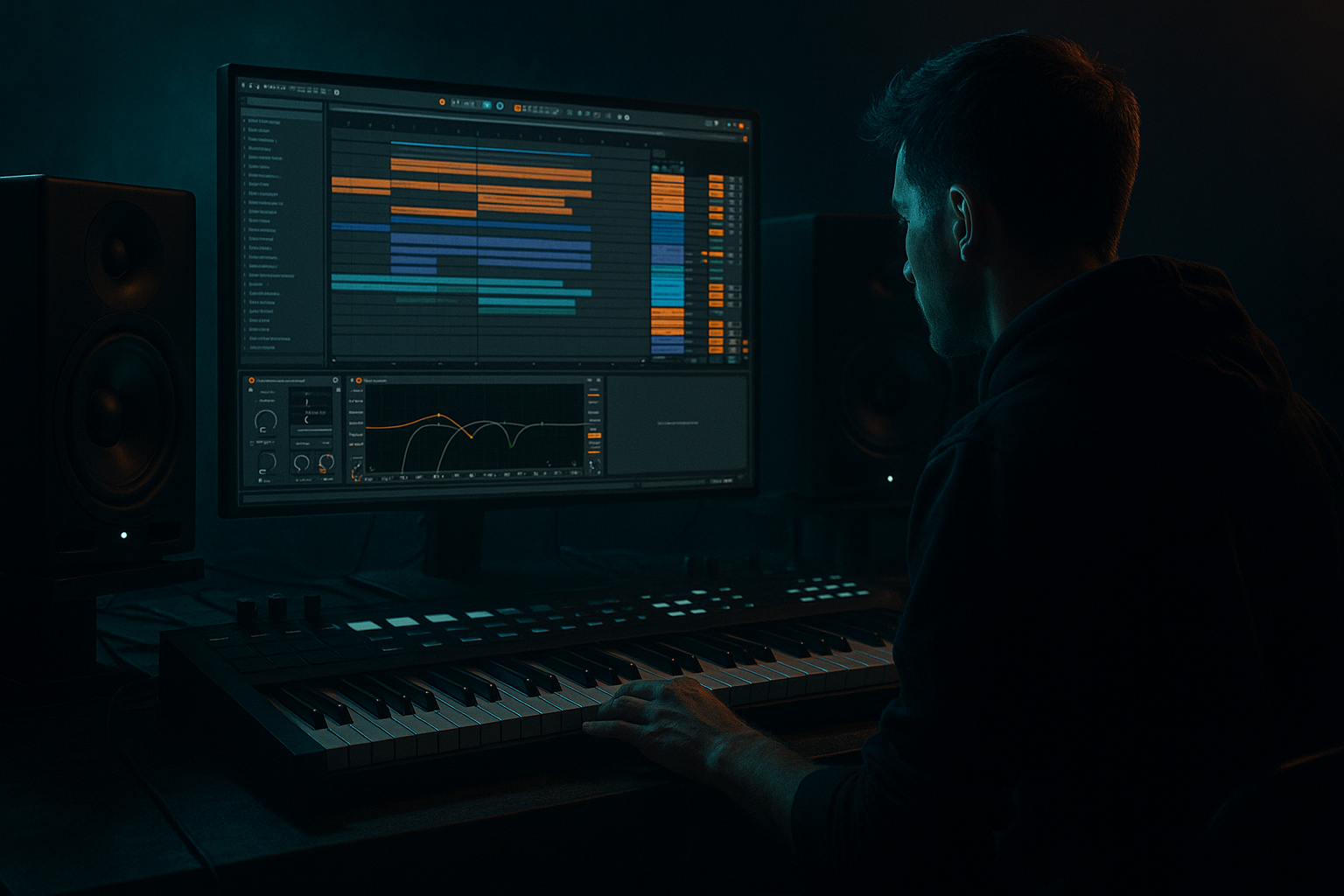
Main tutorial
Lesson Overview
This lesson is about building an oldskool jungle DnB arp blueprint in Ableton Live 12 and then turning it into a macro-controlled performance instrument you can move across a drop, breakdown, or second-drop variation. The goal is not just to make a “busy arp” — it’s to create a recognisable oldskool melodic-bass motif that feels like it came from the DNA of jungle: urgent, chopped, slightly unstable, but still locked to the drums and usable in a modern mix.
This technique lives in the track as a mid-bass hook, tension layer, or answer phrase over the drum loop and sub. In a darker roller or jungle-influenced tune, it can sit in the drop as the thing that gives identity beyond the drums. In a more aggressive tune, it can act as a call-and-response line that punctuates the bass phrase without eating the sub. Technically, it matters because the arp can easily destroy low-end clarity, smear the groove, or become static after eight bars. Macro control solves that by letting you shape note density, tone, filter movement, stereo width, and energy in real time without rebuilding the sound every time.
Best fit: oldskool jungle, dark rollers, break-heavy DnB, atmospheric but hard-edged bass music — especially tracks where you want that classic skippy melody DNA but with modern low-end control.
By the end, you should be able to hear a tight, characterful arp that moves with the drums, stays out of the sub’s way, and can be opened up or stripped down across sections without losing its identity.
What You Will Build
You’ll build a 16th-note jungle arp blueprint in Ableton Live 12 using stock devices, then map the important controls to macros so the sound can evolve from tight, dry, restrained to wide, gritty, urgent.
The finished result should sound like:
- a short, syncopated oldskool arpeggio with a slightly unstable, ravey edge
- a rhythm that dances around the snare and kick, rather than sitting on top of them like a generic EDM arp
- a tone that has midrange bite and controlled harmonics, but leaves room for a separate sub
- a polished-but-raw texture that is mix-ready enough to sit in a DnB drop
- a phrase that can mutate every 4 or 8 bars using macros, making it useful for arrangement and DJ-friendly payoff
- Use harmonic movement, not just brightness, to create menace. A darker arp often feels heavier when it shifts between a few notes with tension, rather than simply opening a filter. Try a minor 2nd or flat 5 coloration in the source notes, but keep it controlled so it still works with the sub.
- Print a “clean” version and a “dirty” version. The clean version can stay present in the drop, while the dirty resampled version can appear for fills or second-drop punishment. This keeps the hook readable while still adding grime.
- Keep the sub and arp in separate emotional jobs. The sub should hold physical weight; the arp should carry attitude and motion. If the arp starts trying to be the bass foundation, the mix gets smaller, not bigger.
- Use macro-controlled width as an arrangement tool, not a constant setting. Narrow in the first phrase, wider in the lift, then back in for impact. That contrast makes the drop feel bigger without needing extra layers.
- Let one macro change the “energy silhouette.” For example, Macro 3 could shorten gate while Macro 1 opens the filter slightly. That creates a more aggressive, percussive shape without just making things louder.
- For a grittier oldskool character, resample through saturation before you distort the arrangement. A printed arp phrase often has more attitude than endlessly modulating the live instrument, and it edits faster in the timeline.
- Stay ruthless about the center. If the arp is wide but the centre loses definition, your kick/snare authority drops. A heavier DnB mix usually feels bigger when the centre is clean, not when every layer is wide.
- Use only Ableton stock devices.
- Keep the source MIDI to 4 notes or fewer.
- Use at least 4 macros.
- Make one version that is tight and filtered, and one that is more open and aggressive.
- Keep the arp’s low end out of the sub range.
- An 8-bar MIDI clip or printed audio phrase
- A macro-mapped rack with at least:
- One 4-bar variation that sounds like a second phrase
- Does the arp still groove when the drums are playing?
- Can you hear the snare clearly through it?
- Does opening the macros create real phrase change without wrecking the low end?
Success means the part feels like a musical hook and a rhythmic device at the same time. It should groove hard even when the bass is muted, and when the sub is added, the two should feel like one system instead of two competing layers.
Step-by-Step Walkthrough
1. Start with a simple MIDI chord or note pool, but think “motif,” not harmony lesson
Create a new MIDI track and load Wavetable, Analog, or even Operator if you want a cleaner oldskool edge. For this blueprint, Wavetable is flexible, but Analog gives a nice immediate rave character. Keep the source simple: try a minor triad, suspended shape, or two-note interval rather than full lush voicings. In jungle and DnB, the arp works best when the source is short and harmonically readable.
Put down a 1- or 2-bar MIDI clip with notes that imply motion, such as root, minor third, fifth, and octave. If you want a darker flavour, keep the pool narrow: a minor 3rd and 5th often reads more threatening than a full stacked chord.
Why this works in DnB: the drums already provide density. The arp needs to be rhythmic and memorable, not harmonically crowded.
What to listen for: the notes should still feel strong when played as a block chord. If they already sound too busy or sentimental, the arp will become mush.
2. Set up the arp rhythm so it fights the right part of the drum groove
Add Ableton’s Arpeggiator before the synth, and set it to a pattern that feels like a jungle phrase rather than a trance run. Start with:
- Rate: 1/16
- Gate: 35–55%
- Style: UpDown or Converge for oldskool movement
- Steps/Octaves: 1–2 octaves max
- Distance/Repeats: keep conservative at first
Now place the MIDI notes so the arp lands in relation to the drums. A classic move is to let the arp avoid the exact kick transient and answer the snare. If your snare is on 2 and 4, try leaving a pocket right before the snare so the arp feels like it pulls into the hit rather than cluttering it.
If your pattern is too straight, add a few notes that are shorter than the bar length so the arp breathes. Oldskool jungle lines often feel like they’re spilling forward but still clipped by the grid.
What to listen for: the arp should create forward motion without sounding like a fast scale exercise. If you hear “busy keyboard demo,” the rhythm is wrong.
3. Shape the instrument so the arp has an oldskool edge before effects
In your synth, start with a basic oscillator setup:
- One saw, or saw + a quieter square
- Slight detune only if it still stays focused
- Filter cutoff around 200 Hz to 2 kHz depending on how bright you want the core
- Filter envelope with a short decay around 80–250 ms
- Amp envelope with fast attack, medium-short decay, and moderate sustain or a quick pluck profile
If using Wavetable, choose a clean saw-based table and keep the movement minimal. If using Analog, one oscillator slightly detuned against another can give an oldskool timbre immediately.
The trick is to make the arp feel animated by the filter and envelope, not by huge synth complexity. Jungle arps often work because the note shape is doing part of the talking.
A useful decision point:
Option A — tighter and more percussive: shorter amp decay, lower sustain, brighter envelope pluck. Good for rollers and a busy break.
Option B — more liquid and haunting: slightly longer decay, more filter movement, softer attack. Good for atmospheric jungle or darker breakdowns that need a melodic hook.
Choose based on what the drums are already doing. If the break is hyper-active, go tighter. If the drums are sparse, you can let the arp breathe more.
4. Build a stock-device processing chain that feels like a record, not a preset
Insert a realistic chain after the synth. A strong starting chain is:
- Auto Filter
- Saturator
- EQ Eight
- Chorus-Ensemble or Utility for width control
- Optional Glue Compressor very lightly
First chain example:
- Auto Filter: low-pass or band-pass depending on tone; start around 1.5 kHz to 6 kHz and automate later
- Saturator: Drive around 2–6 dB, Soft Clip on if needed
- EQ Eight: cut muddy buildup around 200–500 Hz if the arp masks snare body; shave any harsh peak around 2.5–4.5 kHz if it bites too hard
- Utility: keep bass-focused sections in mono or near-mono below the crossover region by controlling width
- Glue Compressor: only 1–2 dB gain reduction if the dynamics need slight glue
Second chain example, for a dirtier oldskool flavour:
- Auto Filter
- Pedal or Saturator
- Redux very subtly
- EQ Eight
- Utility
This chain gives you a more degraded, sampler-like jungle texture. Use it carefully; too much Redux can turn the arp into digital dust.
Why this works in DnB: the harmonics help the arp cut through layers of breaks and sub without needing high volume. Saturation gives presence that survives club playback.
5. Map key movement controls to macros so the arp becomes playable
Drop the devices into an Instrument Rack and map the controls you actually want to move in arrangement. Good macro candidates:
- Synth filter cutoff
- Filter resonance, if it adds character without whistling
- Saturator drive
- EQ high shelf or band gain
- Auto Filter amount or frequency
- Utility width
- Arpeggiator gate
- Arpeggiator octave range or style, if you want section changes
A practical macro setup:
- Macro 1: Tone — filter cutoff
- Macro 2: Edge — saturation drive
- Macro 3: Motion — arp gate
- Macro 4: Lift — octave range or an additional high-pass opening
- Macro 5: Width — Utility width
- Macro 6: Air — EQ high shelf or filter resonance
- Macro 7: Roughness — Redux amount or extra saturation
- Macro 8: Presence — overall output or slight mid boost
Keep the ranges sensible. For example, don’t let width swing from mono to absurdly wide if it collapses the centre. A range that moves from 100% to maybe 130–150% can be enough for a drop variation.
Workflow efficiency tip: name the macros immediately. In a real session, “Macro 3” means nothing. “Motion” and “Edge” get you back to decisions fast.
6. Program the arp so the groove interacts with the break, not against it
Put the arp into context with your drums and sub. Loop 4 or 8 bars with the break and kick/sub in place. This is the point where many good arp ideas die, because they were built in isolation and never checked against the drum pocket.
Start by muting the sub and listening to the arp against the break alone. Then bring the sub back. The arp should feel like it has a lane: either it occupies the upper-mid hook space or it sits lower and more rhythmic, but it should not fight the kick fundamental or the snare crack.
If the break is heavily chopped, use the arp to answer around the gaps. If the break is sparse, the arp can be more constant. Oldskool jungle often sounds best when the arp becomes part of the syncopation grid, almost like another chopped percussion layer with pitch.
What to listen for:
- Does the arp disappear exactly when the snare hits? Good if intentional.
- Does the arp blur the kick? Bad. Shorten gate, reduce low mids, or shift note length.
If the tone masks the snare, cut a small dip around 180–300 Hz or reduce the arp’s body with the synth filter. If it fights the hat sheen, tame 6–10 kHz rather than making the sound darker everywhere.
7. Automate only the moves that create phrase-level payoff
Use clip or arrangement automation to change the arp over 4, 8, or 16 bars, not every beat. Oldskool jungle needs motion, but it also needs punctuation. A very effective pattern is:
- Bars 1–4: narrow, filtered, restrained
- Bars 5–8: slightly more open and brighter
- Bars 9–12: add drive or octave lift
- Bars 13–16: strip it down again before the next section
Good automation targets:
- Filter cutoff opening into a fill
- Arp gate shortening for a more stabbing feel
- Width opening only on the last bar of a phrase
- Saturation rising into the transition
- A small octave lift or resonance bump on the final hit before the drop repeats
This is where the track starts feeling arranged rather than looped. The arp becomes a phrase with intention.
A useful rule: if you automate more than two or three core macro moves in a short section, the part can stop sounding like a hook and start sounding like a test patch. Keep the changes deliberate.
8. Decide whether to keep it MIDI or commit it to audio
If the arp is behaving well and the groove is right, stop here if the part already works in the full drum and sub context. Don’t keep tweaking because the loop feels “possible.” If it’s already giving the track identity, print it.
Commit this to audio if you want:
- a chopped, sample-like oldskool feel
- easier editing for fills and reverses
- more control over tail cleanup and arrangement
- the ability to resample a phrase and make a second variation
Once printed, you can slice the audio and make a call-and-response pattern: one bar of the original arp, then one bar with chopped fragments or reversed hits. This is very effective in jungle and break-heavy DnB because it creates variation without changing the core motif.
If you stay MIDI, keep the benefit of real-time macro movement and easier transposition. If you commit to audio, you gain character and arrangement speed. Both are valid; choose based on whether the phrase needs performance control or sampled identity.
9. Design the drop phrasing around the arp’s tension-release cycle
For a strong DnB arrangement, place the arp so it enters with a clear job:
- Intro or build: filtered and teasing, hinting at the phrase
- Drop 1: concise and rhythmic, not too wide
- Mid-drop variation: open the filter or lift the octave for 4 bars
- Second drop: resample or reharmonize the arp so it feels like an evolution, not a repeat
A concrete phrasing example:
- Bars 1–4 of the drop: arp is narrow, low-pass filtered, and answers the snare
- Bars 5–8: macro opens the filter and adds one extra octave on the last two bars
- Bars 9–12: reduce note density or cut the top end to make room for a drum switch
- Bars 13–16: bring the most aggressive version back for the payoff
The successful result should feel like the arp is lifting the energy without making the groove less readable. If the listener can still point to the kick/snare pattern and remember the melodic hook, you’ve nailed the balance.
Common Mistakes
1. Making the arp too wide too early
- Why it hurts: wide upper harmonics can sound exciting in headphones but collapse the centre of a DnB mix and distract from the drums.
- Fix: use Utility to keep the core narrower, and only widen on upper layers or later phrases. Check mono regularly.
2. Letting the arp occupy sub territory
- Why it hurts: the arp muddies the sub and kick, especially when the MIDI notes dip low or the synth has too much body.
- Fix: high-pass the arp with Auto Filter or EQ Eight so the useful weight starts above the sub region. In many cases, remove everything below roughly 120–180 Hz depending on the sound.
3. Using too much gate or note length so the rhythm becomes choppy in a bad way
- Why it hurts: the part loses its flow and feels like a sequenced machine instead of a phrase with pull.
- Fix: back off the Arpeggiator gate into the 35–55% zone, then listen against the snare. The groove should breathe, not stutter randomly.
4. Over-saturating the midrange until the arp becomes harsh
- Why it hurts: the arp may sound big soloed but turns fatiguing once drums, hats, and snares are in.
- Fix: reduce Saturator drive, then use EQ Eight to tame the harshest band. If needed, automate saturation only for transition bars.
5. Not checking the arp against the drum break
- Why it hurts: jungle and DnB are groove-first. A good arp in isolation can still sit in the wrong rhythmic lane.
- Fix: always test with the break and sub looped. Nudge note start positions or shorten the arp until it locks around the drum accents.
6. Turning every macro into a dramatic full-range sweep
- Why it hurts: if every control moves from extreme to extreme, the arrangement loses contrast and the sound stops feeling intentional.
- Fix: set narrower macro ranges. Let one or two controls make the main statement, and keep the others for subtle evolution.
7. Leaving the low mids cloudy
- Why it hurts: the arp may compete with snare body, break warmth, and bass harmonics.
- Fix: use EQ Eight to trim around 200–500 Hz only if necessary, and compare before/after with the full drum loop.
Pro Tips for Darker / Heavier DnB
Mini Practice Exercise
Goal: Build one 8-bar jungle arp blueprint with macro control and make it work against a break and sub.
Time box: 15 minutes.
Constraints:
Deliverable:
- tone/filter
- drive
- gate or motion
- width or presence
Quick self-check:
Recap
Build the arp from a small musical source, not a giant chord stack.
Use Arpeggiator + stock synth + controlled saturation/filtering to get the oldskool jungle character.
Map the important moves to macros so the sound can evolve across 4- and 8-bar phrases.
Keep the sub separate, the centre clean, and the width disciplined.
If the arp feels like it’s driving the track without stepping on the drums, you’ve got a usable DnB bassline blueprint.

