Main tutorial
Lesson Overview
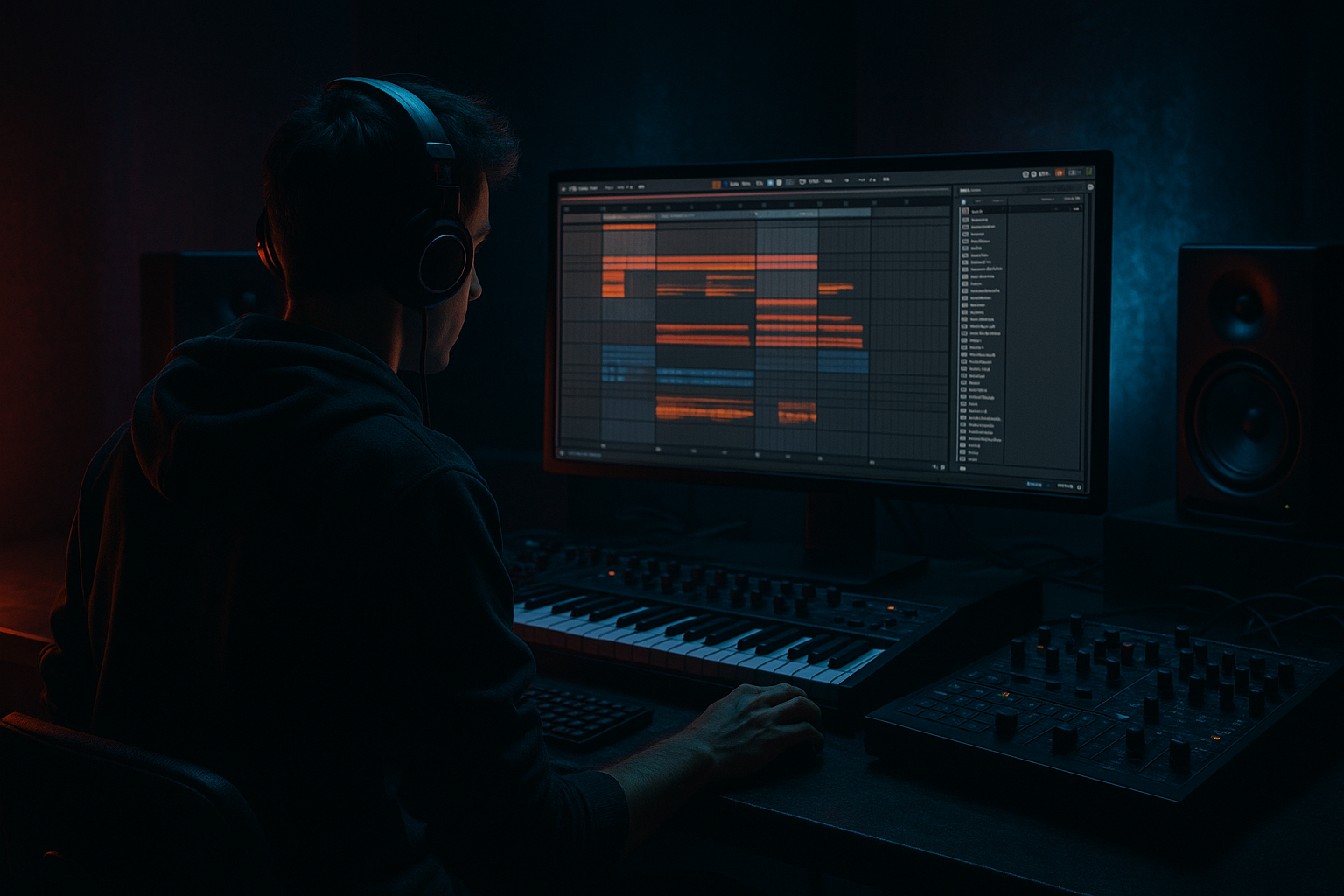
This lesson is about building an oldskool DnB breakbeat stack in Ableton Live 12 and arranging it so it behaves like a real record part, not a loop that just repeats. The goal is to take a classic break-based rhythm, layer it with support drums and bass movement, and turn it into something that can carry an intro, a drop, or a switch-up with proper pressure.
This technique lives at the core of jungle, early DnB, rollers with oldskool influence, and darker break-led club tracks. It matters musically because the break is where the groove and human swing live; it matters technically because the stack has to stay punchy, readable, and DJ-friendly while still sounding dirty and alive. If you do it right, the break feels like it is pushing the track forward instead of just filling space.
By the end, you should be able to hear a tight, weighty break stack with a clear kick/snare hierarchy, audible ghost notes, controlled grit, and enough movement to carry a drop without flattening the low end. A successful result should feel like a break that can survive a loud club system: energetic, layered, and busy in the right places, but still disciplined in the sub and the snare impact.
What You Will Build
You’ll build a stacked oldskool breakbeat arrangement inside Ableton Live 12 with:
- a chopped main break as the rhythmic spine
- one or two support drum layers for punch and texture
- optional sub reinforcement from bass or low drum elements
- group processing that keeps the stack cohesive
- arrangement movement that evolves across 16 or 32 bars
- Let the snare be the face of the break. In darker DnB, the snare is often what sells the impact. If the break is too noisy around the snare hit, carve a little low-mid or reduce competing layer volume rather than boosting the snare endlessly.
- Use ghost notes as forward motion, not decoration. Short little hats, stick hits, and sliced break fragments between beats are what make the bar feel like it is running downhill. Keep them tucked lower in level so they create momentum without drawing attention away from the backbeat.
- Treat the sub like part of the break arrangement. A sustained bass note under every hit can make the whole thing heavy in a bad way. Try letting the bass breathe on snare hits, then re-enter with intention on the offbeat or the bar tail.
- Print dirty versions, then choose the cleanest dirty one. One of the best Ableton workflows is to resample two or three break passes: one raw, one saturated, one slightly filtered. Then pick the one that sounds most dangerous while still keeping the downbeat readable.
- Dark does not mean dense everywhere. Leave one or two frequency pockets clean around the kick fundamental and snare crack. A break feels heavier when the important parts are exposed, not when every layer is loud.
- Use short transitions, not long washes, if you want menace. A one-beat reverse snare, a half-bar filter pull, or a sudden bar-end cut can feel more lethal than a huge riser. In underground DnB, restraint often reads as confidence.
- Keep the second drop more aggressive, not just busier. For example, on the second 16 bars, add an extra chopped top layer, switch the bass response, or move one ghost note earlier. Small changes feel bigger when the first drop already established the language.
- Use only stock Ableton devices and one or two break sources
- Keep the core break centered and mono-compatible
- Add no more than one support layer
- Make at least one 4-bar variation
- a 4-bar clip set: 2 bars of base groove and 2 bars of variation
- a grouped break stack with basic processing
- one printed audio version of the groove
- Does the snare still clearly anchor the bar?
- Can you hear ghost notes without them overpowering the groove?
- Does the break still feel strong when checked in mono?
- Does the variation sound like a real phrase change, not just extra notes?
- Start with a strong break and keep the snare as the anchor.
- Stack layers by job: groove, punch, and texture.
- Use stock Ableton processing lightly and with purpose.
- Shape the break in phrases, not endless loops.
- Check the stack against bass and drums early.
- Resample once the hierarchy works, then edit for arrangement payoff.
- In darker DnB, weight comes from clarity, restraint, and smart contrast — not just more layers.
The sonic character should be grainy, fast-moving, and slightly rugged, with the snare cutting through and the kick punching without bloating the low end. The rhythm should feel driven but not rushed, with enough swing and ghost-note detail to create that classic jungle/DnB momentum. In the track, this part should function as a drop engine, intro tease, or transition section rather than a static loop. Mix-wise, it should be clean enough to sit under a bassline and lead elements without masking them, while still sounding aggressive on its own.
Step-by-Step Walkthrough
1. Start with the right break and set the tempo against the vibe
Load a classic break with good transient contrast: Amen-style material, Think-style material, or any oldskool loop with clear kick/snare/ghost-note separation. Set your project in the usual DnB zone, roughly 172–176 BPM for modern oldskool-leaning material, or slightly lower if you want more rolling headroom.
Warp the break so the first hard snare lands cleanly on the grid, but do not over-correct every micro-hit into robotic alignment. The point is to preserve the human push/pull. If the break is too loose, tighten the main backbeat and leave small internal variations intact.
What to listen for: the snare should feel like the anchor, and the little ticks between hits should still breathe instead of sounding quantized to death. If the loop loses its swagger when warped, back off on the edits and use fewer slices.
2. Build the main break spine with Simpler or sliced audio
Drag the break into Simpler in Slice mode, or keep it as audio and manually chop the key hits if you already know the pattern you want. For intermediate workflow speed, sliced audio often gives you more control over transient placement and arrangement later.
Build a 2-bar pattern with the core hits: kick, snare, and a few ghost hits. Don’t try to use every slice immediately. Start with the structural hits, then add the smaller ones once the groove is stable.
A good oldskool DnB break often needs:
- snare on 2 and 4 as the emotional anchor
- kick support before or after the snare for momentum
- ghost notes between beats to create propulsion
- a few open hat or ride fragments to add top-end drive
If you’re using Simpler, keep the amp envelope fast: attack at 0 ms, decay short to medium, and let the slices speak clearly. If a slice rings too long, trim it in the clip view or reduce its release so the groove stays tight.
3. Layer a second break or support layer for weight and texture
Now make the stack. Duplicate the main break to a new track and turn it into a support role rather than a clone. This is where the oldskool method becomes powerful: one layer for groove, one layer for punch, one layer for grit.
Two solid options:
- Option A: complementary break layer — use another break with a different tone, maybe thinner and more top-heavy. High-pass it around 180–300 Hz so it adds motion and texture without fighting the core low mids.
- Option B: drum reinforcement layer — add a clean kick, snare, or rim shot from Ableton’s stock Drum Rack and place it only on the strongest beats. This gives you stronger backbeat translation on big systems.
Decision point:
- Choose A if you want more authentic, chopped, break-heavy movement.
- Choose B if you want more club impact, more modern punch, and a clearer snare/kick hierarchy.
In many tracks, the best answer is a hybrid: the break carries the identity, while a minimal support layer sharpens the impact.
4. Shape each layer with stock devices so they occupy different jobs
Put the main break through a basic chain that focuses it without sterilizing it:
- EQ Eight: high-pass gently around 25–35 Hz if there is useless sub rumble; make a small cut around 200–400 Hz if the break is boxy; tame harshness around 6–9 kHz only if needed.
- Drum Buss: use a modest amount of Drive to thicken the body, and keep Boom very restrained or off if it starts clouding the sub. In this style, too much boom can make the break feel fake.
- Saturator: a small amount of drive, often around 1–4 dB, is enough to add density and help the snare read on smaller speakers.
For the support layer, do less:
- high-pass the texture layer more aggressively
- keep transient shaping minimal
- use saturation only if it helps the layer sit forward without needing volume
What to listen for: the stacked break should sound bigger, not messier. If the layers blur into one smear, you’ve lost the hierarchy.
5. Lock the groove against the drums and bass before adding more detail
Drop in your kick and bass idea early, even if they are rough. This is a groove-first genre, and the break needs to survive in context. Place the bass so it answers or reinforces the break rather than constantly stepping on the same transient zone.
If the bass is a reese or a low bass phrase, check where it lands relative to the snare and kick:
- let the snare punch through without bass masking it
- avoid stacking heavy bass notes right on the kick if the low end turns muddy
- use short rests so the break can breathe between bass statements
This is where the oldskool method earns its keep: the break is not just a drum loop; it is part of the bassline groove. In jungle and oldskool DnB, the break and bass often feel like one interlocking engine.
If your bass is overpowering the break, thin the bass with EQ, shorten note lengths, or move some bass notes later by a few milliseconds so the transient of the break keeps its edge.
6. Edit the slices for call-and-response rather than constant motion
Don’t let the break fire every slice every bar. That creates fatigue fast. Arrange the break in phrases, like a conversation:
- bar 1: core groove
- bar 2: same groove with an extra ghost hit or open hat
- bar 3: slight variation or fill
- bar 4: leave space or create a turnaround
In Ableton, duplicate the clip and make small edits rather than building endless patterns from scratch. This is faster and keeps the identity consistent. A smart workflow tip: make one “base groove” clip, then duplicate it into variation clips for 4-bar or 8-bar phrases. That keeps you moving and avoids loop trap syndrome.
A useful arrangement example:
- bars 1–8: stripped intro version with filtered break and bass hints
- bars 9–16: full break stack enters
- bars 17–24: add a variation with extra fill at the end of bar 16
- bars 25–32: second phrase with more movement, maybe an extra snare layer or a chopped reverse hit
The point is not just to repeat the break; it is to build tension and payoff through controlled variation.
7. Use envelope, filter, and automation moves for motion without wrecking the low end
Automate the break stack over 8 or 16 bars so it evolves. Stock tools are enough:
- Auto Filter for opening intro versions or tightening the top end before a drop
- Utility to narrow the stereo image on the low end if needed
- Reverb on a send for selective snare tails or transition hits, not the whole break
- Echo or a simple delay throw on end-of-phrase snare hits if the track wants space
Keep the movement purposeful:
- intro: filtered break with reduced top end, maybe around 3–8 kHz softened
- drop: full bandwidth, more transient presence
- turnaround: quick filter dip or stop for one beat before the next section
What to listen for: the transition should feel like energy is being released, not like the mix is just getting brighter. If the top end opens but the groove loses body, the automation is too broad.
8. Commit the stack to audio once the groove is working
When the break stack feels right, commit this to audio by resampling or recording the group to a new audio track. This is one of the best oldskool workflows in Ableton because it lets you treat the break like material to be edited, not just a MIDI pattern.
Why it works in DnB: once the stack is printed, you can chop fills, reverse hits, and micro-edits faster than constantly juggling live layers. It also helps you hear what the break actually does in the arrangement instead of what you hope it does.
After printing, do a quick pass:
- trim tails that overlap awkwardly
- create one-beat fills at bar ends
- reverse a crash or snare slice into a downbeat
- leave one or two empty moments so the next section hits harder
If the printed audio has lost snap, shorten your source release or reduce the bus processing before printing.
9. Glue the stack with subtle group processing, not over-compression
Group the break layers and use gentle control rather than squashing the life out of them. A classic chain could be:
- EQ Eight for cleanup
- Glue Compressor with light reduction, just enough to catch peaks
- Saturator or Drum Buss for density
- Utility to check mono and manage width
Keep compression modest. If the attack is too fast, the break loses its transient bite. If release is too slow, the groove feels pinned down. A useful starting point is a compression setting that only shaves a couple dB on the hardest peaks, not constant heavy reduction.
Mono compatibility note: check the low end and the main snare/kick in mono using Utility. The foundational hit should still feel strong when collapsed. If your break only feels good in stereo, the club translation will suffer.
10. Check the whole idea in context and make one final A/B decision
Before you call it done, audition the break stack with the full drums and bass at drop volume. This is the truth test. A break that sounds huge solo can disappear once the sub and bassline are active.
Now make an explicit A versus B choice:
- A: raw oldskool pressure — keep more break transients, fewer processed layers, more grit, slightly looser swing
- B: tighter club polish — reinforce the snare, tighten the kick, trim low-mid clutter, and make the stack read more cleanly on large systems
Both are valid. Choose A if the track is leaning jungle, deep rollers, or grimey nostalgia. Choose B if you want the track to hit harder in modern club playback while still borrowing the oldskool feel.
A good final test is simple: if you mute the bass for a moment, the break should still carry the pulse; if you mute the break, the bass should not feel disconnected from the rhythm. When both are on, the track should feel like one machine.
Stop here if the break feels busy but not readable. Fix the hierarchy first. Don’t add more fills until the core loop punches properly.
Common Mistakes
1. Layering too many breaks at full range
- Why it hurts: the groove turns into mush, especially in the low mids.
- Fix in Ableton: high-pass support layers with EQ Eight, keep only one layer owning the kick/snare body, and mute any layer that does not have a clear job.
2. Quantizing every slice too tightly
- Why it hurts: oldskool DnB loses swing and sounds stiff.
- Fix in Ableton: leave micro-variation in the chopped audio, or manually nudge only the main backbeat while keeping ghost notes slightly human.
3. Overdoing saturation on the whole stack
- Why it hurts: transient detail gets flattened and cymbals become harsh.
- Fix in Ableton: use lighter drive on the group, and if needed saturate only the support layer or resampled audio, not every element at once.
4. Letting the bass fight the break’s kick pattern
- Why it hurts: low-end mud and weak punch.
- Fix in Ableton: shorten bass notes, move them away from heavy kick hits, or reduce bass low mids around 120–250 Hz if the overlap is ugly.
5. Using too much stereo width in the drum stack
- Why it hurts: the groove loses center focus and can collapse in mono.
- Fix in Ableton: keep the core break and kick/snare layers mostly centered; use width only on top textures or effects, then verify with Utility in mono.
6. Adding fills every bar
- Why it hurts: there is no phrasing or tension; the listener gets fatigued.
- Fix in Ableton: save fills for bar 4, 8, 16, or section endings, and repeat the base groove longer than your instinct wants.
7. Printing the break too early before the hierarchy is right
- Why it hurts: you lock in a flawed balance and spend time editing the wrong version.
- Fix in Ableton: only resample once the core snare, kick, and ghost-note balance works with bass and at least one arrangement section.
Pro Tips for Darker / Heavier DnB
Mini Practice Exercise
Goal: Build a two-bar oldskool break stack that can function in a real DnB drop.
Time box: 15 minutes
Constraints:
Deliverable:
Quick self-check:

