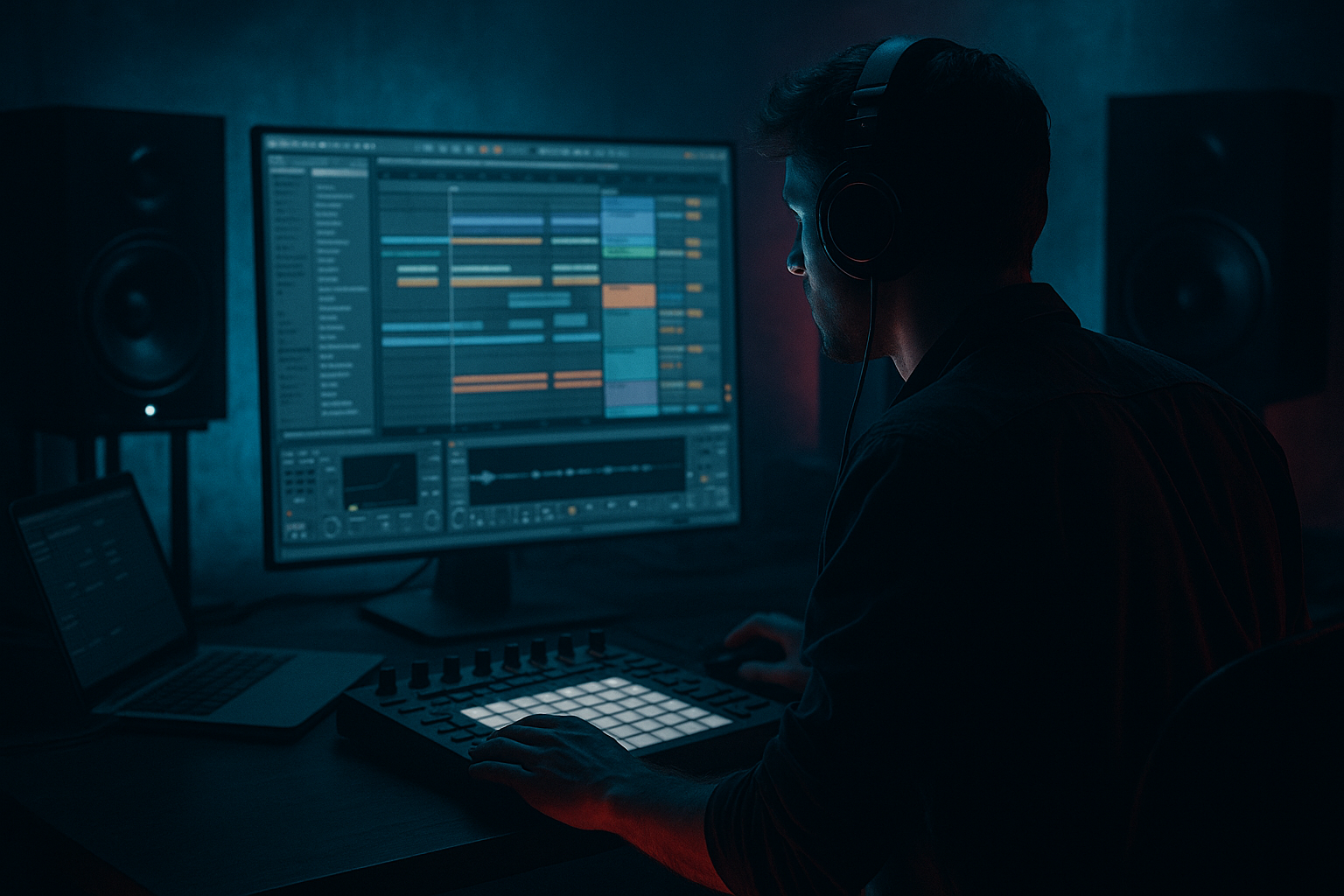
Main tutorial
```markdown
Oldskool Rave Bass Hooks using Session View (Ableton Live) 🔊🧨
Skill level: Beginner
Category: Basslines (Drum & Bass / Jungle)
---
1. Lesson overview
Oldskool rave DnB bass hooks are often simple, punchy, and instantly memorable—built from a few notes, strong rhythm, and classic sound design tricks (square/saw weight, sub support, filtering, saturation).
In this lesson you’ll use Ableton Live’s Session View to:
- Rapidly audition bass hook ideas as loops
- Build A/B/C variations (call/response) like proper jungle/DnB
- Create a rave-style mid bass + sub that locks to a rolling drum groove
- Record your best combos into Arrangement when it’s hitting right 🎯
- A Drum Loop clip (so you can test bass hooks in context)
- A Sub Bass track (clean, mono, stable)
- A Rave Mid Bass / Hook track (the character + movement)
- 3–6 bass clips (variations) that you can launch like an oldskool rave jam
- A quick route to record your clip performance into Arrangement
- Same notes, different rhythm:
- Use an octave jump at the end of the bar:
- Make a 2-bar clip with a repeating pattern but one change at bar 2 end.
- Think: bar 1 is steady; bar 2 has a surprise fill.
- Use very short notes (1/16) like bass stabs.
- Turn Auto Filter resonance slightly higher for that squelch.
- `CALL 1`
- `RESP 1`
- `LIFT`
- `2BAR ROLL`
- `STABS`
- Add a “Reese edge” layer quietly:
- Automate filter cutoff per clip:
- Use Redux lightly for grit:
- Make the hook “answer” with pitch drops:
- Add a tiny room for vibe (not on sub):
- Session View is perfect for rapid bass hook iteration in DnB.
- Build bass in layers: clean mono SUB + dirty moving MID.
- Create multiple clips (call/response/variation) and launch them as Scenes.
- Use sidechain to keep kick + bass clean.
- Record your clip performance to Arrangement to turn loops into a track fast 🎛️
---
2. What you will build
You’ll end up with a Session View “performance-ready” set containing:
Musically, think: rolling DnB at 170–175 BPM with a bass hook that feels like classic rave stabs but in bass form.
---
3. Step-by-step walkthrough
Step 0 — Set up your Live Set for DnB speed ⚙️
1. Set tempo to 174 BPM (top left).
2. In Session View, create these tracks:
- Audio track: `DRUM LOOP` (or MIDI if you prefer Drum Rack)
- MIDI track: `SUB`
- MIDI track: `RAVE MID`
3. Turn on the metronome for now, and set the global quantization to 1 Bar (top middle).
- This keeps clip launching tight and musical.
---
Step 1 — Get a basic drum context (so you write bass properly) 🥁
You’ve got two easy options:
Option A: Use a loop (fastest)
1. Drop a DnB drum loop into `DRUM LOOP`.
2. Warp mode: Beats (good for drums).
3. Loop it to 4 bars.
Option B: Simple MIDI beat (beginner-friendly)
1. Create a MIDI clip on a Drum Rack (kick on 1, snare on 2 & 4).
2. Add hats at 1/8 or 1/16 for momentum.
Tip: Keep the drums playing while you design bass. Bass that sounds huge solo often fails in the groove.
---
Step 2 — Build a clean SUB that behaves in a club 🧱
On the `SUB` MIDI track, add this device chain (all stock):
1. Instrument: `Operator`
- Osc A: Sine
- Level: ~ -12 dB (leave headroom)
- Turn off additional oscillators (B/C/D)
2. MIDI Effect: `Limiter` (yes, on sub track is fine as safety)
- Ceiling: -0.8 dB
- Only catching peaks—don’t squash it constantly.
3. Audio Effect: `EQ Eight`
- Low-pass around 120–160 Hz (gentle)
- Optional: small dip around 200–300 Hz if it muddies.
4. Audio Effect: `Utility`
- Width: 0% (mono sub)
- Gain: adjust later
Write a sub clip
1. Create a 1-bar MIDI clip on `SUB`.
2. Use root notes only at first (example in A minor: A, G, F, E).
3. Rhythm idea (classic rolling support):
- Note on beat 1
- Short note on 1.3 (third 16th of beat 1)
- Note on 3
- Short note on 3.3
Keep notes fairly short (1/8 to 1/16). Let the drums breathe.
---
Step 3 — Create the RAVE MID bass hook sound (the “hook layer”) 🪚
On the `RAVE MID` MIDI track, build this chain:
1. Instrument: `Wavetable` (or Analog if you prefer)
- Osc 1: Basic Shapes
- Position: Square (or slightly toward pulse)
- Osc 2: Saw (optional, lower level)
- Unison: 2 voices (keep subtle)
- Glide/Portamento: On, Time: 60–120 ms (oldskool slide vibe)
2. Audio Effect: `Saturator`
- Mode: Analog Clip
- Drive: 3–7 dB
- Soft Clip: On
- Output: trim so you’re not getting louder-only “better”
3. Audio Effect: `Auto Filter`
- Filter: LP24
- Frequency: start around 250–600 Hz
- Resonance: 10–25%
- Envelope: small amount (so notes “speak”)
- Add LFO:
- Rate: 1/8 or 1/4
- Amount: small (you want movement, not wobble chaos)
4. Audio Effect: `EQ Eight`
- High-pass at ~120 Hz (important—sub lives on the SUB track)
- Small presence boost around 1–2 kHz if it needs bite
5. Audio Effect: `Glue Compressor` (optional but nice)
- Attack: 3 ms
- Release: Auto
- Ratio: 2:1
- Aim for 1–3 dB GR on peaks
Why split SUB and MID?
Because in DnB the sub must be stable and mono, while the mid can be dirty, moving, wide-ish.
---
Step 4 — Write 4–6 hook clips in Session View (this is the magic) ✨
In Session View, you’ll create multiple clips on `RAVE MID` and launch them against the same drums + sub.
#### Clip 1: “Call” hook (1 bar)
1. Create a 1-bar MIDI clip on `RAVE MID`.
2. Use a simple 2–3 note motif in A minor, e.g.:
- A (root), G (flat 7), E (5th)
3. Rhythm suggestion (classic rave punctuation):
- Hit on 1
- Answer on 1.2
- Slide into note on 2.4 (with Glide on)
Keep notes short and snappy. The filter + saturation will do a lot.
#### Clip 2: “Response” hook (1 bar)
- More space on beat 1
- Emphasize beat 3 (DnB loves the second half of the bar)
#### Clip 3: “Upward lift” (1 bar)
- A2 → A3 briefly, then drop back
#### Clip 4: “Syncopated roller” (2 bars)
#### Clip 5: “Rave stab bass” (1 bar)
Workflow tip: Name clips clearly:
Color them too. You’re building a “hook palette” 🎛️
---
Step 5 — Make Session View feel like a performance (Scene launching) 🎚️
1. Create Scenes (rows) like:
- Scene 1: `Intro (Sub only)`
- Scene 2: `Hook A (Call)`
- Scene 3: `Hook B (Response)`
- Scene 4: `Hook C (Stabs)`
- Scene 5: `Drop Switch (2-bar roll)`
2. In each Scene, launch a matching combo:
- Drums + Sub + one Mid clip
3. Use global quantization 1 Bar so everything hits clean.
Now you can “play” your hook like a DJ set—this is very oldskool-rave energy.
---
Step 6 — Sidechain the bass to the kick (cleaner mix instantly) 🧼
You can do this two ways:
Quick method (stock Compressor sidechain):
1. On `SUB`, add Compressor
2. Enable Sidechain
3. Audio From: your kick track (or `DRUM LOOP` if it’s a loop)
4. Settings:
- Ratio: 4:1
- Attack: 1–5 ms
- Release: 50–120 ms
- Adjust threshold so you get 2–5 dB ducking on each kick
Repeat on `RAVE MID` but a bit gentler (1–3 dB).
If using a drum loop: sidechain still works, but it’ll respond to the whole loop. If you want precision, extract a kick to its own track.
---
Step 7 — Record your Session View performance into Arrangement 🎬
When your clip combos are hitting:
1. Press the Global Record button (top transport).
2. Launch Scenes and clips as you “perform” a 32–64 bar structure:
- 16 bars intro (sub + drums)
- 16 bars hook A
- 16 bars hook B
- 16 bars switch-up (2-bar roller)
3. Hit Tab to go Arrangement View and you’ll see your performance recorded.
Now you’ve got an actual DnB arrangement skeleton—built the fun way.
---
4. Common mistakes ❌
1. Writing bass without drums
- In DnB, rhythm is everything. Always loop drums while writing hooks.
2. Sub too wide / stereo
- Keep SUB mono (Utility Width 0%). Wide sub = weak, phasey low end.
3. MID bass fighting the sub
- High-pass the MID around 100–150 Hz so the SUB owns the low end.
4. Over-distorting too early
- Saturation is great, but if it’s all fuzz you lose note definition.
5. No variations
- Oldskool hooks feel alive through call/response and little edits.
---
5. Pro tips for darker/heavier DnB 🕶️⚔️
Duplicate `RAVE MID`, switch Wavetable to saw + saw detune, low-pass it, keep it subtle under the hook.
In each clip, automate Auto Filter Frequency so Scene launching changes energy instantly.
On MID: `Redux`
- Bit Reduction: small (like 10–14 bit feel)
- Keep it subtle—too much turns to sand.
End of bar: quick pitch down (or glide down) screams dark rave.
On MID only: `Reverb`
- Decay: 0.3–0.7s, Low Cut high enough
- You want space, not wash.
---
6. Mini practice exercise 🧪
Do this in 15–20 minutes:
1. Make 4 MID clips:
- 2 x 1-bar call/response
- 1 x 2-bar variation
- 1 x “stabs” clip
2. Keep the SUB clip constant for now.
3. Create 4 Scenes using different MID clips.
4. Record a 48-bar performance into Arrangement:
- 16 bars Scene 1
- 16 bars Scene 2
- 16 bars alternating Scene 3 and 4 every 4 bars
Goal: You should feel like you’re DJing your own bass hook.
---
7. Recap ✅
If you want, tell me what vibe you’re aiming for (jungle roller, jump-up-ish, dark minimal, 94 rave), and I’ll suggest specific note patterns and a clip pack layout for Session View.
```

