Main tutorial
```markdown
Oldskool Rave Piano Hooks with Resampling Only (DnB in Ableton Live) 🎹⚡
1) Lesson overview
In classic jungle/DnB, that rave piano isn’t just a preset—it’s usually a sampled moment that gets re-pitched, chopped, filtered, saturated, and re-sampled until it feels like a weapon.
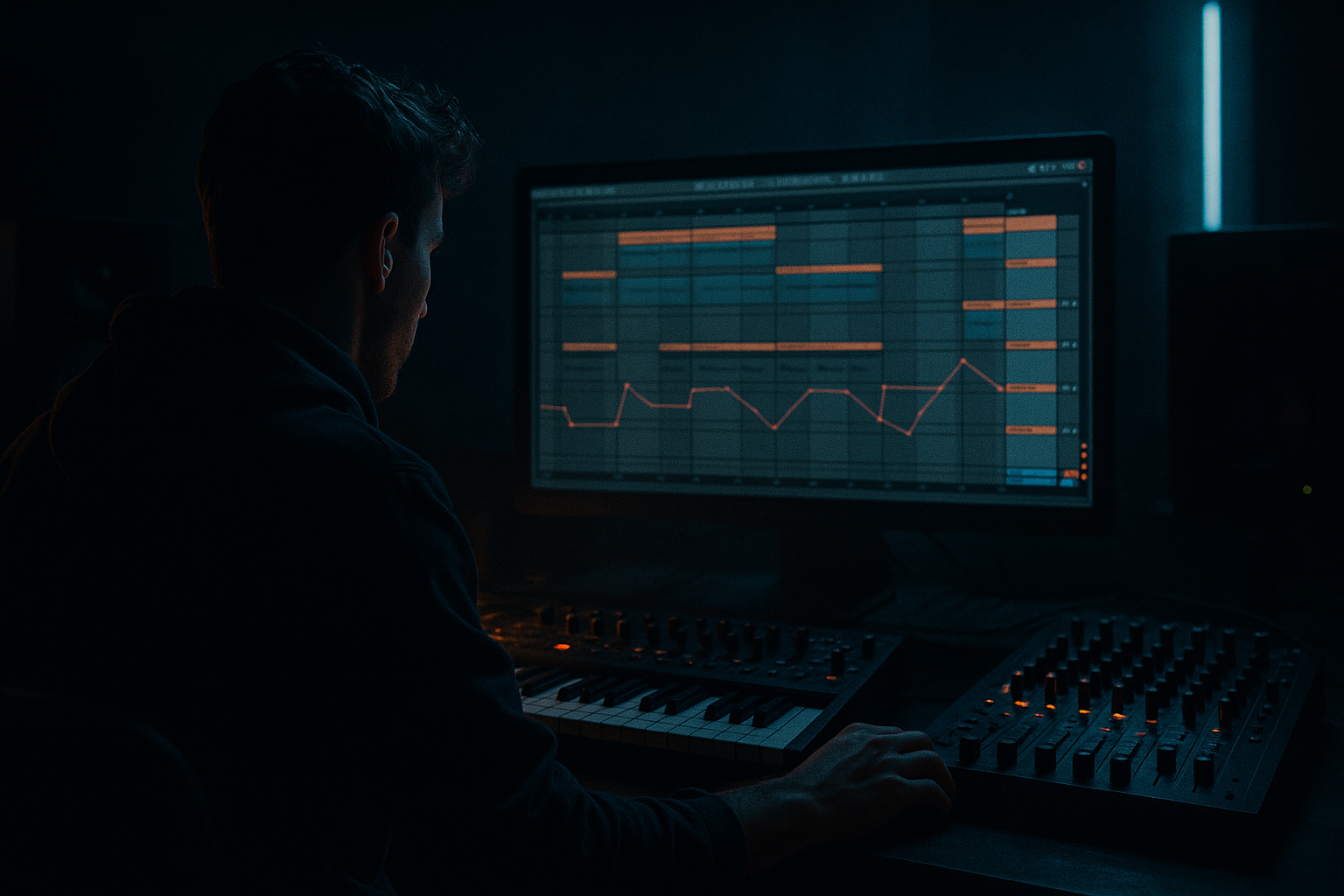
This lesson shows a resampling-only workflow in Ableton Live: you’ll generate a piano-ish source, bounce it to audio, then do all the “oldskool” magic from that audio onward.
You’ll end with a hook that cuts through rolling drums and bass, sits in a 170–174 BPM context, and has that 90s “sample pack” vibe without relying on one.
---
2) What you will build
You’ll build:
- A 4-bar rave piano hook (audio-based) with classic stabs and a call/response.
- A resampled rack of variations: bright stab, dark stab, wide “chorus” stab, and a distorted “hoover-ish” layer.
- A simple DnB arrangement idea (intro → drop → 2nd drop switch-up) that makes the hook feel like a proper roller.
- Load Instrument Rack → choose a simple Grand Piano (if you have a piano pack).
- If not: use Tension (stock) and keep it simple:
- Use stabs, not long pads.
- Chords (one per hit):
- Bar 1: Am stab (beat 1), G stab (beat 2+), F stab (beat 3), E stab (beat 4+)
- Bar 2: Am stab (beat 1), short fill stabs (16ths) around beat 3–4
- Mode: One-Shot
- Trigger: Gate (for tight stabs)
- Start: adjust per slice if needed
- Fade In: `1–5 ms` (removes clicks)
- Filter: On
- Amp Env:
- Compressor
- EQ Eight
- If the piano fights the snare crack:
- Use Hybrid Reverb or Echo sparingly:
- Bars 1–8: filtered VAR 2 (dark) + atmos + minimal drums
- Bars 9–16: bring VAR 1 (wide) as a teaser, but chopped (half as many hits)
- First 16: VAR 3 (crunch) main hook, tight stabs, minimal reverb
- Next 16: answer phrase—transpose the whole hook +2 semitones (audio clip transpose) and reduce hits to let bass speak
- Resample a reverb tail: freeze/print a long tail and reverse it into the next hit (classic)
- Swap to VAR 1 (wide) only on phrase ends (last 2 beats of every 4 bars)
- Automate Auto Filter opening over 16 bars for lift
- Not committing to audio early: the whole point is the sample workflow. Bounce fast, iterate faster.
- Too much low end: piano stabs with 80–200 Hz will ruin your sub clarity.
- Over-widening: 170% width + heavy chorus can smear mono compatibility and weaken the drop.
- Over-degrading: Redux/Erosion are seasoning—if you hear “bitcrusher effect”, you likely went too far.
- Same stab for the entire track: oldskool hooks evolve via resample generations and filtering, not just copy/paste.
- Pitch down a generation: Resample your best stab, then transpose the audio `-5` or `-7` semitones and re-EQ. That creates a heavier “rave ghost” layer.
- Parallel dirt bus: Send piano to a return track:
- Mid/Side control (stock):
- Call-and-response with bass: leave holes. Let the piano answer the bass phrase every 2 bars instead of constant stabs.
- Rave tension notes: sprinkle a quick stab with a raised 7th (e.g., G# in A minor) before returning home. Instant menace.
- You created a piano source, then committed to audio early ✅
- You warped, degraded, chopped with Simpler and treated the hook like a sample ✅
- You built multiple resampled generations (wide/dark/crunch) to keep the drop evolving ✅
- You placed the hook properly in a DnB mix with HP filtering + sidechain + controlled space ✅
---
3) Step-by-step walkthrough
A) Set the session up (DnB context first)
1. Tempo: `172 BPM`
2. Groove: optional but useful later—try Swing 16-55 (subtle).
3. Create tracks:
- MIDI Track: `PIANO SOURCE (TEMP)`
- Audio Track: `PIANO RESAMPLE`
- Audio Track: `PIANO CHOPS`
- Drum Track: `DRUMS (REFERENCE)`
- Bass Track: `SUB/REESER (REFERENCE)`
> Why: Designing in context prevents that “sick piano” that dies once drums/bass arrive.
---
B) Create a “piano-ish” source (you will immediately bounce it)
You can use any instrument for the initial strike—because we’re committing to audio fast.
Option 1 (stock, quick):
- Material: ~30–50
- Decay: short/medium
- Pickup: moderate
- Keep it bright-ish.
Add a “pre-sample chain” (on the MIDI source track):
1. EQ Eight
- HP filter: `~120 Hz` (24 dB/oct)
- Gentle boost: `+2 to +4 dB at 2.5–5 kHz` (wide Q)
2. Saturator
- Mode: Analog Clip
- Drive: `2–6 dB` (don’t smash yet)
- Soft Clip: On
3. Drum Buss (yes, on piano—oldskool trick)
- Drive: `5–15%`
- Crunch: `0–10%`
- Boom: Off (we don’t want sub)
4. Hybrid Reverb (we’ll resample the space!)
- Algorithmic or Convolution “Small Room”
- Decay: `0.6–1.2 s`
- Pre-delay: `10–25 ms`
- Wet: `10–25%`
> We’re baking in character early so the resample already sounds like a record.
---
C) Write a hook that feels jungle/DnB (simple, memorable, “stabby”)
Oldskool rave piano hooks often imply minor tonality with bright voicings.
Try this chord approach (key: A minor):
- `Am (A–C–E)`
- `G (G–B–D)`
- `F (F–A–C)`
- `E (E–G#–B)` (that G# gives classic tension)
MIDI pattern idea (2 bars, repeat/variation):
Timing: Keep hits slightly late on a couple stabs for swing. DnB loves that push/pull.
---
D) Resampling only: commit the piano to audio
Now we stop “synthing” and start sampling.
1. On `PIANO RESAMPLE` track, set Audio From:
- `PIANO SOURCE (TEMP)` → Post FX
2. Arm `PIANO RESAMPLE` and record 4–8 bars.
3. Freeze + Flatten the MIDI track or simply disable it after recording to commit mentally.
Now you only work with audio for the hook.
---
E) Warp + degrade like a 90s sample
On the recorded clip:
1. Warp mode:
- Try Beats (Transient loop), or Complex if it gets weird.
- For crunchy stab behavior: Beats with:
- Preserve: Transients
- Envelope: `~20–60`
2. Clip Transpose:
- Try `-2`, `-5`, `-7` semitones for darker variants.
3. Clip Gain:
- Aim peaks around `-9 to -6 dB` before heavy processing.
Degrade chain (on the audio track):
1. Redux
- Bit Reduction: `10–12 bits`
- Sample Rate: `12–18 kHz` (subtle; don’t destroy)
2. Erosion (tiny = magic)
- Mode: Wide Noise or Sine
- Frequency: `2–6 kHz`
- Amount: `0.2–1.5` (small!)
3. EQ Eight
- HP: `120–180 Hz`
- Dip harshness: often `3–5 kHz` if needed
- Add “bite”: gentle shelf `+1–3 dB @ 8–10 kHz` if it got dull
> This is the “sample pack aging” step. Keep it audible but not gimmicky.
---
F) Chop it into playable stabs (the core technique)
Move the resampled clip to `PIANO CHOPS`.
Method 1: Slice to New MIDI Track
1. Right-click the audio clip → Slice to New MIDI Track
2. Slice by: Transients (or 1/8 if it’s consistent)
3. Slicing preset: Built-in (Simpler)
Now you’ve got Simpler with each stab on pads/keys.
Simpler settings (important for oldskool stab control):
- Type: LP24
- Freq: map to Macro later (start around `3–8 kHz`)
- Res: `0.5–1.5`
- Attack: `0–5 ms`
- Decay: `200–600 ms`
- Sustain: `0`
- Release: `50–150 ms`
Now re-play the hook using the slices—this is where it becomes “rave”.
---
G) Make 3–4 resampled variations (so your hook evolves in the drop)
You’ll create multiple audio generations like old hardware workflows.
#### Variation 1: Bright, wide “anthem stab” ✨
On the Simpler track:
1. Chorus-Ensemble
- Mode: Ensemble
- Amount: `20–40%`
- Rate: `0.3–0.8 Hz`
2. Utility
- Width: `130–170%` (don’t go too extreme)
Resample it: record to a new audio track: `PIANO VAR 1 (WIDE)`.
#### Variation 2: Dark, filtered “roller stab” 🌑
1. Auto Filter
- LP24
- Freq: `700 Hz – 2.5 kHz` (automate!)
- Drive: `2–6 dB`
2. Saturator
- Drive: `4–8 dB`, Soft Clip On
Resample to `PIANO VAR 2 (DARK)`.
#### Variation 3: Crunchy rave “bark” (cuts through drums) 🪓
1. Overdrive
- Freq: `1–2.5 kHz`
- Drive: `20–50%`
2. EQ Eight
- Band-pass-ish: HP `~250 Hz`, LP `~7–9 kHz`
3. Glue Compressor
- Attack: `3 ms`
- Release: `Auto`
- Ratio: `2:1`
- Gain reduction: `1–3 dB`
Resample to `PIANO VAR 3 (CRUNCH)`.
> Now you can switch between these per 8/16 bars to keep energy moving.
---
H) Glue it into a DnB mix (sidechain + placement)
1) Sidechain to kick/snare bus
On the piano audio track (or group):
- Sidechain: `DRUMS (REFERENCE)` (or kick track)
- Attack: `1–10 ms`
- Release: `60–140 ms` (set by groove)
- Ratio: `2:1 to 4:1`
- Aim: `2–5 dB` duck on big hits
2) Keep it out of the sub lane
- HP: `150–250 Hz` depending on your bass weight
- Dip around `180–220 Hz` or `2–4 kHz` slightly.
3) Put it in the “rave space”, not the “modern hall”
- Echo time: `1/8 dotted` or `1/4`
- Feedback: `10–25%`
- Filter the delay: HP `~300 Hz`, LP `~6–8 kHz`
Resample the delay throw if you want that committed oldskool vibe.
---
I) Arrangement ideas (rolling DnB / jungle friendly)
Here’s a reliable structure with hook evolution:
Intro (16 bars)
Drop 1 (32 bars)
Break (8–16 bars)
Drop 2 (32 bars)
---
4) Common mistakes
---
5) Pro tips for darker/heavier DnB 🥷
- Return A chain: Saturator (hard) → Redux → EQ Eight (band-pass)
- Keep send low (`-18 to -10 dB`) for texture.
- Use EQ Eight in M/S mode:
- Cut some harsh highs on the Sides if it gets fizzy
- Keep the Mid punchy so it survives club mono.
---
6) Mini practice exercise (20 minutes) ⏱️
1. Write a 2-bar piano stab pattern in A minor (4–8 hits total).
2. Resample to audio.
3. Make two variations:
- VAR A: wide chorus + bright EQ
- VAR B: low-passed + saturated
4. Arrange 16 bars:
- Bars 1–8: VAR B filtered closed → opening
- Bars 9–16: switch to VAR A on phrase ends only
5. Bounce a quick demo and check:
- Does the hook still cut at -6 dB quieter than you think it should?
- Does the bass feel clearer when piano HP is at 200 Hz?
---
7) Recap
If you want, tell me your sub style (clean sine, reese, or foghorn-ish) and the vibe (liquid/roller/dancefloor/jungle) and I’ll suggest a specific 4-bar hook pattern + processing chain that matches it.
```

