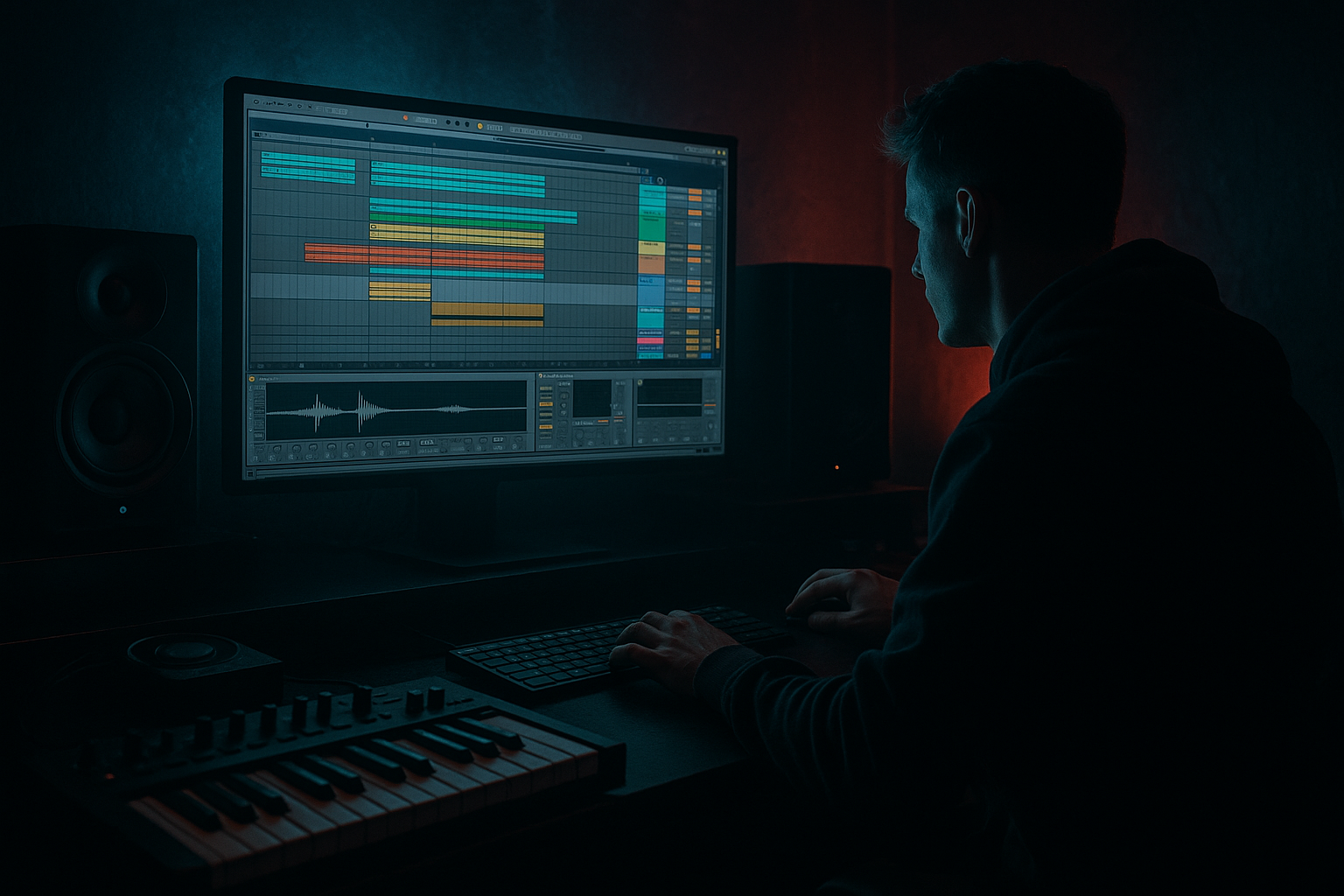
Main tutorial
Oldskool Rave Structure Templates (DnB) in Ableton Live — From Scratch with Clean Routing 🔊
1) Lesson overview
In this lesson you’ll build two reliable “oldskool rave” arrangement templates for drum & bass/jungle inside Ableton Live, starting from an empty set.
You’ll learn:
- How to set up clean routing (Drum Bus, Bass Bus, Music Bus, FX Bus, Master)
- A classic 90s rave DnB structure (intro → tease → drop → breakdown → 2nd drop → outro)
- Practical Ableton stock devices for control and vibe (Utility, EQ Eight, Glue Compressor, Saturator, Reverb, Delay, Auto Filter)
- A workflow that keeps your project organized, loud, and mix-ready ✅
- 32-bar DJ-friendly intro
- 16-bar tease/build
- 64-bar main drop
- 16–32-bar breakdown (pads/vocal stab)
- 64-bar second drop (heavier variation)
- 16–32-bar outro
- faster entry with breaks and edits
- more frequent 8/16-bar switches and fills
- classic “call & response” between breaks and bass
- Kick
- Snare/Clap
- Hats/Top loop
- Break (Amen/Think loop)
- Perc/Fills
- Sub
- Reese/Mid Bass
- Rave stab (chords)
- Pads/atmos
- Lead/hook
- Risers/impacts
- Vox shots / samples
- Reverb (stock)
- EQ Eight after Reverb
- Reverb
- Optional: Saturator (Soft Clip on)
- Delay (or Echo if you prefer)
- Utility: Width 120–160% (keep delay wide)
- Drum Buss
- Glue Compressor
- Blend with send amount (don’t overdo)
- Use a clean punchy kick sample
- Devices:
- Classic rave snare is often bright + crunchy
- Devices:
- Use a hat loop or program 16ths
- Devices:
- Drop an Amen/Think break loop
- Warp mode: Complex Pro (or Beats if you want crunchy transients)
- Devices:
- Instrument: Operator
- Devices:
- Instrument: Wavetable (or Operator with two detuned saws)
- Devices:
- Use a stab sample or create a chord stab in Simpler
- Devices:
- Analog or Wavetable pad
- Devices:
- Keep these on the FX group
- Use Delay throws (Return C) to create classic “space” moments
- Bars 1–9:
- Bars 9–17:
- Bars 17–33:
- Break track EQ Eight high-pass opens slowly (e.g. 250 Hz → 120 Hz)
- Return B (Hall) send on the stab increases toward bar 33
- Add sub but filtered/low volume
- Reese appears in short phrases (call & response)
- Last 2 bars of tease: mute kick or do a 1-bar snare roll (simple, effective)
- Full kick + snare
- Break at full level (or alternating with tops)
- Sub + reese at full
- Every 8 bars, change ONE thing:
- Every 16 bars, add a more noticeable variation:
- Remove kick + sub
- Leave: pads, rave stab, vocal, filtered break
- Auto Filter on the whole DRUMS group: sweep down to reduce energy
- Big reverb throw on a vocal stab (Return B + C)
- Snare roll or break edits increase density
- Reese filter opens
- Add a riser
- Duplicate snare hits, then:
- Add a little send to Return A (room) and automate it up slightly
- Swap bass patch (or change filter/resonance)
- Add extra break chops
- Add a “dark” stab variation
- First 16 bars: “drop 1 but tighter”
- Next 16: add new bass phrase
- Next 16: add extra break edits
- Last 16: strip back for DJ mix-out (remove a layer)
- Remove reese, then sub
- Keep drums and a filtered break for DJs
- Reduce effects gradually
- On break clip → right-click → Slice to New MIDI Track
- Individual tracks peaking around -12 to -6 dB
- Groups peaking around -6 dB
- Master not slamming while arranging (leave headroom)
- Make Drop 2 darker, not just louder:
- Parallel crush the breaks, not the whole mix:
- Use “negative space” for weight:
- Pitch-stretch a stab down for menace:
- Tight sidechain = cleaner heaviness:
- You built clean, scalable routing: Groups + Returns + simple Master
- You learned two classic oldskool rave DnB templates:
- You used stock Ableton tools to stay organized and punchy:
- Your next step is to swap sounds, keep the structure, and practice variation every 8/16 bars.
Skill level: Beginner (but the routing is “pro mindset”)
---
2) What you will build
You’ll create:
A) Template 1 — “Classic Rave Roller” (≈ 5:00–6:00)
B) Template 2 — “Jungle Chop & Switch” (≈ 4:30–5:30)
Both templates are built on clean busses + sends so you can swap sounds later without rewriting your mix.
---
3) Step-by-step walkthrough
Step 0 — Start clean: tempo, grid, and project defaults
1. Create a new Live Set
2. Set tempo:
- Roller DnB: 172–174 BPM
- Jungle: 165–172 BPM
3. Set time signature 4/4
4. Turn on the Arrangement grid:
- Right-click timeline → Fixed Grid
- Use 1 Bar for big moves, 1/16 for edits
Tip: Oldskool rave arrangements love clear 8/16/32 bar blocks.
---
Step 1 — Build clean routing (groups, returns, and master chain)
1A) Create track groups (busses)
Create these tracks, then Group them (Cmd/Ctrl+G):
DRUMS (Group)
BASS (Group)
MUSIC (Group)
FX (Group)
Why this matters: You’ll mix fast by shaping groups, not 50 individual tracks.
---
1B) Create Return tracks (Send FX)
Make Return A–D:
A — Short Room / Drum Space
- Decay: 0.6–1.0s
- Pre-delay: 10–20ms
- Low Cut: 250–400 Hz
- High Cut: 8–12 kHz
- Cut lows below 250–400 Hz (keep it clean)
B — Rave Hall (Bigger)
- Decay: 2.5–4.5s
- Pre-delay: 20–35ms
- Low Cut: 300–600 Hz
C — Delay Throw
- Sync: 1/4 or 1/8 dotted
- Feedback: 25–45%
- Filter: roll off lows below 300 Hz
D — Parallel Drum Crush
- Drive: 5–20
- Boom: 0–10 (careful)
- Attack: 3 ms
- Release: Auto
- Ratio: 4:1
- Aim: -3 to -8 dB gain reduction
---
1C) Master chain (simple + safe)
Keep this minimal while arranging:
1. EQ Eight
- Optional gentle low cut at 20–30 Hz (very mild)
2. Glue Compressor (light glue)
- Attack: 10 ms
- Release: Auto
- Ratio: 2:1
- Gain reduction: 1–2 dB
3. Limiter
- Ceiling: -1.0 dB
- Don’t push loud yet—just prevent surprises.
✅ You now have clean routing that won’t fall apart later.
---
Step 2 — Load core DnB elements (starter sound sources)
You can use your own samples, but here’s a stock-friendly setup.
2A) Drums: build the engine
Kick track
- EQ Eight: cut mud around 200–400 Hz if needed
- Saturator: Drive 1–4 dB, Soft Clip On
Snare/Clap track
- EQ Eight: boost 180–220 Hz (body) and 4–7 kHz (crack) lightly
- Drum Buss: Drive 3–10
Hats/Top loop track
- Auto Filter: high-pass around 200–400 Hz
- Send a bit to Return A (room)
Break track (key for oldskool!)
- EQ Eight: high-pass 80–120 Hz (let kick/sub handle lows)
- Redux (optional): tiny bit for grit (very subtle!)
- Send to Return D for parallel crush
---
2B) Bass: sub + reese split (clean and controllable)
Sub track
- Osc A: Sine
- Envelope: short-ish release (80–150 ms) to avoid clicks
- EQ Eight: low-pass around 80–120 Hz (keep it pure)
- Utility: Width 0% (mono sub!)
- Compressor (sidechain from kick): start with
- Ratio 4:1
- Attack 3–10 ms
- Release 80–150 ms
- Adjust threshold until kick punches through
Reese/Mid Bass track
- Two saws slightly detuned
- Add a little unison (careful—too wide can wreck mono)
- Auto Filter: map cutoff for movement (LFO optional)
- Saturator: Drive 3–8 dB
- EQ Eight: high-pass around 90–130 Hz (avoid fighting sub)
- Optional: Chorus-Ensemble (subtle) for width
---
2C) Music: rave stabs + atmos
Rave stab track
- EQ Eight: high-pass 200–400 Hz
- Auto Filter: automate cutoff for build energy
- Send to Return B (hall) + tiny delay throw (Return C)
Pad/Atmos
- Reverb (Return B or insert)
- Auto Pan slow for movement
Vox shots / oldskool one-liners
---
Step 3 — Create two arrangement templates (bar-by-bar)
Global rule: build in 16/32 bar blocks 🧱
In Arrangement View, set locators. Use Cmd/Ctrl+I to insert time if needed.
---
Template 1: “Classic Rave Roller” (recommended starter)
Target length: ~5:30
Section map (with bar counts)
1. Intro — 32 bars
2. Drum + Bass tease — 16 bars
3. Drop 1 — 64 bars
4. Breakdown — 16–32 bars
5. Build — 16 bars
6. Drop 2 — 64 bars
7. Outro — 16–32 bars
---
3A) Intro (Bars 1–33): DJ-friendly, no heavy bass
Goal: establish tempo + vibe without stealing headroom.
- Atmos/pad + filtered break (high-passed)
- Add a single hat loop
- Bring in snare on 2 & 4 (or clap)
- Add small FX risers
- Introduce the break louder
- Tease rave stab quietly (1 hit every 4 or 8 bars)
Automation ideas:
---
3B) Tease (Bars 33–49): introduce bass movement, still controlled
Classic trick:
---
3C) Drop 1 (Bars 49–113): full roller energy
Bring in:
Make it roll (beginner-friendly arrangement moves):
- Add a hat layer
- Remove the break for 1 bar (mini-dropout)
- Add a crash
- Add a short vocal shot
- Reese pattern changes
- Extra percussion fill
- Stab phrase changes
Ableton workflow tip:
Duplicate the first 16 bars of the drop across the full 64, then add changes using mute automation and clip duplication.
---
3D) Breakdown (Bars 113–145): tension + space
Go-to devices:
---
3E) Build (Bars 145–161): simple but hype
Easy snare roll method:
- 1/4 notes → 1/8 → 1/16 in the last 4 bars
---
3F) Drop 2 (Bars 161–225): same theme, heavier variation
Keep it familiar, but upgrade:
Arrangement formula:
---
3G) Outro (Bars 225–end): mix-out clean
---
Template 2: “Jungle Chop & Switch”
Target: ~5:00, more edits, more attitude.
Sections
1. Intro (16–32 bars): breaks + atmos, quick entry
2. Drop A (32 bars): main chop groove
3. Switch/bridge (8–16 bars): half-time feel or stab-only moment
4. Drop B (32–64 bars): new break pattern / bass variation
5. Breakdown (16 bars): classic vocal + pad + filtered drums
6. Final drop (32 bars): hardest version
7. Outro (16 bars)
Key jungle move:
Use 1-bar and 2-bar break edits. Even one reversed hit or re-triggered snare makes it feel authentic.
Ableton tool for quick chops:
- Choose Transient or 1/8
- Then rearrange slices in MIDI (super fast, very “jungle”)
---
Step 4 — Clean routing: gain staging + group processing (simple rules)
4A) Keep levels sensible
4B) Group chains (starter presets)
DRUMS Group chain:
1. EQ Eight
- Gentle cut if muddy around 250–350 Hz
2. Glue Compressor
- Attack 10 ms, Release Auto, Ratio 2:1
- 1–3 dB reduction
3. Drum Buss (optional)
- Drive 2–6, Transients slightly up/down to taste
BASS Group chain:
1. EQ Eight
- Optional dip around 200–400 Hz if boxy
2. Saturator (light)
3. Compressor (optional gentle glue)
MUSIC Group chain:
1. EQ Eight high-pass 120–200 Hz
2. Utility (widen slightly if needed, but keep bass mono)
---
4) Common mistakes (and how to fix them)
1. Everything hits at once in the intro
- Fix: intros should hint, not fully drop. Save sub + full drums for the drop.
2. No 8/16 bar variation
- Fix: schedule changes. Even one mute or fill every 8 bars keeps momentum.
3. Sub is wide / reese fights sub
- Fix: Sub in mono (Utility Width 0%). High-pass reese at 90–130 Hz.
4. Over-reverb on drums
- Fix: keep drums mostly in short room (Return A). Save big hall for stabs/vocals.
5. Break loop is muddy and eats headroom
- Fix: high-pass break at 80–120 Hz, let kick + sub own the low end.
---
5) Pro tips for darker/heavier DnB 🖤
automate Auto Filter to open less, add distortion, and reduce “happy” high mids.
Use Return D on the break track more than on kick/snare. That gritty break energy is the vibe.
Drop out the reese for 1 bar before a drop hit. Silence makes the impact feel bigger.
In Simpler, drop stabs -3 to -7 semitones, then tame harshness with EQ Eight.
Sidechain sub to kick gently so you can push bass without mud.
---
6) Mini practice exercise (20–30 minutes) 🎯
1. Set tempo to 174 BPM
2. Create the routing:
- DRUMS/BASS/MUSIC/FX groups + Returns A–D
3. Build a 64-bar loop that includes:
- 16 bars intro
- 16 bars tease
- 32 bars drop
4. Requirements:
- Break loop chopped or filtered at least once
- Sub is mono
- One reverb throw (Return B or C) at the end of bar 16 or 32
- One 1-bar dropout right before the drop
When finished, export a quick MP3 and listen away from Ableton—does the drop feel like it “arrives”?
---
7) Recap ✅
- Roller: 32 intro → tease → 64 drop → breakdown → 64 drop → outro
- Jungle: more chops + switches for attitude
- EQ Eight, Utility, Glue Compressor, Drum Buss, Reverb, Delay/Echo, Auto Filter
If you want, tell me your preferred vibe (happy rave / dark techstep / jungle terror) and I’ll give you a ready-to-follow locator map + automation checklist for a full 5–6 minute arrangement.

