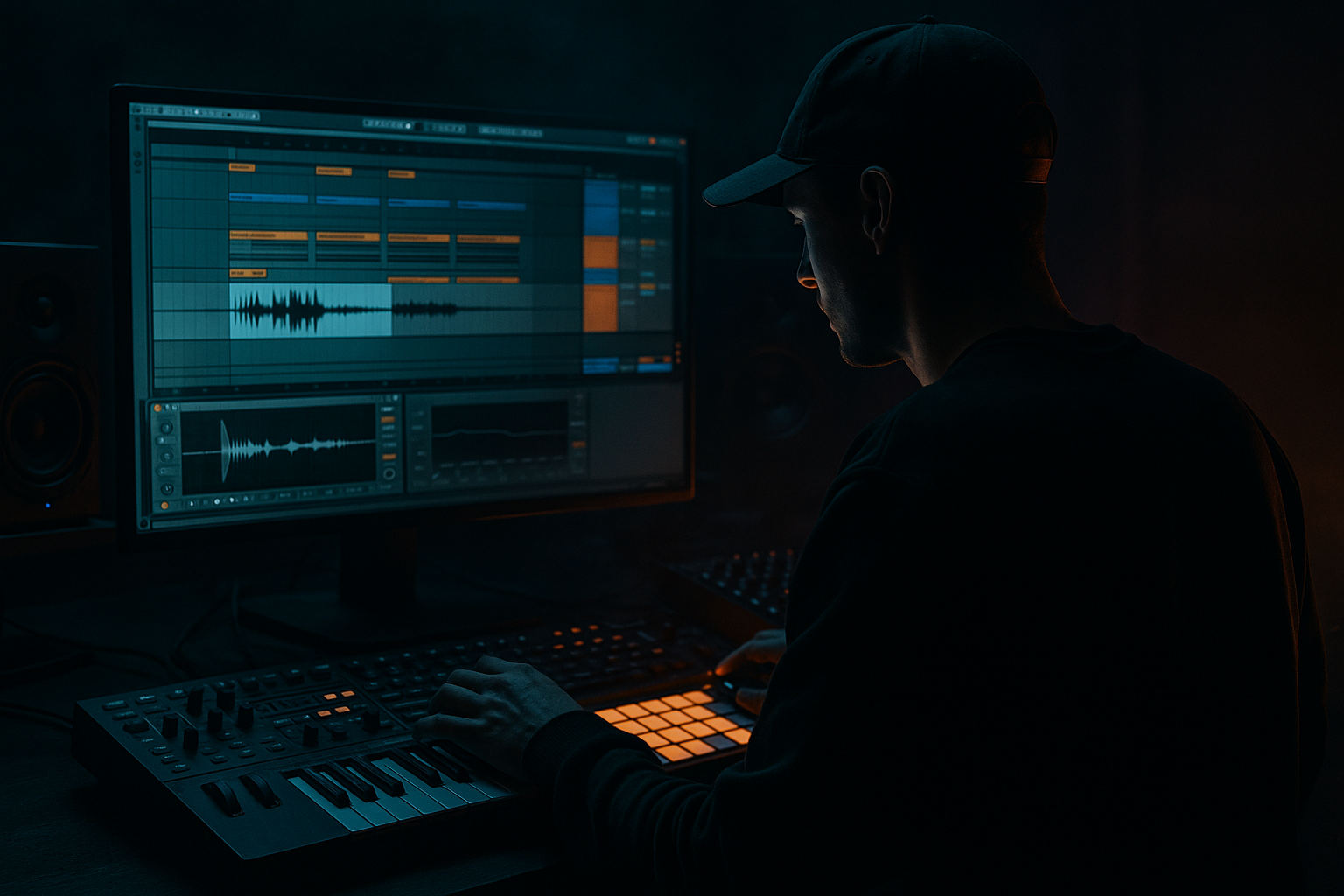
Main tutorial
```markdown
One-bar motif writing from scratch for smoky late-night moods (DnB in Ableton Live) 🌙
1) Lesson overview
In rolling drum & bass, a one-bar motif can carry the entire vibe: it’s the hook, the identity, the “late-night smoke” mood that keeps repeating while drums and bass evolve around it.
In this lesson you’ll write a fresh 1-bar motif from nothing, then make it loop-worthy and arrangement-ready in Ableton Live using mostly stock devices.
We’ll focus on:
- Writing a minimal, moody motif that loops without feeling static
- Choosing dark chord tones and rhythmic placements common in DnB/jungle
- Making it sound textured, nocturnal, and spacious without washing it out
- A simple instrument chain (stock Ableton) for smoky tone
- Micro-variation tools so it stays interesting across 32/64 bars
- A drop-ready arrangement approach: motif in intro → tease → full drop
- Use Drum Rack with a kick on 1, snare on 2 & 4 (half-time feel within 174), hats ticking 1/16.
- Root: F
- Minor 3rd: Ab
- 5th: C
- Minor 7th: Eb (instant late-night)
- 9th: G (adds haze without sounding happy)
- Strong anchors often land around:
- Notes on 1, 5, 7, 11, 14 (counting 1–16)
- Beat 1 (hit)
- Beat 2 “and” area (push)
- A syncopated mid-bar answer
- A late pickup into the loop
- Hit 1: Ab
- Hit 5: G (the 9th tension)
- Hit 7: F
- Hit 11: Eb
- Hit 14: F (resolve/pickup)
- First hit medium
- Second hit slightly quieter
- Third hit medium
- Fourth hit louder (answer)
- Last pickup softer
- Nudge velocities roughly: 70 / 55 / 72 / 85 / 50
- Use a simple sine/triangle carrier + subtle FM for grit.
- Operator presets can be a great starting point—just darken the filter and shorten the amp.
- HP filter around 120–200 Hz (leave room for sub/bass)
- Gentle dip around 300–500 Hz if boxy
- Tiny presence boost around 2–4 kHz if it’s getting lost (be careful)
- Mode: Analog Clip or Soft Sine
- Drive: 2–6 dB
- Turn on Soft Clip
- If it gets harsh, reduce highs with EQ after
- LP12 or LP24
- Cutoff: automate between 600 Hz → 2.5 kHz across phrases
- Add a touch of resonance for character
- Mode: Sync
- Time: 1/8 dotted or 1/4
- Feedback: 15–30%
- Filter inside Echo:
- Keep Dry/Wet 10–20% (DnB mixes hate messy echoes)
- Use Reverb or Hybrid Reverb
- Decay: 1.2–2.5 s
- Pre-delay: 10–25 ms
- Low Cut: 300–600 Hz
- High Cut: 5–8 kHz
- Dry/Wet: 6–15%
- Every 4th bar, shorten the last note (pickup) by 30–50%.
- Every 8th bar, hold the 4th note longer to “sigh.”
- Add a very quiet extra note (velocity 15–30) just before a main hit.
- Keep it on a scale tone (like G → Ab) to create a whispered lead-in.
- Automate filter cutoff to open slightly in bars 9–16.
- Automate Echo dry/wet up by 2–5% at phrase ends (bars 8, 16).
- Duplicate the motif every 8 bars and raise only the last note up an octave (tiny spotlight moment).
- Add Compressor on motif
- Sidechain from kick (and/or snare, depending on style)
- Ratio 2:1–4:1, fast attack, medium release
- Just 1–3 dB gain reduction to “tuck” it in the pocket
- Bars 1–8: motif filtered low (Auto Filter cutoff ~600–900 Hz)
- Bars 9–16: open filter slowly + introduce hats/foley
- Drop drums out for 1–2 bars
- Let motif echo trail (Echo feedback slightly up)
- Add a pitch drop or “tape stop” moment (optional)
- Full drums + bass
- Motif stays mostly consistent, but:
- Strip to motif + atmos
- Reintroduce with a slightly different filter position or timbre for freshness
- Too many notes. If it sounds like a lead melody in EDM, it’s probably too busy for a rolling, late-night DnB loop.
- Too much reverb/echo. You want smoke, not fog. Keep effects filtered and subtle.
- No rhythmic identity. A motif with no syncopation will feel flat next to DnB drums.
- Fighting the bass. Anything below ~150 Hz is sacred territory for the bass/sub in this genre.
- No variation across phrases. A perfect 1-bar loop still needs micro-changes to feel alive.
- Use the b2 or tritone carefully (like a hint of Gb in F minor) for menace—but as a passing tone, not a constant.
- Layer texture, not notes: Duplicate the motif track:
- Resample to audio and treat it like a sample:
- Slight detune + chorus sparingly: Try Chorus-Ensemble at very low wet for width, then mono-check.
- Mid/Side EQ discipline: Use EQ Eight (M/S mode) to keep sides airy but not harsh. Keep core motif intelligible in mono.
- A smoky late-night DnB motif is usually minimal, syncopated, and textured, not melodically busy.
- Start with rhythm, then pick notes from a minor/9th/7th palette for nocturnal emotion.
- Use stock Ableton tools to shape it: Wavetable/Operator, EQ Eight, Saturator, Auto Filter, Echo, Reverb.
- Make it loop for real by adding micro-variation every 4/8 bars.
- Always check it against bass + snare and keep the low end clean.
---
2) What you will build
A 1-bar motif (musical hook) that works in a late-night rolling DnB track, plus:
Target vibe references (conceptually): liquid-minimal rollers, deep jungle atmospheres, techy nocturnal DnB.
---
3) Step-by-step walkthrough
Step 0 — Session setup (so you write like a DnB producer) ⚙️
1. Set tempo: 172–176 BPM (try 174 BPM).
2. Create tracks:
- `DRUMS (placeholder)` (we’ll use a basic loop to write against)
- `BASS (placeholder)` (optional, just a sub note to check clashes)
- `MOTIF` (your main instrument)
3. Set grid to 1/16 and be ready to use triplets occasionally (DnB loves tension between straight and swung feels).
Quick writing trick: Throw a simple drum loop in right away so you compose rhythmically, not academically.
---
Step 1 — Choose a key + harmonic “smoke palette” 🎹
Smoky late-night usually lives in minor keys, often with Dorian/Aeolian flavors.
Pick: F minor (works great for subs and dark pads).
DnB-friendly note choices:
Rule of thumb: Use small melodic range (like within 5–7 semitones) to keep it hypnotic.
---
Step 2 — Start with rhythm first (the motif’s “footwork”) 🥁
Create a 1-bar MIDI clip on `MOTIF`. Loop it.
Classic rolling motif rhythm placements (1 bar in 4/4):
- 1.1.1 (beat 1)
- 1.2.3 or 1.2.4 (off-kilter push)
- 1.3.3 (syncopation)
- 1.4.2 (turnaround)
Try this 1-bar rhythm as a starting skeleton (16th-note grid):
That translates to:
✅ The goal: it should feel like it “pulls” forward without becoming a busy melody.
---
Step 3 — Choose a simple 2–4 note motif (less is more) 🎯
Now assign pitch to your rhythm using your smoke palette (F minor tones).
Example motif (super usable in rollers):
Keep most notes short (staccato-ish), but pick one note to hold slightly longer for emotion.
Velocity shape idea:
In Ableton MIDI editor:
This creates that “spoken” phrasing you hear in deeper DnB.
---
Step 4 — Pick the instrument: smoky but present 🎛️
You want something that cuts through drums/bass but stays nocturnal.
Option A (stock, fast): Wavetable
1. Load Wavetable on `MOTIF`.
2. Osc 1: Basic Shapes (sine/triangle-ish), position around triangle/square blend.
3. Osc 2: off (keep it simple).
4. Filter: LP24, cutoff around 600–1.5kHz, resonance 10–20%.
5. Amp Envelope:
- Attack: 5–15 ms (avoid clicks)
- Decay: 250–450 ms
- Sustain: 0–20%
- Release: 80–180 ms
6. Add a tiny bit of movement:
- LFO → Filter cutoff
- Rate: 1/8 or 1/16
- Amount: small (just a drift, not a wobble)
Option B (stock, mood-machine): Operator
---
Step 5 — Build the device chain (smoke = filtering + space + texture) 🌫️
Here’s a very practical chain that works in DnB:
1) EQ Eight (clean first)
2) Saturator (warmth)
3) Auto Filter (movement / “breathing”)
4) Echo (space, but controlled)
- Low cut: 300–600 Hz
- High cut: 4–7 kHz
5) Reverb (small, dark)
Important: If your motif gets washed out, reduce Reverb first, not the melody.
---
Step 6 — Make it loop for 32 bars without boredom (micro-variation) 🔁
A one-bar motif becomes professional when it evolves subtly.
Use any 2–3 of these:
A) Note-length variation
B) Ghost-note technique
C) Automation lanes (fast win)
D) Call-and-response by octave
---
Step 7 — Check against bass & drums (DnB reality check) ✅
Your motif must live around the bass and snare.
Quick checks:
1. Add a simple sub on `BASS` (Operator sine):
- Play F long notes (or your track’s root)
2. Make sure motif is high-passed enough (no fighting sub).
3. If motif clashes with snare crack (usually 2–5 kHz), notch with EQ Eight slightly around the snare’s bite.
Sidechain (optional but very DnB):
---
Step 8 — Arrangement ideas (how to deploy your 1-bar motif) 🧩
Here’s a simple, effective DnB rollout:
Intro (16 bars)
Build/tease (8 bars)
Drop (32 bars)
- Every 8 bars: one micro-variation (ghost note, octave pop, shorter last note)
- Phrase ends: slight reverb swell or echo lift
Break (16 bars)
---
4) Common mistakes 🚫
---
5) Pro tips for darker/heavier DnB 🖤
- Layer A: clean, dry, present
- Layer B: heavily filtered + reverb, low in the mix (atmos tail)
- Flatten → slice tiny bits → re-arrange micro-stutters at phrase ends (very jungle-friendly).
---
6) Mini practice exercise 🎯
Do this in 20 minutes:
1. Pick a key: F minor or G minor.
2. Write three different 1-bar motifs using only 4 notes max each.
3. For each motif:
- Use one syncopation pattern (different each time)
- Add the same device chain: EQ Eight → Saturator → Echo → Reverb
4. Choose the best one and make a 16-bar phrase:
- Bars 1–8: darker (lower filter cutoff)
- Bars 9–16: slightly brighter + tiny echo lift at bar 16
Deliverable: export a 16-bar loop with drums + motif (bass optional).
---
7) Recap ✅
If you want, tell me your preferred sub style (liquid roller vs techstep vs jungle) and I’ll give you 2–3 motif MIDI patterns tailored to that vibe.
```

