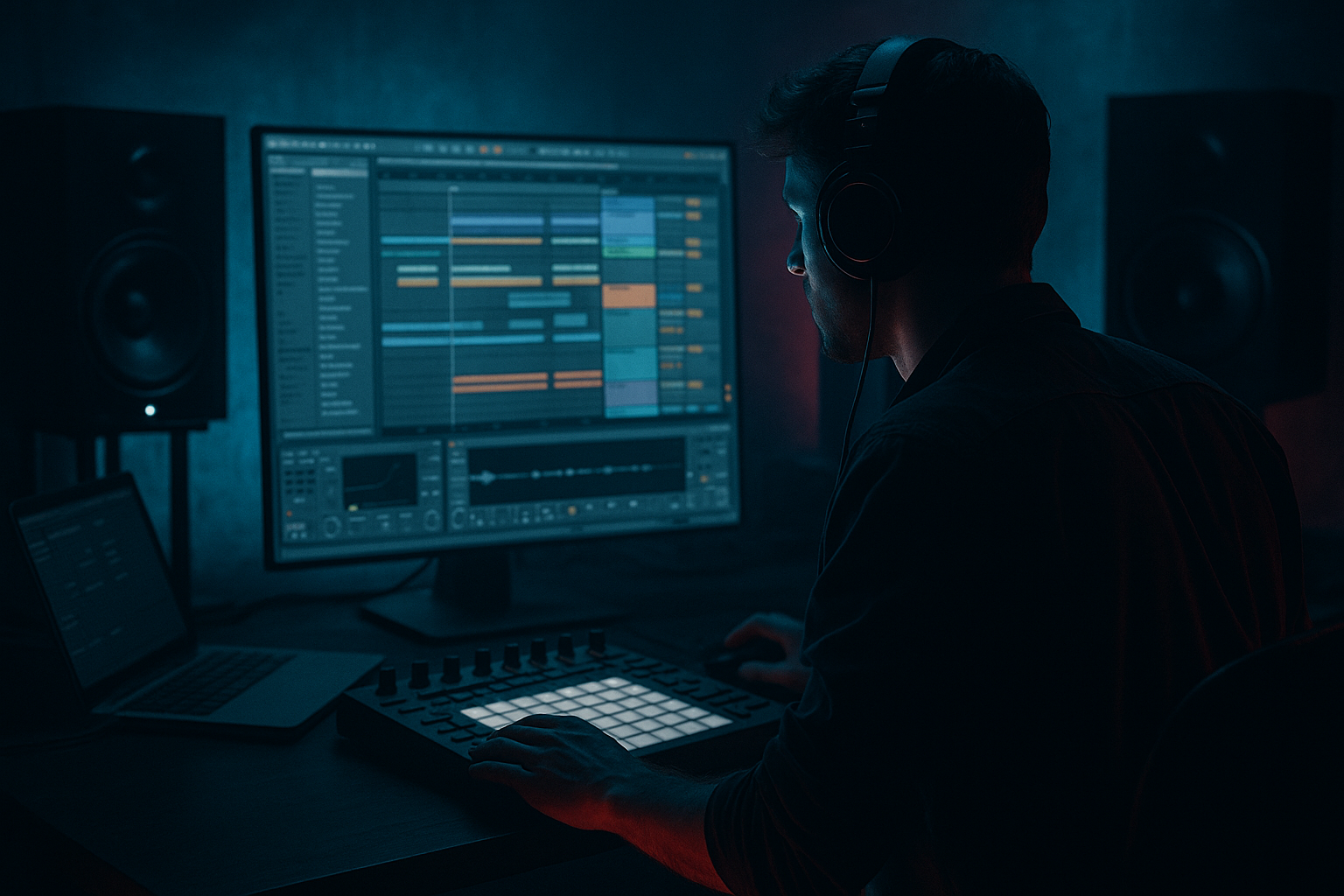
Main tutorial
```markdown
One-Hour Workflow Drills for Break Chopping (DnB in Ableton Live) 🥁⚡
1) Lesson overview
This lesson is a repeatable 60-minute drill designed to make you fast at chopping breaks for drum & bass / jungle / rolling music in Ableton Live. The goal isn’t “perfect sound design”—it’s speed + decision-making: clean slicing, quick groove, clean phase/warp, and arrangement-ready edits.
By the end, you’ll be able to:
- Pull a break in, warp it correctly, and slice it musically
- Build 2–3 variation patterns fast
- Create a DnB-ready break bus chain using stock devices
- Arrange a 16–32 bar drum section with fills and transitions
- A primary chopped break groove (2 bars)
- Two variation clips (ghost notes, switch hits, micro-edits)
- A simple drum arrangement (Intro → Drop → Fill → Switch)
- A Break Bus with glue, saturation, EQ, transient shaping, and optional reverb sends
- Jungle edge (choppy, syncopated, lots of variation)
- Rolling DnB (consistent kick/snare anchors, controlled ghost notes)
- Dark/heavy (crunch + weight, but still punchy and not smeared)
- Device: Reverb (stock)
- Decay Time: 0.35–0.60s
- Size: 15–25%
- Pre-Delay: 8–20ms
- High Cut: 6–9 kHz
- Low Cut: 200–400 Hz
- Keep it subtle—this is glue, not wash.
- Sync: On
- Time: 1/8 or 1/16
- Feedback: 10–25%
- Filter: HP around 300 Hz, LP around 6–8 kHz
- A Drum Rack with each chop on a pad
- A MIDI clip you can edit for patterns
- Open the Drum Rack
- Find the key slices: Kick, Snare, Hat, Ghost notes
- Rename key pads (Kick/Snare/Hat) to stay organized
- If there are too many micro-slices, consider re-slicing:
- Nudge a few ghost hits late by 5–12 ms for swing (don’t quantize everything).
- In Live: select notes → Note Nudge (bottom panel) or use Groove Pool (see below).
- Drag in a groove like Swing 16-XX or MPC-style groove
- Apply at 10–25%
- Commit only if it helps; otherwise keep it loose manually.
- `A – Core`
- `B – Ghost + Stutter`
- `C – Fill`
- Add 1–2 extra ghost notes just before snare hits (like 1/16 before 2)
- Add a short stutter using a hat slice: three 1/32 hits right before a snare (sparingly)
- Replace the last 1/2 bar with busier slicing:
- Add a quick turnaround: snare flam (two snare slices 10–25 ms apart)
- Start around -20 to -12 dB send
- Last bar: automate Reverb send up on a snare hit, then hard cut back dry on the downbeat.
- Warping the kick instead of the snare:
- Too many slices = no control:
- Over-quantizing everything:
- Break bus chain making it smaller:
- Low end fighting your bass:
- Parallel dirt without losing punch:
- Pitch a few slices down for menace:
- Make ghosts scarier, not louder:
- Tighter, weightier snare:
- Darkness lives in the mids, not the sub:
- No new samples after slicing.
- Only stock devices.
- Timer on. Commit decisions.
- Snares locked?
- Kick/snare punch preserved?
- Variation every 2–4 bars?
- Does it roll at 174?
> Suggested tempo: 172–176 BPM
> Timebox: 60 minutes total (set a timer ⏱️)
---
2) What you will build
In one hour you’ll create:
Style targets:
---
3) Step-by-step walkthrough
0:00–0:05 — Session setup (fast and repeatable) 🧱
1. Set tempo: 174 BPM.
2. Create tracks:
- `BREAK (Audio)`
- `BREAK BUS (Audio)` (group later)
- Optional: `KICK (Audio)`, `SNARE (Audio)` for layering
3. Create return tracks:
- A – Short Room (Reverb)
- B – Delay (Echo)
Return A (Reverb) quick settings:
Return B (Echo) quick settings:
---
0:05–0:15 — Import + warp correctly (the “don’t skip” phase) 🎯
1. Drag in a classic break (e.g., Amen, Think, Hot Pants, or any break sample pack).
2. In Clip View:
- Turn Warp ON
- Set Seg. BPM close to the sample’s original if known (optional)
3. Find the real “1” transient (usually the first kick). Set it as:
- Right-click transient → Set 1.1.1 Here
4. Warp mode:
- For full breaks: Beats
- Preserve: Transients
- Envelope: start around 30–60
- If it gets clicky, raise envelope slightly.
Quick warp check: Loop 1 bar and make sure the snare lands consistently on 2 and 4 (or the break’s intended backbeat). If the snare drifts, add a warp marker at each snare and nudge.
> Rule: Warp the snares first. If snares are locked, everything else can be sliced confidently.
---
0:15–0:25 — Slice to MIDI (your main chopping workflow) ✂️
We’ll do this in a way that gives you maximum speed and control.
1. Right-click the audio clip → Slice to New MIDI Track
2. Settings:
- Slice by: Transient
- Create one slice per: Transient
- Slicing preset: Built-in → Slice to Drum Rack
Now you’ve got:
Immediate cleanup (2 minutes):
- Slice by 1/16 if the break is consistent, or
- Keep Transients but delete useless pads later
---
0:25–0:35 — Build a rolling 2-bar core loop (DnB anchors) 🏎️
Goal: stable kick/snare anchors + break spice.
1. In the MIDI clip, set loop to 2 bars.
2. Establish anchors (typical DnB):
- Snare: on beat 2 and beat 4 (1.2 and 1.4, plus 2.2 and 2.4)
- Kick: start with 1.1 and add one more around 1.3 or 1.3.3 depending on vibe
3. Add hats/ghost notes:
- Use slices that have hat texture or shuffle
- Place a few offbeats (the “and” of the beat)
Timing trick (very DnB):
Groove Pool (fast win):
---
0:35–0:45 — Create 2 variation clips (fast, intentional variation) 🔁
Duplicate your 2-bar clip twice:
#### Variation B: Ghost + stutter
#### Variation C: Fill
- Take 4–8 slices and reorder them
> DnB/jungle energy comes from small changes every 2–4 bars, not random chaos every bar.
---
0:45–0:55 — Break Bus chain (stock devices that hit hard) 🔥
Group your break rack track(s): select → Cmd/Ctrl+G
Put these on the group (Break Bus):
1. EQ Eight
- HP filter: 24 dB/oct @ 25–40 Hz (remove sub rumble)
- Gentle cut: 200–350 Hz if boxy (1–3 dB)
- Optional: tiny lift 3–6 kHz if dull (+1 dB)
2. Drum Buss
- Drive: 5–15%
- Crunch: 0–10%
- Boom: 0–20% (be careful—can mess with kick/bass)
- Damp: to taste (often 20–40%)
3. Glue Compressor
- Attack: 3 ms
- Release: Auto (or 0.1–0.3s)
- Ratio: 2:1
- Aim: 1–3 dB gain reduction on peaks
- Optional: Soft Clip ON if you want extra density
4. Saturator
- Mode: Analog Clip
- Drive: 1–4 dB
- Soft Clip: ON
- Output: trim so level matches bypass
5. Transient control (choose one)
- Drum Buss (already helps)
- Or Compressor with fast attack/release to shape spiky hits
- Or EQ Eight dynamic moves using automation (manual but effective)
Send some to Reverb A for cohesion:
Keep low end out of the reverb via the reverb’s low cut.
---
0:55–1:00 — Micro arrangement (16–32 bars) 🧩
Arrange quickly—don’t overthink:
1. Bars 1–8 (Intro):
- High-pass the break bus (EQ Eight automation) from ~200 Hz down to ~40 Hz
- Bring in hats/texture first, then full break
2. Bars 9–24 (Drop / Main):
- Alternate clips: `A` for 2–4 bars, then `B`, then `A`, then `C` as fill
3. Bars 25–32 (Switch / Fill):
- Use `C` at bar 31–32
- Add 1-beat silence or tape-stop style edit (optional)
- Set up the next section
Classic DnB transition move:
---
4) Common mistakes (and how to fix them) 🛠️
Fix: lock snares first. The groove relies on consistent backbeat.
Fix: delete useless pads or re-slice by 1/16. Keep only the hits you’ll actually play.
Fix: nudge ghost notes, use Groove Pool lightly, keep anchors tight.
Fix: gain-stage. If Drum Buss + Saturator are both driven hard, you can flatten transients.
Fix: high-pass the break and let your dedicated kick/sub own 40–120 Hz.
---
5) Pro tips for darker/heavier DnB 😈
Create a return track “DIRT” with Saturator (Analog Clip) + Redux (very subtle) + EQ Eight (band-pass 200 Hz–6 kHz). Send break lightly.
In Drum Rack, transpose specific pads -1 to -3 semitones (often snares or tom-ish hits).
Low velocity + slight saturation + tiny room reverb = creepy movement without clutter.
Layer a clean snare under the break snare (separate track), then use the break for grit/top.
Add character around 300–1.5k (controlled), keep sub clean for club translation.
---
6) Mini practice exercise (15 minutes, repeat daily) 🧠
Do this drill 3–5 times a week:
1. Pick a random break.
2. 5 min: warp + slice to Drum Rack.
3. 5 min: build a 2-bar loop with anchors + 6–10 ghost hits.
4. 5 min: make 2 variations and a 16-bar arrangement.
Rules:
Score yourself (quick checklist):
---
7) Recap ✅
In one hour, your break-chop workflow is:
1. Set tempo + returns
2. Warp correctly (snare-first)
3. Slice to Drum Rack
4. Build a 2-bar core
5. Duplicate into variation clips
6. Break Bus processing (EQ → Drum Buss → Glue → Saturation)
7. Arrange 16–32 bars with fills + transitions
Repeat this drill until slicing feels automatic—speed is what unlocks creativity in DnB. Next step after this lesson: add kick/snare layering and bass-sidechain strategy to make the break sit perfectly in a full mix.
```

