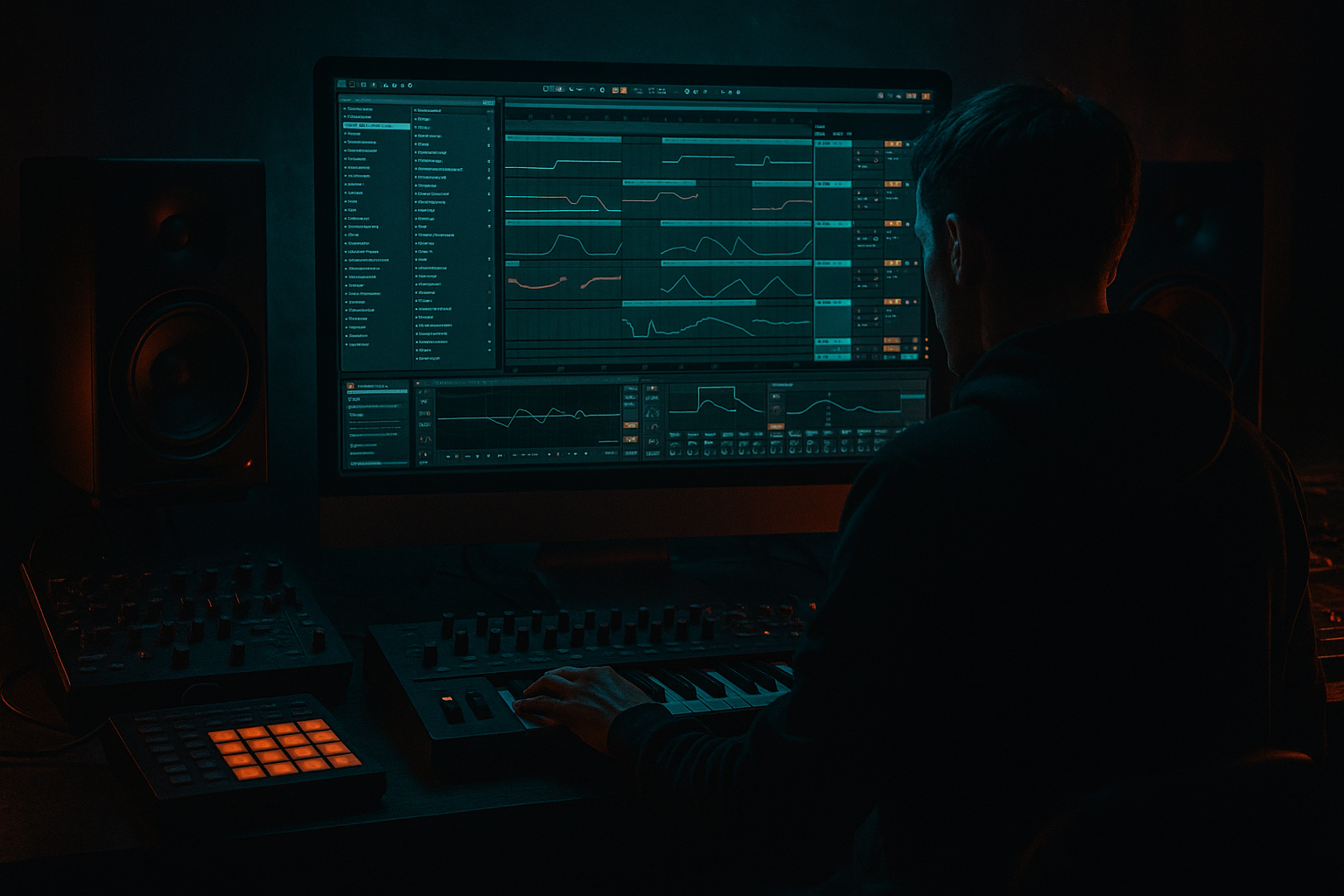
Main tutorial
```markdown
One-knob performance macros: for modern control with vintage tone (DnB in Ableton Live) 🎛️🔥
1. Lesson overview
In drum & bass, the difference between “static loop” and “rolling, alive record” is often movement—tiny changes in tone, space, and energy over time.
In this lesson you’ll build one-knob performance macros in Ableton Live that let you control multiple parameters at once (filter, drive, noise, reverb send, drum crunch, stereo width, etc.) while keeping the sound warm, gritty, and “vintage”—but with modern, performance-ready control.
We’ll do this using:
- Instrument/Drum Racks + Macros
- Macro Variations (Live 11/12)
- Automation + modulation-friendly routing
- Stock devices like Saturator, Echo, Auto Filter, Drum Buss, Redux, Roar (if you have Live 12 Suite), Utility, Glue Compressor
- Auto Filter Frequency
- Auto Filter Drive
- Saturator Drive
- Echo Dry/Wet
- Echo Noise (or Character amount)
- Utility Width (IMPORTANT: limit this)
- Split bass into SUB and MID layers (optional but very DnB):
- If you’re using a Drum Rack: great.
- If you have multiple drum tracks (kick/snare/hats/break), group them (Cmd/Ctrl+G) and do this on the DRUMS group.
- Chain 1: DRY
- Chain 2: CRUNCH (Parallel)
- CRUNCH chain volume
- Drum Buss Transients
- Drum Buss Drive
- Saturator Drive
- Return A (Room) Send for DRUMS group (yes, you can map sends!)
- Range: 100% → 120% (small movement only)
- Set knob positions and save variations like:
- 8-bar phrases are your friend.
- Try this for a roller:
- Make the macro darker, not just louder:
- Use subtle pitch/instability for vintage:
- Add “metal” without fizz:
- Automate macro differently for breaks vs. one-shots:
- If you have Live 12 Suite: Roar
- You built two DnB-focused one-knob macros:
- You learned how to:
- The result: modern performance control with vintage tone movement—perfect for rollers, jungle breaks, and heavy halftime moments 🎛️🥁
Skill level: Intermediate (you know racks, automation lanes, basic routing).
---
2. What you will build
You’ll create two one-knob macro systems ready for DnB:
1) Rolling Bass “Age/Heat” Macro
A single knob that morphs your bass from clean/subby to gritty, filtered, tape-ish, and wide—perfect for intros → drops → breakdowns.
2) Drum Bus “Jungle Smack” Macro
One knob that adds transient punch, crunch, room, and parallel glue—great for breaks, steppy drums, and fills.
You’ll also set up arrangement automation and performance workflows (Macro Variations, mapping ranges, and safe limits).
---
3. Step-by-step walkthrough
A) Set up your session (DnB-ready)
1. Set tempo to 172–176 BPM.
2. Create groups/tracks:
- BASS (MIDI track)
- DRUMS (Drum Rack or group)
- BREAK (audio loop, optional)
- FX RETURNS (Reverb + Delay)
3. On Returns (recommended starting point):
- Return A (Room): Hybrid Reverb
- Algorithm: Room
- Decay: 0.6–1.2s
- Low Cut: 250–400 Hz
- High Cut: 7–10 kHz
- Return B (Dub Echo): Echo
- Time: 1/8 dotted or 1/4
- Feedback: 25–45%
- Filter: HP around 200–400 Hz, LP around 6–9 kHz
This gives you a consistent “space” to macro-control later.
---
B) Build One-Knob Macro #1: Bass “Age/Heat” (modern control, vintage tone) 🧨
#### 1) Create the rack
1. On the BASS track, load your bass source:
- Wavetable (great for DnB), or Operator (classic), or a resampled bass audio.
2. Select the instrument + devices you’ll add next, then press Cmd/Ctrl+G to create an Instrument Rack.
3. Click Macro and rename Macro 1 = AGE/HEAT.
#### 2) Add the “vintage tone” device chain (inside the rack)
Recommended chain after your synth:
1) Auto Filter
- Type: LP24
- Frequency: start around 8–12 kHz (fairly open)
- Drive: 0 dB for now (we’ll macro it)
2) Saturator
- Type: Analog Clip
- Drive: start 2–4 dB
- Soft Clip: On
- Output: adjust to avoid clipping (we’ll keep it controlled)
3) Echo (for subtle tape movement, not obvious delay)
- Mode: Repitch or Noise (for character)
- Time: 1 ms to 12 ms range (short!)
- Feedback: 0–10%
- Dry/Wet: 0–12%
- Use Echo’s Wobble and Noise if available
4) Utility
- Width: start 0–30% (keep low-end mono!)
- Optional: Bass Mono (if using Live 12 Utility features) or just keep width controlled
5) EQ Eight (safety and polish)
- HP: 20–30 Hz
- Optional: small dip 200–400 Hz if mud builds
#### 3) Map parameters to the AGE/HEAT macro (the fun part)
Click Map in the rack, then map these to Macro 1:
- Map range: 12 kHz → 1.5 kHz
(As you turn up Age/Heat, the bass “darkens.”)
- Range: 0 → 8 dB
(Adds that driven filter vibe.)
- Range: 2 dB → 10 dB
(Keep it musical; avoid full destruction unless that’s the vibe.)
- Range: 0% → 10%
(Micro “tape smear” / thickness.)
- Range: 0% → 15%
(Old hardware vibe—subtle!)
- Range: 0% → 35%
(Adds width in the mids; keep the sub stable.)
Now exit Map mode.
#### 4) Add a “Sub Safety” workflow (DnB essential)
To keep the low-end consistent:
1. Duplicate chain within the rack (two chains: SUB and MID).
2. On SUB chain:
- EQ Eight: low-pass around 90–120 Hz
- Utility: Width 0%
- Minimal saturation
3. On MID chain:
- EQ Eight: high-pass 90–120 Hz
- All the Age/Heat character lives here
If you do this, map AGE/HEAT mostly to MID devices, not SUB.
---
C) Build One-Knob Macro #2: Drum Bus “Jungle Smack” 🥁⚡
#### 1) Create a Drum Rack or Drum Group
Add an Audio Effect Rack on the DRUMS group and rename Macro 1 = SMACK.
#### 2) Create 2 parallel chains inside the rack
In the rack, create:
DRY chain: leave mostly clean; maybe light glue.
CRUNCH chain (this is where the one-knob magic happens):
1) Drum Buss
- Drive: start 0–5
- Crunch: start 0–20
- Boom: Off (or tuned carefully—DnB kicks can get messy fast)
- Transients: start 0
2) Saturator
- Type: Soft Sine or Analog Clip
- Drive: start 3–8 dB
- Soft Clip: On
3) Glue Compressor
- Attack: 3 ms
- Release: Auto or 0.1–0.3s
- Ratio: 2:1 or 4:1
- Aim for 1–3 dB GR on the crunch chain
- Soft Clip: On (optional)
4) EQ Eight (shape the parallel)
- High-pass: 120–200 Hz (keeps low end from exploding)
- Slight lift: 3–6 kHz if you want more snap
#### 3) Map the SMACK macro
Map these to Macro 1:
- Range: -inf → -10 dB
(Macro increases parallel blend as it turns up.)
- Range: 0 → +25
(More snap.)
- Range: 0 → 15
- Range: 3 dB → 12 dB
- Range: 0% → 18%
(Adds “in a room” vibe as it gets more savage.)
Optional: Map a Utility Width on the CRUNCH chain:
---
D) Use Macro Variations + Automation like a pro (arrangement control) 🎚️🧠
#### 1) Create Macro Variations (Live 11/12)
On each rack:
- Bass Rack:
- Variation 1: Clean/Sub Focus (AGE/HEAT ~ 10–20%)
- Variation 2: Roller Warm (AGE/HEAT ~ 35–55%)
- Variation 3: Dark Tech (AGE/HEAT ~ 65–80%)
- Variation 4: End-of-phrase Burn (AGE/HEAT ~ 90–100%)
- Drum Rack:
- Variation 1: Tight (SMACK ~ 10–20%)
- Variation 2: Main Drop (SMACK ~ 35–55%)
- Variation 3: Break Abuse (SMACK ~ 70–85%)
Then automate Variation changes or automate the macro itself depending on your workflow.
#### 2) Arrangement automation (DnB phrasing suggestions)
In Arrangement View:
- Bars 1–8 (intro): AGE/HEAT slowly rises 15% → 40%
- Bars 9–16 (pre-drop tension): AGE/HEAT 40% → 70%, then dip right before drop
- Drop: keep AGE/HEAT around 45–60%, push to 75% at the end of every 8 bars
- Drums: SMACK at 35–55% during drop, and spike to 70% on fills (last 1/2 bar)
Automation move that always works:
At the end of an 8 or 16, do a quick +10–20% macro spike for 1 beat, then snap back. Instant “engine rev” energy.
---
4. Common mistakes
1. Mapping too much range
If your macro goes from “nice” to “broken” too quickly, shrink ranges. One-knob control should feel playable.
2. Widening the sub
Keep sub information mono. Use width on mids only, or cap Utility width to ~35% on bass.
3. Over-saturating without gain staging
Use device output trims and watch meters. Saturation sounds best when you’re not accidentally clipping everywhere.
4. Parallel chain low-end build-up
On CRUNCH chains, high-pass aggressively (120–200 Hz) to avoid flabby kicks and smeared subs.
5. Reverb on drums gets muddy fast
High-pass your reverb return and keep decay short for DnB.
---
5. Pro tips for darker/heavier DnB 🕶️
Map filter frequency down + drive up together. Dark rollers feel heavier without needing more volume.
On bass, a tiny bit of Echo wobble/noise or Chorus-Ensemble (very low mix) adds “old gear” life.
Use Saturator (Analog Clip) + EQ Eight low-pass around 8–12 kHz after distortion to avoid harsh top.
Breakbeats love SMACK spikes on fills; steppy drums often prefer steadier settings with occasional accents.
Roar is insane for heavy DnB. Put it on the MID bass chain and map:
- Drive low → medium
- Tone tilt neutral → darker
- Mix 0 → 25%
Keep it restrained for “vintage weight,” not constant destruction.
---
6. Mini practice exercise (15–20 minutes) ⏱️
1. Take a simple 2-bar roller:
- Kick on 1
- Snare on 2 and 4
- Hats shuffling 1/16 with swing
- Basic reese or wobble bass pattern
2. Build the AGE/HEAT rack and map the macro as above.
3. Build the SMACK rack on drums.
4. In Arrangement View, write a 32-bar sketch:
- Bars 1–8: intro (low SMACK, low AGE/HEAT)
- Bars 9–16: tension (increase AGE/HEAT steadily; tiny SMACK bumps)
- Bars 17–32: drop (SMACK mid-high; AGE/HEAT stable with end-of-phrase spikes)
5. Record yourself “performing” the two knobs:
- Arm automation recording
- Hit play and move AGE/HEAT and SMACK like you’re DJing energy
Goal: one pass should already feel like a living track.
---
7. Recap
- AGE/HEAT for bass: filter + drive + saturation + subtle tape smear + safe width
- SMACK for drums: parallel crunch + transient snap + glue + room send
- Map smart ranges for playable control
- Keep the sub stable and avoid muddy parallel lows
- Use Macro Variations and arrangement automation for 8/16-bar DnB phrasing
If you tell me what bass source you’re using (Wavetable/Operator/resample) and what sub range you like (45–55 Hz vs 55–65 Hz), I can suggest tighter mapping ranges for your exact vibe.
```

