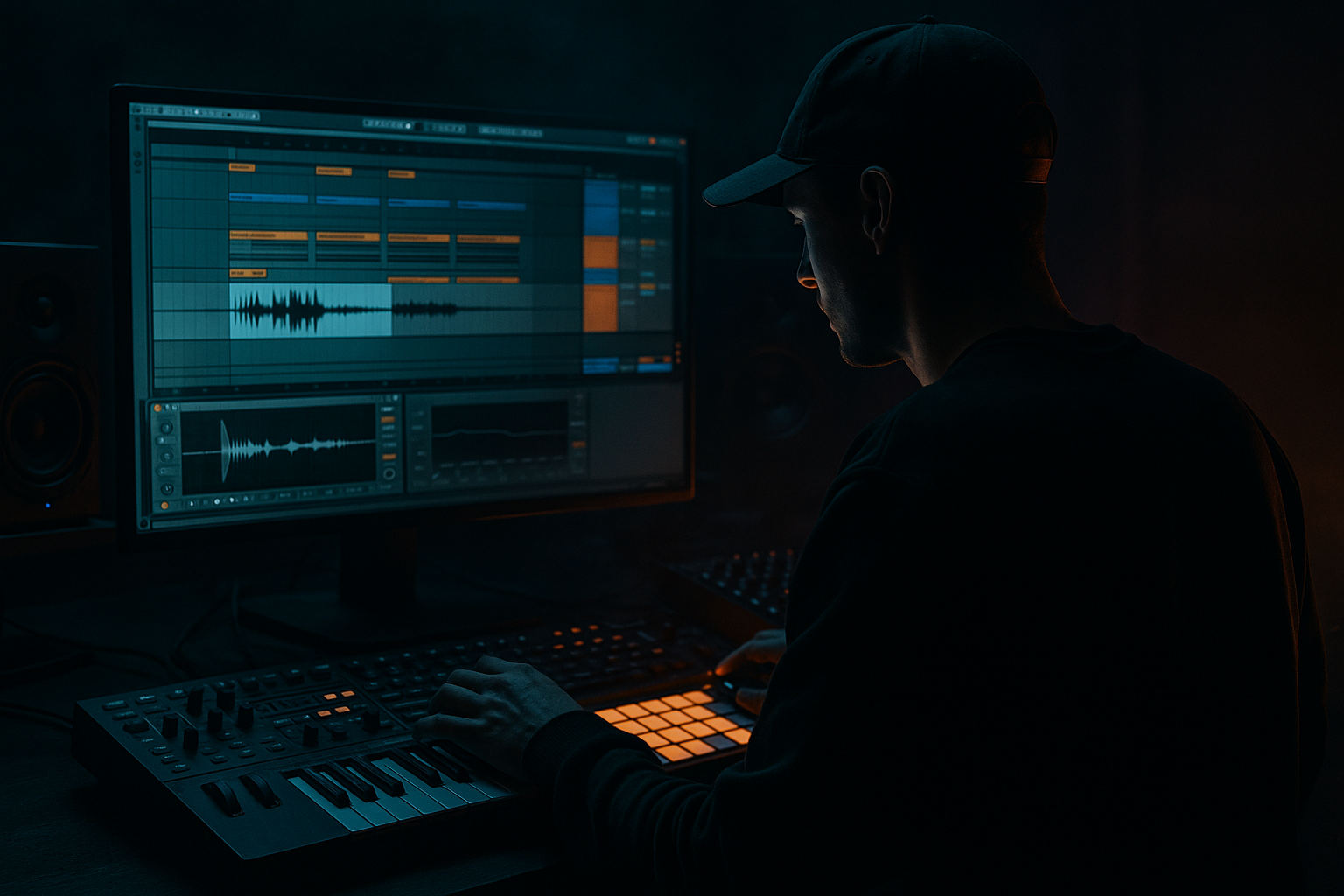
Main tutorial
One‑Note Bass Groove Writing for DJ‑Friendly DnB Sets (Ableton Live) 🎛️🔊
1) Lesson overview
One‑note basslines are a staple in rolling drum & bass and jungle because they lock with the drums, translate well on big systems, and are DJ‑friendly (easy to mix, predictable energy, minimal harmonic clashes).
In this lesson you’ll write groove + movement without changing pitch—using rhythm, envelopes, filtering, saturation, and call‑and‑response with the kick/snare.
Skill level: Intermediate
Goal: A clean, mixable, club‑ready one‑note bass groove with variation for 16/32‑bar DJ arrangements.
---
2) What you will build
You’ll build a two‑layer one‑note bass system in Ableton Live:
- Sub layer (mono, clean): pure low-end foundation (think 45–90 Hz).
- Mid layer (character, controlled): movement + grit that reads on smaller speakers.
- A one‑note MIDI groove that “rolls” with classic DnB swing.
- Automation + variations (every 8/16 bars) for DJ‑friendly arrangement.
- A simple “drop-ready” structure: 16‑bar intro → 32‑bar drop → 16‑bar breakdown/turnaround.
- Oscillator A: Sine
- Level: 0 dB (adjust later)
- Voices: 1 (mono behavior)
- Pitch: pick a note like F or G (DnB-friendly, but any key works)
- Attack: 0.5–2 ms
- Decay: 150–300 ms
- Sustain: -inf (or very low)
- Release: 40–90 ms
- Osc 1: Basic shapes (Square/Saw-ish). Try “Basic Shapes” wavetable.
- Position: around 30–60%
- Voices: 1 (keep it tight)
- Unison: OFF at first (you can add later subtly)
- Filter: LP24 or MS2 (for bite)
- Amp Env: slightly shorter than sub or similar
- Filter Env (Env 2) to drive groove:
- 1e: X
- 1a: X
- 2e: X
- 3: X
- 3a: X
- 4e: X
- Start around 1/16 to 1/8 lengths, but vary them:
- Accents: push velocity up on 3 and 3a.
- Ghosts: lower velocity on 1a and 4e.
- Mode: Comp
- Drive: adjust until accents pop but ghosts remain.
- Phase: 0°
- Shape: Saw Down (or custom if available)
- Rate: 1/4 (sync)
- Amount: 20–60%
- Offset: adjust so the dip hits exactly on the kick
- Start with MID muted or filtered down (Auto Filter cutoff ~200–400 Hz).
- Bring in SUB lightly after 8 bars or keep it minimal until the drop (depends on style).
- Use hats/percussion to build energy, not harmonic changes.
- Bars 1–8: main groove
- Bars 9–16: variation A
- Bars 17–24: variation B
- Bars 25–32: pre‑turn
- Remove SUB for 4–8 bars (or keep a very light sine).
- Use filtered MID + reverb throws on drums.
- Keep it easy for DJs to phrase mix (clear 8/16 bar blocks).
- Sub stability > everything: Keep SUB sine/triangle, minimal modulation.
- Use subtle pitch envelope on MID only (not changing notes, just transient thump):
- Resample for attitude:
- Parallel distortion (safe heaviness):
- Jungle-style swing:
- One‑note basslines work because rhythm + dynamics + timbre create movement without harmonic complexity.
- Build a two‑layer bass: clean mono SUB + controlled MID character.
- Write a syncopated 1‑bar groove, then evolve it over 32 bars using velocity mapping, filter automation, and small rhythmic variations.
- Keep it DJ‑friendly with clear 8/16‑bar phrasing and predictable low-end behavior.
You’ll also build:
---
3) Step‑by‑step walkthrough
Step 0 — Session setup (fast + DJ‑friendly) 🧭
1. Tempo: 172–176 BPM (start at 174).
2. Time signature: 4/4.
3. Arrangement markers (recommended):
- 1–17: Intro (DJ mix-in friendly)
- 17–49: Drop (32 bars)
- 49–65: Breakdown / Turnaround (16 bars)
4. Drum context (important): You need a basic DnB beat to write bass properly.
- Kick on 1 and (optionally) “and” of 2 (varies by style).
- Snare on 2 and 4.
- Hats/shuffles for momentum.
> If your drums aren’t in place yet, add a simple Drum Rack loop first—your bass groove will “answer” the drums.
---
Step 1 — Create the bass group + routing 🧱
1. Create two MIDI tracks:
- `BASS - SUB`
- `BASS - MID`
2. Group them: select both → Cmd/Ctrl+G → name group `BASS BUS`.
3. On `BASS BUS`, add a Spectrum device (Ableton stock) at the end for visual checking.
Why: Separation gives you club‑safe low end and flexible grit without compromising mono sub.
---
Step 2 — Build the SUB (clean, stable, mono) 🧊
On `BASS - SUB`, load Operator (stock) with this setup:
Operator settings
Amp envelope (tight but not clicky)
Add devices after Operator
1. Utility
- Width: 0% (mono)
- Gain: adjust later
2. EQ Eight
- HP filter OFF (don’t high-pass the sub unless you know why)
- Optional: gentle dip around 200–300 Hz if it gets boxy (often more relevant on the mid layer)
> The sub should be boring in solo. That’s a good sign.
---
Step 3 — Build the MID (movement + character) 🧨
On `BASS - MID`, use Wavetable (or Operator if you prefer). Here’s a reliable Wavetable chain:
Wavetable settings
Envelope
- Attack: 0 ms
- Decay: 120–250 ms
- Sustain: 0–20%
- Amount: small to medium (enough to “wobble” without turning into dubstep)
MID device chain (stock)
1. EQ Eight
- High-pass: 24 dB/oct at 120–180 Hz (so it doesn’t fight the sub)
2. Saturator
- Type: Analog Clip (or Soft Sine for smoother)
- Drive: 3–8 dB
- Soft Clip: ON
3. Auto Filter
- Mode: LP or BP
- Map cutoff to a Macro/automation for variations
4. Compressor (optional, not sidechain yet)
- Ratio: 2:1
- Attack: 10–30 ms
- Release: Auto or ~80–150 ms
> The mid layer creates the “rolling” perception even on one note—because your ear follows movement in harmonics, not pitch.
---
Step 4 — Write the one‑note groove (this is the core) 🥁🧠
Create a 1‑bar MIDI clip on both bass tracks (you can copy the same MIDI to both).
Choose your note: start with F1 (sub) / F2 (mid), but keep both playing the same pitch class (octaves are fine).
#### A) Start with a classic rolling rhythm (1 bar)
In 1/16 grid, try this note pattern (X = note on):
This creates forward motion without stepping on the snare (2 and 4).
Note length:
- Some short (tight “thup”)
- One or two longer (helps glue + sustain)
#### B) Add micro‑syncopation with velocity (big payoff)
Why: Velocity becomes tonal motion when mapped to filter/drive.
---
Step 5 — Make velocity do something (movement without new notes) 🎚️
In your MID layer instrument (Wavetable):
1. Use MIDI tab (or modulation matrix) to map:
- Velocity → Filter Cutoff (small amount)
- Optionally Velocity → Env amount or Osc position
In Operator (sub), avoid velocity changing pitch or timbre too much—keep sub consistent.
Ableton trick (stock):
Add MIDI Velocity device before Wavetable to shape dynamics:
---
Step 6 — Sidechain for DJ‑friendly punch (kick space) 🫧
You have two common options:
#### Option A: Classic Compressor sidechain (simple)
On both `BASS - SUB` and `BASS - MID`:
1. Add Compressor
2. Enable Sidechain
3. Audio From: Kick track (or Drum Buss group)
4. Settings starting point:
- Ratio: 4:1
- Attack: 2–10 ms
- Release: 60–140 ms (tune to groove)
- Threshold: aim for 2–6 dB gain reduction on each kick
#### Option B: Volume shaping (more consistent)
Use Auto Pan as a volume shaper:
> For clean DJ mixes, consistent low-end behavior matters. Don’t overpump unless you’re going for a very modern jump-up “bounce.”
---
Step 7 — Glue the bass as a unit (bus processing) 🧩
On `BASS BUS`, add:
1. EQ Eight (gentle)
- Optional: small wide cut around 250–400 Hz if muddy
- Optional: tiny lift around 800 Hz–1.5 kHz if you need presence (mostly mid layer)
2. Drum Buss (yes, on bass—carefully)
- Drive: 1–5
- Boom: OFF (usually)
- Crunch: 0–10%
- Trim to avoid clipping
3. Limiter (safety, not for loudness)
- Ceiling: -0.3 dB
- Make sure it’s barely working (1–2 dB max peaks)
---
Step 8 — DJ‑friendly arrangement moves (variation without changing note) 🧱🎚️
You want the bass to feel alive over 32 bars while staying mixable.
#### A) 16‑bar intro (mix-in)
#### B) Drop (32 bars)
- Add 1 extra 1/16 note before beat 4 (a “pickup”)
- Or increase filter env amount slightly on the MID
- Automate Saturator Drive +1–2 dB
- Slightly shorten a couple of note lengths (tighter roll)
- Brief 1‑beat bass mute before a snare hit
- Or high‑pass the MID more aggressively for 1 bar
#### C) Turnaround / breakdown (16 bars)
---
4) Common mistakes ❌
1. Sub isn’t mono
Fix: Utility width 0% on SUB. Avoid stereo effects on sub.
2. MID layer has too much low end
Fix: EQ Eight HP at 120–180 Hz on MID.
3. Groove fights the snare
Fix: avoid heavy bass hits exactly on 2 and 4 (unless stylistic). Let the snare own that space.
4. All notes same length + same velocity
Fix: vary lengths and velocities—this is how one note becomes a groove.
5. Over-saturating the bus
Fix: saturate MID more than SUB. Keep SUB clean or lightly clipped only.
6. Sidechain release not in time
Fix: adjust release so the bass “returns” in rhythm (often 80–130 ms at 174 BPM).
---
5) Pro tips for darker/heavier DnB 🕶️⚙️
- In Wavetable: tiny pitch env (like +3 to +12 semitones, decay 30–80 ms, very low amount) for a “knock.”
- Freeze/Flatten MID after a good pass, then process audio with Redux (tiny amounts), Saturator, and Auto Filter sweeps.
- Create return track “BASS GRIT,” add Saturator + EQ, send only MID to it.
- High-pass the return at 200–300 Hz so grit stays out of sub.
- Add Groove Pool swing lightly (try MPC-style grooves) but keep it subtle—too much will smear the kick/snare clarity.
---
6) Mini practice exercise 📝
Goal: Make 3 different one‑note bass grooves in 20 minutes.
1. Duplicate your 1‑bar bass MIDI clip to make Clip A, B, C.
2. Keep the same note (e.g., F).
3. For each clip:
- Change only rhythm + note length + velocity (no pitch changes).
- Make one clip sparser (half-time feel), one clip busier (more 1/16s), one clip with longer sustains.
4. Arrange:
- Clip A for bars 1–8
- Clip B for bars 9–16
- Clip C for bars 17–24
- Return to A with a filter lift for bars 25–32
5. Export a quick bounce and listen on:
- headphones
- small speaker/phone (mid layer check)
- if possible, a sub-capable system (sub consistency check)
---
7) Recap ✅
If you tell me what sub note/key you’re writing in (and whether you’re aiming for roller, minimal/techy, jungle, or jump-up), I can suggest a few specific 1‑bar groove patterns that match the vibe.

