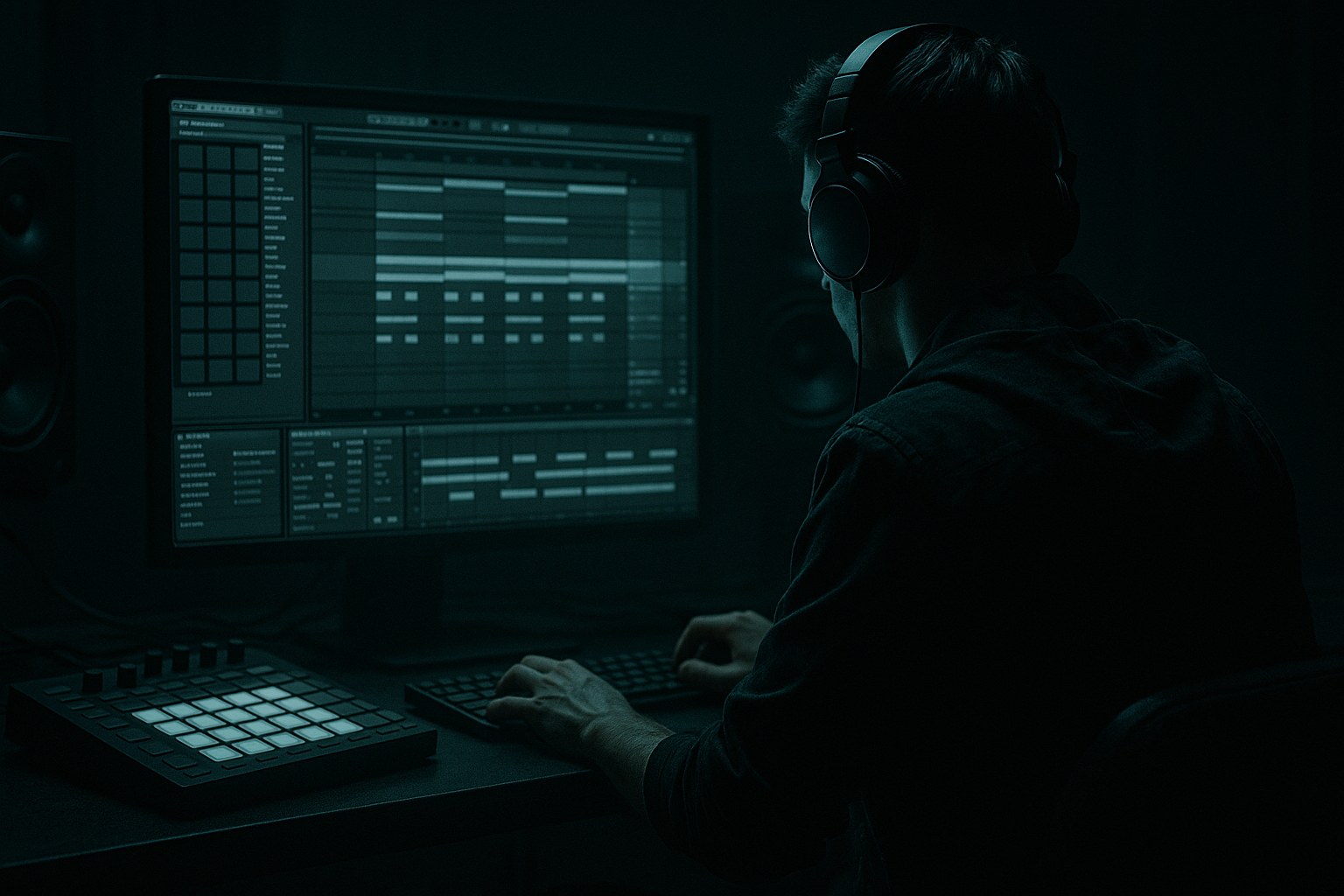
Main tutorial
One-shot Drum Sequencing for Drum & Bass in Ableton Live
Energetic, clear, practical — this lesson teaches you how to make tight one-shot drum patterns for drum & bass (174–176 BPM) using Ableton Live’s stock devices. We'll use Simpler/Drum Rack, MIDI programming, basic mixing, and arrangement ideas so your drums punch, roll, and cut through a heavy mix. 🎧🔥
---
1) Lesson overview
Goal: Learn how to create, sequence, shape, and process one-shot drum hits (kicks, snares, hats, percussion and chopped breaks) for DnB/jungle in Ableton Live using stock devices and practical workflows.
What you'll learn:
- Using Simpler and Drum Rack in One-Shot mode
- Chopping breaks with Slice to New MIDI Track
- Programming tight DnB patterns and rolls
- Layering and routing for punch and grit
- Bus processing and basic mixing for the drum buss
- Arrangement tips for intro/drop/variations
- A punchy kick + layered sub tail
- A snapping snare (with ghost hits and short reverb)
- Fast hi-hats and shuffled percussion
- Chopped break elements used as one-shot hits
- Drum Rack with return buses and a glue compressor on the drum bus
- Leaving Warp on for one-shot samples — causes smeared transients and pitch artifacts.
- Over-quantizing every sample — removes groove; use groove pool or small humanization.
- Using too long or too short release times (causing clicks or no tail).
- Not high-passing individual drum sounds — mud accumulates in 100–300 Hz.
- Stacking too many layers without EQ’ing — phase cancellation and boxy drums.
- Overcompressing drums on both pad-level and bus-level at high ratios — kills dynamics.
- Ignoring velocity: flat velocity = lifeless drums.
- Use Drum Rack + Simpler in One-Shot for tight one-shot sequencing. Disable Warp.
- Chop breaks with Slice to New MIDI Track for unique percussive material.
- Program DnB patterns with strong snares on 2 and 4, syncopated kicks, and fast hi-hats/ghosts.
- Layer snares, high-pass layers, use Saturator/Drum Buss for grit, and Glue Compressor for glue.
- For darker/heavier DnB: tune layers, use parallel distortion, multiband control, and pitch envelopes for dramatic rolls.
Requirements: Ableton Live (Live 10/11 recommended), Core Library with breakbeat samples (or any drum one-shots / breaks).
---
2) What you will build
A 8-bar drum loop tailored for drum & bass (174 BPM) that includes:
This loop will be arrangement-ready (intro → drop) and include two measured variations (fills and rolls).
---
3) Step-by-step walkthrough
A. Project setup
1. Set BPM to 174 (top-right of Ableton). Drum & bass generally sits 170–176. ⚡
2. Create a new MIDI track (Cmd/Ctrl+Shift+T). Name it “DRUM RACK – ONE SHOTS”.
B. Build the Drum Rack
1. Drag a Drum Rack onto the MIDI track.
2. Open Live’s browser → Packs/Core Library → Samples → Drum or Loops and locate:
- one-shot kick samples (or an isolated break with a kick)
- one-shot snares/claps
- hi-hats, percussion one-shots
- breakloops (Amen, Think-like) — use royalty-free or Live Core ones
3. Drag your one-shot samples into individual Drum Rack pads (C1, C#1, D1 etc.). Each pad will host a Simpler by default.
Tip: If Simpler didn’t auto-load, right-click pad → Insert Simpler.
C. Set Simpler to One-Shot mode and tune envelopes
1. Click a pad, open the Simpler device in the bottom panel.
2. Switch Simpler mode to “One-Shot”. This ensures the sample plays full-length regardless of note length.
3. For each pad (recommended settings):
- Kick: Attack 0 ms, Release 200–450 ms (longer to retain low tail), Warp OFF.
- Snare: Attack 0–3 ms, Release 100–220 ms (shorter than kick), set Transpose to tune to project key if layering.
- Hi-hat: Attack 0–5 ms, Release 20–80 ms.
- Perc/Ghost hits: Attack 0–3 ms, Release 40–160 ms.
4. Use Start Offset to remove unwanted silence. Zoom waveform and nudge start to the transient.
Pro tip: Turn off Warp on one-shot samples. Warping can smear transients and change pitch/timing in unwanted ways.
D. Chop a break into one-shots (fast workflow)
1. Drag a break loop into an audio track.
2. Right-click the clip → Slice to New MIDI Track.
3. Choose “Slice by Transient” and target “Default – Drum Rack” (or Slicing preset).
4. Ableton creates a Drum Rack with each slice as a Simpler in One-Shot mode. Great for creating unique percussive hits from a break.
E. Quick pattern programming (basic DnB 4/4)
1. Create a 2-bar MIDI clip on the Drum Rack track (MIDI clip view).
2. Grid: use 1/16 or 1/32 for detailed rolls. Snap to grid on.
3. Basic DnB skeleton (16th grid positions counted left-to-right):
- Kick: place on 1 (bar 1, 1.1.1), and a second on the “&” of bar 2 (e.g., 1.3 or 1.3.3 depending on grid) — experiment with syncopation.
- Snare: main snares on beats 2 and 4 (grid steps 5 and 13 of a 16-step bar).
- Hi-hats: 16th notes, or for a shuffled groove, use 1/16 triplets for swing.
- Ghost snare/perc: add low-velocity hits around snares to create motion.
4. Example pattern (one bar simplified):
- Step 1 (1.1): Kick
- Step 5 (1.2): Snare (strong velocity)
- Step 9 (1.3): Kick (or ghost)
- Step 13 (1.4): Snare
- Hi-hats: every 2 steps, velocity alternating (100, 60) for groove.
Note: DnB often emphasizes fast hi-hat motion and syncopated kicks — don’t be afraid to place off-grid kicks and ghost hits.
F. Create snares with character (layering)
1. Duplicate snare pad in Drum Rack by dropping another snare/white-noise hit onto the same MIDI note (or create a chain in an Instrument Rack).
2. For the layer chain:
- Layer A: body snare (one-shot Simpler) — EQ Eight remove sub (<150 Hz).
- Layer B: top snap (clap or transient heavy) — high-pass at 600 Hz.
- Layer C: short noise (WHT noise or chop) to add bite — Saturator soft clip + high-pass 1.5k.
3. Map macro controls for:
- Blend between layers (Chain Volume).
- Overall snare decay (Simper Release mapped to macro).
G. Rolls and fills
1. Rolls: enter rapid repeated notes (1/64 or 1/32) with gradually decreasing velocities to create decays. Use 1/32 triplets for classic DnB rolls.
2. Pitch-down rolls: duplicate the roll to a new MIDI clip and automate the Simpler transpose (or use pitch envelope in Sampler) to drop -12 to -24 semitones over 1/2–1 bar for a dramatic roll.
3. Use the MIDI Device “Arpeggiator” set to Rate = 1/64 and Gate = 40% for automated rolls on hi-hats or snares (set to “Chord” mode if needed). Keep hands-on for musical rolls.
H. Drum Rack processing and routing
1. Create two Return tracks (Cmd/Ctrl+Alt+T):
- Return A: Saturator → EQ Eight (HP ~200 Hz) → Glue Compressor (fast attack, medium release) — send for grit.
- Return B: Reverb (Hybrid Reverb or Reverb) with short pre-delay and small size for snare snap (wet low).
2. On the Drum Rack track:
- Add an EQ Eight before the Drum Rack for subtractive cleaning (HP at 30–40 Hz).
- After Drum Rack, add: Drum Buss → EQ Eight (cut muddy region 200–400 Hz) → Glue Compressor (2:1, 3–6 dB gain reduction) → Utility (stereo width control).
3. Route: Send snares and hats to Return B (Reverb), send snare layers to Return A (Saturator) sparingly.
I. Drum Bus and low-end control
1. On the Drum Bus (group or single track if not routing to a group):
- Multiband Dynamics: Tighten sub frequencies — bring down mids slightly and add punch in 100–250 Hz if needed.
- Glue Compressor: Attack 10 ms, Release auto, Ratio 2–4:1, aim 2–4 dB gain reduction.
- Optional: Saturator (Tube, Drive 2–4 dB) on mid/high band for aggressive bite.
2. Sidechain the drum bus to the bass (optional) using Compressor (Sidechain input = Bass track) to create space. Pump mildly.
J. Arrangement ideas
1. Intro (0–16 bars): stripped hats, filtered kick, small break chops.
2. Build (16–32 bars): bring in main kick/snare, bass wakes up, add one-shot percussion.
3. Drop (32–48 bars): full drums, full bass, drum fills every 8 bars. Use the previously created rolls and pitch-down automation for fills.
4. Breakdowns: remove kick for 4 or 8 bars, keep snare rolls and reverb tails for tension.
---
4) Common mistakes
---
5) Pro tips for darker/heavier DnB
1. Sub-control: High-pass snares and kicks above 30–40 Hz; keep sub frequencies for dedicated sub-bass. Use Multiband Dynamics to tame mids while leaving sub intact.
2. Hard saturation: Use Drum Buss’s “Distortion” knob and Saturator (Soft Clip mode) on specific drum hits for aggressive character. Don’t overdo—send subtly to return for parallel grit.
3. Parallel compression: Create a return track with Compressor (fast attack, high ratio) and send mids to it — blend back in to taste for density.
4. Snare slam: Layer a short sine or filtered square (one-shot) under your snare and tune it to the snare’s fundamental (−12 to +12 semitones) for a subsnap. Low-pass at ~600 Hz and compress.
5. Pitch envelopes: Use Sampler (not Simpler) for pitch envelopes on one-shots to create dramatic downward sweeps in fills. Example: Pitch Envelope Amount −24 st, Decay 400–700 ms.
6. Use “Slice to New MIDI Track” on a grimey amen break, then re-trigger single slices and run them through heavy distortion on a return to create a jungle-ready texture.
7. Transient emphasis: If you want extra punch, use an EQ Eight with a narrow boost (+3–4 dB) around 2–4 kHz on a duplicate drum layer, then compress/clip it and blend.
---
6) Mini practice exercise (30–45 minutes) 🎯
Follow these exact steps to build a usable DnB loop:
1. Set project BPM to 174.
2. Create a Drum Rack and load:
- 1 kick one-shot (pad C1)
- 1 snare one-shot (D1)
- 1 closed hat (E1)
- 1 open hat/perc (F1)
3. Drop an Amen-like break into an audio track. Right-click → Slice to New MIDI Track → Transient slices → Drum Rack.
4. Create a 2-bar MIDI clip on the Drum Rack:
- Kick on 1.1.1 and 1.3.3 (syncopated)
- Snares on 1.2.1 and 1.4.1 (strong)
- Hats 1/16 with alternating velocities (100/70)
- Add a slice hit from the break on off-beats (ghost hits)
5. Set Simpler of each pad to One-Shot. Adjust release: kick 300 ms, snare 130 ms, hats 40 ms.
6. Add an EQ Eight after Drum Rack: HP 30 Hz, slight cut 200–400 Hz (−2 dB).
7. Create Return A: Saturator → EQ Eight → Glue Compressor. Send snare ~10–15% to this for grit.
8. Program an 8-bar loop by duplicating the 2-bar clip and add:
- A 1-bar snare roll on bars 7–8 using 1/64 notes and a pitch drop automation (Transpose −12 over 1 bar).
9. Put Glue Compressor on the Drum Bus (2:1, 3 dB reduction) and listen on different playback levels.
If you complete this, you’ll have a functional DnB drum loop with character and space for basslines.
---
7) Recap
Go make a loop now — experiment with chopping and layering until the drums hit hard and sit with your bass. If you want, paste a screenshot of your Drum Rack or a short clip and I’ll give exact mix/arrangement feedback. 🚀🥁

