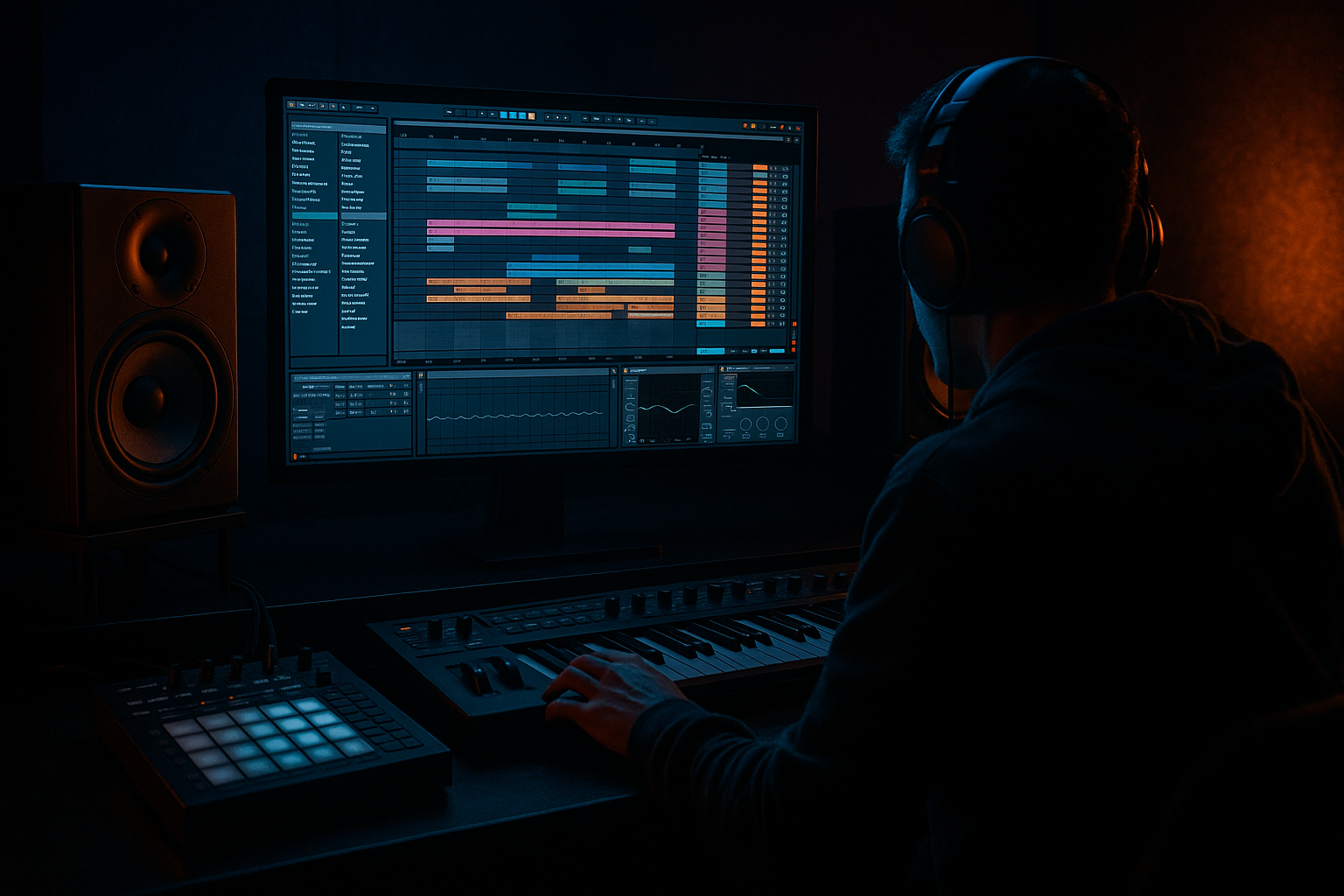
Main tutorial
Outro arrangement for DJs — Drum & Bass in Ableton Live
Teacher tone: energetic, clear, professional. 🎧🔥
---
1) Lesson overview
Goal: make a DJ-friendly outro for a drum & bass track in Ableton Live so DJs can mix your tune out cleanly.
You’ll learn how to build a structured, phrase-aware outro (32–64 bars), set up device-chains for DJ utility (filter, bass-kill, tails), prepare stems and exports, and use Ableton stock devices to sculpt a pro, club-ready exit.
Tempo context: typical DnB 170–176 BPM. This lesson assumes Live Intro/Standard/Suite — all stock devices I mention are part of Live (Utility, EQ Eight, Compressor, Glue Compressor, Saturator, Auto Filter, Reverb, Ping Pong Delay, Drum Rack, Simpler, etc.).
Let’s make your outro DJ-friendly, punchy, and mixable. 🚀
---
2) What you will build
- A 32–64 bar outro arrangement built in Arrangement View with clear 8-bar phrase reductions.
- Two quick-access DJ tools:
- Device chains for:
- Export settings and stem export workflow for DJs.
- Cutting out too much too early: DJs need predictable elements (kick + snare) for beatmatching. Don’t remove the beat before the last 8 bars.
- Over-using long reverb on main mix: reverb tails can clash with the next track and muddy the mix. If you want tails, offer them on a separate FX stem.
- Over-compressing master while exporting DJ edits: leave headroom (-3 dB) so DJs can adjust in their PA/mastering chain.
- Not monophoning the sub: failing to mono the sub-bass causes phase issues when DJs mix on different setups. Utility Width 0% below ~120 Hz is essential.
- Not labeling stems or not indicating BPM/key: always include BPM and beat-length in filenames and in a readme.
- Mono the sub: split bass into two chains (Low-pass < 120 Hz → Utility Width 0%; Mid → Stereo). For beginners, duplicate bass track, lowpass one and set Width 0%.
- Saturation on mid-bass: use Saturator with Soft Clip for thick midrange. Settings: Drive 3–6, Dry/Wet 30–50%.
- Distorted bus reverb: use a small send to a Reverb → Saturator chain to create dark decaying textures (Reverb Decay 6–10 s, Saturator Drive 4). Then EQ out 100–200 Hz to avoid muck.
- Use vinyl/noise tails subtly: a very low-level vinyl tail or jungle smoke sample at -20 to -30 dB adds atmosphere for a heavy outro.
- Keep the groove but remove top-end: automate EQ Eight to reduce 6–16 kHz content gradually — gives the feel of “tunnel” and is club-friendly for darker mixes.
- Use small dash of chorus/modulation on pads (Analog or Chorus-Ensemble) and automate depth down during outro for unsettling vibe.
- Make an alternate "Weighty Outro" stem where the last 16 bars retain the sub and a distorted mid-bass loop, and a "Light Outro" where sub is killed — give DJs options.
- DJs need predictable phrasing and a usable beat: keep kick + snare for the last 8–16 bars.
- Create fast-access tools: Bass Kill macro (Auto Filter in a Rack) and a Drum-only stem.
- Use stock Ableton devices: EQ Eight, Auto Filter, Compressor, Glue Compressor, Saturator, Drum Buss, Reverb, Utility. Mono sub below ~120 Hz. Sidechain to keep low end tight.
- Export stems and keep headroom (-3 dB), include a readme with BPM and outro length.
- For darker/heavier DnB: saturate mids, mono sub, controlled reverb tails, and alternate stems for DJs.
- Provide an Ableton Live template of this setup (rack + macros + recommended automations).
- Walk you through mapping the Bass Kill macro to a MIDI controller and exporting stems with markers.
- A mapped Bass Kill macro (instant lowcut for sub-bass or full bass kill).
- A DJ Drums-stem (kick/snare/perc) ready for quick beatmatching.
- Drum bus (punch + clarity)
- Bass group (mono sub below ~120 Hz + distortion mid)
- Master send with long reverb tail for a musical fade
---
3) Step-by-step walkthrough
Preparation: set your Live set to the track tempo (e.g., 174 BPM). Switch to Arrangement View (Tab). Use 4-bar grid and enable "Triplet/Grid" if needed for fills.
A. Structure and phrase planning (practical)
1. Decide outro length: 32 bars is a great default (2 x 16-bar phrases, or 4 x 8). DJs love 32 or 64 bars. We'll use 32 bars here.
2. Mark phrases: Use color-coded locators (right-click > Insert Locator) at 0, 8, 16, 24, 32 bars. Title them "Outro 1", "Outro 2", etc.
3. Plan element drops per 8-bar phrase:
- Bars 1–8: full mix
- Bars 9–16: remove melodic lead / FX, keep drums + bass + atmos
- Bars 17–24: remove hi-hats and mid percussion, keep kick/snare + sub or bass-filtered bass for swapping
- Bars 25–32: keep kick & simple percussion + optional bass-kill for DJ to mix out; long reverb tails active
B. Build device chains (copy to groups and name them)
1. Drum Bus (group all drums: Drum Rack -> Group)
- Insert EQ Eight (set on the group):
- High-pass at 30 Hz (filter 1, 12 dB/oct) to clean rumble.
- Slight dip around 300–600 Hz if grid sounds boxy (-1.5 dB).
- Drum Buss (stock Live device) -> Glue Compressor -> Saturator:
- Drum Buss: Drive 2–4, Boom 0
- Glue Compressor: Threshold -6 dB, Ratio 2:1, Attack 10 ms, Release 300 ms, Make-Up 0 dB
- Saturator: Drive 3, Soft Sine or Analog Clip, Dry/Wet 40%
- Optional: send a small amount to a Reverb send with long tail for atmosphere.
2. Bass Group
- Bass clips -> Group
- Device chain (top to bottom):
- EQ Eight: low-cut at 25–30 Hz (clean sub rumble)
- Utility: Width = 0% for the low band (we’ll mono sub later via Split)
- Auto Filter (for DJ Bass Kill): Bandpass or Low Cut with Macro mapped (see mapping below)
- Compressor (if needed): Attack 5–10 ms, Release 80–120 ms for glue with kicks
- Saturator: Drive 2–5 for grit on mids
- Optional: use Multiband Dynamics (Suite) or use an EQ to isolate sub and mid bass on two chains if you want mono sub. For beginners: keep sub in single track and use Utility Width 0% on a duplicate low-pass chain.
3. Bass Kill macro mapping (fast DJ tool)
- Create a Rack for the Bass Group (Instrument or Audio Effect Rack).
- Put an Auto Filter inside the Rack: set filter to Low Pass (24 dB slope) and Resonance ~0.6.
- Map the Filter Frequency to a Macro called "Bass Kill".
- Map a second macro to the Filter Resonance if desired.
- Macro mapping suggestion: Bass Kill at 127 = full cut (closed lowpass = no sub), at 0 = full bass.
- Quick preset: set Macro min value = 60 Hz, max value = 12 kHz ; tweak so turning the knob to zero removes sub/mid-bass.
- Bonus: map the macro to a MIDI controller or to an Ableton key for instant use.
4. Master and Reverb tail
- Create a Return track (e.g., Send A) with Reverb:
- Reverb device: Size 70–80%, Decay Time 6–12 s (watch CPU), Pre-Delay 10–30 ms.
- EQ Eight after Reverb: high-cut at 10–12 kHz to avoid harshness.
- For long tails: automate the return send on elements you want tails from (e.g., last snare hit send + full send at bar 30).
- When bouncing, keep reverb tails on a separate stem if you want DJs to avoid long tails; otherwise include them.
C. Arrangement automations and DJ utilities
1. Automate element removals per phrase:
- Use clip follow-through: mute instruments at the start of each 8-bar phrase rather than automating volume every bar (cleaner).
- For smoothness, automate Auto Filter (LP) on the Master or on Instrument Groups: gradually lower cutoff over 8 bars to create a felt fade.
2. Create “Drum Only” stem inside Ableton:
- Duplicate Drum Group → name "DJ Drums Stem".
- On the duplicate, mute all non-drum channels.
- On Master, add Utility before any master limiter and create a Group called "DJ Stems" where you can solo/mute before export.
3. Export stems for DJs:
- File → Export Audio/Video:
- Rendered Track: All Individual Tracks (or Grouped Tracks)
- Sample Rate: 44.1 kHz or 48 kHz (44.1 fine)
- Bit Depth: 24-bit
- Normalize: Off
- Render Length: include at least 1–2 bars of silence after outro to allow DJs to mix
- Master: leave limiter off to keep headroom; aim for -3 dB peaks
- Export: Full Mix + Stems: Drums, Bass, FX, Leads
D. Practical automation details (exact settings)
1. Sidechain Ducking (Kick -> Bass)
- Insert Compressor on Bass Group, enable Sidechain input to Kick bus:
- Ratio 4:1, Threshold depends on source (-14 to -20 dB), Attack 3–10 ms, Release 80–150 ms.
- Lookahead off, Knee soft.
- This keeps the low end tight during the outro where DJs are mixing.
2. Drum reverb sends (for tails)
- Send A (Reverb): set Send on snare & last percussion to 30–50% at the final hit, so tails sustain during tight outro.
3. Master lowpass automation (gentle)
- Insert Auto Filter on the master after Utility:
- Type: Low Pass (24 dB)
- Automate Cutoff from 22 kHz → 4–6 kHz over 16–32 bars for energy smoothing.
- Alternatively use EQ Eight with a high-shelf attenuation automation.
4. Quick crossfade cue (for DJ preview)
- Place a solid 4-bar loop of kick+snare+clap near the end that DJs can use to cue-off easily. Keep this loop at the top timeline level (easy to see).
E. Exporting “DJ Friendly” versions
1. Full Mix (mastered or not) with long tails, -3 dB headroom.
2. DJ Mix Edit: same track but with:
- A 32–64 bar outro where the last 8–16 bars are purely drums (kick + snare + simple perc).
- A separate "No Sub" stem: export the bass group with Auto Filter engaged to cut sub (for DJs who want to avoid low-end clashing).
3. Deliver WAV 24-bit, include a small readme listing BPM, key, and recommended phrase length (e.g., outro 32 bars).
---
4) Common mistakes
---
5) Pro tips for darker/heavier DnB 🎛️🖤
---
6) Mini practice exercise (15–30 minutes) 🛠️
Goal: create a clean 32-bar outro with bass-kill macro and a DJ drum stem.
Steps:
1. Open a short DnB arrangement at 174 BPM with drums, bass, lead and pad. If you don’t have one, drag a 32-bar drum loop into Arrangement and a bass loop.
2. Group drums. Add EQ Eight (HP @ 30 Hz), Drum Buss (Drive 3), Glue Compressor (Attack 10 ms, Release 300 ms).
3. Group bass. Put Auto Filter inside an Audio Effect Rack and map cutoff to Macro 1 (“Bass Kill”). Set Macro min = 60 Hz, max = 12 kHz. Test turning it to remove bass.
4. Duplicate the Drum Group, name "DJ Drums". Mute everything except kick/snare/percs on this duplicate. Place it so it is active in the final 8 bars.
5. Automate Bass Kill Macro to close in the final 8 bars (simulate DJ’s kill). Automate Master Auto Filter lowpass slightly over the final 16 bars.
6. Export: select 0–32 bars, File → Export Audio/Video → Rendered Track: Master, 24-bit WAV. Also export individual Drum and Bass stems (Rendered Track: All Individual Tracks).
You now have a simple DJ-ready outro + stems. Nice! 👊
---
7) Recap
If you want, I can:
Which would you like next? 🎚️🔥

