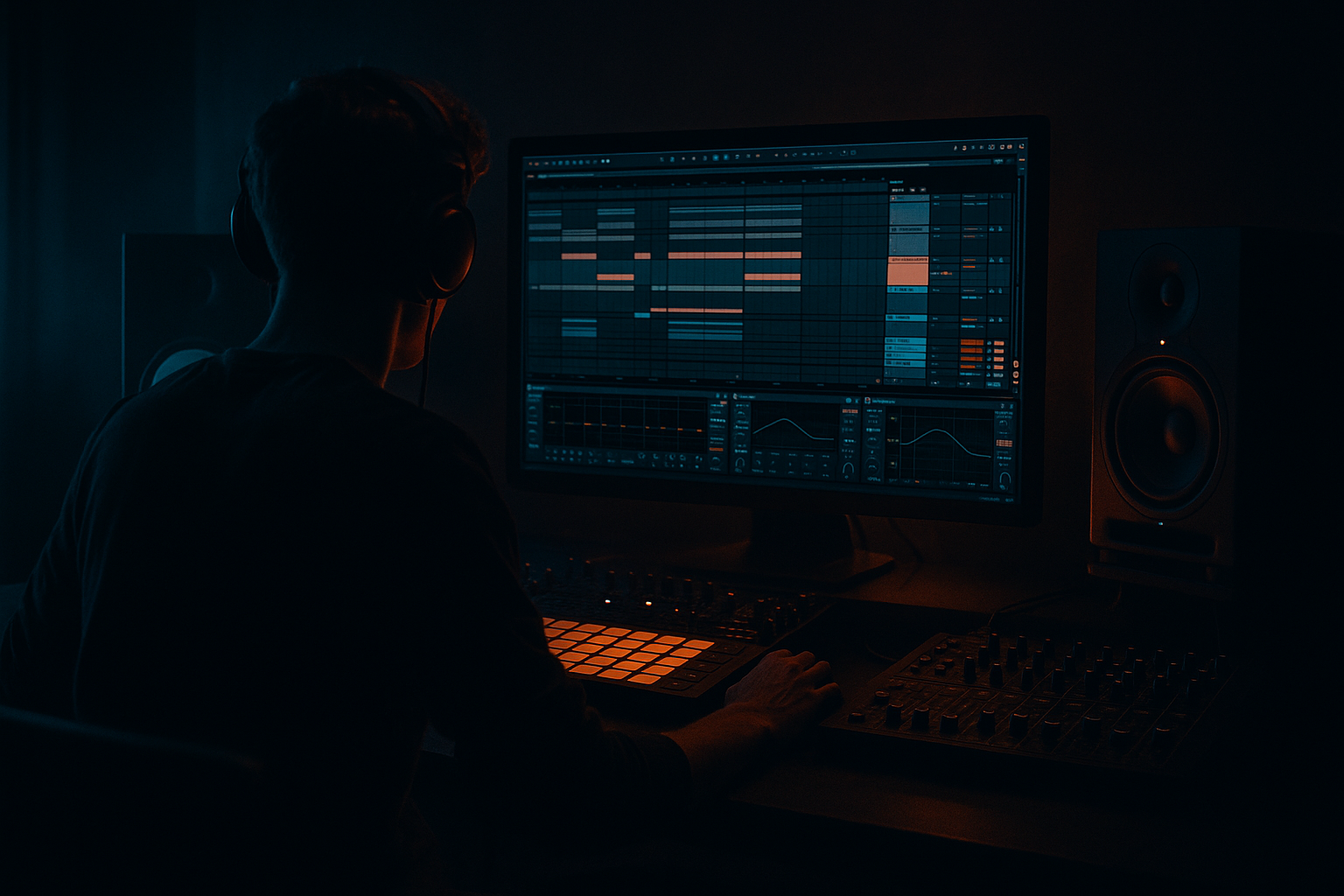
Main tutorial
Pad Drive Guide: Crunchy Sampler Texture Pads in Ableton Live 12 (Oldskool Jungle / DnB) 🔥🎛️
1. Lesson overview
In oldskool jungle and early DnB, pads weren’t “clean cinematic beds”—they were driven, resampled, slightly unstable, and often carried a sampler-era crunch that glued them to breaks and bass.
This lesson focuses on arrangement-first pad processing: how to build a pad that moves through the track, gains intensity in drops, and feels like it’s been through an Akai / E-mu / cheap desk—but using Ableton Live 12 stock devices.
You’re advanced, so we’ll go deep into device chains, resampling workflows, macro control, and arrangement moves that scream jungle.
---
2. What you will build
A two-layer pad system designed for rolling DnB/jungle:
- Layer A (Body): wide, musical pad that holds harmony
- Layer B (Crunch): resampled “sampler-driven” layer that adds grit, midrange, and movement
- A Pad Drive Rack with macros for:
- Arrangement techniques: intro haze → breakdown lift → drop clamp (pads tuck under breaks & bass)
- Key suggestion: F minor / G minor / D# minor
- Write 4–8 bars, simple but emotive:
- Keep voicings mid-high (around C3–C5 range), leave sub space free.
- Wavetable (clean but flexible)
- Drift (instability is perfect)
- Analog (classic pad tone)
- Osc 1: Saw, unison 3–5, detune ~15–25%
- Osc 2: Sine or Triangle lightly mixed (adds “pad glue”)
- Filter: LP24, cutoff ~3–6 kHz, drive low
- Amp Env: Attack 20–60 ms, Release 1.5–4 s
- Bits: 10–12
- Sample Rate: 12–18 kHz
- Soft: On (usually smoother)
- Dry/Wet: 20–50%
- Mode: Wide Noise or Sine
- Freq: 2–6 kHz
- Amount: 0.2–1.5
- Mix it quietly—this is seasoning
- Drive: 5–15%
- Crunch: 5–20%
- Damp: adjust to keep it dark
- Transients: usually negative or low (pads shouldn’t poke like drums)
- Create a Group: `PADS BUS`
- Inside: `PAD A – BODY` and `PAD B – CRUNCH`
- Add devices on the PADS BUS for global control:
- Macro 1 – FILTER OPEN → Auto Filter cutoff (intro closed → drop open)
- Macro 2 – DRIVE → Roar Drive + Saturator Drive (small ranges)
- Macro 3 – CRUNCH MIX → Redux Dry/Wet or PAD B track volume
- Macro 4 – WIDTH → Utility width (e.g., 70% drop, 140% breakdown)
- Macro 5 – PUMP → Sidechain-style ducking (see next step)
- Auto Pan:
- Pads: mostly PAD A, low crunch
- FILTER OPEN macro: low → medium over 16 bars
- Add subtle noise/atmos from breaks; keep drums minimal (rim/hat)
- Automate WIDTH: wide (130–160%)
- Bring in PAD B crunch slowly
- Reduce WIDTH slightly (preparing drop focus)
- Add short reverb throws (automate Hybrid Reverb mix up on last 1/2 bar)
- Last 2 bars: filter down quickly → classic “suck into drop”
- Pads: lower in level
- WIDTH: 70–100% (mono-ish center helps breaks hit)
- PUMP: more pronounced (pads breathe under snare)
- Crunch: keep mid, don’t over-fizz (DnB needs headroom)
- Swap chord voicing up an octave or invert
- Do a 1-bar stop where pads cut out entirely → breaks feel bigger
- Reintroduce pads with more crunch for “second wind”
- Make the crunch darker, not brighter: after Redux/Roar, low-pass around 7–10 kHz so it’s “tape-ish,” not fizzy.
- Mid/Side control with Utility + EQ Eight:
- Resample at multiple “generations”:
- Add subtle pitch instability (sampler wobble):
- Sidechain to snare more than kick:
- You built a two-layer pad system: clean body + resampled crunchy layer.
- You used stock Live 12 tools—Roar, Saturator, Redux, Hybrid Reverb, Glue/Compressor, Utility—to create sampler-era grit.
- You treated pads like an arrangement element: wide and lush in intros, tighter and ducked in drops.
- You committed texture via resampling, which is a huge part of authentic oldskool jungle tone.
- Drive amount
- Crunch/bit depth vibe
- Stereo control (wide → narrow for drops)
- Pump (sidechain feel)
- Filter sweep for transitions
---
3. Step-by-step walkthrough
Step 0 — Session context (so it actually fits jungle)
1. Tempo: 160–172 BPM (try 168 BPM).
2. Drum context: load a break (Amen / Think / Hot Pants style). Even a placeholder loop is fine because pad processing decisions depend on drums.
3. Bass context: a rolling sub + reese mid layer (again, placeholder ok). Pads must not fight the mid bass.
---
Step 1 — Write a pad progression that’s jungle-friendly 🎹
Oldskool pads often lean minor, suspended, and modal.
- Example: Fm9 → DbMaj7 → EbSus4 → Fm9
Ableton instrument options (stock):
Quick starting patch (Wavetable):
---
Step 2 — Build Layer A (Body): warm, wide, controlled
Create a MIDI track: PAD A – BODY
Device chain (in order):
1. Wavetable / Drift / Analog
2. EQ Eight
- HP filter at 120–220 Hz (steeper if bass is busy)
- Small dip 250–450 Hz if it clouds breaks
- Gentle shelf down above 10–12 kHz if it hisses
3. Chorus-Ensemble
- Mode: Chorus
- Rate: 0.15–0.35 Hz
- Amount: 15–30%
- Width: 120–160% (then we’ll control later)
4. Hybrid Reverb
- Algorithm: Hall or Plate
- Predelay: 10–25 ms
- Decay: 2–5 s
- HP in reverb: 250–500 Hz
- Mix: 10–25% (don’t wash the breaks)
Goal: Layer A is the “music.” It should still sound good even before crunch.
---
Step 3 — Build Layer B (Crunch): resampled sampler texture 🧨
Duplicate the MIDI clip onto a new track: PAD B – CRUNCH
Here we intentionally degrade + resample to get that “ripped-from-vinyl / bounced-through-a-sampler” feel.
#### 3A) Pre-crunch shaping (so distortion hits right)
1. EQ Eight
- HP at 180–300 Hz (keep the crunch out of subs)
- Optional: small boost 1.5–3 kHz to excite grit
2. Saturator
- Mode: Analog Clip
- Drive: 4–10 dB
- Soft Clip: On
- Output: trim so you’re not just louder
3. Roar (Live 12) 🔥
- Style: start with Tape or Distort
- Drive: low-medium (you want texture, not a fuzz pad)
- Tone: tilt slightly darker if it gets fizzy
- Modulation: slow movement on Drive or Filter (subtle)
#### 3B) “Sampler” degradation (crunch without murdering transients)
Choose one (or combine lightly):
Option 1: Redux (classic)
Option 2: Erosion (digital grit)
Option 3: Drum Buss (for pad bite)
#### 3C) Resampling workflow (the “oldskool bounce” move) 🎚️
This is where it becomes real.
1. Create a new audio track: PAD RESAMPLE
2. Set its input to Resampling (or from PAD B track).
3. Arm it and record 8 bars of the crunchy pad.
4. Drop the recorded audio into Simpler (Drag audio onto a MIDI track).
5. In Simpler:
- Mode: Classic
- Warp: Off (more “sampler”)
- Snap: On
- Fade: tiny fade-in/out to avoid clicks
- Filter: LP12 with cutoff around 6–10 kHz (if needed)
- Pitch Envelope: tiny amount (1–5) with short decay for subtle “thwip” (optional)
6. Now you can re-trigger that pad like a sampled stab, or hold it like a bed—but with printed grit.
Why this works: distortion + bit reduction behaves differently before vs after resampling. Printing it commits the tone and creates that “it’s a sample” feel that sits with breaks.
---
Step 4 — Combine into a Pad Drive Rack (macros for arrangement control)
Group PAD A and PAD B into an Instrument Rack (or group tracks and build macros via a Rack on a return/bus). A clean way:
PADS BUS device chain:
1. Auto Filter (for sweeps)
- Type: LP12 or LP24
- Add slight Drive if needed
2. Glue Compressor
- Attack: 10 ms
- Release: Auto
- Ratio: 2:1
- Aim for 1–3 dB GR on peaks
3. Utility
- Width control (important for drop focus)
4. Limiter (safety, light)
Macro suggestions (map them):
---
Step 5 — Make the pad “pump” with breaks (DnB spacing) 🥁
Pads in jungle shouldn’t sit flat—they should breathe around kicks/snares.
Method A (transparent): Compressor sidechain
1. On `PADS BUS`, add Compressor (not Glue).
2. Sidechain: On
3. Input: your Kick+Snare group (or drum bus)
4. Settings:
- Ratio: 2:1 to 4:1
- Attack: 3–15 ms (let pad transient breathe a bit)
- Release: 80–180 ms (set to groove)
- Threshold: adjust for 2–6 dB gain reduction on snare hits
Method B (more oldskool / obvious): Auto Pan as tremolo
- Amount: 20–45%
- Rate: 1/4 or 1/8 synced
- Phase: 0 (so it’s volume modulation, not stereo spin)
Map either to Macro 5 – PUMP.
---
Step 6 — Arrangement: where pads live in jungle (and where they don’t) 🎚️
Here’s a practical 64-bar blueprint that feels legit:
#### Bars 1–16 (Intro: haze + tease)
#### Bars 17–32 (Build: tension + pre-drop)
#### Bars 33–48 (Drop: pads support, not dominate)
#### Bars 49–64 (2nd phrase: variation)
Key jungle move: mute pads on the first 1–2 bars of the drop, then bring them in. The contrast makes the drop slam harder.
---
4. Common mistakes
1. Too much low-mid (200–500 Hz) → pads smear the break and kill punch.
2. Over-widening in the drop → your snare loses center impact and bass feels smaller.
3. Crunch = volume → distortion feels “better” because it’s louder. Level-match aggressively.
4. Bitcrushing full-range pads → turns to brittle hash. High-pass before degradation.
5. Reverb not filtered → low reverb mud fights the sub + kick.
---
5. Pro tips for darker/heavier DnB 🕯️⚙️
- Keep pad low-mids more mono, push shimmer to sides.
- Print Crunch v1 → reprocess lightly → print v2.
Two subtle passes often sound more authentic than one extreme pass.
- Use Shifter (tiny detune) or modulate instrument fine pitch very slightly with slow LFO (if using Drift/Wavetable modulation).
- Jungle is snare-led. Try sending only snare to the sidechain key input.
---
6. Mini practice exercise (15–25 minutes) ⏱️
1. Create PAD A and PAD B as described.
2. Resample PAD B into Simpler.
3. Build a 32-bar loop:
- Bars 1–16: filtered wide pad, minimal crunch
- Bars 17–32: more crunch + tighter width + more pump
4. Rules:
- Pad bus must peak at least 6 dB lower than your snare on the drop.
- Automate FILTER OPEN and WIDTH at least once each.
5. Export and A/B:
- With PAD B muted vs on.
The difference should be “texture + movement,” not “everything got harsher.”
---
7. Recap ✅
If you want, tell me your BPM + key + whether you’re using Amen/Think-style breaks, and I’ll suggest a pad chord set + exact macro ranges tailored to your drop density.

