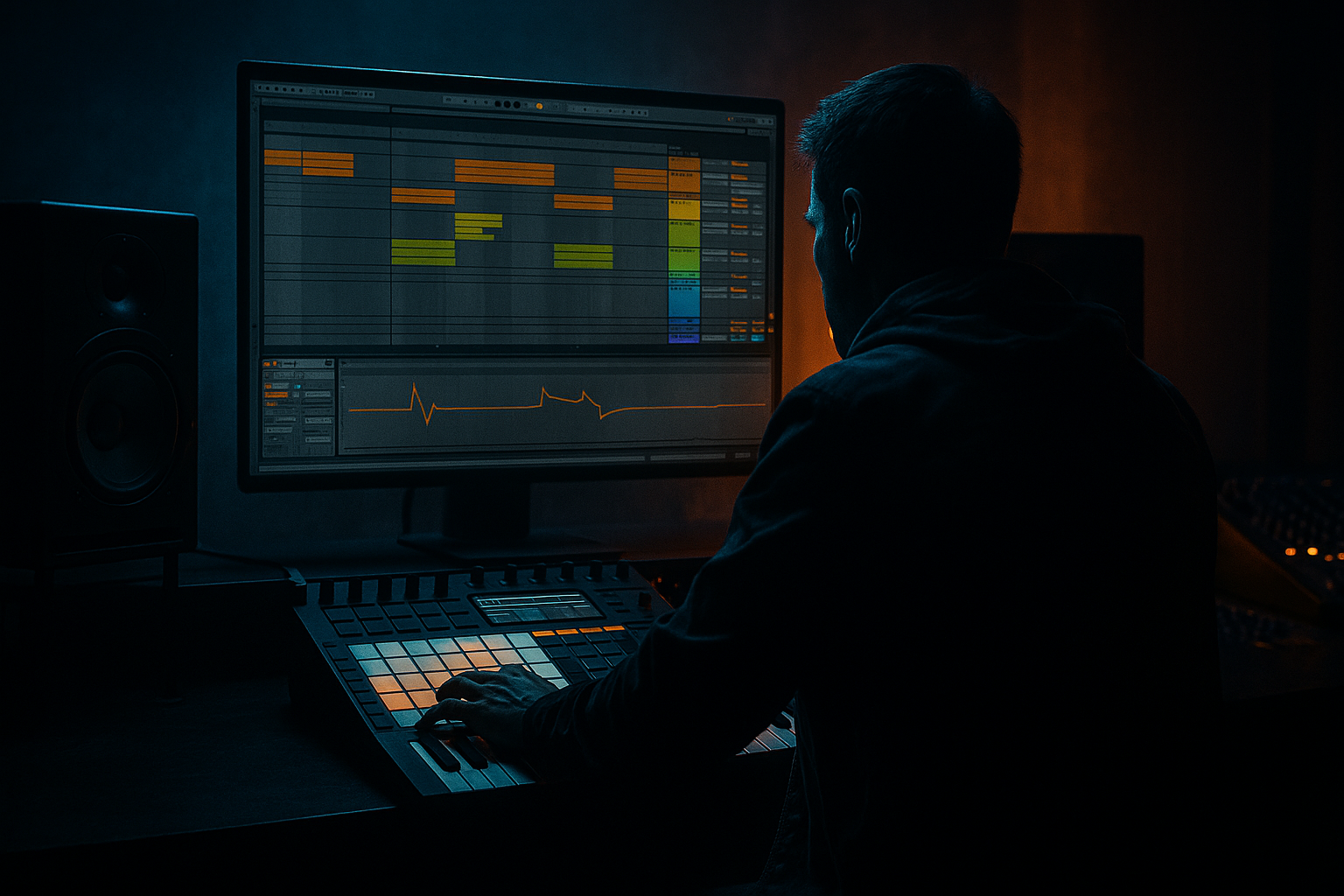
Main tutorial
Pad in Ableton Live 12: Stretch It With DJ-Friendly Structure for Jungle / Oldskool DnB Vibes
1. Lesson overview
In jungle and oldskool drum & bass, pads are not just “background chords.” They are movement, atmosphere, and transition glue. A good pad can make a loop feel like a full record, especially when you stretch it into DJ-friendly phrasing so it breathes like a vinyl-era tune: long intro, clear 16/32-bar sections, breakdown tension, then a clean return to the groove.
In this lesson, you’ll learn how to take a pad sound in Ableton Live 12 and turn it into a long-form, arrangement-ready atmospheric layer that supports rolling drums, Reese bass, breaks, and classic jungle energy. We’ll focus on:
- stretching and shaping a pad for a DJ-friendly structure
- making it sit inside oldskool DnB / jungle arrangement language
- using Ableton stock devices to create motion, grit, and width
- avoiding the common mistake of pads sounding too “lush house” or too static for DnB 🎛️
- a looped pad progression that feels moody and timeless
- a 32-bar DJ-friendly intro with filtered pad evolution
- a breakdown section where the pad opens up and creates tension
- a return section where the pad retracts so the drums/bass hit harder
- a practical device chain using stock Ableton tools:
- an arrangement that works well for:
- a simple analog-style synth pad
- a sampled string pad
- a noisy FM pad
- a detuned saw pad with slow attack
- a vinyl-style atmospheric sample
- minor 7ths
- sus2 / sus4 voicings
- minor 9ths
- two-note clusters for darker tension
- Dm7: D–F–A–C
- Bbmaj7: Bb–D–F–A
- Csus2: C–D–G
- Gm7: G–Bb–D–F
- Bar 1: Dm7
- Bar 2: Bbmaj7
- Bar 3: Csus2
- Bar 4: Dm7
- 2 bars per chord for a deep intro
- 1 bar per chord for more harmonic motion
- 4 bars per chord for atmospheric breakdowns
- longer note lengths
- slightly overlapping notes for smooth legato
- clip looping to keep the phrase stable
- bars 1–8: filtered pad only, maybe with noise or vinyl texture
- bars 9–16: bring in top percussion or ghost break
- bars 17–24: open the filter slightly, increase stereo width
- bars 25–32: tease drums or a bass hint, but keep the pad dominant
- full drums
- bassline enters
- pad is reduced in volume or filtered more tightly
- pad should support, not overpower
- remove kick and bass
- let the pad open up
- add reverb/delay automation
- maybe layer in a reverse pad or FX sweep
- cut the pad low end
- tighten it with a high-pass filter
- bring the bass and breaks back hard
- High-pass filter around 120–250 Hz depending on the pad
- a gentle dip around 250–500 Hz if it sounds boxy
- tame harshness around 2–5 kHz if needed
- HPF at 180 Hz
- small dip at 350 Hz
- high shelf cut if the pad is too glossy
- filter type: Low-pass 12 dB or 24 dB
- resonance: low to moderate
- automate cutoff over 8, 16, or 32 bars
- start the intro muffled
- slowly open before the drop
- close it again during the main groove for contrast
- intro at 1.5–2 kHz cutoff
- breakdown opens to 8–12 kHz
- return section closes back down to 3–5 kHz
- Chorus-Ensemble for subtle movement and width
- Utility for mono control and width adjustment
- keep the pad wide in intros/breakdowns
- narrow it slightly in the drop
- check mono compatibility if your bass is centered
- thicken the pad
- add analog-style edge
- help it cut through on smaller speakers
- Drive: 2–5 dB
- Soft Clip: On
- Curve: default is fine
- slightly reduce bit depth or sample rate for grain
- use subtly, not as a lo-fi gimmick
- great for adding unstable high-frequency noise
- use very lightly on pads to create atmosphere
- Redux sample rate reduction just enough to roughen the top
- Erosion with a subtle noise or wide mode for dusty air
- Decay: 2.5–6 seconds
- Pre-delay: 15–35 ms
- Low cut: 200 Hz or higher
- High cut: 7–10 kHz
- Dry/Wet: use tastefully, often 10–25%
- longer decay
- more wet signal
- broader stereo image
- reduce reverb
- high-pass more aggressively
- keep the pad behind the drums
- synced delay times
- diffusion
- modulation
- darker repeats
- tempo sync: 1/8D or 1/4
- low feedback
- filter the repeats so they don’t clutter the mix
- filter cutoff
- reverb wet level
- delay feedback
- volume
- width
- optional saturator drive
- Bars 1–8: low-pass closed, soft pad in the background
- Bars 9–16: open cutoff slightly, raise reverb a touch
- Bars 17–24: bring in stereo width and shimmer
- Bars 25–32: introduce a little more saturation or delay tail
- Drop: pull the pad back with a filter or volume dip
- lower pad during full drum sections by 2–6 dB
- let it rise in breakdowns
- use Compressor with sidechain from kick
- gentle ratio: 2:1 to 4:1
- attack: 5–20 ms
- release: 80–200 ms
- automate a dynamic dip around the kick/sub region
- use EQ Eight to keep the pad lean
- Amen breaks
- Think breaks
- rolling 2-step drums
- sub bass
- Reese bass
- rewound FX
- keep the pad filtered
- use it to define the mood, not the rhythm
- let the break be the main forward motion
- make the pad simpler
- hold chords longer
- avoid too many chord changes
- automate movement instead of adding notes
- let the pad dominate
- remove drums or strip them back
- use long reverb tails and delay throws
- maybe add a reversed pad swell into the next section
- 4-bar filter opens before the drop
- reverse pad leading into the break
- resampled pad hit on bar 1 of a new section
- long reverb tail that bridges two sections
- cutoff automation synced to 16-bar phrasing
- Freeze the track
- Flatten it
- or Resample into audio
- you can edit the audio more like an old sampler
- you can warp it with more character
- you can chop it into fills and transition hits
- bass root: D
- pad progression: Dm7 → Bbmaj7 → Csus2
- add a note a semitone above the root for tension
- use suspended voicings that never fully resolve
- automate dissonance only in breakdowns
- Saturator
- Overdrive
- Pedal
- or a touch of Drum Buss
- intro tension
- pre-drop noise
- transition fills
- haunted breakdowns
- white noise or vinyl noise sample
- Auto Filter
- Reverb
- low volume
- one version bright and emotional
- one version dark and oppressive
- start with a simple minor chord progression
- stretch or hold it so it breathes at 170+ BPM
- use filter automation and reverb control
- keep the low end clear for drums and bass
- arrange it in DJ-friendly 8/16/32-bar phrases
- add grit with Saturator, Redux, or Erosion
- resample when you want extra character 🎚️
- deeper
- darker
- more atmospheric
- and much more ready for the dancefloor
---
2. What you will build
By the end, you’ll have:
- EQ Eight
- Auto Filter
- Chorus-Ensemble or Utility
- Saturator
- Redux or Erosion
- Reverb
- Delay
- optional Echo
- mixing into DJ sets
- intros/outros
- jungle breakdowns
- rolling amen or breakbeat sections
---
3. Step-by-step walkthrough
Step 1: Choose the right pad source
For jungle / oldskool DnB, your pad should feel nostalgic, dark, and a little unstable. Good choices include:
If you’re using MIDI, keep the chord voicing simple:
For example, in D minor:
Keep the harmony moody, not too busy. Jungle pads often work best when they leave room for drums and bass.
---
Step 2: Program a short chord loop first
Start with a 2-bar or 4-bar loop. Don’t arrange yet.
A strong oldskool DnB chord pattern might be:
This gives you movement without sounding like a full-on emotional breakdown too soon.
Practical tip:
If your tune is fast, around 170–174 BPM, a 4-bar pad loop can feel a bit too “pop song” if it changes every bar. Try holding chords longer:
---
Step 3: Use Ableton’s clip stretching correctly
If you’re working with an audio pad sample, use Ableton Live 12’s warping features to stretch it musically.
#### For audio pads:
1. Drag the pad sample into an audio track.
2. Turn Warp on.
3. Choose a warp mode:
- Complex Pro for full pads with rich stereo content
- Complex for general pad material
- Texture if you want a grainy, smeared ambient feel
4. Set the clip so it matches your project tempo.
5. Adjust the transient/warp markers only if the sample drifts.
#### For MIDI pads:
If it’s a synth pad, use:
DnB-specific stretch idea:
Don’t stretch the pad just for length. Stretch it for vibe and phrasing. In jungle, a pad often acts like a “fog layer” that expands and contracts around the drums.
---
Step 4: Shape the pad with a DJ-friendly structure
Now build the arrangement like a DJ record, not like a loop.
A classic structure might look like this:
#### Intro: 1–32 bars
#### Main groove: 33–64 bars
#### Breakdown: 65–80 bars
#### Drop return: 81–112 bars
This is what makes it DJ-friendly: clear phrasing, energy control, and smooth mixing points.
---
Step 5: Build the stock Ableton device chain
Here’s a very practical pad chain for jungle / DnB.
#### Suggested chain:
1. EQ Eight
2. Auto Filter
3. Chorus-Ensemble or Utility
4. Saturator
5. Redux or Erosion
6. Reverb
7. Delay or Echo
Let’s break it down.
---
#### 5.1 EQ Eight: clean the low end
Pads often get messy in the low mids and can fight the bassline.
Start with:
For darker jungle pads, I often use:
Important:
Leave room for the kick, sub, and Reese. Your pad should usually avoid low-end weight unless it’s a special FX layer.
---
#### 5.2 Auto Filter: movement and tension
This is one of the best tools for DJ-style arrangement.
Set:
Use this to:
A classic move:
That creates a proper “arrival” feeling when the drums come back in 🔥
---
#### 5.3 Chorus-Ensemble or Utility: widen carefully
Pads can sound huge, but in DnB you want width without losing punch.
Options:
Tips:
If the pad is too wide, it can smear the groove and make your drum break feel weak.
---
#### 5.4 Saturator: add grit and density
Oldskool jungle benefits from a bit of grime.
Use Saturator to:
Good starting point:
If the pad is bright and sweet, saturation can make it feel more ravey and less polished. That’s often exactly what you want.
---
#### 5.5 Redux or Erosion: texture and bite
For a jungle feel, texture is everything.
Redux:
Erosion:
Try:
This can help the pad feel like it belongs with breakbeats and samplers.
---
#### 5.6 Reverb: make it cinematic, but controlled
Pads in DnB need space, but too much reverb can destroy the groove.
Start with Reverb:
For breakdowns, automate:
For drops:
---
#### 5.7 Delay or Echo: motion between phrases
A subtle delay makes a pad feel alive.
Try Echo if you want:
Or use Delay for simpler control.
Suggested settings:
In jungle, a delayed pad can fill holes between break hits without needing extra notes.
---
Step 6: Automate the pad for tension and release
This is where the track becomes DJ-friendly.
Automate these parameters:
#### Example automation plan:
This gives your arrangement a proper vinyl-era build.
---
Step 7: Use pad editing to make room for drums
A common mistake is letting the pad take over the whole mix.
Use these practical controls:
#### Volume automation
#### Sidechain compression
If you want the pad to breathe with the kick:
This keeps the pad rhythmic without sounding EDM-like.
#### EQ sidechaining style
If sidechain compression feels too obvious:
---
Step 8: Arrange the pad against breakbeats and bass
Now think like a DnB arranger.
Your pad should interact with:
#### In a break-heavy section:
#### In a rolling bass section:
#### In a breakdown:
---
Step 9: Add DJ-friendly transitions
To make the track mixable and oldskool in feel, use the pad for transitions.
#### Great transition ideas:
A very effective technique:
1. duplicate the pad.
2. on the duplicate, apply a high-pass filter and long reverb.
3. reverse the audio clip or freeze/flatten it.
4. place it just before the drop.
That creates the classic “pulling into the next section” feeling.
---
Step 10: Freeze, flatten, or resample for character
If the pad is sounding too clean or too perfect, commit it.
In Ableton Live 12:
Why this helps:
For jungle, turning a synth pad into audio often helps it feel more authentic and lived-in.
---
4. Common mistakes
1. Too much low end
Pads stealing space from bass and kick is the fastest way to muddy a DnB mix.
Fix: high-pass aggressively and check in mono.
2. Overly long reverb
Huge reverb sounds beautiful solo, but in jungle it can wash out the break.
Fix: automate reverb, or use shorter decay in drop sections.
3. Chord progressions that are too “house”
Bright, uplifting, major-key pad loops can clash with the darker energy of jungle.
Fix: use minor tonalities, suspended voicings, and fewer chord changes.
4. No arrangement movement
A static pad loop gets boring fast at 170 BPM.
Fix: automate filter, width, and wet/dry; introduce section changes every 8/16 bars.
5. Pads too wide in the drop
If the pad is super wide while the bass and drums hit, the mix can lose focus.
Fix: narrow the pad during the drop and widen it during intros/breakdowns.
6. Too many layers
Multiple pads, strings, atmospheres, and chords can turn the track into fog.
Fix: choose one main pad and one texture layer at most.
---
5. Pro tips for darker/heavier DnB
Tip 1: Tune the pad to the bass
If your bass is centered around a root note, make sure the pad harmony supports that tonal center.
Example:
This keeps the tune coherent and heavy.
Tip 2: Use dissonance sparingly
A minor second or tritone in the pad can create serious menace.
Try:
Tip 3: Distort the pad subtly
Run the pad through:
This can make it feel more aggressive and tape-smashed.
Tip 4: Resample to create “ghost atmosphere”
Print the pad with effects, then chop the reverb tail into a new atmospheric layer.
This works brilliantly for:
Tip 5: Make the pad answer the drums
Instead of constant pad wash, automate it so the pad opens in the spaces between kick/snare hits.
That call-and-response approach gives the track bounce and momentum.
Tip 6: Use filtered noise under the pad
A very low-level noise layer, filtered and automated, can make the pad feel more dangerous and analogue.
Try:
This is excellent for darker jungle atmospheres.
---
6. Mini practice exercise
Exercise: Build a 32-bar DJ-friendly pad intro
#### Goal:
Create a pad intro that feels like it belongs before a jungle drop.
#### Steps:
1. Set your project to 170 BPM.
2. Program a 4-bar minor chord loop.
3. Duplicate it across 32 bars.
4. Add this chain:
- EQ Eight
- Auto Filter
- Saturator
- Reverb
- Echo
5. Automate the Auto Filter cutoff:
- bars 1–8: closed
- bars 9–16: slightly open
- bars 17–24: wider/opener
- bars 25–32: almost fully open
6. Automate Reverb wet amount:
- higher at the start
- lower as the intro progresses
7. Add a simple breakbeat starting at bar 9.
8. At bar 25, introduce a bass teaser or filtered sub.
9. Export or bounce the intro and listen to whether it feels mix-friendly.
#### Challenge version:
Repeat the exercise, but make:
Compare which version feels more authentic to your DnB lane.
---
7. Recap
A great jungle / oldskool DnB pad is not just a sustained chord. It’s a structural tool that helps your track feel like a proper record.
Remember the core workflow:
If you do it right, the pad will make your tune feel:
If you want, I can also turn this into a Live 12 session template or give you a specific pad chain preset recipe for dark jungle.

