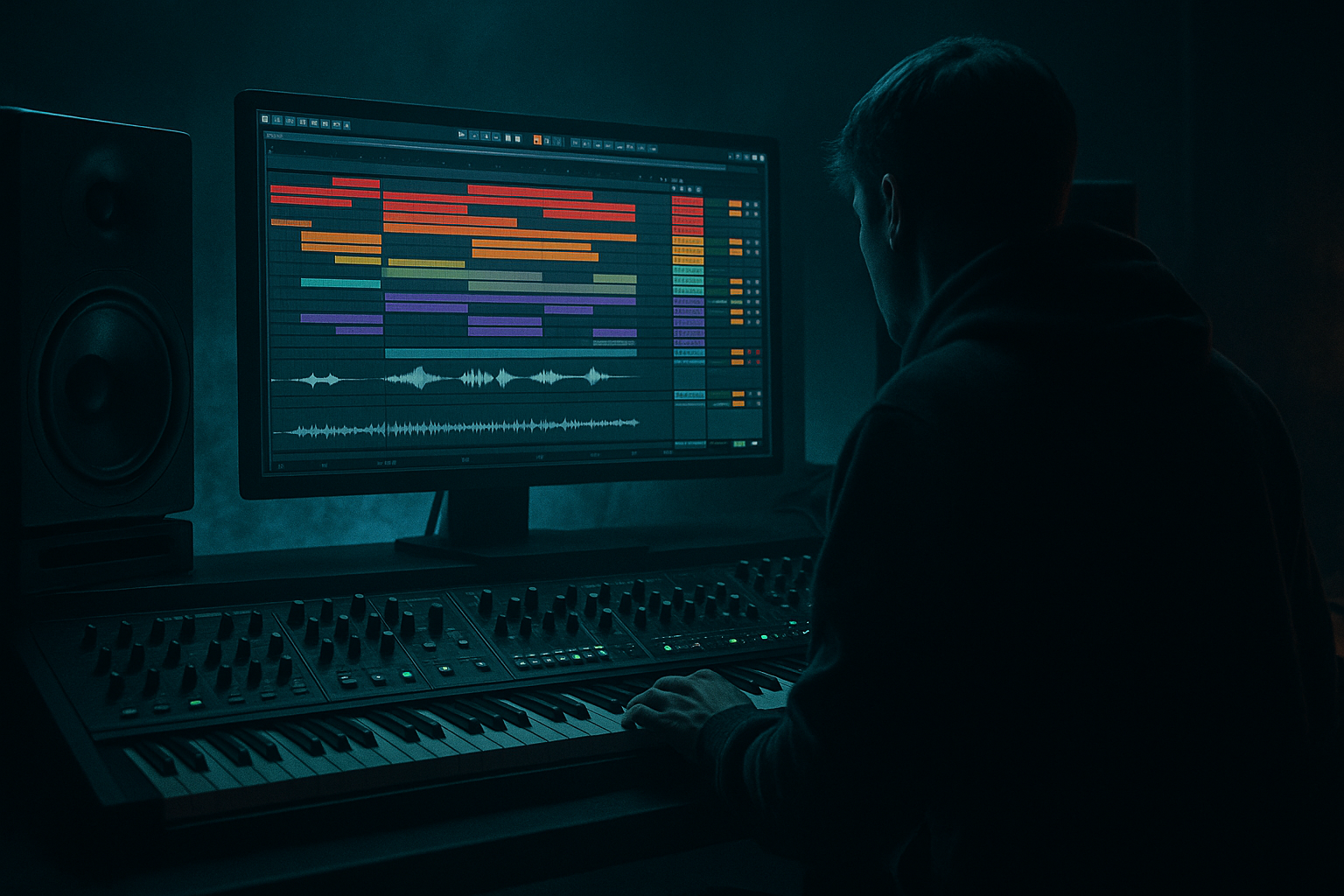
Main tutorial
```markdown
Pan Drift Automation on Field Recordings (DnB in Ableton Live) 🎛️🌧️
1) Lesson overview
Pan drift automation is a subtle-but-deadly technique for making field recordings feel alive in a drum & bass mix. Instead of hard panning or LFO wobble that screams “effect,” we’ll create slow, organic left-right movement that adds width and tension without stealing focus from the kick/snare and bass.
In rolling DnB/jungle, field recordings (rain, crowd noise, train stations, vinyl room tone, alley ambiences) are perfect for:
- Intro atmosphere
- Break transitions
- Between-drop ear candy
- Low-level texture under the main loop
- Plays a field recording loop
- Has controlled pan drift (manual automation + optional modulation)
- Sits behind drums and bass with HP filtering, ducking, and stereo management
- Evolves across a 16–32 bar DnB arrangement (intro → drop → break → drop)
- Rain on concrete, wind in trees
- Subway/rail ambience
- Crowd walla, distant traffic
- Room tone + subtle mechanical hum
- Echo: `1/8` or `1/4`, Feedback 10–18%, Filter ON, low cut 300 Hz, high cut 6–9 kHz, Mix 5–12%
- Hybrid Reverb: Room/Chamber, Decay 0.6–1.2s, Pre-delay 0–10 ms, Mix 6–15%
- Bars 1–8: drift slowly C → L15
- Bars 9–16: drift slowly L15 → R20
- Last half bar: quick return to Center to “reset” before the drop
- Pre-drop pull: pan slowly to one side for 2 bars, then hard reset to center on the drop.
- Break switch: in a 2-bar break, widen + drift faster, then narrow for the drop.
- Impact masking: pan drift left while a riser pans right (opposing motion = drama).
- Automate the cutoff:
- Use LFO (Max for Live) mapped to Utility Pan
- Add a second LFO mapped to Utility Width at even slower rate:
- Keep the drift, but darken the tone:
- Add grit without harshness:
- Make the space feel industrial:
- Use mid/side control strategically (EQ Eight):
- Drop tightness trick:
- Pan drift works best when it’s slow, subtle, and arranged with intention.
- Use Utility + EQ Eight to keep it controlled and mix-safe.
- Automate pan over phrases (8–16 bars), then “reset” at key moments (especially drops).
- Add width automation + sidechain ducking to make it feel wide yet disciplined.
- For darker DnB, cut rumble, tame highs, and keep drops tight.
This lesson focuses on practical automation workflows in Ableton Live using mostly stock devices.
---
2) What you will build
You’ll build a reusable “Drift Texture” audio track that:
---
3) Step-by-step walkthrough
Step 0 — Choose the right field recording 🎙️
Pick something with continuous detail (not too many loud transients):
Tip: If it has harsh peaks (door slams, screams), either edit them out or you’ll fight your limiter later.
---
Step 1 — Set up the track and warp it cleanly
1. Drag your field recording onto a new Audio Track named: `FX_Field_Drift`.
2. In Clip View:
- Warp: ON (if you want it tempo-locked)
- Mode: `Complex` or `Complex Pro` (usually best for ambience)
- If it’s rhythmic (train clacks), try `Beats` but keep it subtle.
DnB context: If you’re at 172–175 BPM, a warped ambience can still feel natural if you avoid extreme stretching.
---
Step 2 — Make it loop and “breathe” musically
1. Set a loop length of 8 or 16 bars.
2. Add clip fades (small fades at the loop edges) to avoid clicks.
3. Adjust Clip Gain so it’s not slamming your bus (aim low: this is texture).
A good starting point: keep it sitting around -18 to -24 dBFS peak before processing.
---
Step 3 — Build a clean, mix-ready device chain (stock)
Add these devices in this order:
1. EQ Eight
- High-pass filter at 150–300 Hz (depending on your bass weight)
- Optional: gentle dip around 2–5 kHz if it fights snares/hats
2. Utility
- Start with Width: 100%
- We’ll use Utility for the pan drift (or automation lane) in a moment
3. Compressor (for ducking later) or Glue Compressor
4. Optional vibe:
- Echo (very low)
- Hybrid Reverb (short, dark room)
Keep this subtle—DnB gets messy fast.
Example settings (tasteful):
---
Step 4 — Create pan drift automation (manual, musical, controlled) 🧭
There are two main workflows. Start with manual automation first—this is the “producer” approach.
#### A) Automation on track pan (Arrangement View)
1. Switch to Arrangement View.
2. Press A to show automation lanes.
3. On the `FX_Field_Drift` track, choose automation for Mixer → Pan (or Utility → Pan if you prefer).
4. Draw a slow drift curve over 8–16 bars:
- Keep it subtle: ±10 to ±25 pan is usually enough.
- Avoid perfectly symmetrical shapes—make it human.
5. Add momentary “nudges” before transitions:
- Example: in the last 1 bar before drop, drift from Center → L20 then snap back to Center on the downbeat.
DnB arrangement idea (16 bars intro):
This makes the drop hit feel tighter because the stereo image recenters.
#### B) Clip automation (good for looping textures)
If the field recording is mostly a loop and you want repeatable motion:
1. Open the audio clip.
2. Go to the Envelopes box (Clip View).
3. Choose:
- Device: `Mixer`
- Control: `Pan`
4. Draw a slow drift inside the clip envelope.
Use this when: you’re building a loop-based jungle intro that repeats but still moves.
---
Step 5 — Add “drift depth” with subtle width automation
Pan drift feels more 3D when width changes slightly too.
1. On Utility → Width, automate over long phrases:
- Intro: 90–110%
- Break: 110–130% (if it’s not clashing)
- Drop: often 80–100% (tighten it so drums/bass feel punchy)
DnB trick: Narrow the ambience at the exact drop → the drums feel wider by contrast, even without changing the drums.
---
Step 6 — Keep the field recording out of the way (sidechain ducking)
We want movement, not mud.
1. Add Compressor after Utility (or use the one you already added).
2. Enable Sidechain.
3. Sidechain input: your Drum Bus or a dedicated Kick+Snare group.
4. Settings to start:
- Ratio: 3:1 to 6:1
- Attack: 5–20 ms
- Release: 80–200 ms (tune to groove)
- Threshold: adjust until you get 2–6 dB gain reduction on hits
Rolling DnB feel: Slightly longer release can “pump” the ambience in tempo, but keep it classy—your groove should still feel fast and controlled.
---
Step 7 — Make transitions: pan “events” + filtering
Now we turn drift into arrangement storytelling.
#### Transition move ideas (very DnB):
Add an Auto Filter (stock) before reverb/echo:
- Intro: open slowly from 500 Hz → 6–10 kHz
- Pre-drop: close quickly to 800 Hz
- Drop: reopen slightly or keep closed depending on heaviness
---
Step 8 — Optional: “Organic drift” using Max for Live (if you have Suite) 🌿
If you want drift that never repeats exactly:
- Rate: 0.03–0.12 Hz (slow!)
- Depth: 10–25 (subtle)
- Shape: Sine or Random (smoothed)
- Rate: 0.01–0.06 Hz
- Depth: 10–20%
Key: Keep the movement slow enough that it feels like “space,” not like EDM autopan.
---
4) Common mistakes ⚠️
1. Too much pan depth
If your ambience swings ±50, it becomes distracting and can feel amateur.
2. No low-cut filtering
Field recordings often have rumble that competes with sub and kick body.
3. Drift during critical drum moments
If your snare is punching and the texture swings wide at the same time, the snare can feel smaller.
4. Stereo chaos + phase issues
Over-widening + heavy reverb can fold weird in mono. Check with Utility → Mono occasionally.
5. Automation that’s too “perfect”
Identical 8-bar curves scream “loop.” Break symmetry—small timing and shape changes help.
---
5) Pro tips for darker/heavier DnB 🖤🔩
Use EQ Eight low-pass around 7–12 kHz so it doesn’t hiss over hats.
Try Saturator after EQ:
- Drive 1–4 dB, Soft Clip ON
- Or use Dynamic Tube mode lightly
Hybrid Reverb with darker room + short decay, then EQ Eight after reverb to cut highs.
- HP the Side a bit higher than the Mid (e.g., Side HP 250–400 Hz)
This keeps the “wide drift” from smearing your low-mid punch.
Automate Utility:
- Just before drop: Width 120%
- On drop: Width 85–95%, Pan 0
Makes the drop hit like a brick.
---
6) Mini practice exercise 📝
Goal: Create a 32-bar intro with evolving drift and a clean drop impact.
1. Load a rain/traffic field recording looped to 16 bars.
2. Device chain: EQ Eight → Utility → Compressor (sidechain) → Echo (optional).
3. Automate:
- Bars 1–16: Pan drift from C → L15 → R15 (non-symmetrical curve)
- Bars 17–32: Slightly faster drift with a couple of small “nudges”
4. Add Width automation:
- Bars 1–24: 105–120%
- Bars 25–32: gradually down to 90%
5. At bar 33 (drop):
- Pan snaps to Center
- Width snaps to 90–100%
- Filter closes slightly right before, then opens a touch on the drop
6. Check mono briefly (Utility → Mono) and make sure the vibe still works.
Deliverable: bounce a 45–60 second clip with drums/bass muted for the first 16 bars, then drums in for 16, then a drop hit.
---
7) Recap ✅
If you tell me your BPM and what kind of field recording you’re using (rain/crowd/train/etc.), I can suggest a specific 32-bar automation plan that fits your arrangement.
```

