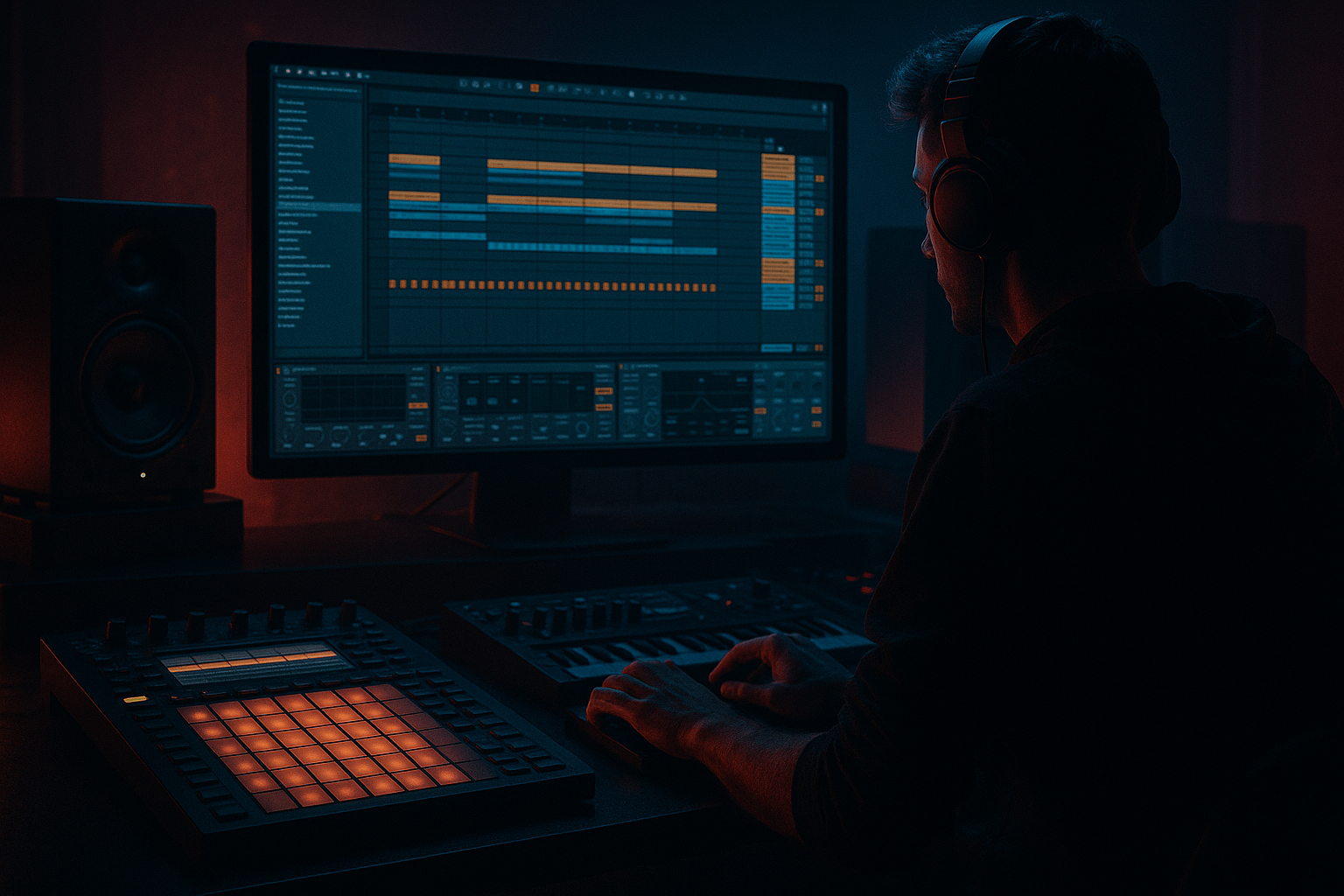
Main tutorial
Parallel Distortion for Bass Presence (DnB in Ableton Live) 🔥
1. Lesson overview
Parallel distortion is one of the fastest ways to make a drum & bass bassline feel louder, clearer, and more “in your face”—without eating all your headroom or turning the low end into mush.
Instead of distorting your whole bass (which often wrecks sub), you’ll:
- Keep a clean sub for weight
- Add a distorted mid layer in parallel for presence + translation (phones, small speakers)
- Control the blend like a DJ: clean + grit = rolling power 😈
- Sub track (clean + stable)
- Parallel distortion return (or Audio Effect Rack) focused on mids
- Optional movement (filtering/chorus) and sidechain for the groove
- Add Compressor lightly (not sidechain yet)
- Enable High-Pass filter
- Optional: a small dip if boxy:
- Mode: Analog Clip (great for DnB edge)
- Drive: start at +6 dB
- Soft Clip: ON
- Output: pull down to match level (don’t let loudness trick you)
- Frequency: 700–1.5 kHz
- Drive: 20–40%
- Tone: 40–60%
- Dynamics: 0–20% (lower = more consistent)
- Low cut again if distortion reintroduced low junk:
- Presence focus:
- Harsh control:
- Ratio: 3:1
- Attack: 10–30 ms
- Release: 50–120 ms
- Aim for 2–5 dB GR so the distorted layer stays stable.
- Width: 0% (mono) for the distortion return (keeps bass focused)
- Gain: adjust so the return isn’t overpowering
- Intro (0:00–0:32): mostly clean bass (low send)
- Drop (0:32): automate Send A up by +3 to +6 dB for impact 💥
- Second 16 bars: introduce more grit (increase Saturator Drive slightly or open EQ presence)
- Breakdown: pull the parallel return down again for contrast
- `BASS` track → Send A
- `Return A` → Saturator Drive
- `Return A` → EQ Eight HP cutoff (tighten/loosen)
- Use Roar (if you have Live 12 Suite):
- Multiband Dynamics (careful):
- Resample the return for texture control:
- Make the distortion “talk” rhythmically:
- Keep sub clean and centered:
- Parallel distortion = clean sub + distorted mids blended in
- Use a Return Track for easy control and automation
- High-pass before distortion (120–180 Hz) to protect low end
- Shape with Saturator / Overdrive, then EQ and keep it mono
- Sidechain the distortion return to keep drums punching
- Automate the parallel amount for drop impact and arrangement dynamics
You’ll do this using Ableton stock devices, with practical DnB-friendly settings.
---
2. What you will build
A simple but professional DnB bass setup with:
End result: a bass that stays solid on a system, but still cuts through busy breaks and hats.
---
3. Step-by-step walkthrough
Step 0 — Project context (DnB-ready)
1. Set tempo to 174 BPM.
2. Load a basic drum loop (Amen-style or tight 2-step) so you can judge bass presence properly.
3. Put a Spectrum on the Master (Audio Effects → Spectrum) for visual feedback.
---
Step 1 — Create a clean bass source (simple to start)
Create a MIDI track → name it `BASS`
1. Drop Operator (or Wavetable if you prefer).
2. Use a clean sine/triangle sub tone:
- Operator
- Osc A: Sine
- Level: around -12 dB (leave headroom)
3. Write a basic rolling pattern:
- Notes around F–G–A in F minor (classic DnB territory)
- Use a rhythm like:
1/8 notes with occasional 1/16 push (to bounce with the drums)
Add a Glue step for consistency:
- Ratio: 2:1
- Attack: 20–30 ms
- Release: 80–150 ms
- Aim for 1–3 dB gain reduction
Keep it clean. The magic happens in parallel.
---
Step 2 — Choose your parallel workflow (Return Track recommended) 🎛️
You have two good beginner-friendly options:
#### Option A: Return Track (best for mixing mindset)
1. Create Return Track A → rename `BASS DIST`.
2. On your `BASS` track, turn up Send A to around -12 dB to start.
#### Option B: Audio Effect Rack (best for self-contained sound design)
1. On the `BASS` track, add Audio Effect Rack.
2. Create 2 chains: `Clean` and `Dist`.
3. Leave `Clean` untouched; build distortion on `Dist`.
4. Blend using chain volumes.
For this lesson, we’ll do Return Track A (cleaner workflow, easier to reuse).
---
Step 3 — Build the parallel distortion chain (the DnB presence layer)
On `Return A (BASS DIST)` add devices in this order:
#### 1) EQ Eight (pre-filter to protect sub)
This is crucial: don’t distort sub unless you intentionally want chaos.
- Frequency: 120–180 Hz
- Slope: 24 or 48 dB/Oct
- Bell at 300–500 Hz, -2 to -4 dB (Q ~1.2)
This means your distortion is mostly mid-bass and harmonics, not the fundamental sub.
#### 2) Saturator (main grit)
Want more bite? Push Drive to +10 to +14 dB, but keep output controlled.
#### 3) Overdrive (optional extra “presence” bite)
Overdrive can add that aggressive mid bark that helps bass read on small speakers.
If it gets fizzy, we’ll tame it next.
#### 4) EQ Eight (post-shape: make it mix-ready)
- High-pass 120–180 Hz (gentler slope ok)
- Small boost at 900 Hz–2 kHz (+1 to +3 dB) if needed
- Dip around 3–6 kHz if it sounds like a wasp 🐝
#### 5) Compressor (optional: “glue” the distorted layer)
#### 6) Utility (for mono control + gain)
---
Step 4 — Blend the parallel layer properly (the key skill)
Now go back to the `BASS` track and blend Send A:
1. Start with Send A all the way down.
2. Bring it up until the bass becomes audible on quieter speakers and in the presence region.
- Typical range: -18 dB to -6 dB send level (depends on Drive)
3. Bypass the return to check:
- If bypass makes bass disappear on small speakers → you’re doing it right.
- If bypass makes no difference → add more Drive or raise the send.
- If it suddenly sounds “smaller” or distorted overall → your parallel is too loud.
DnB target: You should feel the sub, but also hear the bassline rhythm even when the kick/snare hit.
---
Step 5 — Sidechain the parallel layer for roll and punch 🥁
In rolling DnB, the bass must breathe around the kick/snare (or just the kick depending on style).
1. On `Return A (BASS DIST)`, add Compressor (if not already).
2. Enable Sidechain.
3. Choose input: your Kick track (or a ghost kick track).
4. Settings to start:
- Ratio: 4:1
- Attack: 1–5 ms
- Release: 80–140 ms
- Threshold: adjust until you get 3–6 dB reduction on hits
This keeps the distortion from masking drums (big for busy jungle breaks).
---
Step 6 — Arrangement idea (how to use this musically)
Parallel distortion is an arrangement tool, not just a mix trick.
Try this DnB structure:
Automation lanes:
---
4. Common mistakes (and quick fixes)
1. Distorting the sub
- Fix: high-pass the return at 120–180 Hz before distortion.
2. Parallel layer too loud
- Fix: reduce Send A; level-match output; use Utility to trim.
3. Harsh fizz on top
- Fix: post-EQ dip 3–6 kHz, or reduce Overdrive / Saturator Drive.
4. Phase/low-end weirdness
- Fix: keep the return mono (Utility Width 0%).
- Also avoid adding stereo wideners/chorus below ~200 Hz.
5. No improvement on small speakers
- Fix: add more mid focus (boost ~1 kHz), or increase Drive slightly.
---
5. Pro tips for darker/heavier DnB 😈
Replace Saturator + Overdrive with Roar, then:
- Split band mode (or focus band)
- Distort mids only
- Add subtle compression inside Roar
This is insane for modern neuro/dark rollers.
On the distortion return, a light Multiband Dynamics can stabilize mids.
- Don’t crush it—just tame peaks.
Freeze/Flatten the `BASS DIST` return layer (or record it to audio), then:
- chop, gate, reverse little bits for jungle grit
- automate filtering for movement
Add Auto Filter after distortion and automate cutoff slightly each bar.
Tiny motion = bigger perceived energy.
Even in filthy rollers, clean sub wins on big rigs. Let the mids be ugly; let the sub be king.
---
6. Mini practice exercise (10–15 minutes) ⏱️
1. Build the setup exactly as above (Return Track parallel).
2. Create a 2-bar bass MIDI loop with 1/8 notes and one 1/16 fill.
3. Make 3 versions by saving presets/racks:
- A: Warm Roller
Saturator Drive +6 dB, minimal EQ boost
- B: Dark Crunch
Saturator +10 dB, Overdrive on, dip 4 kHz
- C: Heavy Drop
More send automation on drop (+5 dB), stronger sidechain (6 dB GR)
Checkpoint: Play it quietly—can you still follow the bass rhythm? If yes, you nailed presence.
---
7. Recap ✅
If you want, tell me what style you’re aiming for (liquid, jungle, dark roller, neuro) and what bass source you’re using (Operator/Wavetable/sample), and I’ll suggest a tuned distortion chain and exact automation moves for a 32-bar drop.

