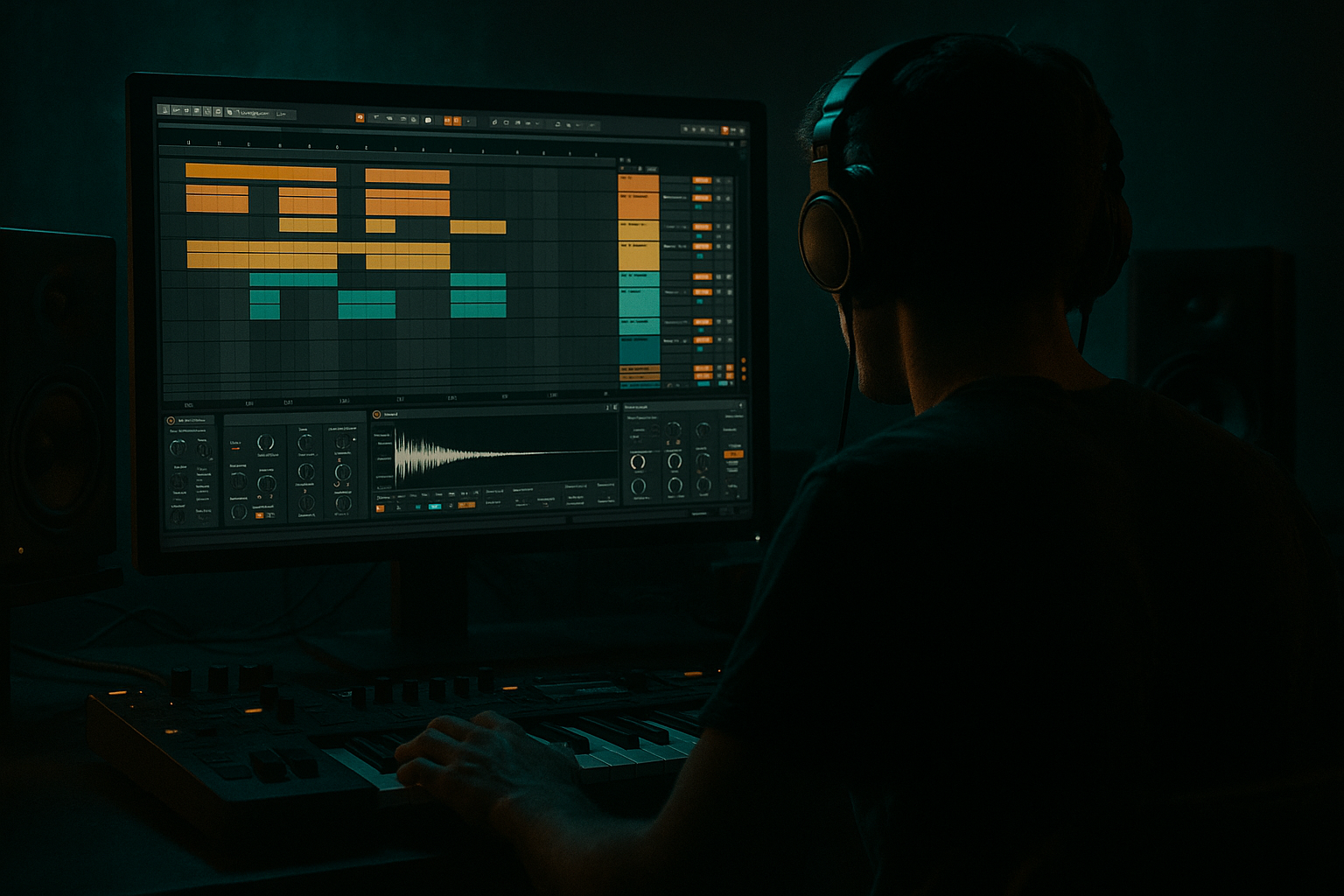
Main tutorial
Parallel Saturation for Drums (DnB @ 170 BPM) — Ableton Live Mixing Tutorial 🔥🥁
1) Lesson overview
Parallel saturation is one of the fastest ways to make drum and bass drums feel louder, denser, and more aggressive without crushing your transient punch. At 170 BPM, you need drums that cut through rolling bass and stay consistent through fast hits—parallel saturation gives you that “always-on energy” while keeping your kick/snare snap intact.
In this lesson you’ll build a dedicated parallel saturation bus for your drum group using Ableton stock devices, with a workflow you can reuse on every DnB/jungle project.
---
2) What you will build
You’ll create:
- A Drum Group (kick, snare, hats, breaks, perc)
- A Parallel Saturation Return/Send (or Audio Effect Rack inside the group)
- A device chain tuned specifically for DnB drum transients + body
- A blend system so you can automate intensity between drops, fills, and breakdowns 🎚️
- Useful if you want everything contained in one group; Return is still easier to manage across sessions.
- HPF: 24 dB/oct at 120–180 Hz
- Optional notch (if cymbals get nasty):
- Optional presence boost (if you want more “crack”):
- Drive: +6 to +12 dB (start at +8 dB)
- Soft Clip: ON
- Curve Type: try Analog Clip or Warmth
- Output: reduce so the channel isn’t massively louder (match-ish by ear)
- Turn on Color if you want more edge (use lightly).
- If you hear fizzy highs: reduce Drive a touch and rely more on parallel level instead.
- Drive: 10–25%
- Boom: 0–15%
- Damp: 10–30% (tames harshness)
- Crunch: 5–20%
- Transient: -5 to +5
- Attack: 3 ms
- Release: Auto (or 0.1–0.3 s)
- Ratio: 2:1 or 4:1
- Aim for 1–4 dB of gain reduction
- Makeup: off (match level manually)
- Use Utility Gain as your main parallel return level control.
- Optional: Width down to 0–60% if the parallel top gets too wide/phasey.
- Snare: send more (often the star of DnB)
- Break: moderate to high
- Hats/tops: subtle
- Kick: usually low
- Drop: push the parallel return up by +1 to +2 dB
- Breakdown: pull it down -2 to -4 dB for contrast
- Fills (last 1 bar): automate a brief push on the return, or increase Saturator Drive slightly for hype
- Automate Utility Gain on the return (simple + effective).
- Or automate Saturator Drive for “overheat moments” 🔥
- Create two parallel returns:
- Band-limit the dirty parallel for that “pirate radio” aggression:
- Use Roar (if you have Live 12 Suite):
- Sidechain the parallel return very lightly from the kick
- Add tiny room to the parallel only
- Parallel saturation is about adding density and aggression while preserving dry transient punch.
- At 170 BPM, it helps drums stay present and consistent against rolling bass.
- Use a Return track with a smart chain:
- Send snare + break more than kick, automate return level for arrangement energy.
- Keep the parallel mostly mid/top-focused for clean, heavy DnB impact.
End result: drums that feel thicker and more present in the mix, with controlled harshness and better perceived loudness.
---
3) Step-by-step walkthrough
Step 0 — Prep your drum routing (clean and fast)
1. Put your drum elements into a Drum Group:
- Kick
- Snare/clap layer
- Hats
- Break (Amen/think/etc.)
- Perc/fills
2. Name the group: DRUMS.
3. Set DRUMS group fader so your master has headroom (aim peaks around -6 dBFS on the master while building).
---
Step 1 — Choose your parallel method (Return track recommended)
Option A: Return track (classic + easy) ✅
1. Create a Return Track: `Create → Insert Return Track`
2. Name it: DRM SAT (PARA)
3. On your DRUMS group (or individual drum tracks), send to this return using Send A.
Why Return is great: you can send snare more than kick, or break more than tops, which is very DnB-friendly.
Option B: Audio Effect Rack inside DRUMS group
---
Step 2 — Build the parallel saturation chain (stock devices)
On DRM SAT (PARA) insert this chain in order:
#### 1) EQ Eight (pre-filtering so saturation hits the right stuff)
This is critical—don’t saturate sub/rumble and then wonder why your mix gets cloudy.
- Start at 150 Hz
- Bell at 7–10 kHz, -2 to -4 dB, Q ~2
- Bell at 2–4 kHz, +1 to +3 dB, Q ~1
DnB logic: The parallel channel is mostly for midrange density and top excitement, not low-end weight.
---
#### 2) Saturator (the core tone)
Ableton Saturator is perfect here.
Start settings:
Optional:
Goal: You want it to sound too crunchy soloed, but perfect when blended quietly under the dry drums.
---
#### 3) Drum Buss (weight + smack control)
Drum Buss is great in parallel because you can push it harder than you’d dare on the dry drums.
Start settings:
- Freq around 50–70 Hz (BUT: if you already high-passed at 150 Hz, Boom won’t do much—keep it low or bypass Boom)
- In parallel, try slightly negative transient if it gets clicky.
If it starts sounding like cardboard: lower Crunch and increase Damp.
---
#### 4) Glue Compressor (optional, but very DnB-useful)
This is for “gel” and density, not for smashing.
Start settings:
Tip: If your snare loses snap, slow attack to 10 ms or reduce GR.
---
#### 5) Utility (blend + safety)
- Jungle breaks often sound cool wide, but too wide parallel can smear hats.
---
Step 3 — Dial the sends (the DnB sweet spot)
Now choose what you send to the parallel chain:
- Try -10 to -6 dB send level
- Try -12 to -8 dB
- Try -18 to -12 dB
- Try -inf to -18 dB
- Many DnB kicks get messy when saturated in parallel unless carefully filtered.
Workflow move: Start with snare only, get it feeling huge, then bring in break, then tops.
---
Step 4 — Set timing/arrangement awareness at 170 BPM ⏱️
At 170, the groove is tight. Parallel saturation can make ghost notes and fast hats feel louder—great, but manage it musically.
Arrangement automation ideas:
In Ableton:
---
Step 5 — A/B properly (don’t get fooled)
1. Toggle return track mute on/off.
2. Match loudness by ear: if “on” is just louder, you’ll overdo it.
3. Listen in context with bass:
- Parallel saturation should help drums sit on top of the bass without needing harsh EQ boosts.
---
4) Common mistakes ❌
1. Saturating low end on the parallel bus
- This adds mud and steals headroom fast. High-pass the parallel path.
2. Over-widening the parallel
- Wide distorted hats can cause phase issues and weak mono playback.
3. Too much compression after saturation
- You lose transient definition and the groove feels flat at 170.
4. Sending everything equally
- DnB works best when you “feature” the snare + break character.
5. No gain staging
- Saturator + Drum Buss + Glue can clip internally; keep levels controlled.
---
5) Pro tips for darker/heavier DnB 😈
1) SAT MID (Clean-ish): Saturator + light Glue
2) SAT DIRTY (Dark): EQ (bandlimit) → Overdrive → Saturator → Redux (tiny) → Utility
Blend them for controlled filth.
- EQ Eight on the dirty return:
- HPF 200 Hz
- LPF 8–10 kHz
This keeps grit in the mids where it reads as “heavy” without sizzling.
- Roar is insane for parallel drum aggression.
- Try a simple setup: Warm mode, Drive moderate, mix low, filter before/after.
- Use Compressor on the return, sidechain from Kick:
- Ratio 2:1, fast-ish attack, release 50–120 ms
This can keep the kick clean while the snare/break stays thick.
- Reverb (short 0.2–0.4s, low mix) can add “glue air” without washing the dry drums.
---
6) Mini practice exercise 🎯
Goal: Make a rolling 170 BPM beat feel louder and nastier without losing punch.
1. Load:
- A clean kick
- A snare (layer if you want)
- A break loop (Amen/Think)
- Closed hats (16ths or syncopated)
2. Build the DRM SAT (PARA) return as described.
3. Start with sends:
- Snare: -8 dB
- Break: -10 dB
- Hats: -14 dB
- Kick: off
4. Do a 16-bar arrangement:
- Bars 1–8: baseline groove
- Bars 9–16: add 1-bar fill at bar 16
5. Automate:
- Return Utility Gain:
- +1.5 dB on bars 9–16
- +3 dB for the last 1/2 bar before the drop/fill
6. Bounce a quick render and check:
- Does the snare feel bigger without getting painfully sharp?
- Do ghost notes come alive without turning into mush?
---
7) Recap ✅
- EQ Eight (HPF) → Saturator → Drum Buss → (optional) Glue Compressor → Utility
If you want, tell me what your drum sources are (clean one-shots vs break-heavy, neuro vs jungle, etc.) and I’ll suggest exact send balances and a darker/neuro-style parallel chain tailored to your kit.

