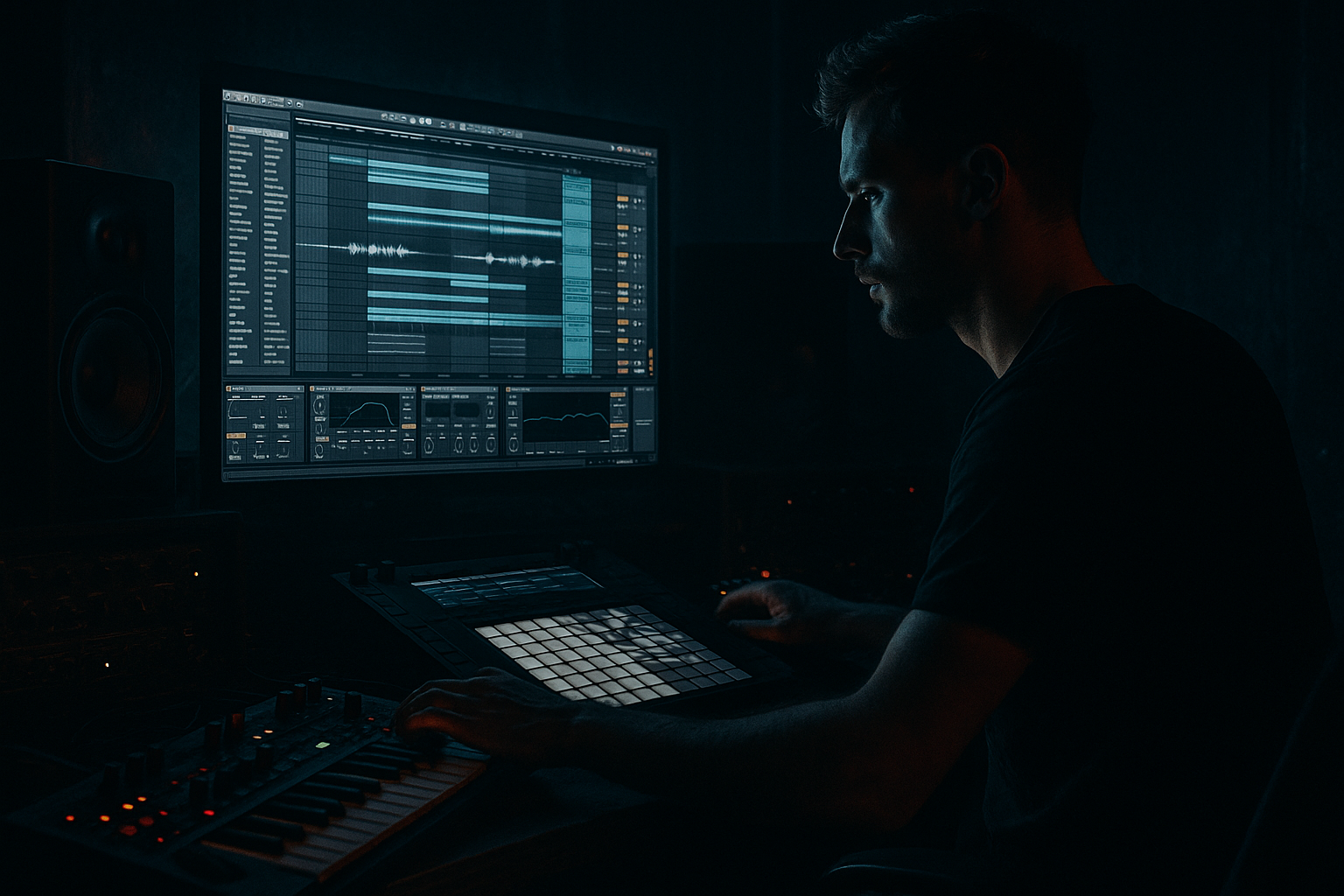
Main tutorial
Parallel Saturation for Drums (DnB in Ableton Live) — Smoky Late‑Night Mood 🌙🔥
1) Lesson overview
Parallel saturation is one of the fastest ways to make drum and bass drums feel thicker, louder, and more “alive” without destroying your transients. Instead of saturating your main drum signal directly, you’ll blend in a distorted/saturated copy underneath.
In late-night, smoky rolling DnB, the goal is usually:
- Tight, punchy transients (kick/snare still snap)
- Warm grit and density (the “club haze” layer)
- Controlled highs (no fizzy harshness)
- Glue and forward motion (ghost notes and tops feel closer)
- Keep it fairly clean at first.
- Aim for peaks around -6 dBFS on the group meter (gives headroom for saturation).
- Use it as your “output trim” later.
- On `DRUM BUS` channel, raise Send A to start around -18 to -12 dB.
- Blend until you feel thickness when it’s on, and miss it when it’s off.
- Start with Send B at -20 to -14 dB from hats, breaks, and sometimes snare.
- Usually less kick into this layer (kick can get clicky).
- Individual drum tracks (kick/snare/hats/breaks separately) ✅ best control
- Or the DRUM BUS group (quick and simple)
- Kick: mostly Warm Smash, little/no Grime Air
- Snare: both (snare loves parallel grit)
- Hats/tops: mostly Grime Air, tiny Warm Smash
- Break layer: both, but watch harshness
- Drop: push `Warm Smash` return up 1–2 dB for impact.
- Second 16 bars: introduce `Grime Air` slowly (automation on Send B) to increase tension.
- Breakdown: pull both returns down, then slam back in for the drop.
- Halftime switch: reduce highs on the returns (Auto Filter cutoff down) for a darker section.
- Automate Send A / Send B on key drum elements or the group.
- Automate the Saturator Drive slightly (+2 dB more at drop) for extra urgency.
- Over-saturating the full-range signal
- Crushing transients on the main bus
- Sending everything equally
- No EQ before saturation
- Making the return too wide
- Keep the distortion mid-focused: HP around 200–350 Hz on the grime layer keeps subs clean.
- Use subtle compression after saturation: it “prints” the grit into a steady layer.
- Clip the parallel, not the main: Saturator Soft Clip on the return can add loudness illusion safely.
- Sidechain the parallel layer slightly from the kick:
- Breaks love band-limited crunch: A tiny Redux/Overdrive layer can make breaks feel like vinyl-era jungle—perfect for smoky mood.
- Parallel saturation = clean transients + blended grit.
- Build two returns:
- Send strategically per drum element, and automate for arrangement energy.
- Control harshness with band-limiting and post-EQ, not by avoiding saturation.
We’ll build this from scratch using stock Ableton devices.
---
2) What you will build
You’ll create a clean drum bus plus two parallel return layers:
1. Warm Smash (Body) — adds low-mid weight and thickness
2. Grime Air (Texture) — adds midrange bite/character without harsh top
You’ll end with a controllable drum sound that fits rolling/steppy DnB, jungle breaks, and halftime sections.
---
3) Step-by-step walkthrough
Step 0 — Prep your drums (DnB context)
1. Set tempo: 172–176 BPM.
2. Build a simple 2-bar DnB loop:
- Kick on 1, snare on 2 and 4
- Add hats/shakers 1/16s or shuffled 1/16s
- Add a break layer (optional): e.g., chopped Amen or classic break under your one-shots
Ableton tip: Group all drum tracks into a Drum Bus Group (Cmd/Ctrl+G). Name it: `DRUM BUS`.
---
Step 1 — Route your drum bus cleanly
On the `DRUM BUS` group:
Add a Utility at the end of the group chain:
---
Step 2 — Create a Return track for parallel saturation (Warm Smash)
1. Create Return Track A (Right click in Return area → Insert Return Track).
2. Name it: `A - Warm Smash`.
On `A - Warm Smash`, build this chain (all stock):
#### Device Chain: Warm Smash (Body)
1. EQ Eight (pre-filtering going into saturation)
- Turn on HP filter at 30–40 Hz (24 dB/oct)
Why: avoid saturating useless sub rumble.
- Gentle LP filter at 10–12 kHz if your drums are bright
Why: smoky mood = less fizz.
2. Saturator
- Mode: Analog Clip
- Drive: +4 to +8 dB
- Soft Clip: ON
- Output: pull down so the Return doesn’t jump in volume (start around -4 dB)
- Optional: click Color (if available in your version) for extra tone shaping.
3. Drum Buss
- Drive: 5–15%
- Crunch: 0–10% (keep it subtle for “smoke,” not “sandpaper”)
- Boom: 0–15%
- Frequency: 50–80 Hz (DnB kick weight zone depends on your kick)
- Transients: -5 to -15 (yes, reduce transients on the parallel so the main stays punchy)
4. Glue Compressor (to thicken the sustain)
- Attack: 10 ms
- Release: Auto (or 0.3 s)
- Ratio: 4:1
- Threshold: aim for 3–6 dB of gain reduction
- Makeup: as needed, but don’t chase loudness here
5. EQ Eight (post shaping)
- Pull a little 250–400 Hz if it gets boxy (1–3 dB)
- Optional gentle shelf down 8–12 kHz if it’s bright
✅ Now set the return send amount from your drum tracks or drum bus:
Important: This is parallel. The return should be felt more than obviously heard.
---
Step 3 — Add a second parallel layer for darker “grime” (Grime Air)
Create Return Track B and name it: `B - Grime Air`.
#### Device Chain: Grime Air (Texture)
1. EQ Eight (band-limit so it sits like a layer)
- HP filter: 200–350 Hz (24 dB/oct)
- LP filter: 6–9 kHz (24 dB/oct)
This keeps it mid-focused and dark.
2. Overdrive
- Freq: 700 Hz – 1.5 kHz
- Drive: 20–45%
- Tone: 30–45% (lower tone = darker)
- Dynamics: 30–60%
- Dry/Wet: 100% (it’s a parallel return, so keep device wet)
3. Redux (optional, for jungle-ish crunch)
- Downsample: 2.0 – 6.0
- Bits: 10–14
- Dry/Wet: 10–25%
Very small amounts = “cigarette paper” texture, not videogame noise.
4. Auto Filter (movement = late-night vibe)
- Filter type: Lowpass
- Frequency: 4–8 kHz
- Resonance: 0.8–1.2
- Envelope: tiny (0–5%)
- LFO: Amount 5–15%, Rate 0.10–0.25 Hz (slow drift)
5. Utility
- Width: 70–110% (keep it controlled; don’t go ultra-wide)
- Gain: use as final trim
Send into `B - Grime Air` lightly:
---
Step 4 — Decide where to send from (best practice routing)
You can send to returns from:
DnB approach suggestion:
---
Step 5 — Make it “smoky late-night” in the arrangement 🎚️
Parallel saturation can be automated like an instrument.
Try these arrangement moves:
In Ableton:
---
Step 6 — Gain staging (don’t skip this!)
Parallel chains can trick you into thinking “better” just because it’s louder.
Quick method:
1. Toggle the return track mute.
2. Match perceived loudness:
- If it’s louder with the return on, trim return Utility Gain down.
3. Keep Drum Bus peaks still roughly around -6 to -3 dBFS before master processing.
---
4) Common mistakes 🚫
If you don’t band-limit, the top end gets fizzy and the low end smears.
Saturate in parallel so your kick/snare still hit clean.
Kick ≠ hats ≠ breaks. Different send amounts are what make it pro.
Saturators exaggerate whatever you feed them.
Wide distortion can mess up mono compatibility and club translation.
---
5) Pro tips for darker/heavier DnB 🖤
- Add Compressor on the return
- Sidechain from kick
- 1–3 dB GR
This keeps the groove breathing and avoids low-end masking.
---
6) Mini practice exercise (15 minutes) ⏱️
1. Use a basic pattern: kick + snare + hats + break loop.
2. Build Return A (Warm Smash) exactly as above.
3. Build Return B (Grime Air) exactly as above.
4. Do three mixes (save versions):
- Version 1: Only Warm Smash (Send A)
- Version 2: Only Grime Air (Send B)
- Version 3: Both, but automate Send B up in the 2nd half of the loop
5. Export 8 bars of each and compare:
- Does the snare feel fuller without getting louder?
- Do hats feel closer without getting harsh?
- Does the groove stay punchy?
---
7) Recap ✅
- Warm Smash for body (Saturator → Drum Buss → Glue → EQ)
- Grime Air for texture (EQ band-limit → Overdrive/Redux → Filter movement)
If you want, tell me what drum sources you’re using (clean one-shots, breaks, or both) and I’ll suggest exact send targets and a starting point for your kick/snare EQ so the saturation lands perfectly in a rolling DnB mix.

