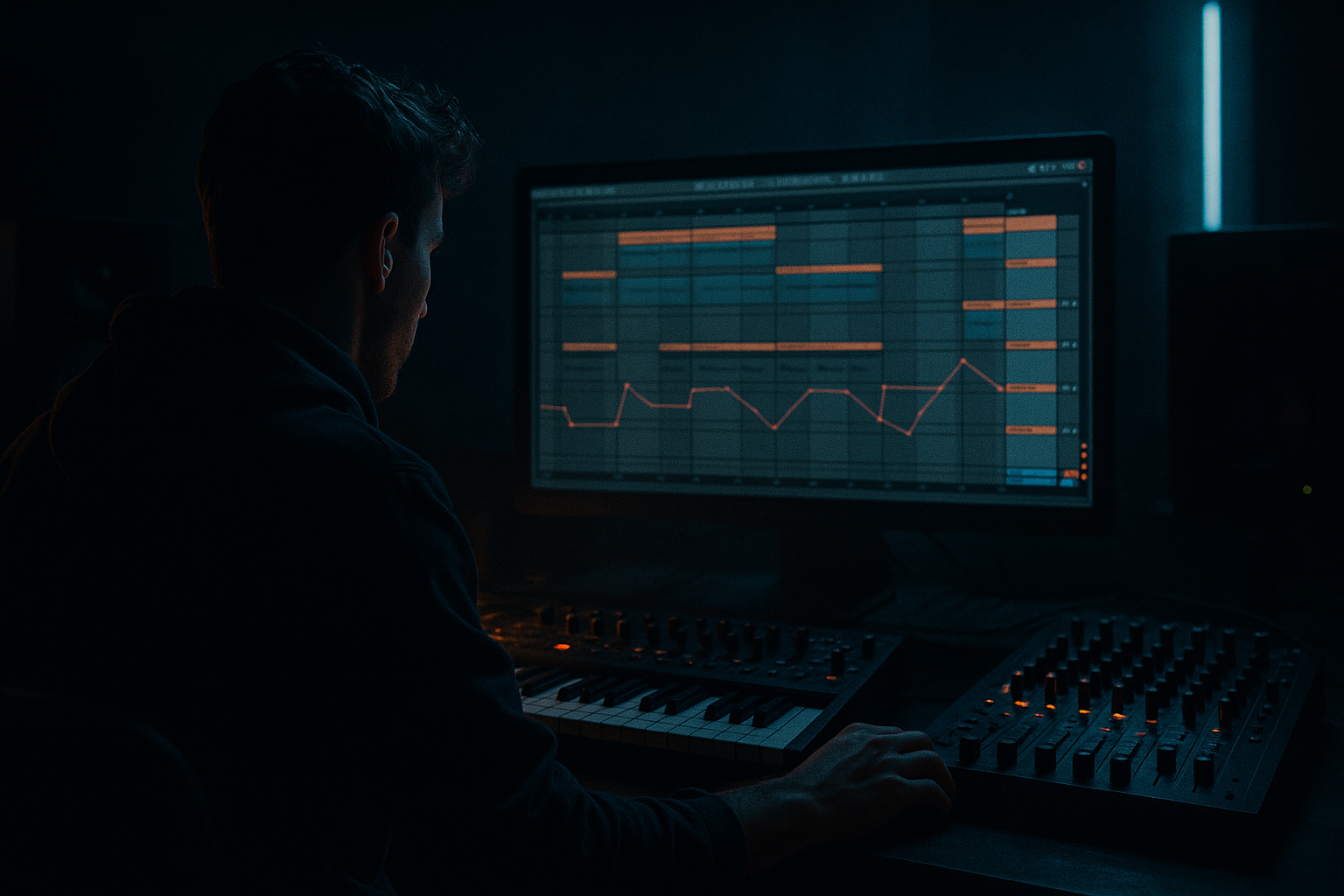
Main tutorial
```markdown
Percussion Density & Perceived Groove (Advanced DnB in Ableton Live)
1) Lesson overview
Percussion density isn’t just “more hits = more energy.” In drum & bass, where you add density (and where you remove it) shapes perceived groove, forward motion, and how “rolling” the track feels. Today we’ll focus on building controlled density using Ableton Live stock tools—so your drums feel busy, but never cluttered. 🥁⚡
You’ll learn:
- How to layer density across time ranges (1/16, 1/32, micro-ghosts) without smearing the groove
- How to use velocity, swing, and micro-timing to make density feel musical
- How to “sidechain the density” (dynamic control) so the kick/snare remain dominant
- Arrangement tactics: density ramps, fill placement, call/response between hats and percussion
- Tight kick + snare backbone (2-step foundation)
- Ghost notes that imply shuffle without messing the grid
- Hat system: anchor hat + density hat + texture hat
- Perc layer (rim/clave/shaker) that adds motion but ducks out of the way
- A “density automation lane” so the groove evolves across 16–32 bars
- Bar loop: 1 bar
- Place kick on 1.1.1
- Add a second kick either:
- Place snare on 1.2.1 and 1.4.1 (DnB standard)
- Put Drum Rack on Kick and Snare tracks (separate racks or simpler: Simpler).
- Add Drum Buss on Snare (not the whole bus yet):
- Closed hat on 1/8 notes (straight) or 1/16 offbeats depending on subgenre.
- Start simple: 1/8 offbeats:
- Velocity alternating: 85 / 70 / 85 / 70
- Tiny timing: leave it mostly grid-locked for now.
- Add 1/16 hats, but not continuous. Use bursts.
- Keep these quieter:
- Add Auto Filter (stock) to this hat layer:
- Use Utility with automation:
- Or use Corpus subtly (yes, really):
- Add very low-velocity snare ghosts before the main snare:
- Velocity: 10–30
- Timing: nudge slightly late (1–6 ms) for a lazy pull, or slightly early for urgency.
- Turn off grid temporarily: `Ctrl/Cmd + 4`
- Use nudge: select notes → `Alt` drag, or adjust in the Note panel (Start time).
- EQ Eight: high-pass at 200–400 Hz
- Saturator: tiny drive 1 dB
- Optional: Gate keyed by the ghost track itself if it’s too messy
- Put a rim/clave on 1.1.2 (sets forward lean)
- Another on 1.2.4 (answers the snare)
- A quiet one on 1.4.4 (leads into the next bar)
- Strong → medium → soft (e.g., 80 / 55 / 35)
- Add Groove Pool swing subtly:
- Add Compressor
- Enable Sidechain
- Sidechain input: Snare track
- Settings:
- Put Multiband Dynamics on Density Hat
- Use only the High band (above ~5 kHz) to clamp slightly on snare hits (via sidechain compressor before it, or manual automation).
- Bars 1–4: backbone + anchor hat only (clean)
- Bars 5–8: introduce ghost snare + light perc (subtle movement)
- Bars 9–12: add density hat bursts (beats 3–4)
- Bars 13–16: add a micro-fill (1/32 roll, reverse hat, or break slice)
- Automate Utility Gain on Density Hat track (the “Density Fader”)
- Automate Auto Filter cutoff on hats (opening = excitement)
- Use Clip Envelopes for per-clip variation (super fast for DnB)
- Add an Amen-style break (or any crisp break) as a low-level texture.
- High-pass it at 200–400 Hz so it doesn’t fight kick/snare.
- Gate it rhythmically if needed:
- Use density to imply menace, not sparkle:
- Saturate selectively, not globally:
- Transient control on busy hats:
- Make space for reese/sub movement:
- “Dread” groove trick:
- Percussion density is a groove design tool, not just an energy knob.
- Use a hat system (anchor/density/texture) to control complexity cleanly.
- Make ghosts barely audible and use micro-timing to steer the pocket.
- Protect kick/snare with sidechain ducking and smart frequency management.
- Arrange density in waves across 16–32 bars for rolling progression. 🚀
---
2) What you will build
A rolling DnB drum section (think modern roller / jungle-informed), with:
Target tempo: 172–176 BPM.
---
3) Step-by-step walkthrough
Step 0 — Session + routing setup (5 minutes)
1. Set tempo: 174 BPM
2. Create tracks:
- DRUMS BUS (Audio Track)
- Kick (MIDI)
- Snare (MIDI)
- Hats (MIDI)
- Perc (MIDI)
- Break Layer (Audio) (optional but very DnB)
3. Route all drum tracks to DRUMS BUS (set their “Audio To” → DRUMS BUS).
4. On DRUMS BUS, start with this stock chain:
- Glue Compressor
- Attack: 3 ms
- Release: Auto
- Ratio: 2:1
- Threshold: aim for 1–2 dB GR (don’t smash yet)
- Saturator
- Drive: 1–3 dB
- Soft Clip: On
- EQ Eight
- HP filter: 25–30 Hz (24 dB/oct)
- Gentle dip if harsh: -1 to -2 dB @ 6–9 kHz (wide Q)
Why: This gives you a consistent “bus feel” while you build density.
---
Step 1 — Lock the backbone (kick + snare that never lies)
You want density around the backbone, not replacing it.
Kick pattern (classic 2-step-ish):
- 1.3.3 (common roller push), or
- 1.3.1 (more open), depending on vibe
Snare:
Device suggestion (stock):
- Drive: 2–6
- Crunch: 5–15%
- Boom: Off (unless you need body; if on, keep low)
✅ Rule: Kick and snare should read clearly even when you mute everything else.
---
Step 2 — Build a 3-layer hat system (anchor → density → texture)
This is where perceived groove lives. 🎛️
#### 2A) Anchor Hat (steady reference)
On Hats track:
- 1.1.3, 1.2.3, 1.3.3, 1.4.3
Humanization:
#### 2B) Density Hat (fills the gaps)
Duplicate the hat lane to a second chain in the same Drum Rack (or use a second MIDI track).
- Example: add 1/16 hats only in the last half of bar (beats 3–4).
- Velocity range: 25–55
- Filter: HP
- Freq: 4–8 kHz
- Drive: 0–3
This makes density air-like instead of mid-heavy.
#### 2C) Texture Hat (movement without “more hits”)
Add a third hat/shaker, but instead of more notes, add modulation:
- Gain: automate -inf to -10 dB for “ghost entrances”
- Type: Tube/Beam
- Dry/Wet: 5–12%
- Tune: match key-ish (or just by ear)
This creates perceived complexity without spamming MIDI.
---
Step 3 — Ghost notes: the secret engine of “rolling”
Ghosts must be felt, not heard.
On Snare track (or separate Ghost Snare track):
- Place ghosts around 1.1.4 and/or 1.3.4
Ableton workflow:
Processing for ghosts (stock):
✅ If you mute the main snare and only hear ghosts clearly, they’re too loud.
---
Step 4 — Perc layer: call/response, not constant chatter
On Perc track, pick a rim/clave/conga tick. Jungle and rollers love this. 😈
Pattern idea (1 bar):
Velocity contour:
Make it groove-friendly:
- Try Swing 16-55 or MPC 16 Swing (very light)
- Apply only to Perc and Density Hat, not kick/snare.
- Timing: 10–20%
- Velocity: 0–10% (don’t randomize too much)
- Random: 0–5%
---
Step 5 — Control density with dynamics (so it doesn’t flatten your mix)
Density often reads as “groove” until it starts fighting the snare transient.
#### Sidechain your density layers from the snare (stock Compressor)
On Density Hat and Perc tracks:
- Ratio: 2:1 to 4:1
- Attack: 1–3 ms
- Release: 60–120 ms (tune to bounce)
- Threshold: aim for 1–4 dB GR on snare hits
This keeps the snare as the “speaker,” while the density becomes “room tone.”
#### Multiband trick: duck only the harshness
Instead of full-band ducking:
This keeps shimmer but avoids sizzling over your snare crack.
---
Step 6 — Arrange density like a DJ-friendly weapon (16–32 bars)
DnB grooves thrive on evolving repetition.
16-bar plan:
Ableton tools:
Optional jungle flavor: Break Layer
- Gate with sidechain from a hat pattern for “chopped air”
---
4) Common mistakes
1. Constant 1/16 hats at the same velocity → sounds like a drum machine treadmill, not a roller.
2. Swing on kick/snare → your backbone loses authority (unless you really know the pocket you want).
3. Ghost notes too loud → the snare feels weak and your groove gets “papery.”
4. Density in the wrong frequency range → midrange percussion builds mud and masks bass presence.
5. No arrangement strategy → the groove feels static even if it’s busy.
---
5) Pro tips for darker/heavier DnB 🖤
Low-pass some hat layers to 6–10 kHz and push a gritty mid texture (2–5 kHz) carefully.
Put Saturator on Perc and Break Layer with Soft Clip on, but keep clean transient on snare.
Use Drum Buss on hats with:
- Transients: -5 to -15 (tames spikiness)
- Drive: small
Sidechain density layers from Kick AND Snare if your bass is aggressive. Heavy rollers need that headroom.
Put a tiny late offset (3–8 ms) on percussion after the snare (like 2.2-ish hits). It creates a dragging, heavy pocket without slowing tempo.
---
6) Mini practice exercise (15–25 minutes)
Goal: Create three versions of the same 8-bar loop with different perceived groove—without changing kick/snare placement.
1. Build your backbone (kick/snare) and anchor hat.
2. Duplicate the loop 3 times (A, B, C).
3. In A: Add density via more notes (1/16 bursts).
4. In B: Add density via velocity + micro-timing (same note count as A, but fewer actual hits).
5. In C: Add density via texture + modulation (Auto Filter movement, Corpus/room tone, break layer whisper), minimal added hits.
6. Level match all three (very important).
7. A/B/C test: Which one feels “fastest”? Which one feels “heaviest”? Which one feels most “expensive”?
---
7) Recap
If you want, tell me your substyle (liquid, neuro, jungle, minimal roller) and I’ll suggest a specific 1-bar density blueprint + swing/micro-timing values that match it.
```

