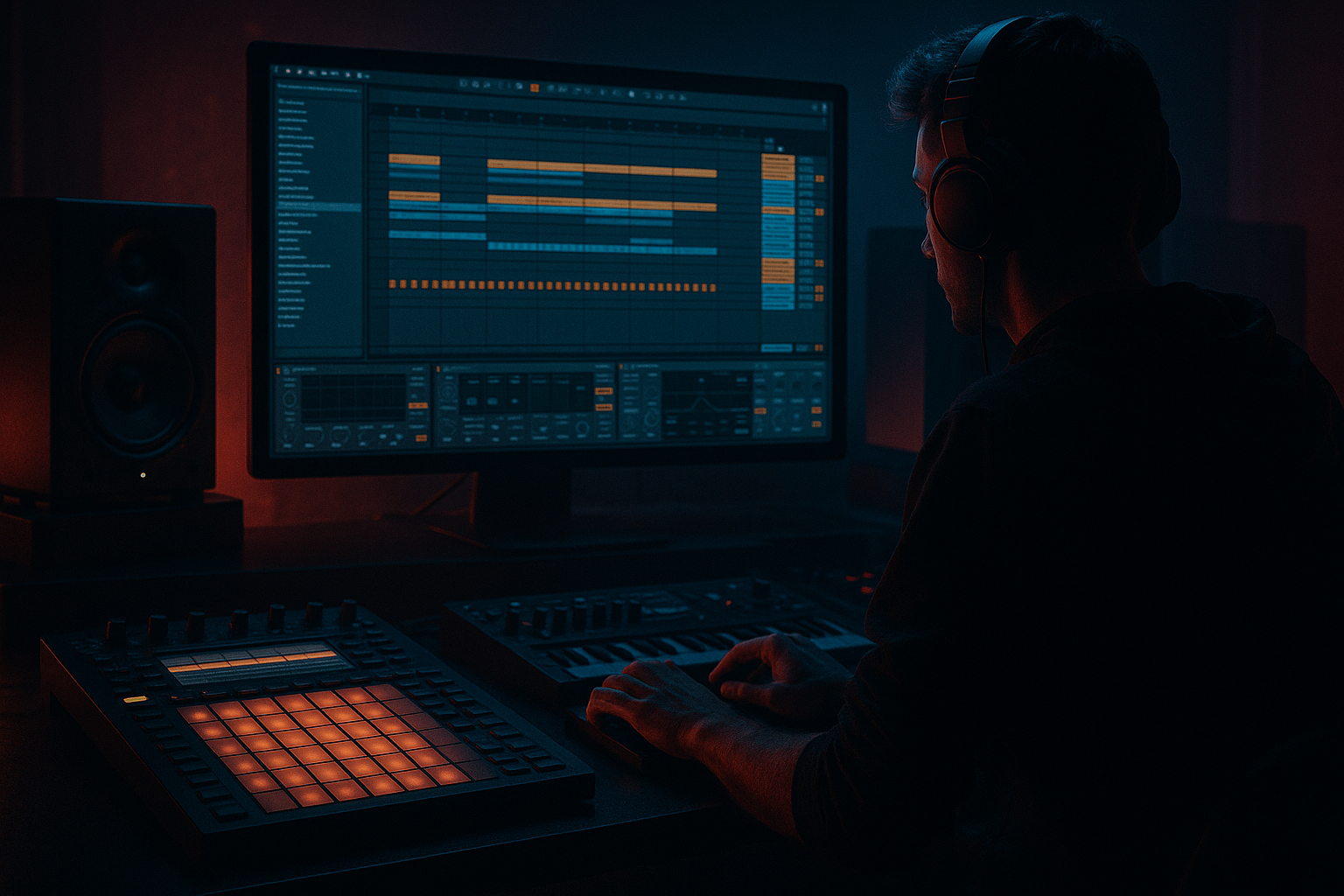
Main tutorial
```markdown
Percussion Mute Choreography with Automation (DnB in Ableton Live) 🔥🥁
1) Lesson overview
“Mute choreography” is the art of strategically cutting percussion elements in and out to create tension, groove variation, and impact—without constantly adding new sounds. In drum & bass, where patterns can loop for long stretches, micro-arrangement and automated mutes keep your drums feeling alive and “DJ-friendly” while still hitting hard.
In this lesson you’ll learn multiple Ableton Live-native ways to automate percussion muting (safe + musical), plus how to arrange these moves like proper rolling/jungle energy. ⚙️
---
2) What you will build
A 16–32 bar rolling DnB drum arrangement where:
- Hats, rides, ghosts, and fills are muted/unmuted with intention
- Transitions are powered by automated cuts + reverb throws
- Drops and reloads feel heavier because percussion “breathes”
- You have a repeatable workflow template you can reuse in every track
- A Drum Group with clean sub-groups (Kick/Snare, Hats, Perc, FX)
- Mute automation lanes (or better alternatives) that are stable in arrangement
- A few “performance macros” for quick writing and live-style edits 🎛️
- Tempo: 172–176 BPM
- Grid: set 1/16 (and toggle triplets when doing jungle-ish rolls)
- Create a Drum Bus group (Cmd/Ctrl + G) containing:
- Snare on 2 and 4
- Kick pattern: keep it simple (2–4 kicks per bar) with variation every 2 bars
- Closed hats on offbeats (1/8) and add 1/16 hats for roll
- Add occasional open hat at the end of bar 4/8
- Ghost snare notes around the main snare (low velocity)
- A rim/wood hit or short foley on syncopations
- Use Drum Rack for hats/percs so you can automate groups easily later.
- For groove: apply Groove Pool (try Swing 16-XX lightly at 10–20%).
- Reliable in Arrangement
- No surprise behavior with returns/sidechain
- Easy to “half-mute” (e.g., -12 dB) for subtle dips
- Duplicate the clip and remove notes for “mute” sections.
- Or use clip envelope for Utility Gain / Filter.
- Full hats + percs
- Keep it “roll-ready”
- Hats dip to -10 to -14 dB for half a bar
- Perc stays in → groove continues, but energy shifts
- Full hat mute for 1/4 or 1/2 bar right before the snare
- Add a tiny reverb throw on a hat hit (see Step 5)
- Bring hats back but filter slightly up (HP around 200–350 Hz) for a lighter feel
- Automate small “stutters”: mute hats for 1/8 on bar 11 beat 4
- Blackout hats + percs for 1 beat
- Let kick/snare smack alone (classic DnB drama) 😈
- On Hats Utility: draw automation shapes (0 dB ↔ -inf)
- On Perc Utility: do fewer mutes; keep the “glue” going
- On Auto Filter: automate Frequency up slightly in build sections
- Always use a tiny fade in the automation curve (5–20 ms).
- If using sends (Reverb/Delay), consider muting the send amount too.
- Utility ramp (manual curve)
- Reverb: keep Decay short for drums (0.6–1.2s) unless throwing
- Delay: use Echo with Filter on to keep it dark
- Put a Compressor after Hybrid Reverb on the return, sidechained to the kick/snare for pumping control.
- You can write automation like you’re performing a mix.
- Great for building 64–128 bar arrangements quickly.
- Intro (DJ mixable): hats filtered + sparse percs, gradual unmute
- First drop: full tops, minimal mutes (let it roll)
- Mid-16: add 1–2 “air pockets” (1/8–1/2 bar)
- Breakdown: remove hats entirely, keep ghosts/foley + reverb throws
- Second drop: more aggressive mutes + more frequent punctuation
- Outro: reverse of intro—strip tops out in stages
- Mute tops to reveal distortion character:
- Use “negative space” before the snare:
- Dark tops during heavy bass phrases:
- Parallel crush for returns only:
- Ride control:
- Resample drums to audio and try the same choreography with clip gain automation.
- Mute choreography is arrangement energy control for rolling DnB 🥁
- Best workflow: Utility Gain automation (clean, reliable), plus Auto Filter for tonal fades
- Use short ramps to avoid clicks
- Add reverb throws so mutes feel cinematic instead of empty
- Build patterns in 8/16-bar phrases with 2–4 intentional “edits” per phrase
You’ll end up with:
---
3) Step-by-step walkthrough
Step 0 — Session setup (fast but important)
- Kick + Snare track (or a Drum Rack)
- Hats track
- Perc/Ghosts track
- FX track (noise sweeps, crashes, impacts)
Why: You’ll choreograph mutes across layers, not randomly per track.
---
Step 1 — Build a solid “rolling base” percussion loop (8 bars)
Create an 8-bar loop first. Example DnB percussion structure:
Kick/Snare:
Hats:
Perc/Ghosts:
Ableton stock suggestions:
---
Step 2 — Pick the right “mute method” (avoid the common trap)
You can automate track mute, but it’s not always the most musical or stable way—especially when resampling, exporting stems, or changing routing.
Here are four practical mute methods, from safest to most “performance-y”:
#### Method A (Recommended): Utility gain automation 🎚️
On your Hats track (and Perc track):
1. Add Utility as the first device.
2. Automate Gain from `0 dB` down to `-inf dB` for “mute”.
3. Add tiny ramps (5–20 ms) to avoid clicks.
Why it’s great:
#### Method B: Auto Filter “DJ-style cut” 🧼
1. Add Auto Filter.
2. Use High-Pass mode (12 or 24 dB/oct).
3. Automate Frequency up to 300–800 Hz to thin hats/percs or “mute” low content.
4. Combine with a Utility gain dip for “full blackout” moments.
DnB use: perfect for making the groove feel like it’s being “pulled back” before a snare.
#### Method C: Gate with automation (rhythmic muting) 🚪
1. Add Gate on hats.
2. Set Threshold so it opens normally.
3. Automate Threshold high to force it shut (“mute”), or automate Return for texture changes.
DnB use: tight, choppy hat drops—works great for neuro/techy sections.
#### Method D: Clip-based mutes (for loop-based writing) ✂️
If your hats are MIDI:
DnB use: good for building 64-bar arrangements quickly without messy lanes.
✅ For this lesson, use Method A + a touch of Method B.
---
Step 3 — Create a “Mute Choreography Map” (16 bars)
Think like a DJ and like a drummer. Your goal: contrast.
Here’s a practical 16-bar plan (copy this vibe):
Bars 1–4 (establish groove):
Bar 5 (micro-dip):
Bar 8 (pre-phrase punctuation):
Bars 9–12 (variation):
Bar 16 (transition moment):
Implementation:
---
Step 4 — Make it clean: avoid clicks + keep tails controlled
When you hard-mute percussion, two issues happen:
1) Clicks/pops (zero-crossing problem)
2) Reverb/delay tails still going (mud)
Do this:
Stock tools:
---
Step 5 — Add “reverb throw mutes” (signature DnB move) 🌌
This is a huge part of percussion choreography: you mute the dry sound but let a processed tail carry the moment.
Setup:
1. Create a Return track: A – Throw Verb
2. Put Hybrid Reverb (or Reverb) on it:
- Hybrid Reverb: Plate or Hall
- Decay: 1.8–3.5s (longer than normal)
- High-pass: 250–500 Hz
- Low-pass: 6–10 kHz
3. On the Hat track, automate Send A up briefly on a single hat hit (or last 1/16 before a mute).
4. Immediately after, mute the hats with Utility.
Result: the hats disappear but the space blooms—perfect for pre-drop tension.
Optional polish:
---
Step 6 — Macro-ize it for fast writing (performance workflow) 🎛️
If your hats/percs live in a Drum Rack or group:
1. Group your Hat chain (Cmd/Ctrl + G).
2. Map a Macro to Utility Gain (or the on/off of Utility).
3. Name it: `HATS MUTE`
4. Repeat for `PERC MUTE`, `TOPS HP`, `THROW SEND`.
Why it’s powerful:
---
Step 7 — Arrangement ideas (how DnB sections actually use mutes)
Use mute choreography to signal sections:
A good rule:
> If your drums loop for 8 bars, add at least 2 deliberate percussion “edits” inside that 8.
---
4) Common mistakes
1. Muting too much, too often
If everything is cutting out, nothing feels special. Use mutes like punctuation, not constant stuttering.
2. Muting the “glue” layer
Often your ghost/snare texture or quiet shaker is what holds the roll together. Don’t kill all motion at once.
3. Clicks from hard cuts
Fix with short automation ramps or use Utility instead of track mute.
4. Reverb wash building up
If you do throw verbs without filtering/HP, you’ll cloud the mix fast.
5. Automation chaos
Keep a system: hats mutes on one lane, percs on another, filter on another. Name lanes and color tracks.
---
5) Pro tips for darker/heavier DnB 😈
When you cut hats for a beat, the midrange of the snare + bass grit feels bigger. Great for neuro/techstep vibes.
Muting hats for the last 1/8 before snare 2 or 4 makes the snare feel like it jumps forward.
Automate Auto Filter low-pass on hats down to 7–10 kHz when the bass does complex movement. Less hash = more weight.
Put Saturator (Soft Clip on) after Hybrid Reverb on the return—subtle drive makes throws feel expensive.
If you have rides, don’t full mute—dip to -6 to -12 dB so the track doesn’t lose forward motion.
---
6) Mini practice exercise (15–20 minutes)
1. Make a 8-bar drum loop (kick/snare + hats + percs).
2. Duplicate it to 16 bars.
3. Add Utility to hats and percs.
4. In bars 1–16, create:
- Three hat mutes: 1/8, 1/4, and 1 beat (different locations)
- One perc mute (short) so the groove doesn’t collapse
- One reverb throw right before a 1-beat hat blackout
5. Listen and ask:
- Does the groove still roll when hats cut?
- Do the mutes feel intentional (like a DJ edit), not random?
Bonus:
---
7) Recap
If you want, tell me your current drum layout (separate tracks vs Drum Rack) and I’ll suggest a clean macro + routing template tailored to it.
```

