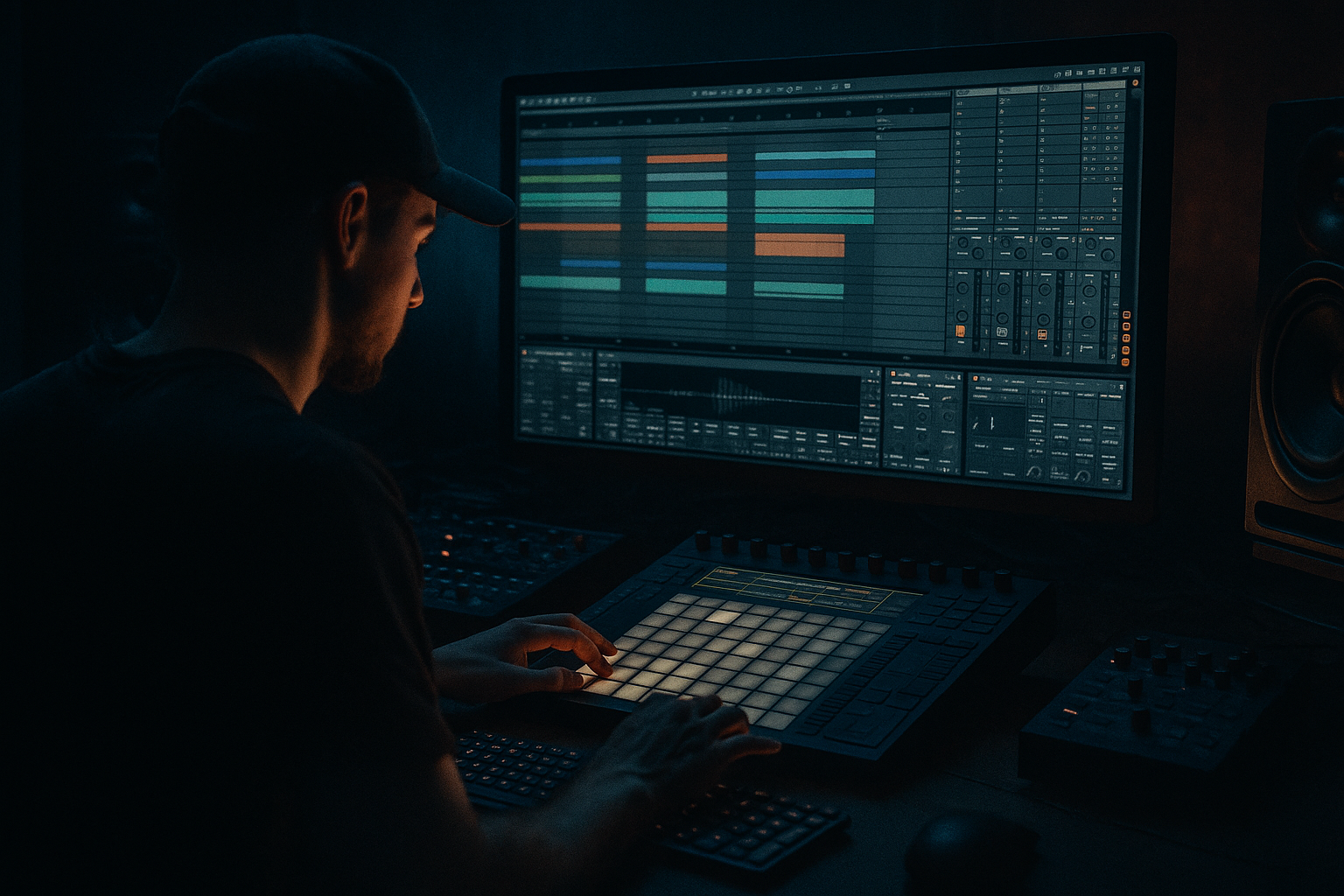
Main tutorial
Pirate Radio Shuffle Transform: Floor-Shaking Low End in Ableton Live 12
For jungle / oldskool DnB breakbeats — beginner-friendly, practical, and heavyweight 🔊🥁
1. Lesson overview
In oldskool jungle and pirate-radio-era drum and bass, the shuffle transform approach is all about turning a basic breakbeat into something that feels:
- loose but controlled
- human but sequenced
- fast, rolling, and unpredictable
- supported by a low end that shakes the room
- warp and slicing
- Groove Pool swing
- drum rack layering
- sample editing in Simpler
- saturation and sidechain control
- tight arrangement loops that evolve over 16–32 bars
- a jungle-inspired breakbeat loop
- a shuffle-transformed drum pattern
- a heavy sub layer
- a dark bass support layer
- a simple 8-bar arrangement that sounds like the start of a classic rave roller
- 160–174 BPM
- chopped breakbeat energy
- snare crack with swing
- hats slightly late/behind the beat
- sub that stays stable while the drums dance around it
- clear snare hits
- some ghost notes
- a bit of room tone or grit
- strong transient attack
- enough movement to feel human
- not so much that the groove collapses
- Timing: 55–62%
- Random: 0–5%
- Velocity: 5–15%
- Base: keep close to 0 if the groove already feels good
- mute individual hits
- duplicate kicks/snare ghosts
- shift hats slightly late
- layer your own hits under the break
- build custom shuffle patterns instead of relying only on the loop
- keep the main snare hits strong on 2 and 4
- add ghost hits just before or after the snare
- slightly delay hi-hats and shakers
- leave small gaps to make the kick/snare punches breathe
- Bar 1: strong groove, a little sparse
- Bar 2: more ghosts and extra hat movement
- repeat with tiny changes every 2 bars
- Simpler
- EQ Eight
- Saturator
- Drum Buss
- EQ Eight
- Drum Buss
- Saturator
- Glue Compressor
- High-pass gently around 25–35 Hz to remove rumble
- Small cut around 250–400 Hz if the break is muddy
- Slight boost around 3–6 kHz for snare snap if needed
- Drive: 2–6 dB
- Soft Clip: On
- Use lightly so the break gains density, not harshness
- Drive: 5–20%
- Crunch: small amount if you want bite
- Boom: be careful — on the break itself, too much boom can fight the sub
- Transient: slightly up for extra attack
- Ratio: 2:1 or 4:1
- Attack: 10 ms
- Release: Auto or 0.3–0.6 s
- Aim for only 1–3 dB of gain reduction
- follow the root note of the break’s musical center
- use long notes, not busy runs
- let the sub hit under the kick and snare space
- Oscillator A: Sine
- Filter: off or very gentle low-pass
- Volume envelope: short attack, medium release
- mono
- clean
- centered
- compressed only if needed
- Wavetable
- Analog
- Operator
- Roar in Live 12 for aggressive color if you want modern weight
- Oscillator: saw or slightly detuned saws
- Low-pass filter around 200–800 Hz
- Add subtle saturation
- Keep it rhythmically simple
- leave room for the snare
- don’t step on the sub
- hit on off-beats or after the kick
- use small syncopations to enhance the shuffle
- keep the sub steady
- let the mid-bass pulse slightly off-grid
- use automation for filter movement and note length variation
- automate a low-pass filter
- open it slightly in fills
- close it a bit during heavy sections
- filtered break
- no sub yet
- maybe just a vinyl noise or atmosphere
- full break enters
- light sub
- no bass support yet
- bass support layer comes in
- add extra ghost snares or hat variations
- fill or reverse break
- small drop into the next section
- 2-bar drum loop variations
- 4-bar call-and-response fills
- break dropouts before the main snare
- short drum fills leading into bass hits
- ghost note changes
- hat shifts
- snare rolls
- bass note changes
- high-pass one layer
- low-pass another
- blend them for depth
- use Roar gently on the bass
- or Saturator with soft clipping
- shorter note lengths
- simpler oscillator shapes
- checking whether the note starts are aligned with the kick impact
- slightly open the bass filter on the last beat of every 4 bars
- increase drum saturation during fills
- cut the low end briefly before a drop
- Does it still groove when played quietly?
- Is the sub strong but not muddy?
- Does the break feel shuffled, not robotic?
- a sliced and swung breakbeat
- micro-timing movement
- clean, stable sub bass
- dark bass support
- small arrangement variations
- Warp
- Groove Pool
- Slice to New MIDI Track
- Drum Rack
- Simpler
- Operator
- Wavetable
- EQ Eight
- Saturator
- Drum Buss
- Compressor
The goal is not just to add swing. It’s to make the drums feel like they’re leaning forward, with that classic skippy, off-grid shuffle that sits perfectly against a deep sub and gritty bassline.
In Ableton Live 12, you can build this using:
We’ll build a pirate-radio-style break with a shuffled transform feel, then combine it with a solid sub and dark bass support to get a proper DnB foundation. 🚀
---
2. What you will build
By the end of this tutorial, you’ll have:
Target sound
Think:
---
3. Step-by-step walkthrough
Step 1: Set the tempo and start with the right drum source
1. Open Ableton Live 12
2. Set the tempo to 170 BPM
- If you want it a little more classic jungle, try 165 BPM
3. Create a new Audio Track
4. Drag in a classic breakbeat sample:
- Amen-style break
- Think-style break
- Funk break
- Any dusty live drum loop with strong ghost notes
What to look for in the sample
Choose a loop that has:
If the break is too clean, you can still use it, but you’ll need more processing later.
---
Step 2: Warp the break properly
For drum and bass, the break needs to stay tight.
1. Double-click the break sample to open it in Clip View
2. Turn Warp on
3. Set the warp mode to:
- Beats for punchy drum loops
4. Try these settings:
- Transient loop mode: Off
- Preserve: 1/16 or 1/8 depending on the loop
- Envelope: around 80–100%
Practical goal
You want the loop to lock to the grid without sounding too edited. If it feels smeared, reduce how much warping is happening.
---
Step 3: Create the shuffle feel with Groove Pool
This is where the “pirate radio shuffle” starts to appear.
1. Open the Groove Pool
2. Drag in a groove such as:
- MPC 16 Swing
- MPC 16 Swing 57
- or any subtle 16th-note swing groove
3. Apply it to your break clip
Important
For jungle/DnB, don’t overdo swing. You want:
Good starting points
Why this works
The shuffle transform approach is about repositioning the feel of the break, not just making it “swung.” You’re creating a rolling, elastic feel that still hits hard on the snare.
---
Step 4: Slice the break into a Drum Rack for control
Now we turn the break into playable pieces.
1. Right-click the break audio clip
2. Choose Slice to New MIDI Track
3. Use:
- Transient slicing for natural drum hits
4. Ableton will create a Drum Rack with slices on pads
Why slice it?
Because once the break is in a Drum Rack, you can:
---
Step 5: Build a 2-bar shuffle transform pattern
Open the MIDI clip created by slicing and start shaping the rhythm.
Basic pattern idea
Use the original break as a reference, then:
Practical editing steps
In the MIDI clip:
1. Duplicate the break pattern for 2 bars
2. Remove a few extra kick hits to make room for sub movement
3. Shift some hat notes slightly late:
- try nudging them by 5–15 ms
4. Add one or two ghost snare notes before the main snare
5. Leave one or two tiny gaps in the loop to create tension
A useful structure
Try this feeling:
That evolving instability is very jungle.
---
Step 6: Tighten the break with Ableton stock devices
Now we shape the tone.
On the Drum Rack or the break track, add these devices:
#### Option A: Simpler chain per slice
If using slices inside Drum Rack:
#### Option B: On the full break bus
If keeping the loop on an audio track:
Suggested settings
#### EQ Eight
#### Saturator
#### Drum Buss
#### Glue Compressor
---
Step 7: Build the floor-shaking low end
The shuffle only feels huge if the low end is strong and stable.
You need two low-end layers:
1. sub
2. character bass / mid-bass support
---
#### A) Create the sub
1. Create a MIDI Track
2. Load Operator or Wavetable
3. Set it to a simple sine-style sub:
- Operator: use a sine oscillator
- Wavetable: choose a sine-like wavetable or basic sine
Sub notes
Write a simple pattern:
Suggested sub settings
#### Operator
#### Important
Keep the sub:
---
#### B) Create a dark bass support layer
Add a second MIDI track for a mid-bass or reese-style support.
Good stock devices:
Simple bass recipe
Bass rhythm suggestion
Use short notes that answer the break:
---
Step 8: Make the kick and bass work together
This is crucial in DnB.
#### Sidechain compression
On the sub and bass tracks:
1. Add Compressor
2. Enable Sidechain
3. Input from the kick or kick group
4. Set:
- Ratio: 2:1 to 4:1
- Attack: 1–10 ms
- Release: 50–150 ms depending on groove
- Threshold until the kick clears space cleanly
Better yet
Use a ghost kick or a dedicated kick trigger if your break kick is inconsistent. That gives you a stable sidechain source.
---
Step 9: Add shuffle movement to the low end without making it messy
The low end should not copy the drum shuffle exactly.
Instead:
Useful trick
On the bass track:
This gives movement while preserving weight.
---
Step 10: Arrange it like a proper jungle intro
A good DnB arrangement builds energy quickly.
8-bar starter arrangement
#### Bars 1–2
#### Bars 3–4
#### Bars 5–6
#### Bars 7–8
Classic jungle arrangement ideas
Keep it dynamic. Jungle and oldskool DnB thrive on constant micro-variation.
---
4. Common mistakes
1. Over-swinging the break
Too much swing makes the groove feel lazy instead of driving.
Fix: Keep groove values moderate. Aim for subtle movement, not exaggerated shuffle.
---
2. Letting the sub get too busy
A busy subline can blur the drums and destroy impact.
Fix: Make the sub simple and long. Let the break do the rhythmic work.
---
3. Over-processing the break
Too much compression or saturation can flatten the punch.
Fix: Use processing in layers, lightly. Check the break in context with bass.
---
4. Ignoring phase and low-end clash
If kick, sub, and bass are fighting, the track loses power.
Fix: Use EQ cuts, sidechain, and mono control on the low end.
---
5. Making every bar identical
A static loop sounds amateur in drum and bass.
Fix: Add tiny variations every 2 or 4 bars:
---
5. Pro tips for darker/heavier DnB
Tip 1: Use filtered break layers
Duplicate the break and create a filtered version:
This can make the groove sound huge without overcrowding the mix.
---
Tip 2: Add grime with Roar or Saturator
For darker energy:
A little harmonic dirt helps the bass translate on smaller speakers.
---
Tip 3: Keep the sub phase-consistent
If your sub sounds weak, try:
---
Tip 4: Use ghost notes for tension
Very quiet snare or hat ghosts before the main hit are a classic jungle move.
They make the groove feel more alive without adding clutter.
---
Tip 5: Automate filter and distortion on fills
A small bit of automation can make a loop feel like a real section:
---
6. Mini practice exercise
Try this 20-minute exercise in Ableton Live:
Exercise goal
Create a 2-bar jungle shuffle loop with a sub under it.
#### Part A: Break
1. Load one breakbeat loop
2. Warp it in Beats mode
3. Apply a groove from the Groove Pool
4. Slice it to MIDI
5. Remove 2–3 hits and add 1–2 ghost hits
#### Part B: Low end
1. Add a sine sub in Operator
2. Write a simple 2-bar bassline using 2–4 notes
3. Sidechain it to the kick or a ghost kick trigger
#### Part C: Mix
1. Add EQ Eight to the break
2. Add Saturator to the sub lightly
3. Add Compressor sidechain on the bass
4. Listen at low volume and make sure the kick/snare still cut through
Challenge
Export the loop and ask:
If yes, you’re on the right path. ✅
---
7. Recap
The pirate radio shuffle transform approach is about combining:
In Ableton Live 12, the core tools are:
The big takeaway
For jungle and oldskool DnB, the shuffle is not just rhythmic decoration — it’s part of the identity of the track. The drums should feel like they’re tumbling forward while the low end stays powerful and locked. That contrast is what makes the floor shake. 🧨
If you want, I can also turn this into a step-by-step Ableton project template with exact track names, device chains, and a 16-bar arrangement map.

