Main tutorial
Lesson Overview
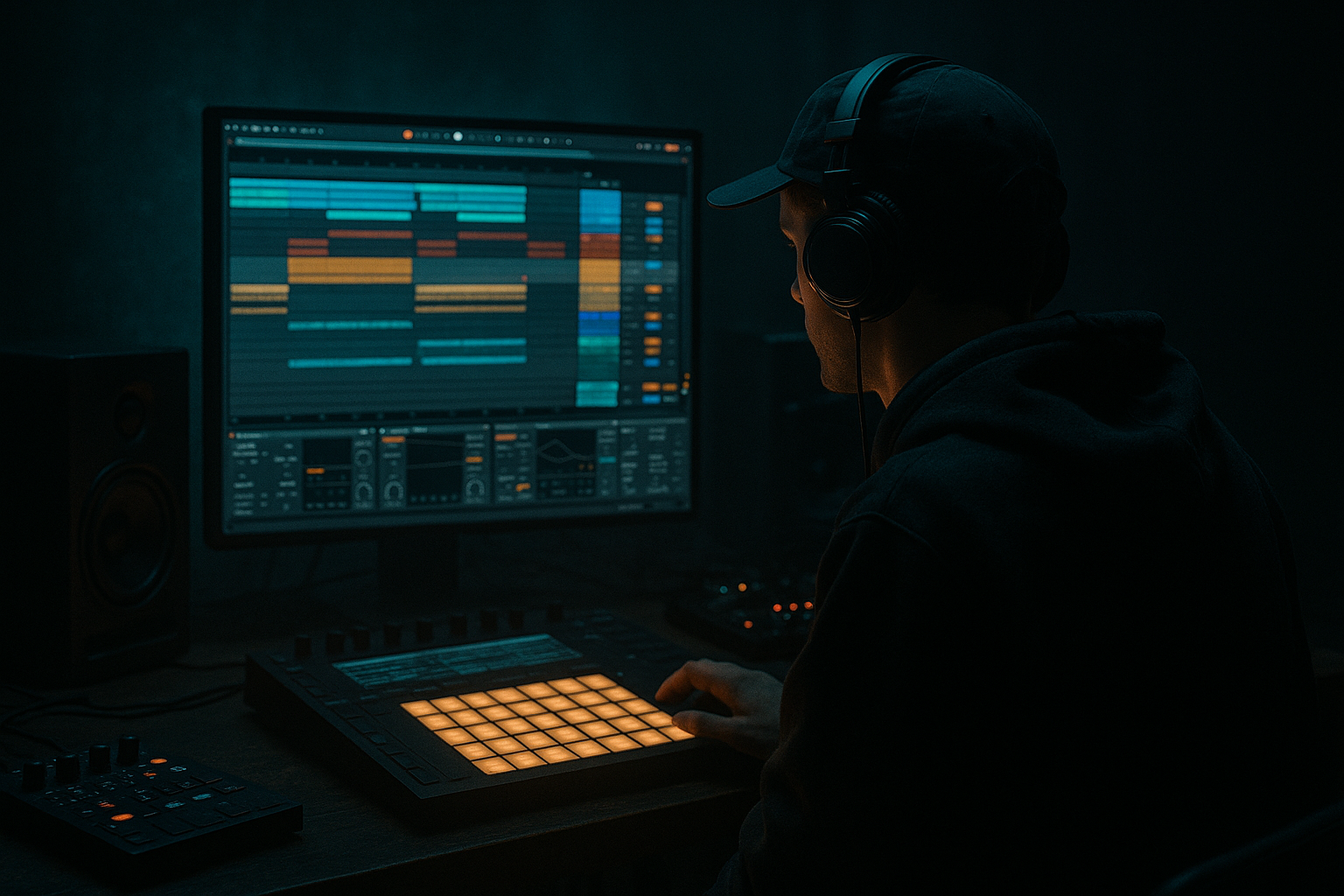
This lesson is about building a pirate-radio transition drive for jungle / oldskool DnB inside Ableton Live 12: a gritty, lo-fi, tension-building bassline passage that sounds like a rogue broadcast bleeding through the system before the drop hits. Think radio chatter energy, unstable filtering, broken-up reese motion, and pressure rising over 4 to 8 bars without trashing the low end.
This technique lives best in the intro-to-drop transition, 8-bar switch-up, or second-drop launch of an oldskool/jungle-inspired track. It matters musically because it gives your arrangement a story: the track feels like it’s being “tuned in,” intercepted, or hijacked rather than just starting and stopping. It matters technically because this kind of passage needs to stay exciting while still being DJ-friendly, mono-safe in the subs, and clear against breakbeats.
Best fit: jungle, oldskool DnB, dark rollers with vintage tension, pirate radio-inspired intros, and grimey transitional sections. By the end, you should be able to make a bass-driven transition that feels like a broadcast drifting through static, with enough control that it still lands as part of a proper club arrangement — not just a sound effect.
What You Will Build
You will build a 4- or 8-bar pirate signal transition made from a bassline that feels unstable, narrow-band, and intentionally degraded, but still powerful underneath. It should have:
- a sub-led foundation
- a midrange reese or buzz layer
- filter movement that opens and closes like a radio dial
- bit of break-up / saturation for grit
- rhythmic phrasing that locks to the drums instead of floating aimlessly
- enough mix discipline to keep the drop powerful after the transition
- note lengths around 1/8 to 1/2 bar
- one note landing slightly before the snare for push
- one held note at the end of bar 2 to give the transition something to “tune through”
- In Wavetable, start with a saw-based or square/saw blend patch.
- Keep it mono or strongly centered for the low end.
- Use one oscillator octave low, and if you add a second oscillator, keep it subtle so the fundamental stays clear.
- In Saturator, add light-to-moderate drive to thicken harmonics.
- In Auto Filter, shape the tone with movement.
- Use Operator for a cleaner, deeper root that you can distort later.
- Keep the oscillator waveform simple.
- Use Saturator to generate the radio grit.
- Use EQ Eight to carve the useful band after the distortion.
- Saturator drive around 2 to 6 dB
- Auto Filter cutoff starting around 150 Hz to 600 Hz depending on whether you want it murky or obvious
- Resonance low to moderate, roughly 10% to 25%
- Keep the Dry/Wet of any overt processing conservative until you hear how it reacts in context
- Sub layer: a clean sine/triangle-style low end
- Character layer: reese, buzz, or distorted midrange
- Wavetable
- Auto Filter
- Saturator
- Redux, very lightly if needed
- start partially closed so the signal feels hidden
- open the filter gradually over 2 to 4 bars
- dip it again before the drop or switch
- emphasize a few midrange peaks with resonance so it feels like a scanner locking onto signal
- low start: around 150–300 Hz on the character layer
- more open point: around 1 kHz to 3 kHz if you want the pirate-radio “speech band” energy
- resonance: enough to create a vocal-ish focus, but not so much that it whistles harshly
- a held note across beat 1
- a short cutoff before beat 3
- a pickup note into the next bar
- a tiny gap right before the drop
- Bars 1–2: sparse, filtered notes
- Bars 3–4: more movement, a short answer phrase every 2 beats
- Final bar: a rising or opening gesture, then a quick cutoff into the drop
- Auto Filter shapes the band and motion
- Saturator adds density
- EQ Eight removes useless lows below about 120 Hz
- Pedal can add a more obviously damaged, speaker-like texture
- EQ Eight cleans and narrows the useful band
- Auto Filter animates the tuning effect
- cut sub heavily
- keep a narrow midrange focus around 500 Hz to 2.5 kHz
- shave harshness around 3.5 kHz to 6 kHz if it gets spitty
- does the bass leave room for the snare transient?
- does the sub stay clear under the kick?
- does the bassline feel like it pushes forward or drags behind the beat?
- Bars 1–2: filtered, distant, under control
- Bars 3–4: more open, more harmonic bite
- Bars 5–6: extra saturation or slight rhythmic variation
- Bars 7–8: strip the low end briefly or create a final tuning sweep into the drop
- a hard cut
- a quick filter close
- a reverse swell
- a drum fill that takes over
- or a one-beat empty space before the first drop hit
- Use a narrow “signal window” instead of full-spectrum noise.
- Make the filter movement asymmetric.
- Print the best 1–2 bars to audio and chop them.
- Let the break own the top end.
- Use small gain automation instead of huge EQ swings.
- Try a brief pre-drop choke.
- Keep the low end stable even when the character layer is damaged.
- Use only Ableton stock devices.
- Keep one clean sub layer and one dirty character layer.
- Use no more than 3 automation lanes total.
- The transition must fit over a simple kick-snare or break loop.
- Does the bass still feel clear in mono?
- Can you hear the sub without the character layer masking it?
- Does the phrase feel like it belongs to the drums, not just a sound design loop?
- If you mute the automation, does the section lose its identity? If yes, the movement is doing real work.
The finished result should feel like a broadcast signal being dragged across the spectrum: murky, urgent, and a little dangerous, but still readable. In the mix, it should sit as a transitioning bassline role, not a full drop bass. Success sounds like this: the section creates tension and identity, clearly sets up the next phrase, and when you remove the drums, it still sounds like a purposeful musical idea rather than random distortion.
Step-by-Step Walkthrough
1. Start with a simple bass phrase that can survive degradation
Open a new MIDI track and write a 2-bar bass phrase first, not the full transition. Keep it rhythmically simple: think one to three notes per bar, with at least one clear low anchor note. For jungle/oldskool energy, a good starting point is a root + fifth + octave shape or a root note held with a small pickup note leading into the next bar.
Make sure the phrase has space. The pirate-radio effect works because the gaps let the filtering, noise, and automation speak. If the line is already crowded, the transition becomes mushy fast.
A practical starting point:
What to listen for: the phrase should already feel like it has a direction. If it sounds like a static loop, simplify it until the motion feels intentional.
2. Build the core tone with Ableton stock devices
Use a strong, controllable synth base. Two solid stock-device chains:
Option A: Wavetable → Saturator → Auto Filter
Option B: Operator → Saturator → EQ Eight
For the pirate signal vibe, the point is not a pristine bass tone. It’s a controlled deterioration of a clear bass source.
Useful starting values:
What to listen for: the bass should still have a defined center. If the distortion smears the pitch, back off the drive or simplify the source waveform.
3. Split the idea into sub and character layers
This is where the transition starts to feel like a real DnB bassline instead of a single sound.
Create two layers:
The sub layer should stay simple and centered. Use a clean instrument or a very plain oscillator, and keep it mostly below 100–120 Hz. The character layer can live higher, around 150 Hz upward, with all the grime and movement.
Why this works in DnB: the drums need a stable low-end anchor. If your pirate-radio effect lives entirely in the subs, the kick and bass relationship collapses. By separating the roles, you can make the section sound wild while the dancefloor still feels the weight.
Ableton stock chain example for the character layer:
Keep Redux subtle. You want broadcast damage, not digital collapse. A small amount of bit depth reduction can add the “old transmitter” quality, especially on the midrange layer.
Decision point:
A — Deeper, more ominous pirate signal
Use more of the sub layer and keep the character layer band-limited. Good for darker rollers and suspenseful intros.
B — Harsher, more broken-up signal
Let the character layer dominate with more saturation and slight bit reduction. Good for jungle edits, ravey switches, and more aggressive drop setups.
4. Design the “tuning” movement with filters, not random automation
The defining feature of this approach is the feeling of a radio being tuned. In Ableton, use Auto Filter and automate the cutoff in a way that feels deliberate, not wobbly for the sake of it.
A strong movement pattern:
Good ranges:
If you want the transition to feel more like old pirate radio with a cheap receiver, use a narrower bandpass flavor. If you want a bassline drive that still punches through club systems, use low-pass opening with a narrow mid emphasis rather than fully bandpassing the sound.
What to listen for: when the filter moves, the transition should feel like energy is arriving, not just frequency content changing. If the move sounds flat, layer in resonance or automate a small gain lift around the opening point.
5. Add rhythmic density with note edits and short gaps
Now turn the bass into a transition engine by editing the MIDI rhythm. This is where the section starts to behave like DnB.
Use syncopated note lengths and short pauses around the snare. Try:
A classic oldskool approach is to make the bassline answer the break, not compete with it. If the kick and snare are active, place bass notes so they support the snare impact and leave space for the break’s ghost notes.
Practical phrasing example:
If the transition is 8 bars long, let the first 4 bars feel like signal acquisition, and the last 4 bars feel like the receiver has locked in.
6. Process the midrange layer for pirate-radio grit
This is where the “broadcast” character actually becomes audible. Use a focused processing chain on the character layer, not the sub.
Two useful stock-device chains:
Chain 1: Auto Filter → Saturator → EQ Eight
Chain 2: Pedal → EQ Eight → Auto Filter
For a pirate-radio tone, keep the character layer intentionally band-limited:
Important mix note: if the character layer is stereo, check it in mono. Pirate-radio style often sounds cooler wide, but if the width is coming from phasey processing, the line can disappear in club playback. Keep the important movement in level and filter automation, not in fragile stereo tricks.
7. Place the bass against the drums and test the pocket
Bring in your drums — ideally a break, snare, or kick-snare skeleton — and test the transition in context. This is where many good sound-design ideas fail.
Check:
If the transition is for jungle, the bass should often feel like it is weaving around the break, not sitting on top of it. If the break is busy, simplify the bass rhythm. If the break is sparse, you can let the pirate signal become more active.
A useful listening cue: mute the drums, then unmute them. A successful result should make the section feel like it has more momentum with the drums, not less. If the drums disappear under the bass, your midrange layer is too wide, too loud, or too full-spectrum.
8. Automate movement across 4 or 8 bars with clear phrase logic
Now make the section feel arranged, not looped. Use automation to evolve the pirate signal over a musically obvious phrase length.
A strong arrangement shape:
A very effective move is to automate the filter cutoff opening while also reducing the bassline density. That creates the illusion of the signal getting stronger without overcrowding the transition.
Another useful move: in the final bar before the drop, commit to audio if the automation feels better when you can cut and rearrange the result quickly. Resampling lets you make a precise stutter, reverse tail, or tuned sweep without building a fragile live chain.
Stop here if the bassline already gives you a clear pirate-radio identity and the drums still punch. Don’t keep adding more devices just because the section feels “too simple.” In DnB, clarity usually beats complication.
9. Shape the exit into the drop
The transition should not just “end.” It should hand off energy to the drop or the next section. That can mean:
For oldskool/jungle energy, a strong method is to let the pirate signal collapse in the last half-bar and leave a gap for the drop snare or kick to land with authority. That little hole in the arrangement creates impact.
If the track is more DJ-oriented, keep the outro or intro version cleaner. The transition version can be more theatrical, but the usable mix should still give another DJ a workable phrase.
What to listen for: the handoff should feel like the signal has either been cut by the station or swallowed by the tune. If the drop feels delayed or weak, your transition is probably occupying too much of the last beat.
Common Mistakes
1. Making the whole effect full-range
- Why it hurts: the sub gets distorted and the kick loses authority.
- Fix: split sub and character layers. Keep the sub clean below roughly 100–120 Hz and process the grit separately.
2. Using too much stereo width on the bass
- Why it hurts: pirate texture can sound exciting in headphones but collapse in mono and on club systems.
- Fix: keep the important low-end and core rhythm centered. Check the chain in mono and narrow the character layer if needed.
3. Over-automating random filter movement
- Why it hurts: the signal stops sounding like a tuned broadcast and starts sounding like a generic wobble.
- Fix: automate in phrase lengths of 2, 4, or 8 bars with clear start, open, and release points.
4. Crowding the rhythm with too many notes
- Why it hurts: the bass fights the break, and the transition loses the oldskool pocket.
- Fix: simplify the MIDI. Leave holes around snare hits and use short pickup notes instead of constant movement.
5. Letting saturation destroy the pitch
- Why it hurts: the bass stops reading as a line and becomes noisy blur.
- Fix: reduce drive, clean the source waveform, or saturate only the midrange layer.
6. Not checking the section with drums
- Why it hurts: a cool sound can still fail in the groove.
- Fix: audition the pirate signal with the actual break or kick-snare pattern before you commit the automation.
7. Building the effect as a one-off sound effect
- Why it hurts: it feels pasted on instead of part of the arrangement.
- Fix: write a proper bass phrase and make the effect serve the section’s harmonic and rhythmic function.
Pro Tips for Darker / Heavier DnB
Dark pirate energy often works best when the midrange is focused between roughly 700 Hz and 2 kHz, with the sub kept clean underneath. That gives menace without washing out the mix.
Open more quickly than you close, or vice versa. That slight imbalance feels like imperfect hardware and adds underground character.
Once the movement feels right, resample it. Then you can reverse the tail, cut a micro-gap, or repeat one sliver as a fill. This is faster than trying to over-engineer the MIDI version.
If your break is already noisy and oldskool, keep the pirate bass’s top end darker. That contrast makes the section feel bigger and avoids brittle high-frequency clutter.
A 1–2 dB lift at the opening point can make the signal feel like it’s “locking in” without changing the tone too dramatically.
Cutting the bass for a fraction of a beat before the drop often hits harder than extending the transition endlessly. In DnB, the pause can be louder than extra noise.
The darker the top, the more important the sub discipline becomes. If the subs wander, the whole illusion collapses.
Mini Practice Exercise
Goal: Build a 4-bar pirate-radio transition bassline that works with a jungle break.
Time box: 15 minutes.
Constraints:
Deliverable:
A 4-bar section that starts filtered and distant, opens into a more aggressive broadcast tone, then cuts cleanly into the next phrase.
Quick self-check:
Recap
Build the pirate signal effect as a bassline transition, not a random texture. Keep the sub clean, the midrange focused, and the filter movement phrase-based. Check it with your drums early, because in DnB the groove decides whether the idea works. Use saturation and filtering to suggest a damaged broadcast, then arrange it so the section opens tension and lands the drop with real weight. The best result sounds like a rogue signal being pulled into the tune — murky, tense, and fully ready for the floor.

