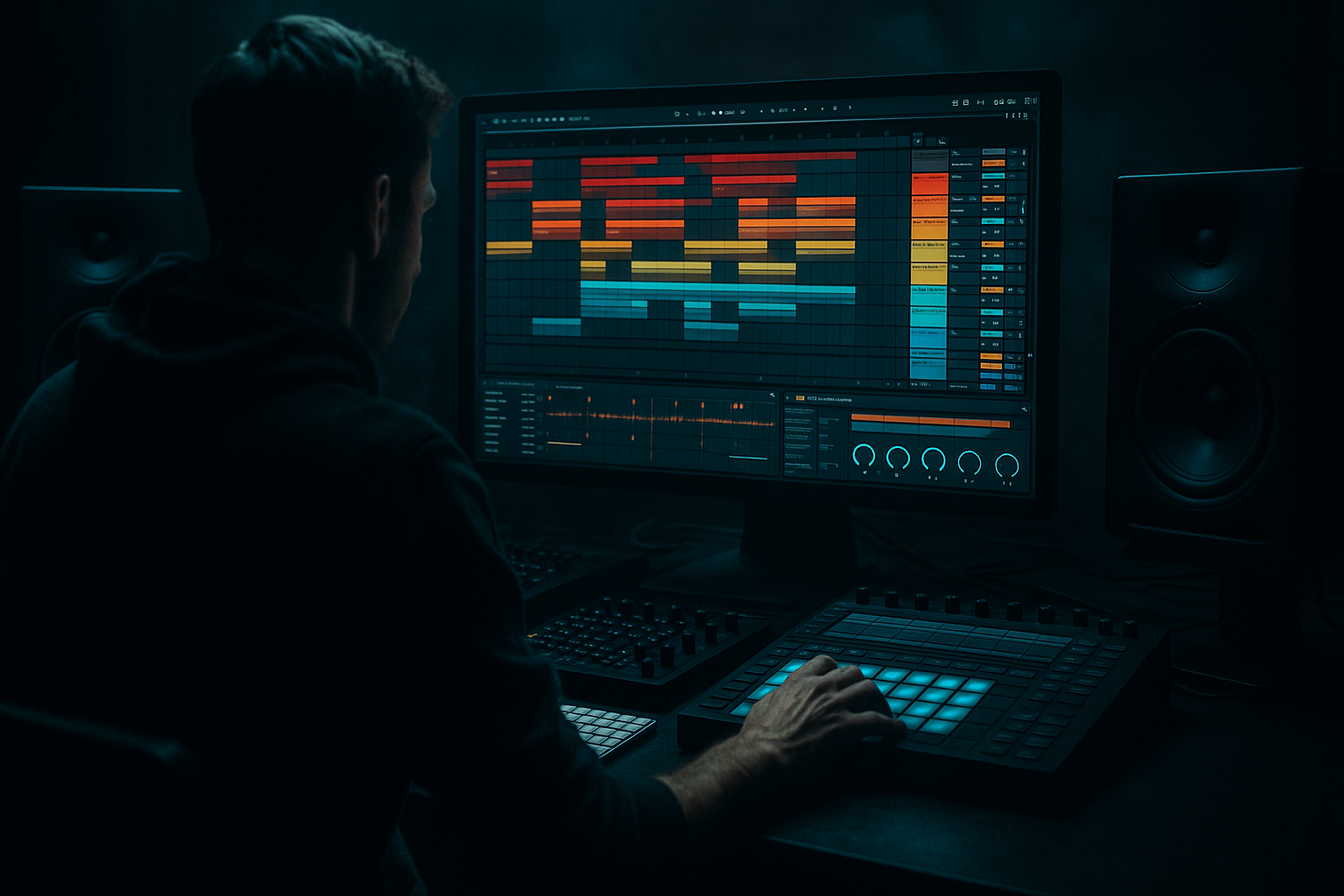
Main tutorial
Lesson Overview
This lesson is about building a Pirate Signal-style amen variation blend inside Ableton Live 12: a hybrid break approach where the original amen character stays recognisable, but it’s re-ordered, re-layered, filtered, and partially resampled so it behaves like a modern DnB weapon rather than a loop pasted on top.
In a real track, this lives in the drum section, usually under or around the drop, and it often shows up as:
- a main groove break
- a call-and-response fill
- a second-drop variation
- a transition between bass phrases
- or a half-broken, chopped lift before the bass comes back in
- dusty but modern
- tight in the center
- slightly different every 4 or 8 bars
- heavy enough for club playback
- mix-ready enough to sit under a bassline without masking the sub
- Keep the center rigid, let the edges misbehave. In darker DnB, the kick, snare, and sub should stay disciplined while ghost hits, hats, and noise tails carry the menace. That gives you intensity without losing club function.
- Resample one “dirty” pass and one “clean” pass. A clean print gives you the structural groove; a dirtier print with more saturation or filtering can be dropped in for second-drop aggression. This is especially effective if the tune needs a visible escalation without changing the bassline.
- Use missing hits as tension devices. In heavy rollers, removing one expected snare ghost or kick pickup before the main hit can feel more violent than adding more notes. The absence creates impact space.
- Filter the variation in, not just out. A fast high-pass opening from the variation layer can create urgency, but keep the low-end entrance controlled so the drop doesn’t lose weight.
- Let the break answer the bassline, not compete with it. If the bass phrase stutters, let the amen variation occupy the off-beat gaps. If the bassline is sustained, give the break more movement. That call-and-response logic is what keeps darker DnB readable at loud volume.
- Don’t chase wide for the sake of width. Heavy DnB often feels bigger when the center is focused and the upper percussion is selectively spread. Mono-compatible pressure beats fake stereo hype every time.
- Use only stock Ableton devices.
- Keep the foundation layer mostly intact.
- Make the variation at least 3 dB quieter than the foundation at first.
- Limit yourself to two automation moves max.
- Check the result with bass and kick playing, not soloed.
- one stable amen foundation
- one variation layer with at least two meaningful phrase changes
- one printed audio version of the variation
- Can you still hear the snare identity clearly?
- Does the variation add motion without blurring the bass?
- Does the groove still feel good in mono?
- If you mute the variation, does the track lose energy but not fall apart?
Why it matters musically and technically: the amen is already culturally loaded and rhythmically busy, so the trick is not “making it more active.” The trick is controlling its motion so it supports the drop without fighting the bassline, snare backbeat, or sub. In darker DnB, jungle-leaning rollers, neuro-tinged halftime switch-ups, and club-focused break edits, this approach gives you movement, grit, and identity without losing DJ usability or low-end focus.
By the end, you should be able to hear a break that feels alive, intentional, and mixed into the track, not just chopped for novelty. A successful result should sound like the amen is breathing around the bassline, with enough variation to keep repeat plays interesting, but enough stability that the floor still locks in.
What You Will Build
You will build a two-part amen variation blend in Ableton Live 12:
1. A primary groove layer: an edited amen with a stable pocket, punchy snare placement, and controlled low-end.
2. A variation layer: a resampled, partially processed version that adds ghost movement, syncopated edits, and texture without destabilising the main groove.
The finished result should feel:
In context, this should behave like a serious drum utility layer: the kick/snare energy remains readable, the hats and ghost notes give motion, and the variations help the arrangement evolve. If it’s working, you’ll hear the drop “roll” with purpose rather than looping mechanically.
Step-by-Step Walkthrough
1. Start with a clean amen source and make it into two usable roles
Drop a clean amen break onto an audio track and set the clip to the project tempo. In Ableton Live 12, warp it so the break locks to your session grid without squashing the natural swing. For DnB, that usually means keeping the break’s transient shape intact rather than aggressively quantising every hit.
Make two duplicates of the clip:
- Amen A = foundation
- Amen B = variation
The foundation clip should preserve the core groove. The variation clip will be edited more aggressively later.
What to listen for: the snare should still feel like a backbeat anchor, not a flattened tick. If the break loses its “human push,” you’ve warped too tightly.
2. Edit the foundation clip for pocket first, not complexity
Open the clip and clean up the obvious timing drifts only where they harm the groove. Don’t force the entire loop onto a sterile grid. In DnB, especially with an amen, the best feel often comes from keeping micro-pushes in the hats and ghost notes while making the main hits land where the track needs them.
Practical move:
- Keep the snare landing strong on the two and four equivalent for your chosen DnB phrasing
- Tighten any stray kick that blurs the downbeat
- Leave some off-grid hat movement intact
- Use clip gain to even out any overly loud ghost hit that distracts from the pocket
If the break is fighting your kick or snare layer, lower the break clip gain by 2–4 dB before touching EQ. You want headroom for the bass and additional drum layers.
What to listen for: the loop should still bounce when muted with the bassline later. If it only sounds good soloed, it’s not ready.
3. Build the first stock-device processing chain for the foundation
On the Amen A track, use a realistic stock chain like this:
Drum Buss → EQ Eight → Saturator → Utility
Suggested starting points:
- Drum Buss: Drive around 5–15%, Crunch very light or off, Boom only if the break is thin, and keep it subtle. You want density, not a trashed transient.
- EQ Eight: high-pass only if needed, usually around 30–45 Hz to clear sub-rumble, and a gentle cut around 250–400 Hz if the break clouds the bass.
- Saturator: Soft Clip on, Drive around 1–4 dB for edge and density.
- Utility: keep the break mostly mono or narrow the lowest portion by reducing width if the sample is too wide.
Why this works in DnB: the amen has plenty of transient energy already. You’re using saturation and bus shaping to make it read on club systems without turning the snare into brittle noise.
Decision point — A versus B:
- A: cleaner, more rolling — keep Drum Buss modest, preserve transient clarity, and let the bass do the aggression.
- B: dirtier, more pirate-radio energy — push Saturator a little harder and let the break carry more attitude, but only if the bassline is simpler.
Choose A for neuro rollers and modern club cuts. Choose B for darker jungle-inflected tunes or rougher second-drop sections.
4. Cut the variation clip into musical phrases instead of random slices
On Amen B, stop thinking in “cool chops” and start thinking in bar logic. Use the transient markers or manual cut points to slice around:
- the opening kick
- the main snare
- one or two ghost notes
- a hat or ride tail that can fill space
A strong approach is to make an 8-bar variation phrase from the same source:
- bars 1–2: mostly original groove
- bars 3–4: one extra kick displacement or snare pickup
- bars 5–6: a reverse-feel or missing-hit tension move
- bars 7–8: a fill that leads back into the drop or next section
Keep the slices musical. Do not cut every transient just because you can. The point is to create recognisable evolution, not a chopped collage.
If you want a more jungle-leaning result, keep the snare identity obvious. If you want a more modern hybrid result, let the ghost work and missing-hit tension carry more of the phrase.
5. Resample the variation layer once the gesture is clear
This is the point where you stop tweaking endlessly. Route or record Amen B to audio and commit the take once the chop pattern, timing, and rough processing feel right. In advanced DnB work, printing the variation is useful because it turns “maybe” decisions into something you can arrange like a real performance.
Suggested workflow:
- Record 4 or 8 bars of the variation
- Print with the processing chain on, if the tone is part of the design
- Keep a dry backup version for later comparison
Commit this to audio if the variation starts feeling right rhythmically but you keep changing tiny details that are no longer improving the groove. At that point, the move is to arrange it and test it against the bassline.
Why this works in DnB: printed audio lets you place edits with intention and keeps CPU low, especially once you add bass processing and automation elsewhere.
6. Blend foundation and variation so one supports the other
Put Amen A and Amen B in the same drum section and balance them like layers, not rivals. The foundation layer should hold the main pulse; the variation should sit slightly behind it in energy.
Practical balance guide:
- Keep the variation 3–6 dB lower than the foundation at first
- High-pass the variation a little higher if it adds too much low-mid clutter, often around 60–120 Hz
- If the variation is too sharp, trim a little around 2–5 kHz
- If it feels weak, add a touch of transient emphasis with Drum Buss rather than more volume
Now mute and unmute each layer while the bass is playing. The foundation should feel like the body of the groove; the variation should feel like motion or attitude, not another full drum loop competing for attention.
What to listen for: when both play together, the groove should feel wider in time, not wider in stereo. If the stereo field gets exciting but the center loses authority, you’ve gone too far with width or overlapping high end.
7. Use an A/B arrangement strategy for drop evolution
This is where the technique becomes a track decision, not just a loop trick.
A practical arrangement example:
- 8-bar intro of the drop: Amen A only, with bassline exposed
- bars 9–16: bring in Amen B on the second half of every 4 bars, or on the last 2 bars as a lift
- second drop: swap the emphasis so Amen B becomes the lead feel, while Amen A is reduced or filtered
You can also make a DJ-friendly edit by keeping the first drop more readable and saving the more fractured variation for the second drop. That gives the tune a clear identity arc: recognition first, escalation second.
A good rule: if the track is already bass-dense, place the more detailed amen variation in the call-and-response spaces between bass phrases, not under sustained bass notes.
8. Shape the interaction with the bassline, not just the drums
Check the full context with sub, midbass, and kick together. This is the real test.
In a darker DnB context, the amen should not mask:
- the sub fundamental
- the kick’s first transient
- the main snare crack
- the bass riff’s syncopation
If the bassline has a strong offbeat pulse, let the amen variation answer it on the spaces between notes. If the bassline is more sustained, the break can be busier.
Two practical checks:
- Mono check: collapse the drum layers with Utility and confirm the groove still makes sense in center. If the amen loses identity in mono, reduce wide hats or phasey processing.
- Low-end check: if the kick and amen low mids are blurring the sub, carve a small dip in the break around 120–250 Hz before reaching for heavier compression.
This is also the moment to decide whether the variation should live as a texture layer or a featured rhythmic event. If it sounds too busy with the bass, demote it. If it sounds too polite, increase its presence only in select bars.
9. Use automation to create controlled variation, not constant motion
Automate only a few things that matter:
- filter cutoff on the variation layer
- Dry/Wet of a delay or reverb return for transitions
- Saturator drive into a fill
- volume dips before snare-led moments
Good automation ranges are small. For example:
- a filter sweep from about 180 Hz up to 8–10 kHz over 1–2 bars for a tension rise
- a tiny Drive bump of 1–2 dB into a fill
- a short drop in break volume of 1–3 dB before a bass hit to create a pocket
The goal is not constant animation. The goal is to make the break feel like it has phrasing.
What to listen for: if the automation is obvious without the drums and bass, it may be too much. In DnB, the best movement often feels like momentum, not “look at this effect.”
10. Finish the blend with a mix pass that protects punch and translation
On the drum bus, check whether the amen layers need a gentle glue treatment or whether they’re already stable. If you use a bus process, keep it restrained. In DnB, over-compressing the break can kill the snap that makes the track work on a system.
A practical finishing chain on the drum bus could be:
EQ Eight → Glue Compressor → Utility
- EQ Eight: small cleanup only, maybe a gentle notch if a resonance appears
- Glue Compressor: light gain reduction, often just 1–2 dB on peaks, slow-ish attack to keep transients alive
- Utility: final width or mono management if needed
If the break feels exciting but gets smaller in mono, fix the width problem at the source. Don’t just widen the bus more to compensate.
A useful “stop here” moment: if the groove works with bass, translates in mono, and the variation feels like an intentional second voice rather than a messy duplicate, stop editing and move on. At this stage, more tweaking usually reduces impact.
Common Mistakes
1. Over-quantising the amen until it loses its swing
- Why it hurts: the break stops breathing and becomes generic grid content.
- Fix: re-edit only the hits that interfere with the kick/snare relationship, and leave small microtiming differences on hats and ghost notes.
2. Making the variation as loud as the foundation
- Why it hurts: the ear stops hearing a hierarchy; the groove becomes crowded.
- Fix: pull the variation down 3–6 dB, and use it as contrast rather than a second lead drum loop.
3. Letting low-mid buildup cloud the bass
- Why it hurts: the amen and bass fight in the area where DnB systems feel weight, making the drop less clean.
- Fix: use EQ Eight to trim around 120–250 Hz or make a gentle cut around 250–400 Hz depending on the source.
4. Stereo-widening the break too early
- Why it hurts: the groove feels big in headphones but weak in clubs, and the center loses authority.
- Fix: keep the core break narrow or centered, and restrict width to upper texture elements only.
5. Using too much saturation on the variation layer
- Why it hurts: the transient gets blurred and the snare turns papery.
- Fix: back off Saturator Drive, or use Drum Buss lightly and preserve the crack.
6. Treating the amen like a loop instead of a phrase
- Why it hurts: the drop feels repetitive and static.
- Fix: arrange the variation in 2-bar or 4-bar gestures, and give it a clear role in the section structure.
7. Ignoring the bassline while editing drums
- Why it hurts: a break that sounds perfect soloed can destroy the groove once sub and bass enter.
- Fix: check every major drum decision with the bass and kick playing, especially before committing audio.
Pro Tips for Darker / Heavier DnB
Mini Practice Exercise
Goal: Build a playable 8-bar amen variation blend that works with a simple bass loop.
Time box: 15 minutes.
Constraints:
Deliverable: An 8-bar clip set with:
Quick self-check:
Recap
A Pirate Signal-style amen variation blend is about hierarchy, phrasing, and controlled aggression. Keep one layer as the groove anchor, use the second as a printed variation voice, and make both serve the bassline and arrangement. In DnB, the best break work is not the busiest — it’s the most intentional. If the result feels heavy, readable, and alive in the drop, you’ve nailed it.

