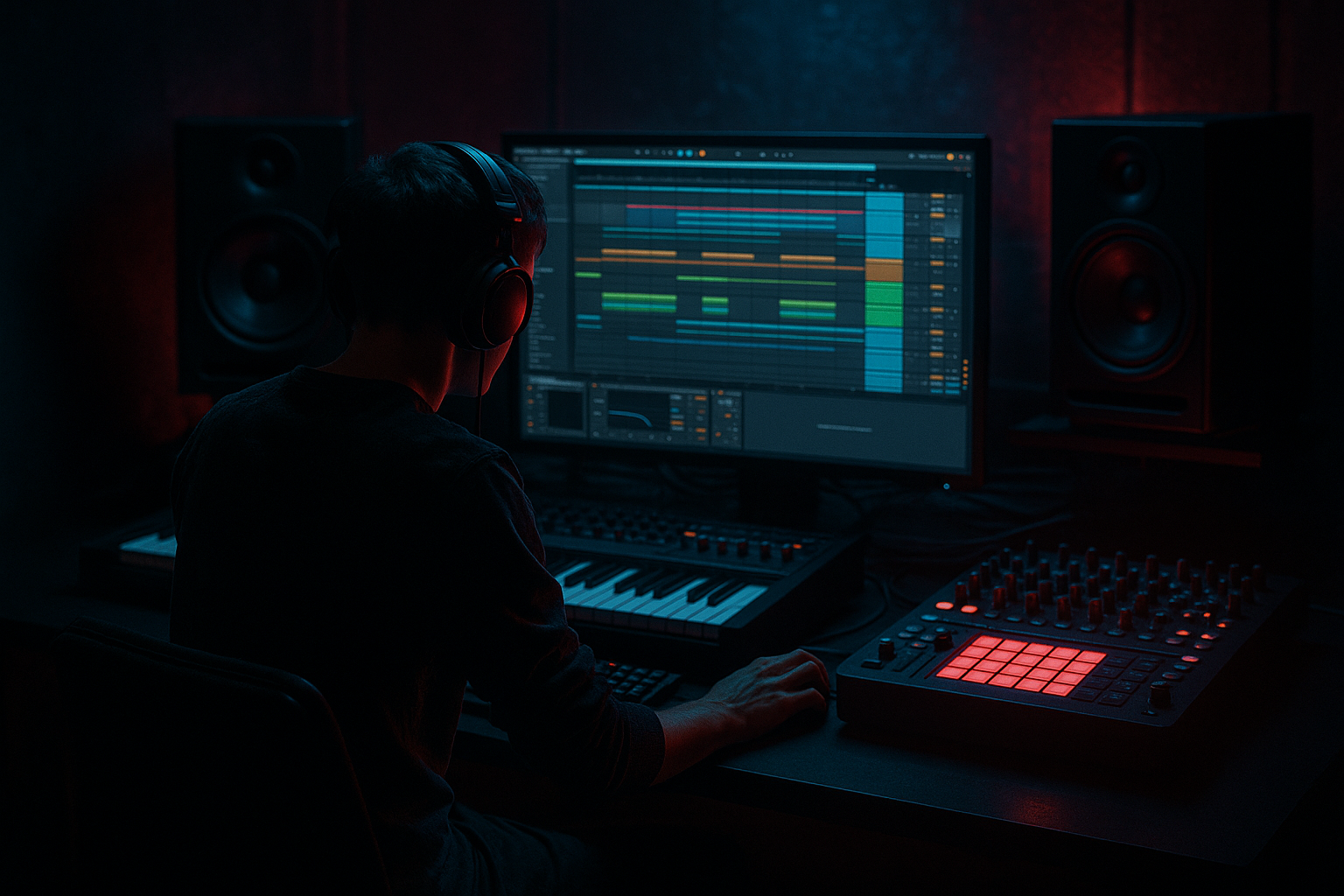
Main tutorial
Pitch a Breakbeat with Chopped-Vinyl Character in Ableton Live 12
1. Lesson overview
In this lesson, you’ll learn how to pitch a breakbeat up or down in Ableton Live 12 while keeping that chopped, vinyl-style character that makes drum and bass and jungle feel alive ⚡
We’re not just changing tempo. We’re going for that old-school sampler feel:
- slightly gritty transient edges
- rhythmic slice movement
- pitch-shifted drum tone without losing punch
- controlled “wobble” in the break’s body
- a result that sits naturally in DnB / jungle / rolling bass music
- you want a break to match a tune at 170–174 BPM
- you want a half-time or double-time feel without reprogramming everything
- you want the break to sound like it’s been lifted from vinyl, chopped, and repitched
- you want a break that still sounds tight and modern, not just lo-fi for the sake of it
- classic chopped Amen energy
- pitched break accents that feel sampled from hardware
- slightly unstable texture, but still punchy
- ready for intro, buildup, or main drop layering
- Amen-style breaks
- Think or Funky Drummer-style material
- stripped break loops with ghost notes
- live drum recordings with room tone and dynamic hats
- strong kick and snare definition
- ghost notes or shuffle
- enough transient detail to survive pitch shifting
- not too much sub rumble if you’re planning to layer with a bassline
- Drag the break into an Audio Track
- Set project tempo to your target DnB tempo, e.g. 172 BPM
- If the loop is not already at that tempo, don’t panic—Ableton will handle it
- For breaks: Beats or Complex Pro depending on the goal
- For a chopped-vinyl feel: often start with Beats
- If you’re pitching more dramatically and need smoother audio: try Complex Pro
- Transient Loop Mode: On for rhythmic punch
- Preserve: 1/16 or 1/8 depending on break density
- Envelope: lower values often keep it more chopped and percussive
- Loop: off unless you’re building a seamless loop
- Keep Formants moderate
- Use small pitch changes for more natural results
- Avoid overdoing it if you want that sampled drum machine grit
- Zoom in and place warp markers at the start of the kick/snare transients
- Don’t over-quantize every tiny hit
- Let some microtiming breathe; that is part of the vinyl charm
- adjust Transpose by semitones
- try +2, +3, -2, or -3 semitones first
- listen to how the snare body changes
- quick workflow
- a break that needs to sit with a bassline
- preserving simplicity
- retriggerable slices
- easier drum rolls
- pitch manipulation with more sampler personality
- program a 1-bar or 2-bar break pattern
- duplicate some snare or hat slices
- pitch select slices down by -1 to -3 semitones
- pitch occasional ghost hits up slightly for lift
- a DJ or sampler chopping a break
- subtle pitch instability
- “call-and-response” between main hits and ghost hits
- automate Filter Frequency
- automate Volume Envelope Decay
- automate Start slightly on select hits for a tighter chop
- Drive: 5–20%
- Crunch: subtle to moderate
- Boom: use carefully; tune it to the track key if needed
- Transients: increase if the break lost punch after warping
- restore attack
- fatten the kick/snare
- add that slightly aggressive drum bus energy
- Soft Clip: On
- Drive: 2–8 dB
- Try Analog Clip or Soft Sine depending on the tone
- Keep output compensated
- thickens midrange
- smooths digital edges
- helps the break feel “printed”
- high-pass gently around 30–40 Hz if there’s rumble
- dip muddy area around 180–350 Hz if the break is cloudy
- boost a little around 3–6 kHz for snare crack if needed
- tame harsh hats around 8–10 kHz if pitch shifting made them brittle
- Attack: 10–30 ms
- Release: Auto or 0.1–0.3 s
- Ratio: 2:1 or 4:1
- Aim for 1–3 dB gain reduction
- harmonic weight
- grit
- tone-shaping with character
- subtle drive
- low-frequency focus only if the break is too clean
- keep it controlled, especially on hats
- sample-rate reduction
- digital crunch
- old hardware flavor
- duplicated break layers
- parallel chain
- fills and transitions
- extracting groove from a funk break
- using a subtle shuffle groove
- applying 10–30% groove amount, not 100%
- vary note velocity
- offset a few hats slightly off-grid
- shorten or lengthen select ghost notes
- repeat a snare slice with very slight timing differences
- pitched, chopped, saturated
- can be slightly dirty or lo-fi
- carries vibe
- high-pass the break
- keep snare crack and transient detail
- minimal processing
- use EQ Eight to cut lows
- maybe add Transient shaping with Drum Buss
- compress lightly
- add more saturation, filter movement, and pitch drift
- let it be messy if needed
- filtered break loop
- lowpassed chop layer
- vinyl noise or ambience in the background
- tease the rhythm before full bass drops
- full pitched break + bassline
- keep the break slightly drier for impact
- automate extra distortion on fills
- every 8 bars, swap in:
- isolate a repitched break fragment
- add reverb tails or delay throws
- filter down and reintroduce for tension
- Saturator
- Redux
- Roar
- Auto Filter with resonance
- the snare body becomes lower and meaner
- the kick and bass feel more unified
- the break has that “pressed from tape or vinyl” tone
- automate a lowpass filter closing on the last beat of every 8 or 16 bars
- reopen it into the drop
- combine with reverb throws on a snare hit
- record the break to audio
- consolidate it
- process the printed audio rather than endlessly tweaking MIDI
- duplicate a snare slice
- delay it by 5–15 ms
- reduce volume significantly
- pitch it slightly if needed
- one clean version
- one dirtier version
- one fill variation for bars 8 and 16
- choose a break with strong transient movement
- warp it carefully, not aggressively
- pitch it in small, musical moves
- use Simpler for slice-based chopping and sampler character
- add Drum Buss, Saturator, EQ Eight, Glue Compressor, Roar, or Redux to shape tone
- layer clean and dirty versions for punch and vibe
- arrange the break dynamically across your DnB track
- a device-chain preset recipe
- a MIDI slicing template
- or a bar-by-bar jungle drum arrangement guide for Ableton Live 12.
This workflow is especially useful when:
We’ll use stock Ableton Live 12 devices and a workflow that gives you both control and character.
---
2. What you will build
By the end, you’ll have a breakbeat chain that does this:
1. Warp and slice a breakbeat cleanly
2. Pitch it to suit your DnB tune
3. Add vinyl-style chop character
4. Reinforce the break with transient shaping, saturation, and filtered ambience
5. Arrange it so it works in a 16-bar DnB loop with bass and fills
Final sound goal
Think:
---
3. Step-by-step walkthrough
Step 1: Choose the right break
Start with a break that already has movement.
Good choices for DnB/jungle:
What to look for
Choose a break with:
Import and place it
---
Step 2: Warp it the right way
This is where a lot of people lose the character. Don’t just slam it into Complex mode and move on.
Suggested warp mode:
Practical settings
If using Beats:
If using Complex Pro:
Warp markers
DnB tip:
A break that is too perfectly grid-locked can feel lifeless once the bass hits. Keep a little human push/pull in the hats and ghosts.
---
Step 3: Pitch the break like a sampler, not like a clean loop
Here’s the key move: pitching should feel intentional and sampled.
Two useful approaches
#### Approach A: Pitch the clip directly
In the Clip View:
This works well for:
#### Approach B: Sample it into Simpler for more chop control
This is the more advanced and more “chopped vinyl” approach.
Build a Simpler chain
1. Drag the break into Simpler
2. Set mode to Slice
3. Slice by:
- Transients for natural break chopping
- or 1/16 if you want tighter pattern control
4. Map slices to MIDI notes
5. Use Transpose inside Simpler or in the MIDI Clip to pitch the whole break or selected slices
This gives you:
---
Step 4: Create chopped-vinyl character with slice and pitch movement
Now we make it feel like a record that’s been chopped on hardware or lifted from an old sampler.
Method 1: Sliced break with note-level pitch changes
In a MIDI clip controlling Simpler:
This creates the feeling of:
Method 2: Use envelope movement
In Simpler:
Tiny changes here can make the break feel like a live vinyl resample instead of a static loop.
Method 3: Resample and repitch
For extra authenticity:
1. Create a new audio track
2. Set input to Resampling
3. Record your sliced/pitched break performance
4. Rewarp the recorded audio
5. Pitch that recorded audio again if needed
This “bounce and rewarp” method often creates the best broken-up, sampler-like artifacts.
---
Step 5: Add stock Ableton devices for grit and glue
Now we shape the sound so it lands in a DnB mix.
Recommended device chain
A strong starting point:
Simpler / Audio Clip → Drum Buss → Saturator → EQ Eight → Glue Compressor → Roar or Redux → Reverb/Delay Send
Let’s break that down.
---
Drum Buss
This is excellent for DnB breaks because it adds weight and snap fast.
Suggested settings:
Use it to:
---
Saturator
A classic for bringing sampled attitude.
Suggested settings:
What it does:
---
EQ Eight
Use EQ to carve the break so it fits the bassline.
Typical moves:
DnB mix note:
If your sub is heavy, the break doesn’t need to own the low end. Keep the kick definition, but let the bassline dominate the sub region.
---
Glue Compressor
Useful for snapping chopped hits together.
Suggested starting point:
This keeps the break energetic without flattening it.
---
Roar or Redux
For heavier character, these can be excellent in moderation.
#### Roar
Use for:
Try:
#### Redux
Use sparingly for:
Great on:
---
Step 6: Add vinyl-style movement with groove and humanization
This is where the break starts to breathe.
Groove Pool
Ableton’s Groove Pool is a powerful way to make a break feel less rigid.
Try:
Humanize sliced MIDI
If using Simpler:
This is especially effective in jungle and rolling DnB where the break should feel animated, not robotic.
---
Step 7: Layer with a clean impact layer
A repitched chopped break often benefits from reinforcement.
Best layering approach
Duplicate the break and split the job:
#### Layer 1: Character layer
#### Layer 2: Clean punch layer
Practical method
On the clean layer:
On the character layer:
This is a very effective DnB technique because it preserves impact while keeping the chopped-vinyl personality.
---
Step 8: Arrange it like a DnB tune
Break character matters most when it’s arranged in context.
Common arrangement ideas
#### Intro
#### First drop
#### Variation bars
- a different pitch setting
- an alternate chop pattern
- a reverse slice or fill
- a snare flam layer
#### Breakdown
DnB arrangement trick
If your bassline is very active, simplify the break on downbeats and let the ghost chops do the work.
If your bassline is more sparse, let the break be more expressive and chopped.
---
4. Common mistakes
1. Over-warping the break
Too many warp markers can kill groove and make the break sound edited instead of played.
Fix:
Use only the markers you need. Preserve natural motion in the ghost notes.
---
2. Pitching too far
Extreme pitch changes can make the snare thin or the hats nasty in the wrong way.
Fix:
Start with small moves: ±1 to ±3 semitones.
If you want heavier movement, resample and process in layers.
---
3. Losing the transient
Aggressive stretching or smoothing can flatten the break.
Fix:
Use Drum Buss, transient enhancement, or a parallel dry layer.
---
4. Too much low end in the break
This fights the sub and makes the tune muddy.
Fix:
High-pass gently and keep sub responsibilities with the bassline.
---
5. Making it lo-fi without purpose
Vinyl character is not the same as just making everything degraded.
Fix:
Keep the break musical. Use saturation, pitch, and timing instability intentionally.
---
5. Pro tips for darker/heavier DnB
Use parallel grit
Create a return or duplicate track with:
Blend in just enough to darken the break without destroying it.
---
Pitch the break against the key
If your tune is in a minor key, pitching the break down 1–2 semitones can make it feel darker and heavier.
This works especially well when:
---
Use filter automation on fills
For darker rollers:
That gives your chopped break more drama without clutter.
---
Resample into audio for final weight
Once the pattern is working:
This helps the break feel more committed and aggressive, which is often better for heavier DnB.
---
Add micro-flams to snares
A tiny second snare slice, delayed by a few milliseconds, can create classic jungle tension.
Try:
That subtle smear can make the break feel savage 🔥
---
6. Mini practice exercise
Exercise: Build a 2-bar chopped, pitched DnB break
Do this in Ableton Live 12:
1. Import an Amen-style or funk break
2. Warp it in Beats mode
3. Convert it to Simpler > Slice
4. Program a 2-bar MIDI pattern
5. Pitch:
- main snare slice: original pitch
- one ghost snare: -2 semitones
- one hat slice: +1 semitone
6. Add this chain:
- Drum Buss
- Saturator
- EQ Eight
- Glue Compressor
7. Resample the result to audio
8. Rewarp the resampled audio and make one alternate version:
- darker
- more filtered
- slightly more chopped
Goal
Create:
That gives you a reusable DnB workflow for intros, drops, and transitions.
---
7. Recap
Here’s the core idea:
Final takeaway
A great pitched breakbeat in drum and bass is not just “tempo-correct.”
It should feel like a sampled performance with attitude—tight enough for a modern mix, but alive enough to carry jungle spirit and chopped-vinyl character 🥁⚡
If you want, I can also turn this into:

