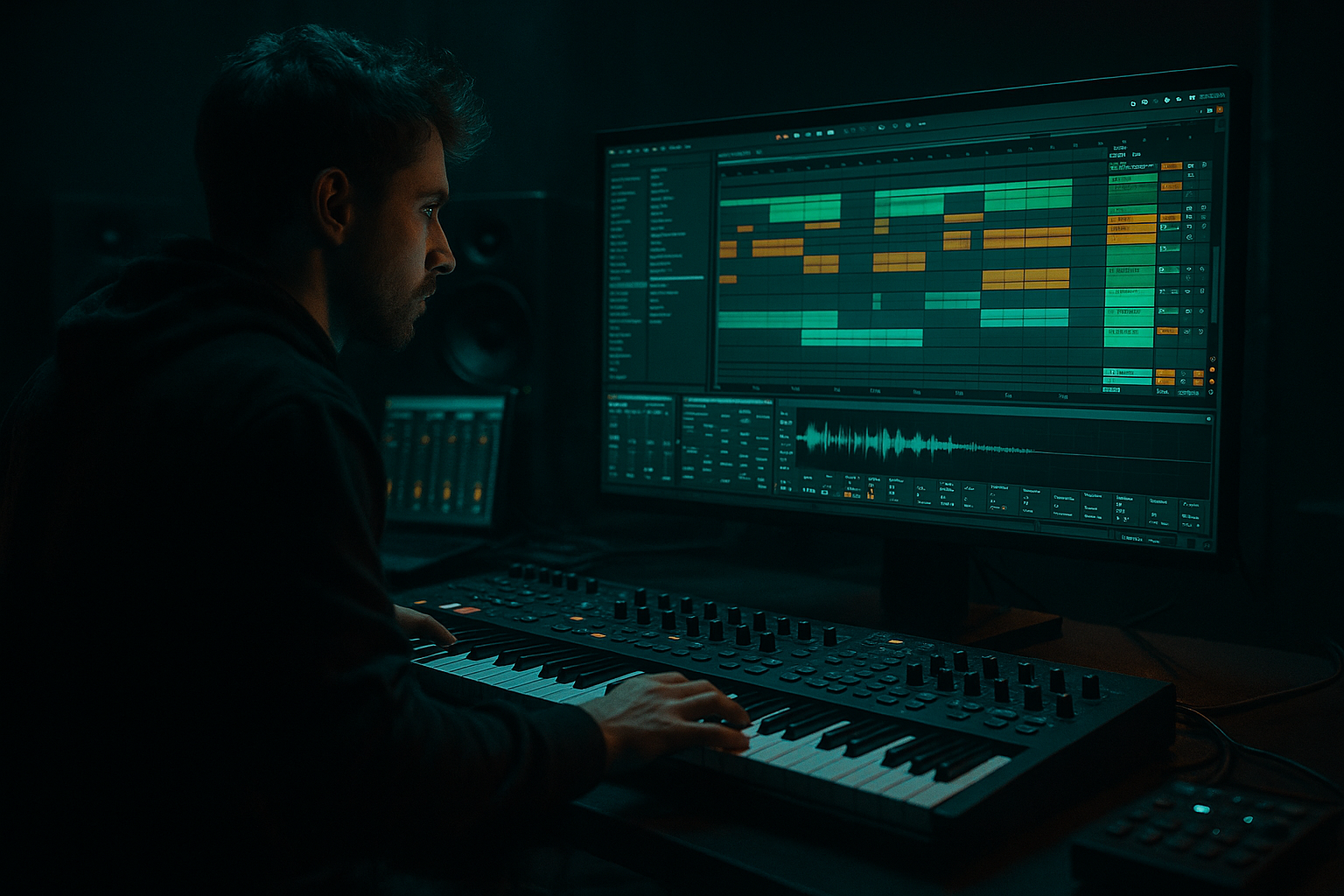
Main tutorial
Lesson Overview
A pitched jungle fill with chopped-vinyl character is one of those finishing moves that can make a DnB arrangement feel expensive instantly. In a drum & bass track, this kind of fill usually appears at the end of an 8, 16, or 32-bar phrase to pull the listener into the next section: into a drop, a switch-up, a halftime breakdown, or a new bass call-and-response. The goal is not just “a cool FX moment” — it’s to create momentum, tension, and the feeling that the track has been sampled, cut, and reassembled from a living record collection.
In Ableton Live 12, you can build this effect entirely with stock tools by combining break chopping, pitch automation, vinyl-style degradation, transient shaping, and controlled resampling. For advanced DnB production, this matters because fills are often what separate a technically solid tune from one that feels like it was arranged by a human with taste. The best fills in jungle, rollers, neuro, and darker half-step DnB do three things at once: they preserve groove, they destabilize pitch/texture in a musical way, and they land cleanly back on the one. That last part is critical — a great fill sounds chaotic but still behaves like a weapon in the arrangement.
This lesson focuses on creating a fill that has that chopped-vinyl feel: pitched-up and pitched-down fragments, brief rhythmic stutters, dusty tone, and a slightly unstable, sampled character. You’ll build it in a way that works in a modern DnB mix, not just as a lo-fi effect. That means controlling the low end, keeping the snare crack readable, managing stereo width, and ensuring the fill doesn’t smear the kick/bass impact of the next downbeat.
What You Will Build
You’ll create a 1- to 2-bar jungle-style fill built from chopped break fragments and pitch-swept stabs, designed to sit at the end of a phrase in an Ableton Live 12 DnB arrangement. The result will feel like:
- A broken, vinyl-sampled drum fill with fast pitch movement
- Brief reverse-like swells and “wobbling record” pitch drift
- Chopped break slices that jump between registers
- Dusty, slightly degraded tone with controlled grit
- A fill that can lead into a drop, bass switch, or halftime reload
- Clean enough to sit in a professional DnB mix without muddying the sub or harshing the top end
- Over-pitching every slice
- Letting the fill’s low end clash with the drop
- Making it too clean
- Using too much reverb on every hit
- Forgetting the arrangement function
- Widening the whole fill too much
- Use a reese-adjacent tail fragment behind the fill, but high-pass it and keep it short. A tiny warped bass ghost can connect the fill to the next drop without muddying the sub.
- Layer one pitched-down snare fragment with a very short Room Reverb or Hybrid Reverb tail for a grimy underground slap, then filter the tail down around 6–8 kHz.
- Automate Corpus subtly on a drum slice if you want metallic tension, especially for neuro or darker halftime transitions. Keep mix low; this is for tone, not obvious effect.
- For a roller, reduce pitch range and focus on groove. For jungle, allow more slice fragmentation and a looser, sampled rhythm.
- Use Drum Buss on the fill return, not the full drum group, so the fill gets extra aggression without flattening the whole kit.
- If the tune is very sub-heavy, design the fill as a midrange event. Let the bassline answer afterward rather than fight during the fill.
- Try a final hit that is pitched down slightly and then cut short with a tiny fade. That abrupt “record getting yanked” feel is a strong underground marker.
- Reference the fill against the snare density and bass phrasing of the surrounding bars. In darker DnB, the best transition effects often feel like an extension of the groove, not a separate soundtrack.
- Use only Ableton stock devices
- High-pass each fill to keep the low end clear
- Resample at least one version
- Make one automation move per version: pitch, filter, or send level
Musically, think of a final bar before a drop where the drums start to disintegrate: a snare gets pitched up for urgency, a ghosted break slice drops in low for weight, and the whole thing bends like it was pulled off a vinyl deck just before the next section slams in.
Step-by-Step Walkthrough
1. Set up the source material for maximum chop potential
Start with a drum break that already has character. In DnB, a classic break, a stripped Amen-style pattern, or a custom break with ghost notes works best. Drag it into an audio track in Ableton Live 12 and warp it to the project tempo. For this lesson, aim for a fill source with enough transient detail to survive slicing: kick, snare, hat movement, and a few tails.
Use Clip View to tighten the break:
- Warp Mode: Beats for punchy break material
- Preserve: Transients or 1/16 for crisp slicing
- Transient envelope: keep attack strong if the break is too soft
If your source is too clean, print a more interesting version by sending it through Saturator with Drive around 2–5 dB, then resample it. You want the fill to feel like it came from a battered dubplate, not a pristine sample pack.
2. Slice the break into playable fragments
Right-click the audio clip and use Slice to New MIDI Track. For advanced DnB work, slice by transients or 1/8 notes depending on how dense the source is. This gives you a Drum Rack with individual slices you can sequence like a fill instrument.
In the Drum Rack:
- Keep the most useful slices on adjacent pads
- Group similar hits: snares, hats, tail fragments, reverse-feeling slices
- Remove or mute weak slices that don’t contribute to the phrase
Now program a short fill pattern at the end of an 8- or 16-bar section. Don’t overdo density. A strong jungle fill usually works because it alternates space and movement. Try a pattern like: snare slice → pitched-up hat slice → lower kick ghost → snare drag → tiny break tail.
Why this works in DnB: break-driven fills keep the language of the genre intact. Instead of sounding like generic EDM FX, the transition feels rhythmically native to jungle and rollers, where micro-edits and ghosted drum motion are part of the groove DNA.
3. Build pitch movement with resampling, not just MIDI notes
To get that chopped-vinyl pitch character, create a new audio track and set its input to resample from the Drum Rack track. Record the fill performance in real time or bounce the MIDI pattern to audio once you like the rhythm. This gives you a single audio phrase you can process like a record chop.
Now use Clip Envelope or automation to pitch-select fragments:
- For small, musical jumps: ±2 to ±5 semitones
- For more obvious jungle-style movement: ±7 to ±12 semitones on isolated hits
- Use slower rises into the fill and quick drops on the last hit for tension
If you prefer to stay in MIDI, use Simpler in One-Shot mode on a chosen slice, then automate Transpose with clip envelopes or a MIDI pitch lane. A pitched snare fragment rising by +3 semitones into a final downbeat is often enough to create that “vinyl pulled back” feeling without sounding cartoonish.
Advanced tip: pitch only the mid/high fragments and leave the sub fundamentals out of the fill. In DnB, low-end pitch movement can blur the kick-bass contract unless it’s very intentional.
4. Add chopped-vinyl instability with Simpler and sample start control
Take your resampled fill audio and load it into Simpler. Set it to Classic mode if you want tighter, more “sampler-like” behavior, or One-Shot if you want each chop to fire cleanly. Now map the musical instability through Start, Transpose, and Glide behavior.
Useful starting points:
- Filter: low-pass around 8–12 kHz for dusty tops, or 12–16 kHz if you want brighter crackle
- Glide/Portamento: short, around 10–40 ms on overlapping slices
- Start position modulation: tiny offsets to mimic off-center vinyl sampling
- Transpose: automate or clip-envelope jumps of +2, +5, +7 semitones for a more “sampled record” feel
If you want more literal chopped-vinyl flavor, duplicate the clip and offset the start point on each copy by a few milliseconds. That subtle imperfection creates a sampled artifact feel without resorting to gimmicks. For darker rollers, keep the pitch movement tighter and more mechanical. For jungle, be more aggressive and let a couple of slices “over-lean” in pitch.
5. Shape the fill’s envelope so it hits like a transition, not a loop
This is where many fills fail. They sound interesting soloed but don’t function in arrangement. Use the Simpler's Amp Envelope, or if working in audio, use fades and automation to sculpt the phrase.
Suggested movement:
- First hit: slightly shorter, strong transient
- Middle fragments: shorter decay, more rhythmic
- Final hit: longer tail or reverse-feel swell into the downbeat
If you use Simpler:
- Attack: 0–2 ms
- Decay: 80–250 ms depending on slice length
- Sustain: low or zero for chopped hits
- Release: 20–120 ms for a soft tail
Then add Utility and automate Gain for phrase emphasis. A fill often works better when the last 1/4 bar gets 1–2 dB louder as it approaches the drop, rather than slamming everything from the start. That tiny lift helps the listener feel the arrival.
6. Process the fill with vinyl-style grit using stock Ableton devices
Now add character without destroying impact. Insert a light chain of stock devices on the fill bus:
- Saturator: Drive 1.5–4 dB, Soft Clip on if needed
- Redux: very subtle, reduce bit depth or sample rate lightly for texture
- Drum Buss: Drive low to moderate, Transients slightly up if the hits need more bite
- EQ Eight: trim harshness around 3–6 kHz if the slices get spiky
- Auto Filter: automate a short cutoff sweep to fake DJ-style record motion
A useful chain for darker DnB:
- EQ Eight → Saturator → Drum Buss → Utility
Example starting points:
- Saturator Drive: 2–3 dB
- Drum Buss Drive: 5–15%
- Drum Buss Crunch: 5–20% if you want more dust
- Utility Width: 70–100% on the fill, but keep the sub content mono or removed
If the fill feels too clean, resample it again after processing. In DnB, second-generation audio often sounds more believable because it captures the “print and degrade” workflow that suits jungle aesthetics.
7. Lock the low end and keep the kick/bass relationship intact
This is a mastering-minded move, even though you’re still building the fill. The biggest risk with pitched fills is low-frequency clutter that fights the kick or bass right when the drop lands.
Do this:
- High-pass the fill around 100–180 Hz depending on the arrangement
- If the fill includes a useful low tom or kick fragment, keep only one controlled low hit
- Use Utility to collapse anything below the crossover region to mono if needed
- Check the fill against the sub-bass phrase that follows
If your main bass enters immediately after the fill, leave a little breathing room. A 1/16 or 1/8 pocket of silence before the downbeat can make the next sub hit feel heavier. In mastering terms, clarity at the phrase boundary matters more than extra fill density. The listener should feel the transition, not hear a low-end argument.
8. Automate movement in a way that feels like DJ manipulation
Now make it feel like a real record being worked. Automate a few complementary parameters across the last bar:
- Auto Filter cutoff down or up by 15–40%
- Simpler Transpose: short pitch rise on one slice, pitch drop on the last slice
- Reverb send: only on one or two hits, not the whole fill
- Delay send: tiny slap or ping on a snare fragment for spatial smear
- Pitch envelope on resampled audio: use a fast downward bend on the final slice
A strong arrangement trick is to start the fill “normal,” then let it become more broken each 1/4 bar. For example:
- Beat 1: clean chopped snare
- Beat 2: pitch-up hat slice
- Beat 3: degraded break tail
- Beat 4: final pitched-down hit into silence or impact
This gives the impression of an increasingly unstable vinyl source. It works especially well before a drop, a rewind, or a bass switch, because the listener’s ear is pulled forward by motion rather than just volume.
9. Place the fill in a real arrangement context and test the transition
Drop the fill into the final bar before a key section. Good contexts include:
- End of an 8-bar pre-drop phrase before a heavy drop
- Final bar of a 16-bar roller section before a bass re-entry
- Switch-up from full-time drums into halftime or half-step groove
- Mid-track breakdown where the drums “tear apart” into a new groove
Play it with the full arrangement, not solo. The fill should:
- Leave the next kick and bass hit intact
- Create tension without masking the snare backbeat of the next section
- Feel like part of the drum language of the tune, not a decorative add-on
If it’s too busy, simplify the middle hits. If it’s too polite, increase the pitch spread on just one fragment or add a second-generation resample pass.
10. Final mastering check on the fill: transient, stereo, and harshness
Before you commit, audition the fill in context with a mastering-style perspective. Even if you’re not mastering the track yet, think like the final listener.
Check:
- Peak control: no accidental overs on the fill bus
- Mono compatibility: especially if you used widening or layered stereo FX
- Top-end harshness: pitched-up slices can bite at 4–8 kHz
- Low-mid congestion: around 200–500 Hz if the break is thick
Use EQ Eight to notch any harsh resonance, and keep the fill’s stereo width intentional. Many classic jungle fills are effectively narrower than people think. A slightly mono-centered transient with a little stereo dust around it can hit harder than a wide, blurry effect.
Common Mistakes
Fix: keep most of the fill within a narrow range and use one or two dramatic pitch moments as accents.
Fix: high-pass aggressively enough that the kick and bass regain authority on the next downbeat.
Fix: resample, add gentle Saturator or Redux, and use imperfect slice starts to fake sampled hardware behavior.
Fix: send only selected slices to space. Jungle fills need motion, not wash.
Fix: place the fill where the listener needs a reset, lift, or transition. If it doesn’t change the phrase energy, it’s not doing its job.
Fix: keep the transient core more focused and let stereo detail live in the tails or effects.
Pro Tips for Darker / Heavier DnB
Mini Practice Exercise
Spend 15 minutes creating three versions of the same 1-bar pitch jungle fill in Ableton Live 12.
1. Build a chopped break fill from one audio break and slice it to a Drum Rack.
2. Make Version A: subtle roller-style fill with only ±2 to ±4 semitone movement.
3. Make Version B: classic jungle-style fill with one pitched-up snare slice and one pitched-down final hit.
4. Make Version C: darker, heavier version with more saturation, less stereo width, and a stronger low-pass/dusty top.
5. Place each version at the end of an 8-bar phrase and compare which one best supports:
- a high-energy drop
- a halftime switch-up
- a grimy roller transition
Rules:
After the comparison, pick the version that best serves arrangement, not just the one that sounds coolest soloed.
Recap
A great pitched jungle fill in DnB is about controlled chaos: chopped break fragments, musical pitch movement, sampled-vinyl instability, and clean transition behavior. Build it from real drum language, resample it for character, process it with stock Ableton devices, and always test it in context with the bass and drop. Keep the low end clear, automate with intention, and let the fill function as a phrase-turning device, not just an effect.

