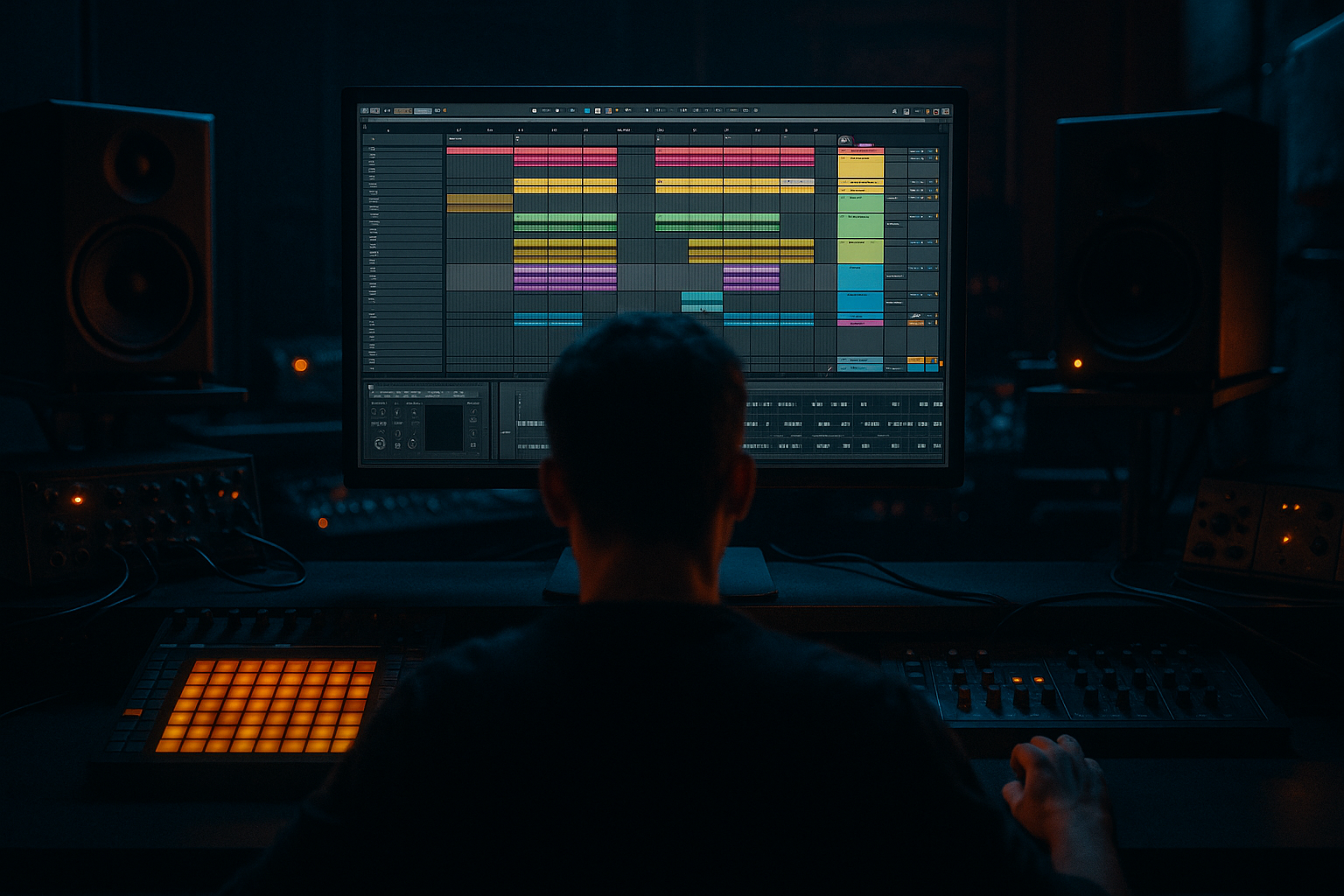
Main tutorial
Pitch Oldskool DnB Sampler Rack for Rave Pressure (Ableton Live 12) 🔥🎛️
Skill level: Intermediate
Category: Mastering (with “mix-to-master” thinking)
---
1. Lesson overview
Oldskool jungle/DnB pressure often comes from pitched breaks, pitched stabs, and resampled grit—but the secret sauce is controlling the tonal shift and transient behavior so it still hits hard on a modern system. In this lesson you’ll build a pitch-focused Ableton Sampler Rack designed for that classic “rave-lean” energy, then glue it into a mastering-aware chain that keeps loudness and weight without flattening the groove. 🚀
We’ll aim for:
- Breaks that speed up / pitch up like old hardware samplers
- Controlled low-end so the master doesn’t buckle
- A “finished” pressure feeling that translates in clubs
- Sampler with break/stab samples
- Macro-controlled pitch (with “old sampler” behavior)
- Transient shaping + saturation tuned for jungle drums
- Pre-master “pressure” bus (glue + clip) to hit the master right
- Optional parallel dirt chain for extra grit
- Gain staging into the master chain
- A light master chain using stock Ableton devices (Glue Compressor, Saturator, Limiter) 🎚️
- Warp: Off inside Sampler (we want classic pitch/time coupling)
- Voices: 8 (or 4 if CPU tight)
- Filter: On
- Pitch/Osc tab: keep at default for now
- Map EQ Eight HPF frequency to Macro 3
- Range: 20 Hz → 90 Hz (for quick cleanup when pitching high)
- Drive: 5–12%
- Crunch: 10–25%
- Boom: 0–15%
- Damp: 10–30% (tames harshness)
- Transient: +5 to +20 (helps breaks stay snappy)
- Map Drum Buss Drive + Crunch together
- Keep it subtle—this is “pressure,” not fuzz.
- Mode: Analog Clip
- Drive: 2–6 dB
- Soft Clip: On
- Output: pull down to match level (aim same loudness on/off)
- Map Saturator Drive (2 → 8 dB)
- Map Output inversely (0 → -6 dB) so it doesn’t jump wildly
- Redux (yes—old sampler magic)
- Auto Filter (band-limit like old hardware)
- Clean: 0 dB
- Dirt Parallel: -12 to -20 dB (blend only!)
- Map Dirt chain volume from -inf → -12 dB
- Bars 1–16: base groove (Macro 1 at 0)
- Bars 17–32: add subtle Dirt Blend
- Bar 33 (pre-drop): 1-bar pitch ramp + low cut ramp
- Bar 34: drop back to 0 semitones, low cut back down—impact feels massive 🎇
- Attack: 3 ms
- Release: Auto (or 0.3s)
- Ratio: 2:1
- Threshold: adjust for 1–2 dB gain reduction on peaks
- Makeup: Off (level match manually)
- Mode: Soft Sine or Analog Clip
- Drive: 1–3 dB
- Soft Clip: On
- Ceiling: -1.0 dB
- Gain: 0 dB (don’t slam it—just safety)
- Warping the break in audio with Beats/Complex while also pitching in Sampler → phasey, smeary transients. If you want oldskool pitch, keep Sampler Warp off.
- Pitching up without low-cut automation → low-mid builds and the master limiter chokes.
- Too much Redux → hats turn to sand, snare loses crack. Blend it in parallel.
- Over-compressing the drum group → kills the “rolling” bounce and makes the groove feel small.
- No gain staging → saturation and clipping become random, not musical.
- Make the dirt midrange-only: put an EQ Eight before Redux on the Dirt chain with HPF ~200 Hz and LPF ~8–10 kHz. Keeps sub clean and top controlled.
- Add “shadow” with Roar (Live 12 stock) (optional):
- Reese synergy: tune the pitched breaks/stabs to the reese’s root or fifth (Macro 2 fine tune helps). Dissonance is cool—but controlled dissonance is heavier.
- Transient-first mindset: if it stops feeling like DnB, it’s usually transients getting too soft. Use Drum Buss Transient or back off Glue.
- Automate pitch for “pressure phrases”: subtle +2 semitone lift for 8 bars can feel like the room is speeding up.
- Drop feels bigger when pitch returns
- Master limiter works less hard on the lift (because low cut is managed)
- You built a Sampler-based pitch rack that captures oldskool “speed-up” energy while staying master-friendly.
- You used macros to control pitch, tuning, low-cut, grit, clip push, and dirt blend—so the sound is playable and automatable.
- You reinforced the vibe with parallel Redux dirt and controlled bus pressure using Glue + Saturator + safety limiting.
- You learned an arrangement trick: pitch ramps + low-cut ramps = rave tension without ruining headroom.
---
2. What you will build
You’ll create a single Instrument Rack called:
“Rave Pressure Pitch Rack”
It will include:
You’ll also set up a simple Mastering-aware workflow:
---
3. Step-by-step walkthrough
Step 0 — Session prep (DnB context) 🏁
1. Set tempo to 170–174 BPM (start at 172).
2. Create a Drum Bus group and a Music Bus group (stabs/bass).
3. Leave headroom: target -6 dB peak on the Master before limiting.
Why: pitch-based energy can spike transients and low-end; headroom keeps your mastering moves clean.
---
Step 1 — Build the Sampler Rack core 🎹
1. Create a MIDI track → load Instrument Rack.
2. Drop Sampler into the Rack.
3. Drag in an oldskool source:
- Classic Amen / Think / Funky Drummer slice, or
- A rave stab / hoover hit / reese one-shot
Sampler settings (break-focused starting point):
- Type: MS2 (or PRD)
- Freq: 12–16 kHz (start open, we’ll macro it)
- Res: 0.10–0.30
Key concept: “Oldskool pitch-up = faster playback + higher pitch.” That’s the vibe.
---
Step 2 — Add key tracking + “Old Sampler” pitch behavior 🎚️
We want two pitch modes:
1) Classic pitch (affects speed + tone)
2) Fine offset “tune” for keying into your track
#### A) Macro 1: “Rave Pitch”
1. In Sampler → Transp. (Transpose)
2. Map it to Macro 1
3. Set Macro range: 0 to +7 semitones (DnB sweet spot)
- If you want more chaos: try -5 to +12
Tip: +3 to +7 semitones gives instant “rave pressure” on breaks without becoming chipmunk chaos.
#### B) Macro 2: “Fine Tune”
1. Map Sampler Detune to Macro 2
2. Range: -20 to +20 cents
Use: lock the break/stab into the key of your bassline.
---
Step 3 — Keep the low-end stable (crucial for mastering) 🧱
Pitching breaks up often pushes low-mid bite, but you must prevent sub clutter.
1. After Sampler, add EQ Eight
2. Set:
- HPF at 25–35 Hz (24 dB/oct)
- Gentle dip if needed:
- 250–400 Hz: -2 to -4 dB (Q ~1.2) if it gets boxy
- Optional: small cut around 7–10 kHz if hats get brittle when pitched
Macro 3: “Low Cut”
This is a mastering-minded move: pitch changes can wreck master headroom if the low-end blooms.
---
Step 4 — Add punch and grit (oldskool bite without killing transients) 💥
Add Drum Buss after EQ Eight.
Suggested starting settings:
- Frequency: 50–70 Hz (be careful—can fight your sub)
Macro 4: “Grit”
---
Step 5 — Add “rave air” movement with controlled distortion 🌪️
Add Saturator after Drum Buss.
Settings:
Macro 5: “Clip Push”
This gives you that “printed hot to tape/sampler” feel while staying gain-controlled.
---
Step 6 — Build parallel dirt inside the Rack (big oldskool energy) 🧪
In the Instrument Rack:
1. Click Chain List → create 2 chains:
- Clean
- Dirt Parallel
Clean chain: keep what you built so far.
Dirt Parallel chain: copy the chain, then add:
- Downsample: 2.0–6.0
- Bit Reduction: 0–3 (tiny amounts)
- Type: Bandpass
- Freq: 500 Hz – 8 kHz
- Drive: small (0–6)
Now set chain volumes:
Macro 6: “Dirt Blend”
This is huge for jungle vibe—grit without losing punch.
---
Step 7 — Add “rave pitch throws” for arrangement impact 🎯
Oldskool arrangement trick: pitch-up moments to lift energy into drops or fills.
1. Automate Macro 1 (Rave Pitch) at key moments:
- End of 8 or 16 bars: ramp +0 → +5 semitones over 1 bar
- Quick jab: +0 → +7 for a single snare fill hit
2. Combine with Macro 3 (Low Cut):
- When pitching up, also raise low cut from 30 → 70 Hz
- This prevents low-mid “woof” and keeps master clean.
DnB arrangement idea (rolling):
---
Step 8 — “Mastering-aware” pressure bus (before the Master) 🧷
Create a Return track or a Drum Bus group processing chain (recommended: group your pitched breaks + drums).
On the Drum Group add:
#### A) Glue Compressor (gentle glue, not squashing)
#### B) Saturator (bus polish)
#### C) Limiter (only catching spikes on the bus, not final loudness)
This keeps your master limiter from doing all the work.
---
Step 9 — Simple master chain (stock, clean, DnB-safe) 🎛️
On the Master, keep it minimal:
1. EQ Eight (optional)
- HPF at 20 Hz (very gentle; 12 dB/oct)
- Tiny shelf if needed: +0.5–1 dB at 10 kHz
2. Glue Compressor (optional)
- Aim: 0.5–1 dB GR max
3. Limiter (Ableton Limiter)
- Ceiling: -1.0 dB
- Push Gain until you hit your target
- For modern DnB loudness, many aim roughly -7 to -5 LUFS integrated (genre dependent), but don’t wreck your transients to get there.
Check: If the limiter is pumping, fix it upstream (low cut, less boom, less clip push).
---
4. Common mistakes ⚠️
---
5. Pro tips for darker/heavier DnB 🖤
- Put Roar on the parallel chain with a band focused around 300 Hz–3 kHz, mild drive, and mix low. This adds threat without fizz.
---
6. Mini practice exercise 🎓
Goal: Build a 32-bar rolling loop with one “rave pressure” lift.
1. Load an Amen (or any break) into your rack.
2. Program a simple 2-step or rolling pattern (kick/snare backbone) and layer the break quietly.
3. Set:
- Macro 1 (Rave Pitch): 0
- Macro 6 (Dirt Blend): around -18 dB (barely there)
4. At bar 31 → 32, automate:
- Macro 1 ramp 0 → +5
- Macro 3 ramp 30 Hz → 70 Hz
- Macro 5 (Clip Push) +1–2 dB
5. Drop at bar 33 back to normal.
Listen for:
---
7. Recap ✅
If you want, tell me what kind of source you’re using (Amen, Think, stab, hoover, etc.) and the key of your tune, and I’ll suggest macro ranges and EQ points tailored to your loop.

