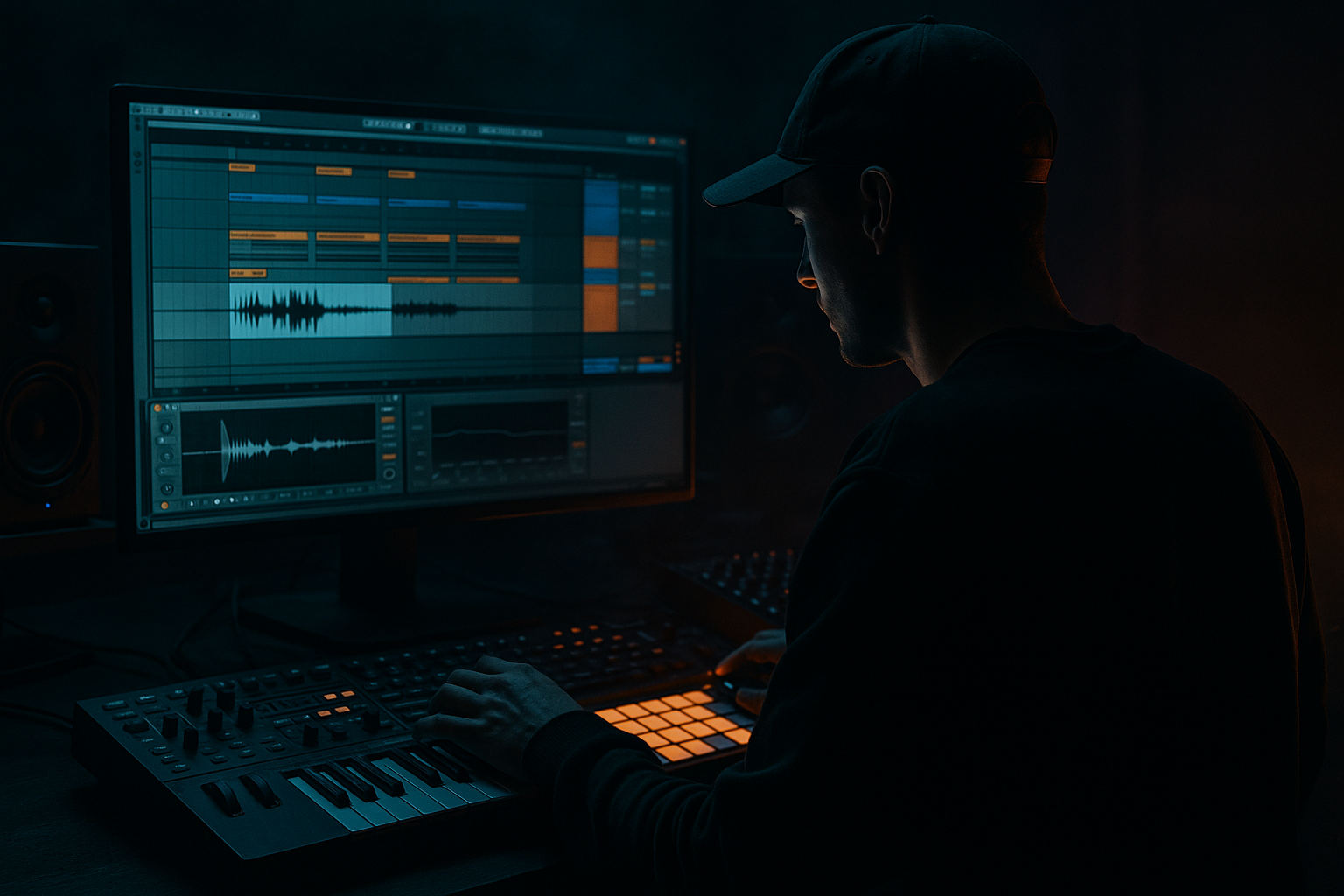
Main tutorial
Pitching Rave Vocals (Ableton Live 12 Stock Packs) — Advanced DnB Sampling 🎤⚡
1) Lesson overview
In drum & bass, the vocal hook isn’t just “a sample on top”—it’s often a rhythmic instrument: pitched, time-warped, resampled, and layered into the groove. In this lesson you’ll take stock Ableton Live 12 Pack vocals (no third-party tools), then pitch them into rave territory while keeping them tight, aggressive, and mix-ready for rolling/techy/jungle DnB.
We’ll focus on:
- Pitching workflows (clip vs Simpler vs resampling)
- Formant control (without external plugins)
- DnB-ready timing (syncopation, call/response, pre-drop teases)
- Stock-device chains for grit, width, and impact
- A main pitched hook (tonal, sits with bass)
- A chopped call/response layer (percussive, groove-focused)
- A dark processed layer for drops (distorted + filtered + roomy)
- A resampling workflow so you can commit, slice, and re-pitch quickly
- Short phrases work best (“come on”, “selecta”, “inside”, “run it”, “listen”)
- Clear consonants = better chop definition
- Minimal reverb baked in (easier to place in your space)
- Adjust Formants (if available in your view for Complex Pro) to keep the voice from going “chipmunk” when pitching up.
- Pitch up + formants slightly down = classic rave “hype but not tiny.”
- Slicing: Transient (good for spoken phrases), or Beat if it’s rhythmic
- Start with 1/16 grid for quick jungle-style peppering
- If your bass is in F minor, try pitching the vocal so its strongest note lands on F / Ab / C.
- Complex Pro for clarity
- If you want gritty time-stretch artifacts, try Texture:
- Use automation to increase:
- Mode: LP24
- Resonance: 10–25%
- Automate cutoff from ~500 Hz → 8–12 kHz into the drop
- Put the main phrase on bar 9 beat 1 or beat 3
- Add chopped replies on off-beats:
- Hook Clean (main)
- Hook Dark (more distortion + less top end)
- Hook FX (long delays/reverb tails)
- Use Hook FX only in transitions
- Use Hook Dark layered quietly under the clean in the drop for size
- Cut all long tails on the drop downbeat for tightness
- Pitching up without controlling brightness → harsh, brittle vocals that fight hats and cymbals.
- Too much warp marker surgery → smeared consonants, loss of impact.
- Over-reverb in the drop → your mix loses punch and the snare feels smaller.
- Ignoring key center → vocal feels “floating” against the bass note.
- No resampling → you stay stuck tweaking instead of committing and arranging.
- Distort in parallel:
- Mid/Side control with EQ Eight:
- Make the vocal “live in the drum room”:
- Pitch automation moments:
- Texture-mode ugliness (controlled):
- Use Clip Transpose + Warp for fast pitching, Simpler Slice for rhythmic control, and Resampling to commit and build character.
- Keep vocals tight and percussive—DnB vocals are groove tools, not just toplines.
- Build a reliable stock chain: EQ Eight → Glue → Saturator → Delay/Reverb (returns).
- For rave energy: pitch up (+5/+7), manage brightness, layer “air,” and automate throws.
- For dark/heavy: parallel distortion, controlled stretch artifacts, and aggressive arrangement contrast.
---
2) What you will build
You’ll build a complete “rave vocal system” for a DnB track:
Target vibe: rolling 174 BPM, with the vocal acting like a lead stab and a rhythm accent.
---
3) Step-by-step walkthrough
Step 0 — Session setup (DnB fundamentals)
1. Set tempo to 174 BPM.
2. Set a loop of 16 bars (8-bar intro + 8-bar drop is a classic test bed).
3. Build a simple DnB skeleton first:
- Drums: kick on 1, snare on 2 & 4 (or 2 and 4 in half-time feel), add shuffled hats.
- Bass: a rolling Reese or sub pattern with space for the vocal.
> You want the vocal to “answer” the drums and bass, not fight them.
---
Step 1 — Find a vocal from Live 12 stock Packs
Use only stock content:
1. Open Browser → Packs.
2. Look for vocal-ready material in:
- Core Library (often has usable vocal clips)
- Any installed Ableton Packs that include audio clips/samples (vocal phrases, shouts, spoken lines).
3. Drag an audio phrase into an Audio Track.
Selection criteria (DnB-friendly):
---
Step 2 — Decide your pitching method (Clip vs Simpler)
You have three strong stock workflows:
#### A) Clip pitching (fastest for auditioning)
1. Click the clip → Clip View.
2. Turn Warp ON.
3. Choose a Warp Mode:
- Complex Pro for intelligible vocals (best overall)
- Complex if you want slightly rougher artifacts
- Tones for robotic, synthy vibes (can work for jungle shouts)
4. Adjust:
- Transpose: start at +3, +5, +7 semitones for “rave uplift”
- For darker: -3, -5, -7 semitones
Complex Pro tip:
#### B) Simpler (best for chops, MIDI control, and performance)
1. Right-click the vocal clip → Slice to New MIDI Track (or drag the sample into Simpler).
2. In Simpler:
- Mode: Slice (for rhythmic stabs), or Classic (for one-shot style)
- Enable Warp inside Simpler if needed (depends on version/settings)
3. Now you can play slices on a MIDI keyboard and write groove like a lead.
Slice settings for DnB:
#### C) Resampling (best for committing + reprocessing)
1. Create a new Audio Track named VOCAL RESAMPLE.
2. Set Audio From to the original vocal track (or “Resampling”).
3. Record the processed vocal pass.
4. Now you can warp/pitch the resample again for layered artifacts.
This is how you get those gnarly, “been-through-the-rack” vocals fast. 🔥
---
Step 3 — Get the vocal in key (advanced, practical approach)
DnB vocals often “work” even when they’re not perfectly melodic, but matching tone center helps the bass feel bigger.
Fast method:
1. Add Tuner (stock) after the vocal.
2. Find a sustained vowel (“ah”, “oh”, “ee”) in the phrase and loop it.
3. Adjust Transpose until Tuner shows a stable note near your track key.
Practical target:
> Don’t over-correct every syllable—DnB loves attitude and imperfection.
---
Step 4 — Tight warping so it hits with the drums
Vocal timing is everything in rolling DnB.
1. In Clip View, set the 1.1.1 marker correctly (start of phrase).
2. Warp the phrase so key hits land:
- Right before snare (classic “snare lift”)
- On the off-beat (to bounce with hats)
3. Use warp markers sparingly—too many can smear consonants.
Warp mode recommendations:
- Grain Size: start 20–40 ms
- Random: 5–15%
This can add a wicked broken, “pirate radio” vibe when used subtly.
---
Step 5 — Build a stock device chain (DnB vocal rack)
Here’s a practical chain that’s reliable for DnB:
#### Main Hook Chain (clean but hyped)
1. EQ Eight
- HP filter: 90–140 Hz (24 dB/Oct)
- Dip harshness: 2.5–4.5 kHz (narrow-ish, -2 to -5 dB)
- Add bite if needed: gentle shelf 8–12 kHz
2. Glue Compressor
- Attack: 3 ms
- Release: Auto
- Ratio: 2:1
- Aim: 1–3 dB gain reduction
3. Saturator
- Mode: Soft Sine or Analog Clip
- Drive: 2–6 dB
- Turn on Soft Clip if you want it upfront without spikes
4. Delay (stock Delay device)
- Time: 1/8 or 1/4 (sync)
- Feedback: 15–35%
- Filter: HP around 200–400 Hz, LP around 6–9 kHz
- Keep it subtle; you want bounce, not wash
5. Reverb
- Decay: 0.8–1.6 s (DnB usually shorter for tightness)
- Pre-delay: 15–35 ms
- HP/LP in the Reverb: HP ~ 250–500 Hz, LP ~ 7–10 kHz
✅ DnB workflow tip: Put Delay + Reverb on Return tracks so you can automate sends for pre-drop hype and drop tightness.
---
Step 6 — Create the “pitched rave” effect (without external formant plugins)
You can fake formant-ish behavior and thickness with layering:
#### Technique: Split into “Body” + “Air” layers
1. Duplicate the vocal track: Vox Body and Vox Air.
2. Vox Body
- Pitch up/down to taste (e.g., +5 semitones).
- EQ Eight: low-pass around 6–8 kHz to focus on core tone.
- Add Saturator for weight.
3. Vox Air
- Same clip, but pitch higher (e.g., +12 or +7).
- EQ Eight: high-pass around 3–5 kHz.
- Add Redux very lightly (bit depth 10–12, soft touch) for sparkle/grit.
- Keep it low in level—this is the “rave sheen.”
Blend until it sounds like one vocal, just more “larger-than-life.”
---
Step 7 — Turn the vocal into a rhythmic instrument (classic DnB placement)
Now arrange it like a DnB hook:
#### A) Pre-drop tease (bars 7–8)
- Reverb send
- Delay feedback
- A filter sweep (Auto Filter)
Auto Filter settings:
#### B) Drop call/response (bars 9–16)
- Example: main phrase hits, then 1–2 chopped syllables answer on the “and” of 2 and 4.
#### C) Jungle-style stutters
1. In Simpler Slice mode, write 1/16 repeats of one syllable.
2. Add Beat Repeat (stock) for controlled chaos:
- Interval: 1/8 or 1/16
- Grid: 1/16
- Chance: 10–25% (keep it tasteful)
- Variation: 0–20%
3. Automate Beat Repeat ON only for 1 bar at phrase ends.
That “one-bar glitch” is pure rave DNA. 🧬
---
Step 8 — Sidechain the vocal to the snare (yes, really)
In DnB, the snare is king. Let it punch through.
1. Add Compressor to the vocal bus.
2. Sidechain input: Snare track.
3. Settings:
- Ratio: 2:1 to 4:1
- Attack: 1–3 ms
- Release: 50–120 ms
- Threshold: adjust for 1–3 dB ducking on snare hits
This keeps the vocal loud without masking the crack.
---
Step 9 — Resample and “print” variations for arrangement
Make 3 printed versions:
Then in Arrangement View:
---
4) Common mistakes
---
5) Pro tips for darker/heavier DnB 🖤🔩
Duplicate the vocal, slam it with Roar (if available in your Live 12 suite) or Saturator + Overdrive, then low-pass it. Blend under the clean vocal for menace without losing intelligibility.
Tighten the sides by cutting harsh highs on the Side channel, keep the Mid more present so it’s solid in clubs.
Use a short Room reverb on a return, decay 0.4–0.9 s, and send a little snare + vocal into it. This glues the top end like classic rave recordings.
Print a version pitched -7 for one bar before the drop, then switch to +5 on the drop. That contrast is huge in heavy rollers.
For dark techy DnB, a slightly broken time-stretch can sound criminal—in a good way. Use Texture mode and resample it so it becomes a signature.
---
6) Mini practice exercise (15–25 minutes) 🧪
1. Pick one stock vocal phrase from Packs.
2. Create three tracks:
- Vox Main (Complex Pro, +5 semitones)
- Vox Chops (Simpler Slice, MIDI chops)
- Vox Dark (resampled, pitched -5 semitones, saturated)
3. Arrange:
- Bars 1–8: tease with filter sweep + delay throws
- Bars 9–16: main hook on bar 9, chops answering on off-beats
4. Mix constraints:
- HP everything below 120 Hz
- Sidechain to snare for 2 dB ducking
- Reverb only on returns (automate sends)
Export a quick bounce and check: Does the snare still dominate? Does the vocal feel like part of the groove?
---
7) Recap
If you tell me your track key (e.g., Fm, G#m) and whether you’re making a roller vs jump-up vs jungle, I can suggest specific pitch intervals and a vocal placement pattern that’ll lock to your drum groove.

