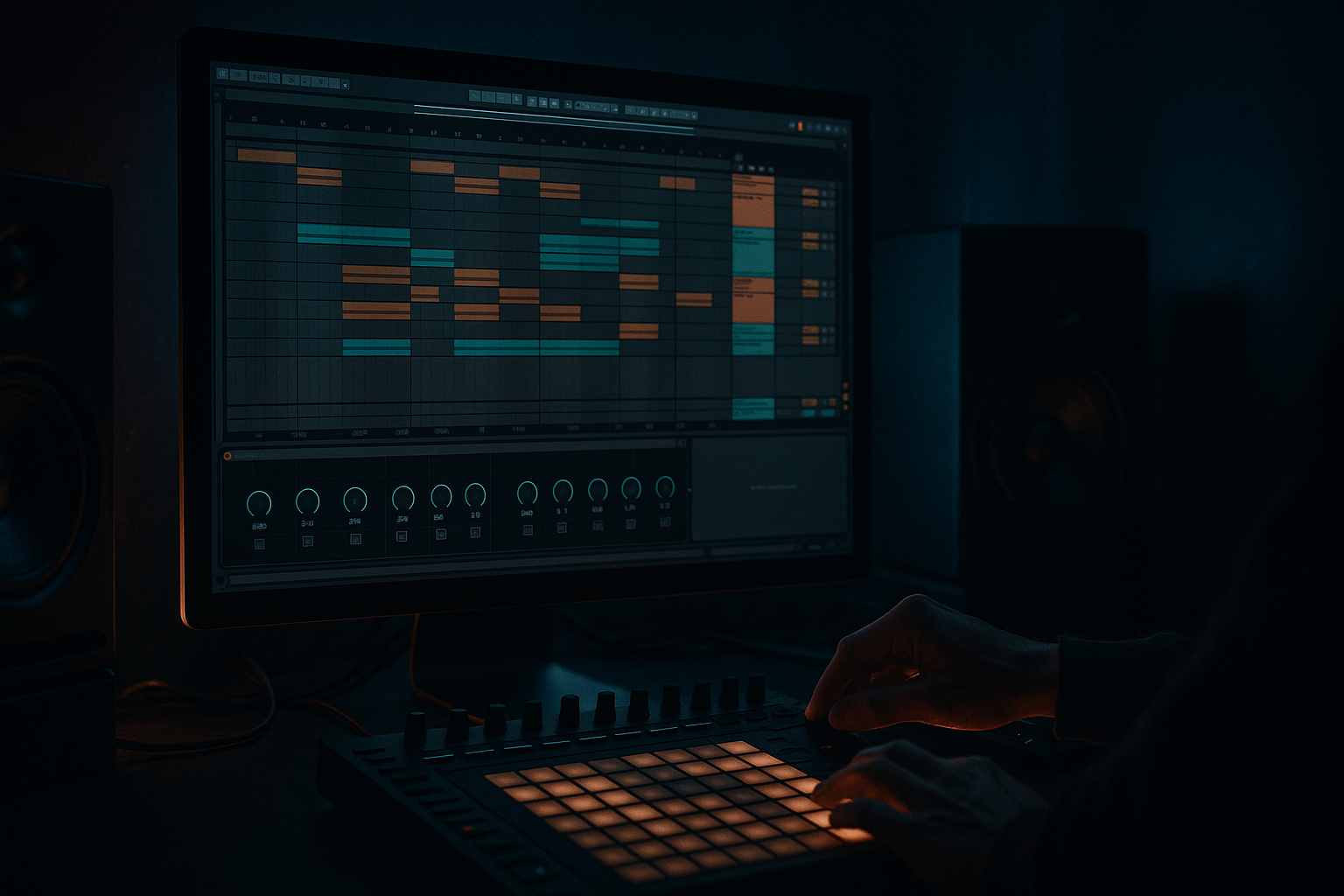
Main tutorial
Polyrhythmic Layer Control in Ableton for Drum & Bass
1. Lesson overview
Polyrhythms are one of the fastest ways to make a drum & bass groove feel more intelligent, more tense, and more alive without overcrowding the arrangement. In DnB, this is especially powerful because the main pulse is usually very stable: kick, snare, bass weight, and fast forward momentum. When you place controlled rhythmic layers around that pulse, you get movement without losing dancefloor clarity.
In this lesson, we are not making “random complex rhythms.” We are learning polyrhythmic layer control: how to add rhythmic loops or MIDI patterns that cycle against the main 2-step or break pattern while keeping the groove tight, dark, and mix-friendly.
We’ll build this inside Ableton Live using stock devices and DnB-focused workflow.
By the end, you’ll know how to:
- Create polyrhythmic percussion layers that loop against a standard DnB drum pattern
- Keep the groove readable and heavy
- Use Follow Actions, Clip Length, Groove Pool, Velocity, Auto Pan, Shaper-style modulation via stock tools, and sidechain control
- Make layers feel rolling rather than messy
- Arrange these ideas for intros, drops, switch-ups, and second-drop development 🔥
- A main drum bus holding the core kick/snare groove
- A break layer
- A polyrhythmic percussion layer running in a different loop length than the main drum loop
- A polyrhythmic hat or rim layer using MIDI notes grouped across a different subdivision
- Controlled dynamics so the groove stays powerful
- A short arrangement showing how to introduce and evolve the rhythmic tension
- Core drums: 1-bar or 2-bar DnB beat
- Layer A: 3-beat percussion loop over 4/4
- Layer B: 5-step hat or click cycle
- Bass + drums relationship: sidechain and frequency pocketing so the rhythm stays dark and clean
- Arrangement move: layer appears subtly in intro, grows in build, and becomes more obvious in the drop
- Techstep
- Neuro-influenced rollers
- Dark jungle
- Minimal DnB
- Tribal/heavy percussion-led drum & bass
- Tempo: 172–176 BPM
- Create these tracks:
- Kick on 1.1 and around 1.3.3 / 1.3.4 depending on your variation
- Snare on 1.2 and 1.4
- Add ghost kicks very carefully if needed
- Load kick and snare one-shots
- Put Simpler on each pad if you want tighter envelope control
- EQ Eight
- Saturator
- Drum Buss
- EQ Eight
- Saturator
- Compressor
- Drag in a classic-style break sample or chopped break
- Use Simpler in Slice mode or drop the audio directly into Arrangement/View
- Warp Mode:
- EQ Eight
- Drum Buss
- Compressor or Glue Compressor
- shuffle
- ghost notes
- top-end motion
- old-school jungle energy
- rim
- conga hit
- metallic hit
- woodblock
- industrial foley hit
- Create a MIDI clip
- Open Clip View
- Set:
- Program hits like:
- snare
- main hat
- break transient accents
- Make the first hit strongest
- Reduce the second and third accents
- Add one ghost hit much lower
- Hit 1: 110
- Hit 2: 78
- Hit 3: 92
- Ghost: 45–60
- Random: 5–12%
- Out Hi: limit if too peaky
- Low-pass around 6–12 kHz for darker styles
- Slight envelope or automation for movement
- closed hat
- shaker
- vinyl click
- filtered top percussion
- Think in groups of 5 sixteenth-notes
- Place accents every 5 steps
- Step 1
- Step 6
- Step 11
- Step 16
- then continue across a 2-bar phrase if needed
- Sidechain input: Snare or Drum Group
- Ratio: 2:1 to 4:1
- Attack: 1–10 ms
- Release: 60–150 ms
- Threshold: enough for 2–5 dB gain reduction on snare hits
- Shorten Decay
- Reduce Sustain
- Adjust Release carefully
- Use Filter inside Simpler if the sample is too wide or bright
- Use clip fades
- Shorten sample end
- Add Gate if a tail is too loose
- Timing: 20–45
- Velocity: 10–25
- Random: 0–10
- Base: 1/16
- main snare
- critical kick anchors
- sub bass stabs that must stay locked
- Kick: sub + punch
- Snare: body + crack
- Break: mids/top texture
- Perc Poly: upper mids or filtered mids
- Hat Poly: top-end motion only
- Bass: low-end authority and midrange aggression
- HP: 250–500 Hz
- LP: 5–10 kHz if it’s too clicky
- Narrow cut where snare presence lives if necessary
- HP: 500 Hz+
- Control brittle highs around 8–12 kHz
- narrow the center energy
- keep air and texture in sides only where appropriate
- Put Utility on Perc Poly
- Width: 0–60%
- Gain down by 1–3 dB
- Mono the low-mid content if needed
- Simpler or Drum Rack
- Velocity gives variation
- EQ removes clutter
- Filter darkens and focuses
- Saturator helps the sound read at low volume
- Sidechain protects the backbeat
- Auto Pan adds internal pulse
- Utility keeps placement controlled
- Main drums minimal
- Bring in Perc Poly low in the mix
- Filter it with Auto Filter
- Let listeners feel motion before they fully hear it
- Add break layer
- Open Perc Poly filter slightly
- Introduce Hat Poly quietly
- Automate Utility Width wider near the build end
- Main kick/snare full power
- Bass in
- Perc Poly tucked behind drums
- Hat Poly more audible only in upper band
- Sidechain both layers more aggressively if the drop feels crowded
- Mute Perc Poly for 2 bars, then reintroduce it
- Double the saturation briefly
- Change the clip launch position
- Swap to a different 3-beat pattern
- Add jungle edits to break while leaving poly layer unchanged
- Auto Filter Frequency
- Saturator Drive
- Utility Gain
- Compressor Threshold
- Reverb Send for transition moments
- dark in verse/drop
- brighter in fills/transitions
- then dark again when bass returns
- Short dark room
- Low cut around 400 Hz
- High cut around 5–7 kHz
- Send only selected hits, not the full pattern
- chain hits
- scraped metal
- machine clicks
- re-sampled snare tops
- jungle break fragments
- low-passed ride tails
- Drive low to moderate
- Crunch subtle
- Avoid over-boom
- If percussion loops every 3 beats, let a bass stab appear every 6 or 12 beats
- This ties the rhythmic cycle into the musical arrangement
- Saturator
- Auto Filter
- Compressor
- Tempo: 174 BPM
- Create a 2-step kick/snare groove
- Add one break layer
- Use a rim, conga, or metallic hit
- Create a clip with 3-beat loop length
- Program 4–5 hits
- High-pass to 350 Hz
- Sidechain to snare for 3 dB GR
- Use a closed hat or click
- Create a 2-bar clip
- Accent every 5 sixteenth-notes
- Add Auto Pan
- Extract groove from your break
- Apply lightly to Hat Poly only
- Leave kick and snare mostly rigid
- Bars 1–4: drums + break
- Bars 5–8: add Perc Poly filtered
- Bars 9–12: add full bass + Hat Poly
- Bars 13–16: mute Perc Poly for 2 bars, then bring it back
- Can I still clearly feel the snare on 2 and 4?
- Does the poly layer add motion rather than confusion?
- Is the groove darker and heavier, not brighter and busier?
- Does the arrangement reveal the rhythm gradually?
- Build a strong core groove first
- Use different clip lengths for true evolving polyrhythms
- Use accent patterns for implied polyrhythms
- Control complexity with:
- Keep the snare and main kick relationship sacred
- Use arrangement to reveal and reset the tension
- In darker/heavier DnB, make the polyrhythm more subtle, filtered, and narrow
- a follow-along Ableton session plan
- a stock-device rack recipe
- or a specific neuro / jungle / minimal roller version of the same lesson.
---
2. What you will build
You’ll build a dark rolling DnB groove at around 174 BPM with:
Final result concept
You’ll have:
This is ideal for:
---
3. Step-by-step walkthrough
Step 1: Set up the core DnB groove
Start with the main anchor first. If the central beat is weak, polyrhythms will only make it worse.
Project setup
Use 174 BPM for this lesson.
- Kick
- Snare
- Break
- Perc Poly
- Hat Poly
- Bass
- Drum Bus Group
Group all drum tracks into a Drums group.
Build the core beat
Use a 1-bar or 2-bar foundation.
#### Basic DnB skeleton
If using Drum Rack:
Suggested stock processing on kick/snare
#### Kick chain
- HP unnecessary sub-rumble below 28 Hz
- Small dip around 250–350 Hz if boxy
- Soft Sine or Analog Clip
- Drive: 2–4 dB
- Drive: 5–12%
- Boom: use carefully or off if your bass owns the sub
#### Snare chain
- HP around 120 Hz
- Boost body around 180–220 Hz if needed
- Add crack around 2–5 kHz
- Drive: 2–5 dB
- Attack: 10–30 ms
- Release: 50–120 ms
- Aim for 2–4 dB GR
Keep this central groove stable. That’s your grid reference.
---
Step 2: Add a break layer for DnB motion
A lot of DnB polyrhythm works best when a break provides the “human glue” between strict rhythmic layers.
Create a break track
- Beats for preserving transients
- Transient envelope around 80–100
- Preserve: 1/16 or experiment
Break processing
Use:
- High-pass around 120–180 Hz
- Small notch if the snare clashes
- Drive around 10–20%
- Crunch lightly
- Fast-ish release
- Aim for cohesion, not flattening
Groove objective
The break should not overpower the programmed drums. It should add:
At this stage, loop 2 bars and make sure the groove already rolls on its own.
---
Step 3: Create your first polyrhythm using clip length mismatch
This is the cleanest and most practical method in Ableton.
Instead of forcing weird grid math into one clip, use a separate clip with a different loop length so it cycles against the main groove.
Example: 3-beat percussion loop over 4/4
In Perc Poly, load a percussive sample:
Use Drum Rack or Simpler.
Program the MIDI
Set the clip loop length to 3 beats instead of 1 bar.
In Live:
- Loop Length: 0 bars, 3 beats
- Beat 1
- Beat 1.2
- Beat 2.3
- Beat 3.2
This clip will now loop every 3 beats while your track remains in 4/4. Over time, it shifts position against the main snare backbeat.
Why this works
Your main groove repeats every 4 beats, but the percussion repeats every 3 beats.
The full cycle resolves after 12 beats, creating evolving tension without changing tempo.
This is exactly the kind of controlled rhythmic drift that sounds advanced in DnB.
Keep it subtle
This layer should usually sit lower in the mix than:
Target it as a movement layer, not a lead event.
---
Step 4: Use velocity and tone to control rhythmic hierarchy
This is where most producers fail. They make a cool rhythm, but every hit has equal importance, so it sounds mechanical and distracting.
In the MIDI editor
For the 3-beat percussion clip:
Example velocity shape:
Add stock dynamic control
Put Velocity before the instrument if needed:
Then use Auto Filter:
Good DnB principle
The more complex the rhythm, the darker and smaller the sound often needs to be.
If your polyrhythmic layer is too bright, wide, or loud, it will wreck the roll.
---
Step 5: Build a second polyrhythmic layer using grouped note placement
Now let’s make a hat/click rhythm that implies a different grouping, even if it still fits inside a 1-bar clip.
This is useful when you want the effect of a polyrhythm without a completely different loop length.
On the Hat Poly track
Load:
Use Drum Rack or Simpler.
Program a 5-note grouping over 16ths
In a 1-bar clip:
For example:
Better approach:
Create a 2-bar clip and place accents every 5 sixteenth-notes continuously. This creates a longer evolving hat phrase that rubs against the 4/4 structure.
Processing chain
Try:
1. EQ Eight
- HP around 300–500 Hz
- Dip harshness near 7–10 kHz if needed
2. Auto Pan
- Amount: 15–35%
- Rate: synced or free
- Try Phase = 0° if using it as a tremolo/gater instead of panning
3. Utility
- Width: 60–100%
4. Compressor sidechained from snare or drum bus
- Small reduction, 1–3 dB
Important trick
Set Auto Pan Phase to 0° to create amplitude modulation rather than stereo movement.
This gives your layer a pulsing internal rhythm that can reinforce or blur the polyrhythm in a useful way.
For dark DnB, subtle amplitude modulation often works better than obvious panning.
---
Step 6: Create control with sidechain and envelope shaping
Complex rhythmic layers need to “bow” to the main groove.
Sidechain the poly layers to the snare
Use Compressor on Perc Poly and Hat Poly.
#### Sidechain settings
This keeps the backbeat clear while preserving movement between snares.
Tighten sample tails
If using Simpler:
For audio clips:
This matters a lot in DnB because too much overlap kills impact.
---
Step 7: Use groove extraction without losing the polyrhythm
A big mistake is quantizing everything perfectly while also trying to create organic movement.
Better approach
Let the polyrhythmic timing exist, but apply a shared groove feel to selected layers.
Workflow in Ableton
1. Right-click a break clip
2. Choose Extract Groove
3. Open Groove Pool
4. Apply extracted groove to:
- break
- non-essential percussion
- hat poly layer
Groove settings suggestion
Avoid applying strong groove to:
This gives your polyrhythmic layers human swing while the main DnB chassis stays solid.
---
Step 8: Frequency-slot the layers properly
Polyrhythms get messy mostly because of frequency overlap, not rhythm theory.
Use frequency roles
Suggested EQ zones
#### Perc Poly
#### Hat Poly
Use EQ Eight in M/S mode if needed:
Utility for focus
If the groove gets washed:
Dark rolling DnB often feels better when secondary percussion is narrower than you think.
---
Step 9: Build a practical device chain for polyrhythmic percussion
Here’s a solid stock chain you can save as a preset.
Device chain: Perc Poly Control Rack
Instrument:
Then:
1. Velocity
- Random: 8%
- Drive into natural variation
2. EQ Eight
- HP at 350 Hz
- Gentle dip at harsh resonance
3. Auto Filter
- LP or BP mode
- Envelope amount low
- Frequency around 2–8 kHz depending on tone
4. Saturator
- Drive: 1.5–3 dB
- Soft Clip on
5. Compressor sidechained from snare
- GR: 2–4 dB
6. Auto Pan
- Phase: 0°
- Amount: 20–35%
- Rate: experiment with 1/8, 3/16, 1/4
7. Utility
- Width: 40–80%
Why this works
Save this rack. You’ll use it constantly.
---
Step 10: Make the polyrhythm evolve in arrangement
In DnB, polyrhythms are most effective when introduced in stages.
Arrangement idea for a 32-bar phrase
Bars 1–8: Intro
Bars 9–16: Build
Bars 17–24: Drop
Bars 25–32: Variation
Choose one:
That contrast makes the groove feel like it’s progressing rather than looping.
---
Step 11: Use follow-up modulation for advanced control
For advanced producers, the real magic is controlling when the listener notices the polyrhythm.
Automation targets
Use automation on:
Smart DnB move
Keep the polyrhythmic layer:
This is especially effective in heavier rollers. The listener feels the groove complexity, but the drop still slams.
Stock reverb tip
Use Hybrid Reverb or Reverb on a send:
This gives atmosphere without smearing the groove.
---
4. Common mistakes
1. Making the polyrhythm louder than the groove
If the listener notices the layer more than the snare relationship, it’s too much.
Fix: Pull it down 2–5 dB and filter it darker.
2. Using sounds that are too full-range
A big industrial hit with lows, mids, and highs will destroy clarity.
Fix: Use EQ Eight aggressively. High-pass more than you think.
3. No velocity shaping
Equal hits = robotic clutter.
Fix: Accent the cycle, not every note.
4. Too many competing loop lengths
A 3-beat loop, 5-step hats, 7-step percussion, shuffled break, and syncopated bass all at once is usually too much.
Fix: Start with one contrasting rhythm layer, then add a second only if the groove still reads.
5. Sidechaining only to the kick
In DnB, the snare/backbeat is often the key anchor.
Fix: Sidechain complex layers to the snare or full drum bus, not just the kick.
6. Forgetting arrangement control
If the polyrhythm stays constant for the whole track, it stops feeling special.
Fix: Introduce, mute, filter, and re-accent it across sections.
7. Over-widening top layers
Wide hats and percussion can make the drop feel weak and washed out.
Fix: Use Utility to narrow layers and automate width only for transitions.
---
5. Pro tips for darker/heavier DnB
Keep the poly layer “felt” more than “heard”
For dark rollers, the best polyrhythms often sit almost subliminally. You feel forward motion, but the listener couldn’t easily sing the pattern back.
Use filtered metallics and foley
Great sources:
Drop them into Simpler, shorten, saturate, and filter.
Re-sample your polyrhythm
Once your pattern is working:
1. Record 8 or 16 bars to audio
2. Chop the best moments
3. Reverse a slice or two
4. Layer into fills
This is excellent for neuro and techstep workflows.
Use Drum Buss carefully
On dark percussion:
You want grit, not floppy lows.
Let the bass answer the rhythm
A heavy DnB bassline can reinforce the polyrhythm without copying it exactly.
Example:
Parallel distortion for upper percussion
Create a return with:
Send small amounts of Perc Poly into it. This helps the rhythm read on smaller speakers without making the dry track harsh.
Jungle-inspired trick
Take a break ghost note or hat slice and use it as the source for the polyrhythmic layer. That way, even though the rhythm is shifting, the tone DNA still belongs to the break. This keeps the groove cohesive 🥁
---
6. Mini practice exercise
Here’s a focused exercise you can complete in 20–30 minutes.
Goal
Build a 16-bar dark DnB loop using one main groove and two controlled polyrhythmic layers.
Step A: Core beat
Step B: Perc Poly
Step C: Hat Poly
- Phase: 0°
- Amount: 25%
- Rate: 3/16 or 1/8
Step D: Groove
Step E: Arrangement
Make 16 bars:
Step F: Bounce and evaluate
Ask yourself:
If not, simplify and darken.
---
7. Recap
Polyrhythmic layer control in Ableton for DnB is about contrast with discipline.
Key takeaways
- Velocity
- EQ Eight
- Auto Filter
- Compressor sidechain
- Auto Pan
- Utility
If you get this right, your beats stop feeling like simple loops and start feeling like they’re turning over internally—that hypnotic rolling motion that makes great drum & bass so addictive. ⚡
If you want, I can also turn this into:

