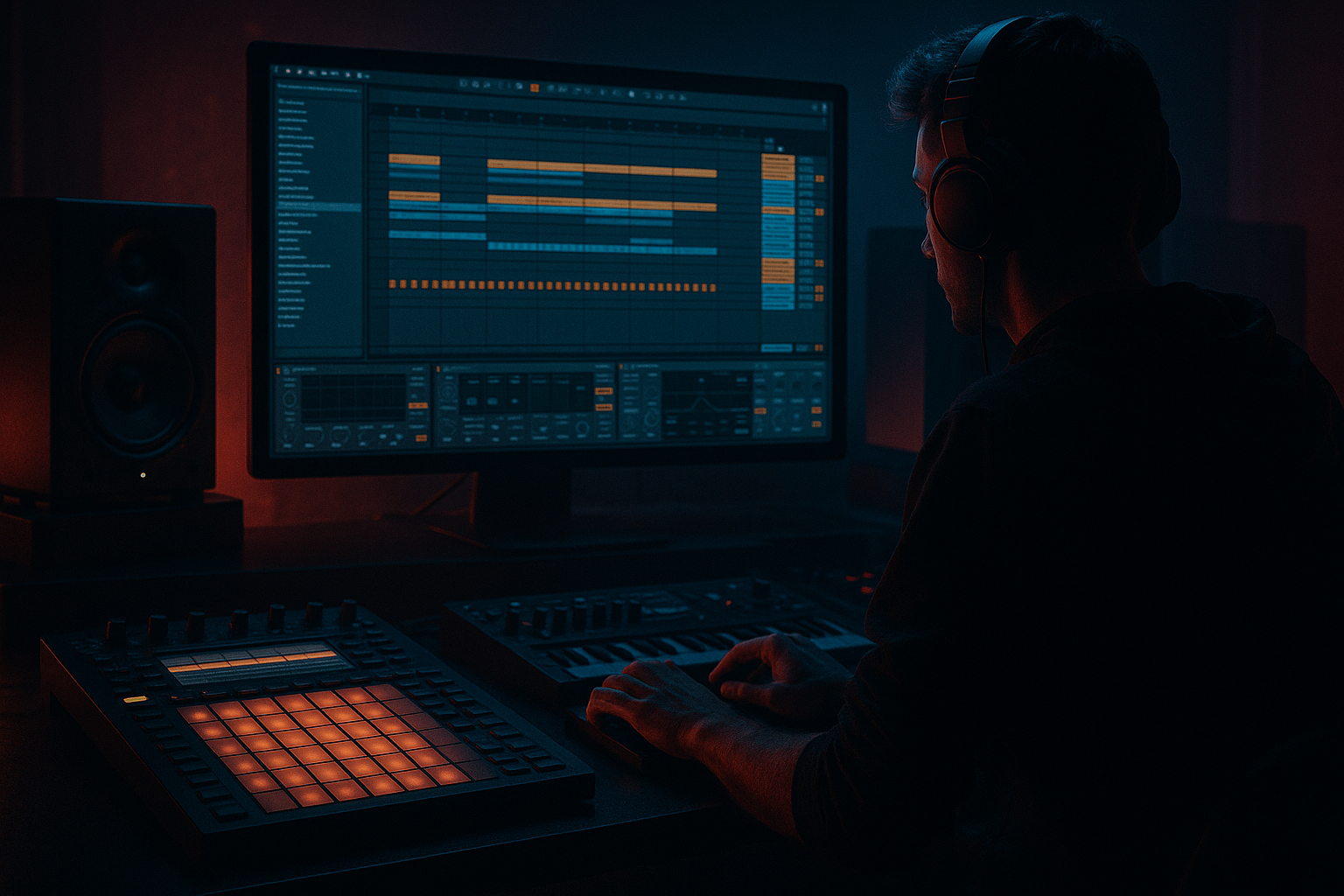
Main tutorial
Polyrhythmic Percussion in Drum & Bass (Ableton Live)
Teacher: energetic, clear, and professional — let’s make your grooves move in weird, heavy ways. ⚡🥁
---
1) Lesson overview
This lesson teaches advanced techniques for creating polyrhythmic percussion layers in Ableton Live specifically for drum & bass/jungle/rolling bass music. You will learn how to:
- Design independent looping percussion clips with different loop lengths (3-bar, 5-bar, etc.) that create true polyrhythms against a 2-bar DnB drum loop.
- Use Drum Rack/Simpler, MIDI clip loop lengths, Groove Pool and stock audio effects (Beat Repeat, Ping Pong Delay, EQ Eight, Saturator, Glue Compressor, Drum Buss) to sculpt and glue the parts.
- Route and process a percussion bus for clarity and weight while preserving the groove and transient impact.
- Arrange and automate polyrhythmic cycles in a musical way so they enhance the drop rather than clutter it.
- A 2-bar core break/drum Rack pattern (kicks + snares).
- Three independent percussion layers that loop at different lengths (3 bars, 5 bars, 7 bars — choose two or three), creating evolving polyrhythmic interplay that resolves over long cycles.
- FX processing (Beat Repeat + Ping Pong Delay triplets) to accentuate off-grid motion.
- A percussion bus chain that keeps low end tight and adds grit/saturation for dark, weighty DnB.
- You are not trying to "fit" these clips into the 4/4 grid; you are designing repeating cycles that phase against the 2-bar drum loop.
- Use different timbres and stereo placement per layer to avoid clutter (e.g., shaker narrow center, metallic layer wide).
- Keep sub energy out of these percussive layers — high-pass at ~200–300 Hz per layer (use EQ Eight).
- Use the polyrhythm cluster as a tension device: introduce Percussion A at bar 1, Percussion B at bar 9, Percussion C at bar 25. Let cycles drift until you intentionally "lock" everything by muting the odd-length loops before the drop.
- Plan where the LCM resolves. For example, with 2-bar drums and a 3-bar shaker, the full cycle repeats every 6 bars. Use that to place accents or fills.
- Automate low-passes to make the polyrhythms feel like they emerge from the mix into the drop.
- Use Follow Actions for clips in Session View to rotate through multiple variations of a 3-bar pattern to keep the rhythm alive.
- Overcrowding frequency space: not high-passing percussive layers. Fix: HP > 200–300 Hz on percussion chains.
- Too many hits = rhythmic mush. Aim for sparse strong hits on longer loops — let the ear find the pattern.
- Over-processing each layer separately (lots of saturation/compression) causing transient loss. Fix: use parallel processing on the bus — duplicate the group, process one aggressively, and blend.
- Expecting instant musicality with very long LCM cycles — they can take time to resolve and may feel aimless if not arranged intentionally.
- Neglecting transient preservation: make compressor attack long enough to let transients punch through (5–15 ms typical).
- Forgetting tempo dependence on effects: triplet delays and Beat Repeat grid values must be set to taste for polyrhythmic feel.
- Polyrhythms in Ableton are best achieved by independent clip loop lengths (3, 5, 7 bars) running against a 2-bar DnB drum loop. This creates evolving cycles that sound fresh and hypnotic.
- Use Drum Rack/Simpler, EQ Eight, Saturator, Drum Buss and Glue Compressor on individual chains and the percussion bus to get punchy, dark DnB character.
- Add micro-polyrhythms with Beat Repeat and triplet Ping Pong Delay. High-pass percussive layers and sidechain lightly to preserve sub energy.
- Arrange intentionally: introduce layers sequentially, automate effects, and plan where cycles resolve so polyrhythms become musical devices rather than noise.
Tempo reference: 174 BPM (typical DnB), but techniques apply across 170–176 BPM.
---
2) What you will build
A heavy DnB loop with:
Result: A rolling, hypnotic groove that stays poundy but feels "out of sync" in a musical, jungle-inspired way. 🔥
---
3) Step-by-step walkthrough
Project setup (5 min)
1. New Live Set. Set BPM to 174.
2. Create these tracks:
- 1: Drum Rack — "Core Drum"
- 2: MIDI — "Percussion A (3-bar)"
- 3: MIDI — "Percussion B (5-bar)"
- 4: MIDI — "Percussion C (7-bar)" (optional)
- 5: Audio Return A: Reverb (medium-short)
- 6: Audio Return B: Delay (Ping Pong Delay)
- Group tracks 2–4 into "Percussion Bus" (Cmd/Ctrl+G) for buss processing.
Create the core DnB drums (15–20 min)
1. Load Drum Rack on "Core Drum". Populate with:
- Kick (one-shots), Snare (backbeat), Amen-style sliced break or layered break hits. Use Simpler or Slices if you prefer sample-slicing.
2. Program a tight 2-bar pattern (loop length = 2 bars). Typical DnB pocket:
- Bar 1: Kick on 1, ghost kicks before/after snare, snare on 2.
- Bar 2: Syncopation with kick after snare, snare on 4.
- Keep kick transients clipped and snare punched.
3. Insert on the Drum Rack chain:
- EQ Eight (HP at ~30–60Hz to keep sub only for bass, cut muddy region ~200–400Hz on percussive layers later).
- Saturator (Drive 2–5, Soft Clip on) — subtle.
- Glue Compressor (fast-ish attack 10 ms, release ~0.2s, ratio 2:1) — dial for punch.
- Drum Buss (distortion ~25–40, transient > 5–10 for snap) — use sparingly.
Build polyrhythmic percussion clips (30 min)
Core principle: let each percussion clip loop at a different bar length. Ableton clips loop independently, so you can have a 3-bar shakers loop against a 2-bar drum loop. The polyrhythm “cycle” is the LCM of the clip lengths.
A. Percussion A — 3-bar shaker (3:2 polyrhythm)
1. Create a new MIDI track with Drum Rack or Simpler loaded with a tight shaker, hi-hat, or clave sample.
2. Create a MIDI clip. In the Clip View set:
- Loop: ON
- Length: 3 Bars (type `3` in length or set bars/beats to `3|0|0`)
3. Program a lively pattern over the 3 bars. Example (for clarity):
- Use 16th subdivisions. Accent on certain steps to create groove: 1e&a, 2&, etc.
- Vary velocity to avoid robotic feel.
4. Add groove: Drag a slight groove from the Groove Pool (e.g., "Swing 8th 56" or a 16th swing preset), but set Timing to ~20–40% and Amount to taste. Or leave raw if you want rigid polyrhythm.
B. Percussion B — 5-bar tom/tick loop (5:2:3 compound)
1. New MIDI clip, Loop Length = 5 Bars.
2. Use deeper toms, rimshots, or reversed percussive one-shots. Program sparse hits that emphasize off-grid moments.
3. Keep dynamics intentional — fewer hits but stronger dynamics so the polyrhythm reads clearly.
C. Percussion C — 7-bar metallic pattern (optional; creates long cycle)
1. Loop Length = 7 Bars. Use metallic, resonant hits (Wavetable/Operator or sampled metal hits).
2. Program 1–3 hits per bar, tune pitches for harmonic interest. This will create very long cycle interplay (LCM(2,3,5,7) gets huge — musical tension).
Notes on programming:
Percussion bus chain (essential) — Apply to the group
1. On the Percussion Bus Group:
- EQ Eight: HP at 200–300 Hz (slope 12–24 dB/octave) to keep low end for kick/bass.
- Saturator: Drive 2–6, Curve "Soft" or "Medium" for grit.
- Drum Buss: Distortion ~15–30%, Boom off if not needed, Character to taste.
- Glue Compressor: Attack ~5–10 ms (let transients pass), Release ~150–300 ms, Ratio 2–3:1, Makeup gain as needed.
- Utility: Width as desired (try 95–110% for a slightly wide feel). Reduce width on low frequencies with an EQ if needed.
2. Use a send to the Reverb and Ping Pong Delay:
- Reverb: Short plate style, predelay ~20 ms to keep transients. Return gain low (10–20%).
- Ping Pong Delay: Set Sync to 1/8T or 1/16T triplet for rhythmic echoes that create polyrhythmic impressions. Feedback ~25–40%. Filter the delay return with EQ Eight (low-pass ~8–10 kHz, HP ~300 Hz) to avoid blurring.
Accent FX — add motion and micro-polyrhythms
1. Use Beat Repeat on a duplicate of a percussion track or an audio send:
- Interval: 1/4 or 1/8
- Grid: 1/16 or 1/16T (experiment)
- Chance: 30–60%
- Decay: short
- This will generate micro-rhythmic stutters that feel polyrhythmic against the steady hits.
2. Ping Pong Delay on another send with triplet rates creates offset echoes against straight 16ths.
3. Automate the amount of Beat Repeat or Delay sends to make sections evolve (intro sparse, drop fully wet).
Arrangement tips (how to use polyrhythms musically)
---
4) Common mistakes
---
5) Pro tips for darker/heavier DnB
1. Subtle parallel distortion: Duplicate the percussion bus, saturate and low-pass that duplicate (HP ~500 Hz to keep grit), then blend below ~200 Hz for added “weight” without more low-end.
2. Harmonic tuning: Tune metallic percussive hits to notes that reinforce the bassline's root or fifth. A slightly detuned metallic hit repeating at a 3-bar interval can create harmonic movement and tension.
3. Heavy transient shaping: Use an Envelope Shaper (stock? use Utility + Compressor or third-party) or use Drum Buss transient control for clipped, snappy hits—fast attack and short release on bus.
4. Use narrow band resonant EQ automation: sweep a resonance around 400–800 Hz on the percussion bus during builds for reedy, jungle vibe — automate wet/dry.
5. Sidechain bus compression from kick: sidechain percussive bus to the kick (or an invisible transient routing) to maintain pocket and make space for low end.
6. Dirt and saturation: use Saturator (Analog Clip) + Utility to lower output and then glue again — creates a heavy, compressed midband.
7. Spatial horror: modulate Ping Pong Delay feedback with LFO (if you have Max for Live) or automate feedback amount manually to create eerie evolving echoes.
---
6) Mini practice exercise (30–45 min)
Goal: Build a 2-bar DnB loop with 3-bar and 5-bar polyrhythms and make it musical.
Step-by-step:
1. Tempo = 174 BPM.
2. Core drums: Create a 2-bar Drum Rack pattern (kick + snare on 2 and 4, ghost kicks). Loop it.
3. Percussion A: New MIDI clip length = 3 Bars. Load a shaker/hihat in Drum Rack. Program a 16th-note pattern that accents the 3rd beat of bar 2. High-pass at 250 Hz.
4. Percussion B: New MIDI clip length = 5 Bars. Use a tom/rim sample. Place 4 sparse hits across the 5 bars (not evenly!). High-pass at 250 Hz.
5. Create Percussion Bus: HP @ 250 Hz → Saturator Drive 3 → Glue Compressor (attack 10ms, release 200ms).
6. Add Ping Pong Delay return: Sync to 1/8T, Feedback 30%, Filter low-pass 8kHz.
7. Listen for the full cycle: Find where the 2-bar core and the 3-bar/5-bar layers all align. Place a fill or vocal stab there to create a moment of release.
8. Export a 60–90 second loop and check how the polyrhythm evolves. Tweak velocities and accents for clarity.
Deliverable: A 16–32 bar loop where the percussion texture clearly shifts and resolves in a musically satisfying way.
---
7) Recap
Go make something that moves people’s heads and rattles car trunks. If you want, send me a short audio clip or Ableton project structure and I’ll critique the polyrhythmic choices and give mix/process tweaks. 🚀

