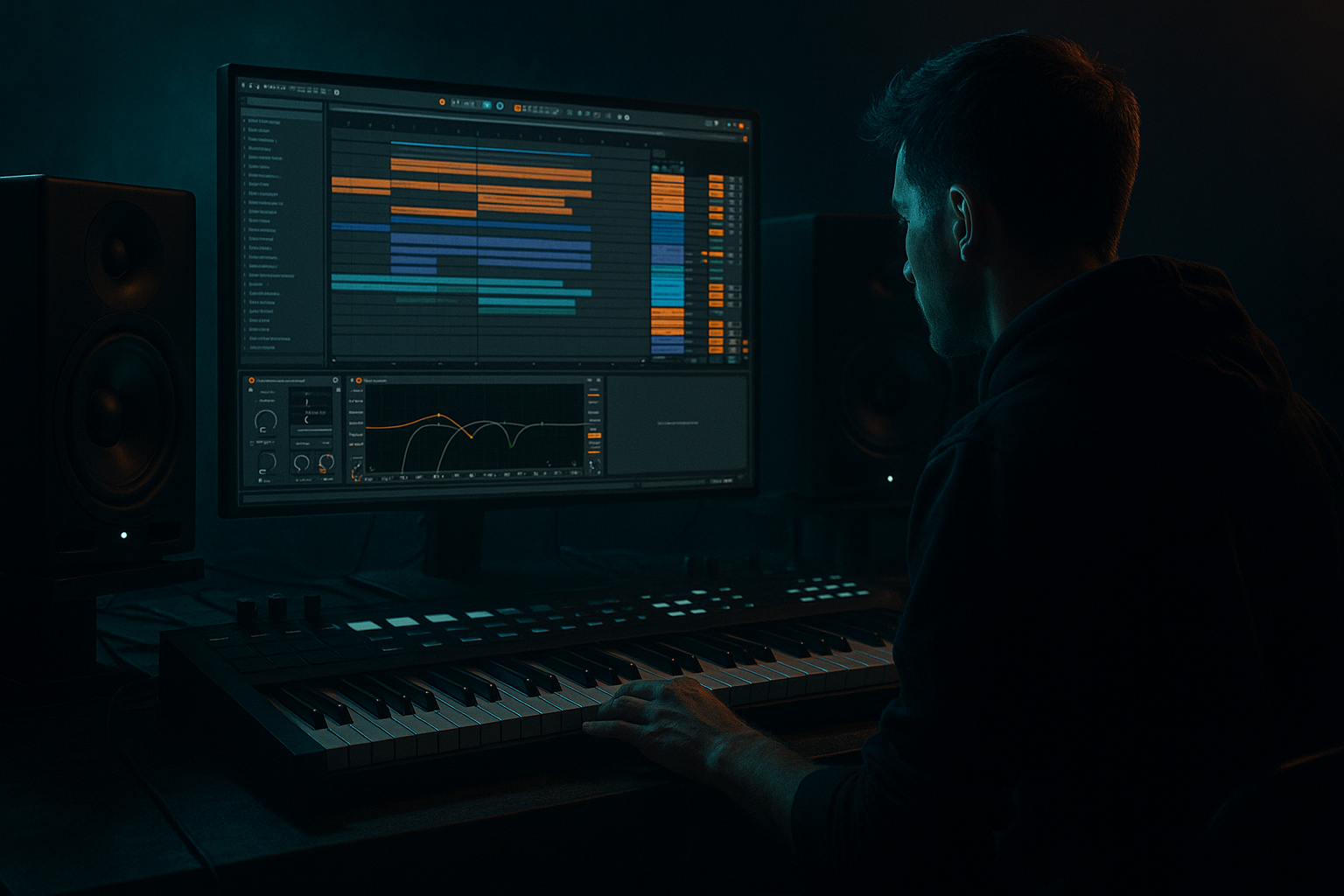
Main tutorial
Printing Break Layers to Audio Early (DnB Workflow in Ableton Live) 🎛️🥁
1) Lesson overview
Printing (a.k.a. bouncing/resampling/freezing & flattening) your break layers to audio early is one of the fastest ways to level-up your drum and bass workflow. It makes you commit, reduces CPU, and—most importantly—gets you into arrangement, groove, and impact instead of endlessly tweaking plug-ins.
In DnB/jungle, your drums usually become a stack: classic break + punchy kick/snare + tops + ghost notes + textures. If you keep everything as MIDI + 12 effects forever, you’ll fight latency, CPU, and decision paralysis. Printing turns your drums into “instruments” you can slice, nudge, and mangle like the old-school days—without losing modern control.
---
2) What you will build
You’ll create a rolling DnB drum stack built from:
- Break layer (Amen/Think/Hot Pants style)
- One-shot reinforcement (kick/snare for modern punch)
- Top loop / hats (tight high-end rhythm)
- Ghost/percussion layer (movement)
- Tighten groove and phase
- Do surgical edits
- Create variations/fills
- Make heavier drops by resampling distortion/saturation
- EQ Eight
- Drum Buss
- Saturator
- Add a tight hat loop or synth hats.
- High-pass aggressively:
- Add movement:
- Use rim clicks, muted snares, bongos, foley.
- Keep it quiet but rhythmic.
- Try:
- 1/16 snare repeats
- micro-stutters
- “Amen turnaround” style endings
- sudden dropouts
- Bars 1–2: full groove
- Bars 3–4: remove some hats or ghosts
- Bars 5–6: bring back energy
- Bars 7–8: add a fill (snare rush / break chop)
- `Drums_A_2bars`
- `Drums_B_2bars_NoTops`
- `Drums_Fill_1bar`
- Zoom in and nudge the printed snare transient a few ms earlier if it lags.
- Or nudge your reinforcement snare against the break snare to avoid flam.
- Use Track Delay (bottom of mixer) for tiny offsets:
- Printing too late: if you wait until everything is “perfect,” you’ll never get to arrangement.
- Warping the break badly: over-warping kills groove; under-warping makes it sloppy. Use minimal warp markers.
- Ignoring phase/flam between break snare and layered snare: if your snare sounds “wide but weak,” it’s usually timing/phase.
- Printing with no headroom: leave space. Aim peaks around -6 dBFS on the drum bus before heavy mastering.
- Committing without versioning: print v1/v2/v3. Commitment is good; losing options is not.
- Parallel distortion print:
- Rumble/room tail control:
- Transient focus after printing:
- Create a “shadow snare”:
- Half-time fakeout:
- Printing break layers early is a decision + speed hack for DnB.
- Use a clean drum group, warp your break properly, and keep bus processing light before printing.
- Print with Resampling (fast), Freeze/Flatten (controlled), or Export stems (archival).
- Once printed, you unlock the real DnB sauce: chops, fills, micro-timing, and resampled heaviness.
Then you’ll print these layers to audio in a clean, repeatable way, and use the printed audio to:
---
3) Step-by-step walkthrough
Step 0 — Session setup (so your prints line up)
1. Tempo: set to 172–176 BPM (try 174 BPM).
2. In Preferences → Record/Warp/Launch:
- Auto-Warp Long Samples: Off (optional but recommended for breaks; you’ll warp manually)
- Warp Fades: On (helps avoid clicks when slicing)
3. Create a project folder:
`Project → Samples → Printed Drums` (keep your prints organized from day one).
---
Step 1 — Build a 4-layer drum group (clean routing)
1. Create a Group Track named: DRUM BUS.
2. Inside it, create 4 audio tracks:
- BREAK
- KICK/SNARE
- TOPS
- GHOSTS
Why audio tracks? You can still use MIDI on separate tracks if you want, but DnB breaks are faster to handle as audio once you start warping/slicing and doing micro-edits.
---
Step 2 — Break layer: warp it properly (don’t skip this)
1. Drop a break (Amen/Think/etc.) onto BREAK.
2. In Clip View:
- Turn Warp ON
- Warp mode:
- Complex Pro (safe for full breaks)
- Or Beats for tighter transient control (often better for DnB edits)
- If Beats, try:
- Preserve: Transients
- Envelope: 100
3. Set the 1.1.1 marker exactly at the first downbeat transient.
4. Set loop length to 1 bar or 2 bars (DnB: 2-bar breaks are gold).
5. Tighten timing:
- Add warp markers only where needed (kick/snare hits)
- Keep micro-swing from the original break—don’t grid-lock everything or it goes lifeless.
Quick target: Snare on 2 and 4 should hit confidently; ghost notes can be loose.
---
Step 3 — Reinforcement: modern kick/snare under the break
1. On KICK/SNARE, load a Drum Rack (MIDI) or just place one-shots as audio.
2. If using Drum Rack (recommended):
- Place Kick on C1, Snare on D1.
- Program a simple 2-step DnB pattern:
- Kick on 1
- Snare on 2
- (Optional) extra kick before snare for drive: e.g., 1.3.3 (taste-dependent)
Device chain suggestion (KICK/SNARE track):
- Kick: low boost if needed at 50–80 Hz, cut mud 200–400 Hz
- Snare: shape body 180–240 Hz, crack 3–6 kHz
- Drive: 5–15
- Boom: 0–20 (keep subtle; DnB subs live elsewhere)
- Transients: +5 to +20 for snap
- Mode: Soft Sine or Analog Clip
- Drive: 2–6 dB
- Turn on Soft Clip if you want controlled aggression
---
Step 4 — Tops and ghosts: fast groove without clutter
TOPS
- EQ Eight: HP at 200–400 Hz (depends on loop)
- Auto Filter with slight envelope or LFO at 1/8 or 1/16 (subtle)
- Utility: narrow width if it’s messy; widen only if it’s clean
GHOSTS
- Delay (simple) at 1/16 with low feedback for tick-tick movement
- Reverb tiny room (decay ~0.3–0.8s), then HP the reverb return
---
Step 5 — Pre-print drum bus processing (light, not final)
On DRUM BUS, keep processing simple. Your goal is glue + headroom before printing.
Suggested DRUM BUS chain (stock):
1. EQ Eight
- Gentle cut if muddy: 250–400 Hz (1–2 dB)
- Small shelf if harsh: 8–10 kHz (taste)
2. Glue Compressor
- Attack: 3 ms
- Release: Auto (or 0.1–0.3s)
- Ratio: 2:1
- Aim for 1–3 dB gain reduction on peaks
3. Soft Clip (optional)
- Use Saturator with Soft Clip ON
- Drive: 1–4 dB
- Keep an eye on transients—don’t flatten the groove.
---
Step 6 — Print early: three reliable methods (choose one)
You want consistent alignment, repeatability, and fast iteration.
#### Method A: Resampling to a new audio track (fastest)
1. Create a new audio track named PRINT – DRUMS.
2. Set its Audio From to: Resampling.
3. Arm PRINT – DRUMS.
4. Solo your DRUM BUS (or mute everything else).
5. Record 8 or 16 bars (enough for variations).
6. Consolidate: select the recorded region → Cmd/Ctrl + J.
7. Rename the clip:
`Drums_Print_174bpm_16bars_v1`
✅ Best for: committing quickly and capturing exactly what you hear.
---
#### Method B: Freeze & Flatten (clean, per-track commitment)
Great when you want to print BREAK or TOPS individually.
1. Right-click a track (e.g., BREAK) → Freeze Track
2. Right-click again → Flatten
3. You now have a printed audio file with effects baked in.
✅ Best for: CPU-heavy chains and controlled printing of individual layers.
---
#### Method C: Export stems (most controlled, slower)
1. Set loop braces to your target length (e.g., 16 bars).
2. File → Export Audio/Video
3. Rendered Track: choose All Individual Tracks or Selected Tracks Only
4. PCM, 24-bit, render start/end exactly at bar lines.
✅ Best for: collaboration or archiving “hard commits.”
---
Step 7 — Make the printed audio work for you (editing + arrangement)
Now you’re in the fun zone: audio-driven DnB edits.
#### A) Slice for fills and variation
1. Duplicate PRINT – DRUMS clip to a new track: PRINT – DRUMS EDITS
2. Right-click clip → Slice to New MIDI Track
3. Choose:
- Slicing: Transient
- Preset: Built-in (works fine)
Now you can re-trigger slices for:
#### B) Create 2-bar call/response arrangement (rolling)
A classic DnB arrangement trick:
Do it by cutting audio regions and consolidating into new clips:
#### C) Tighten punch with micro-nudging (audio is faster)
- Try -5 ms to -15 ms on KICK/SNARE if it feels late
- Or delay the break slightly if it’s too “ahead”
---
4) Common mistakes
---
5) Pro tips for darker/heavier DnB 🖤
Duplicate DRUM BUS → call it DRUM CRUSH
Chain: Saturator (Analog Clip) → Drum Buss → EQ Eight (HP 120 Hz) → Glue Compressor
Blend in low (like -18 to -10 dB). Then print the blend. This creates that dense neuro/techy grime.
If your break has room tone, shape it with Gate (sidechain from snare) so the space “breathes” only on hits.
On the printed audio, use Drum Buss Transients +10 to +30 for extra bite. Audio reacts differently than layered live chains—often better.
Duplicate printed drums → filter HP 600–1k → saturate → short reverb → tuck under. Gives eerie snap without washing the mix.
In the last 2 bars before a drop, cut the printed drums to hit only on the half-time snare positions—instant weight.
---
6) Mini practice exercise (15–25 minutes) ⏱️
1. Build a 2-bar loop at 174 BPM with:
- One warped break on BREAK
- One kick + snare reinforcement
- Hats on TOPS
2. Add only two effects per layer max.
3. Print 16 bars using Resampling.
4. From the printed audio:
- Make 3 variations:
1) Full energy
2) No tops for 2 bars
3) 1-bar fill using slice/repeat
5. Arrange a 32-bar drum-only intro:
- Bars 1–8: filtered / minimal
- Bars 9–16: full groove
- Bars 17–24: variation + ghost emphasis
- Bars 25–32: fill into a “drop marker”
---
7) Recap
If you want, tell me what style you’re aiming for (jungle, rollers, jump-up, neuro, deep/minimal), and I’ll suggest a specific break choice + a tight 16-bar “print-ready” drum template for that lane.

