Main tutorial
Pull Oldskool DnB Call-and-Response Riff Using Groove Pool Tricks in Ableton Live 12
1. Lesson overview
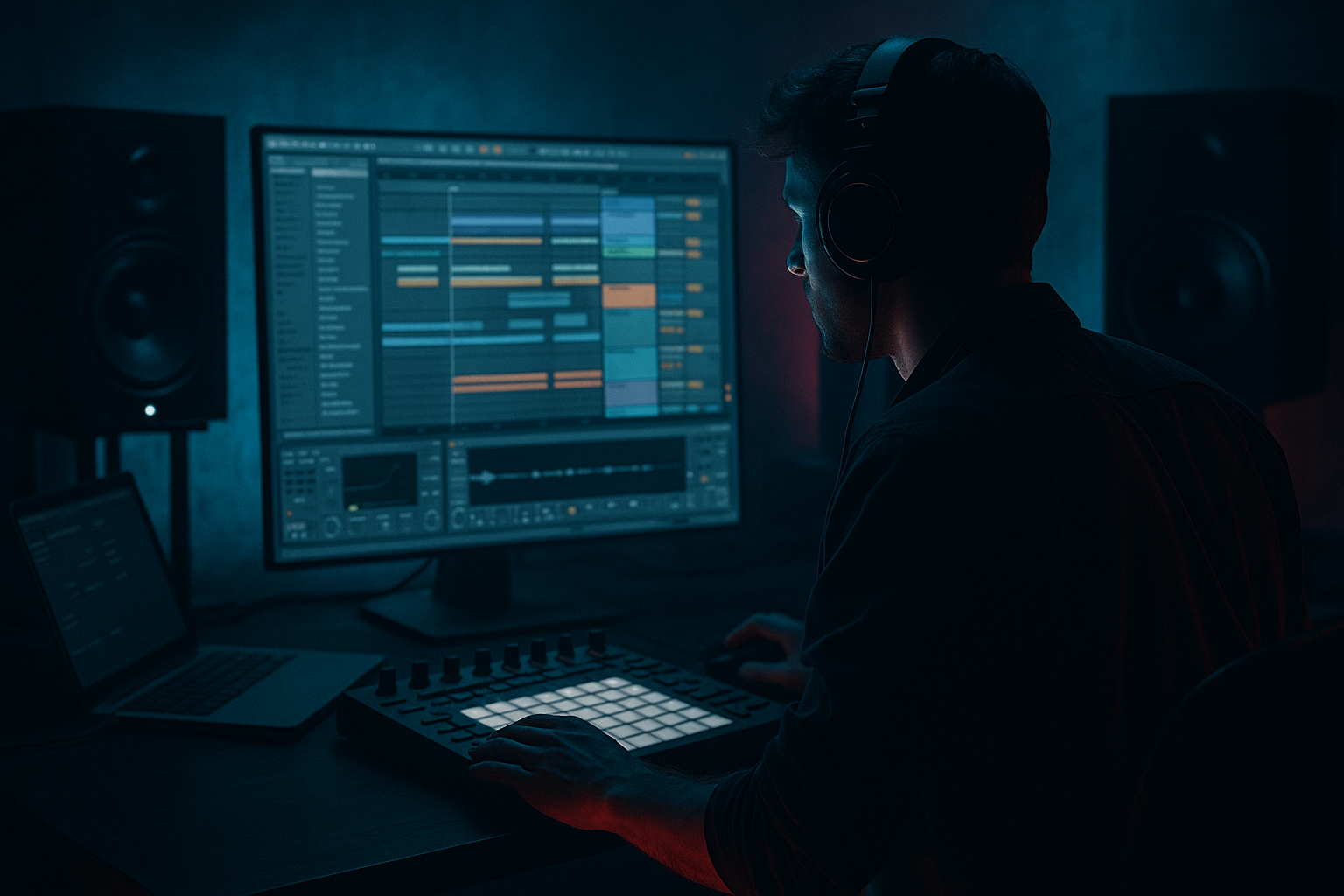
In this lesson we’re building a ragga-inflected oldskool DnB call-and-response riff in Ableton Live 12 using the Groove Pool as the main performance tool. The goal is to make a simple chopped stab or vocal-like riff feel swingy, human, and pressure-cooked without losing the tightness needed for modern drum and bass. 🔥
This is especially useful for:
- Ragga / jungle / oldskool DnB phrases that need bounce
- Question-and-answer musical hooks
- Mid-tempo-to-fast DnB material that should feel “played” rather than grid-stamped
- Adding movement and personality to a loop without over-editing every note
- Building a two-part call and response
- Using Groove Pool to create offset, swing, velocity variation, and micro-humanization
- Shaping the riff so it sits against a 2-step or break-based drum pattern
- Making it work in a club-ready DnB arrangement
- A two-bar call-and-response riff
- A ragga-style rhythmic phrase with offbeat anticipation
- A groove template created from either a drum loop or pre-made groove
- A MIDI clip with controlled timing and velocity variation
- A supporting bass/drum context so the riff feels like real DnB, not just a looped sample
- An arrangement-ready section that can work as:
- Call = the first phrase sets up tension
- Response = the second phrase answers with variation, weight, or attitude
- 174 BPM is the classic sweet spot
- Anywhere from 170–176 BPM works fine
- 1 MIDI track for the riff
- 1 drum group or at least a kick/snare loop for groove reference
- 1 bass track if you want to test the riff against sub movement
- Kick on the 1
- Snare on the 3 or 2 and 4 feel depending on your pattern
- A few ghost hats/percs for motion
- A vocal chop
- A resampled ragga phrase
- A short brass stab
- A organ/keys hit
- A detuned synth stab
- A sampled FX note or one-shot phrase
- Sampler for pitched phrases and expressive one-shots
- Simpler if you want quick slicing and easy envelopes
- Wavetable or Analog for making your own stab layer
- Drift for gritty, slightly unstable tonal hits
- a short vocal syllable
- a dub-style stab
- or a filtered chord hit with a rhythmic decay
- Bar 1 = Call
- Bar 2 = Response
- Place the clip in Simpler or directly on an audio track
- Chop it into 2–4 pieces
- Arrange them in a question-answer structure
- Leave tiny gaps so the groove can breathe
- A breakbeat
- A drum loop
- A MPC-style swing feel
- A custom MIDI pattern
- Start around 50–65% Timing
- If the riff feels too late or lazy, reduce it
- If it feels stiff, increase it slightly
- Keep low, around 3–8%
- Too much random timing makes the riff lose its DnB precision
- Try 10–20% Velocity
- This helps the riff feel alive, especially if the notes are repetitive
- If needed, keep Base at default unless you want a specific reference point for the groove application
- Don’t over-quantize after applying groove
- The point is to let the groove shape the timing, not the grid
- Timing: 58%
- Random: 5%
- Velocity: 15%
- Does the call sit just behind the beat?
- Does the response feel like it answers naturally?
- Is the phrase locking with the snare and hats?
- Increase timing slightly
- Reduce timing
- Shorten note lengths
- Tighten the low-end layers
- Apply groove only to selected notes
- Or duplicate the riff and keep one layer more rigid for stability
- More groove
- Slightly more delay behind the beat
- Lower velocity on some hits
- Shorter note lengths
- Slightly tighter timing
- Stronger accent on the first answer note
- Maybe a longer note or tail
- A different octave or filter opening
- Call = lazy, ragged, shuffling
- Response = sharper, more authoritative
- Velocity
- Note length
- Note placement
- Pitch variation
- Make the first call hit slightly softer
- Make the second or third hit more aggressive
- Shorten “reply” notes so they punch instead of smear
- Add a tiny velocity dip on passing notes
- Map velocity to Volume and/or Filter Cutoff
- This gives every hit a more expressive ragga-style response
- Velocity up = brighter, louder stab
- Velocity down = darker, more tucked-in stab
- You want character, not cinematic gloss
- The call should leave space for the snare
- The response should not fight the kick/sub
- Hats can reinforce the shuffle if the groove is aligned well
- Put the call phrase just before the snare
- Let the response land after the snare, creating anticipation
- break-based
- chopped
- or using ghost notes
- Operator, Wavetable, or Roar for more aggressive tone
- Keep sub clean and mono
- Let the mid-bass answer the riff in short phrases
- Sub holds a note under the call
- Mid-bass answers on the response
- Or vice versa
- Riff does the chatter
- Bass does the muscle
- Drums do the propulsion
- Filter cutoff
- Delay send
- Reverb send
- Dry/wet of Saturator or Echo
- Velocity offset is not automatable directly, but note editing is your friend
- Call phrase = narrower, filtered, dry
- Response phrase = brighter, wider, more delay
- Short slap delay on the response
- Drier call
- Slightly wider response with a touch of stereo movement
- Drums only
- Tease a filtered version of the call
- Full call-and-response riff enters
- Bass stays minimal
- Bring in variation
- Reverse the order: response first, then call
- Add a fill at bar 12
- Strip down one element
- Automate a filter sweep or echo throw
- Prepare for the drop or next section
- Drift or Wavetable
- Mild detune
- Saturator or Roar
- Band-pass filter automation
- reverse small parts
- chop the tail
- pitch individual answers down a semitone or octave
- lower
- dirtier
- more filtered-open
- more distorted
- or more compressed
- Make the call phrase use a higher register
- Make the response lower and nastier
- Automate a filter opening only on the response
- Extract groove from a break or drum loop
- Apply it to your riff clip
- Use different groove behavior for call and response
- Shape the sound with stock Ableton devices
- Leave space for drums and bass
- Use contrast, not repetition
We’ll focus on:
---
2. What you will build
By the end of this tutorial, you’ll have:
- a drop hook
- a build into the drop
- or a breakdown motif
Think of it as a musical exchange:
That classic jungle energy comes from the push/pull between the two.
---
3. Step-by-step walkthrough
Step 1: Set your project up for DnB timing
Start with a typical DnB tempo:
Create:
If you’re building from scratch, load a clean drum reference first:
You need a rhythm anchor before you start grooving the riff.
---
Step 2: Choose a source that suits ragga DnB
For this style, the riff source should have attack and attitude. Good options:
Good stock Ableton choices:
For a classic vibe, use:
Keep the source short enough to feel percussive.
---
Step 3: Build the call-and-response phrase in MIDI or audio
#### Option A: MIDI-based riff
Create a 2-bar MIDI clip and program a simple motif.
Example structure:
- Hit on beat 1
- Another hit on the “&” of 2
- A shorter pickup into beat 4
- Mirror the contour, but answer on a slightly different rhythm
- Add one longer note or octave change for contrast
The key is not to over-compose. You want a rhythmic exchange, not a lead line.
#### Option B: Audio-based riff
If using a vocal or stab sample:
If the phrase is too busy, simplify it. DnB call-and-response works best when there’s space between statements.
---
Step 4: Create or extract a groove for the riff
This is where the lesson gets interesting.
You can pull groove from:
#### Best method: extract groove from a drum clip
1. Find a loop with good swing
- Amen-style break
- chopped shuffle break
- ragga percussion loop
- oldskool hat pattern
2. Right-click the clip
3. Choose Extract Groove
4. The groove appears in the Groove Pool
Now you have a groove template that can be applied to your riff.
---
Step 5: Prepare the Groove Pool settings
Open the Groove Pool and find your extracted groove.
Important settings to inspect:
#### Timing
#### Random
#### Velocity
#### Base
#### Quantize
A good starting point for oldskool DnB:
That usually gives enough bounce without sounding sloppy.
---
Step 6: Apply the groove to the riff
Select your riff clip and drag the groove from the Groove Pool onto it.
Now listen for:
If it’s too rigid:
If it drags too much:
If the riff is MIDI and the drum groove is very syncopated, you may need to:
That blend often sounds bigger.
---
Step 7: Use groove contrast between call and response
This is the main trick. Don’t just apply the same feel everywhere.
#### Call phrase
#### Response phrase
This creates the feeling of a real musical conversation.
A very effective DnB method:
That contrast is gold in jungle and ragga DnB.
---
Step 8: Humanize with velocity and note length
Groove isn’t just timing.
Open the MIDI clip and edit:
Practical approach:
If using Simpler or Sampler:
For example:
That makes the phrase breathe.
---
Step 9: Shape the riff with stock Ableton devices
Here’s a practical device chain for the riff track:
#### If using a sample/stab
1. Simpler
- Classic or One-Shot mode depending on source
- Slight filter roll-off if needed
2. EQ Eight
- High-pass around 120–180 Hz if the source fights the bass
- Notch harsh resonances if necessary
3. Saturator
- Light drive for density
- Try Soft Clip On for grit
4. Auto Filter
- Use subtle envelope or automation for movement
5. Reverb or Echo
- Keep sends controlled, not washed out
#### If using MIDI synth stab
1. Wavetable / Drift / Analog
2. EQ Eight
3. Saturator
4. Compressor or Glue Compressor
5. Auto Filter
6. Optional Chorus-Ensemble for width
For oldskool DnB, less is more:
---
Step 10: Make the riff talk to the drums
Now test the riff against a drum pattern.
Focus on these interactions:
A classic arrangement trick:
This is especially effective if the drums are:
The riff should feel like it’s dancing around the break, not sitting on top of it.
---
Step 11: Add a bass layer that follows the conversation
Even though this lesson is about the riff, the bass matters.
Use a simple bass layer to support the hook:
Try this:
If the riff is very rhythmic, keep bassline notes sparse.
A good DnB relationship:
---
Step 12: Automate groove-related movement
You can make the call-and-response feel more alive by automating:
Arrangement idea:
That gives the impression of space opening up for the answer.
A classic ragga move:
---
Step 13: Build a 16-bar DnB phrase
Here’s a simple working arrangement:
#### Bars 1–4
#### Bars 5–8
#### Bars 9–12
#### Bars 13–16
This kind of arrangement keeps the hook from getting stale.
---
4. Common mistakes
1. Applying too much groove
If the riff gets too late, the whole thing feels drunk rather than head-nodding. Keep the timing human, but still locked.
2. Using the same groove intensity on both phrases
If the call and response are identical, the conversation disappears. Use contrast.
3. Letting low mids clash with the bass
A ragga stab or vocal chop can fill 200–500 Hz fast. Clean it with EQ Eight.
4. Overloading with reverb
Oldskool DnB has space, but not blurry space. Keep effects punchy and mostly controlled by sends.
5. Quantizing after applying groove too aggressively
You’ll destroy the feel you just created. Let the groove live.
6. Making the riff too melodic
For this style, the rhythm is usually more important than the harmony. Keep it compact and syncopated.
---
5. Pro tips for darker/heavier DnB
Tip 1: Use groove to create menace, not just bounce
A slightly behind-the-beat stab can sound more threatening than a perfectly locked one. Dark DnB thrives on tension.
Tip 2: Layer a dirty mid stab under the riff
Try:
That gives the riff bite.
Tip 3: Use negative space
The darker the track, the more powerful the gaps. Let the response phrase hit harder by removing elements before it.
Tip 4: Resample the riff and chop it again
Bounce the groove-heavy phrase to audio, then:
That can turn a clean call-and-response into a proper underground weapon 😈
Tip 5: Make the response nastier than the call
The “answer” can be:
That progression gives the drop forward motion.
Tip 6: Sidechain the riff subtly to the kick/snare
Use Compressor with sidechain from the drum bus if needed. Keep it gentle so the groove still feels alive.
---
6. Mini practice exercise
Exercise: Build a 2-bar ragga DnB hook
1. Set project to 174 BPM
2. Create a 2-bar MIDI clip
3. Program a simple 4-note call and 3-note response
4. Extract a groove from a breakbeat loop
5. Apply the groove to the riff
6. Set:
- Timing: 55–60%
- Random: 4–6%
- Velocity: 10–15%
7. Add EQ Eight and Saturator
8. Duplicate the riff and make one version:
- darker
- shorter
- slightly less groovy
9. Arrange the two versions as a call-and-response loop over 8 bars
#### Challenge variation
If it feels like the two phrases are talking to each other, you’ve nailed it.
---
7. Recap
You’ve now got a practical method for creating an oldskool DnB call-and-response riff using Groove Pool tricks in Ableton Live 12.
Key takeaways:
The magic in ragga DnB is not just the notes — it’s the timing, attitude, and push-pull energy. Groove Pool is one of the best ways to inject that oldskool swagger into a modern Ableton workflow.
If you want, I can also turn this into:
1. a screen-by-screen Ableton Live 12 workflow, or
2. a rack chain + MIDI example for a specific ragga stab or vocal chop.

