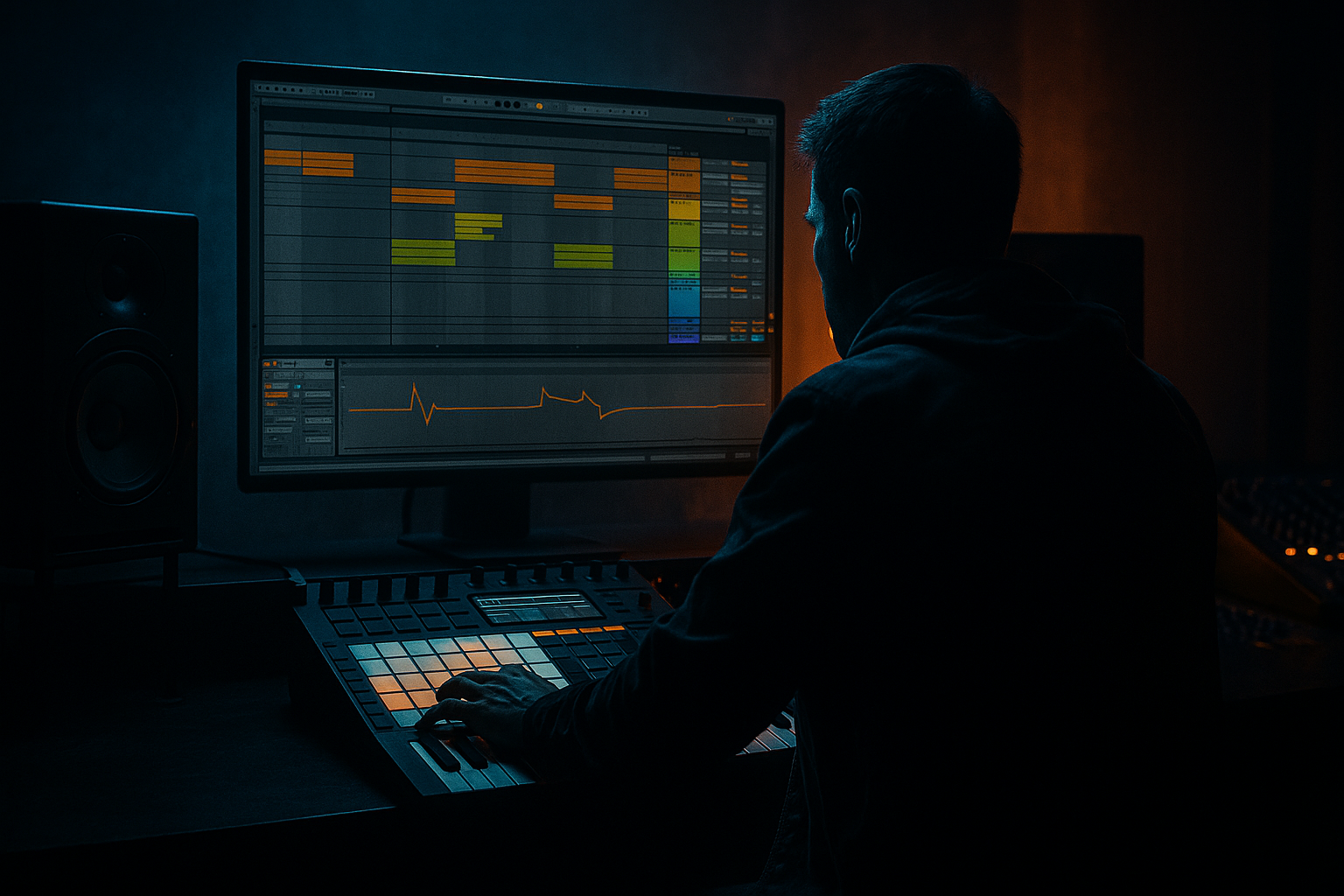
Main tutorial
Push a bassline with chopped‑vinyl character in Ableton Live 12 (Oldskool Jungle / DnB) 🎚️🧨
1) Lesson overview
In this lesson you’ll design a DJ‑tool style bassline that feels like it was sampled from vinyl, chopped, re‑pitched, and re‑sequenced—but built cleanly inside Ableton Live 12 using mostly stock devices. The goal is that classic jungle “bootleg sampled bass” energy: gritty midrange, unstable pitch, transient clicks, and that slightly smeared “needle + MPC” vibe, while still hitting hard on modern systems.
You’ll end with:
- A playable bass instrument rack (with macro control)
- A print-to-audio workflow for authentic “chop” behavior
- A simple arrangement method for rolling 90s-inspired bass patterns
- Tempo: 165–172 BPM (try 170 BPM)
- Groove: load an MPC-ish groove or swing from Groove Pool (subtle!)
- Make two tracks:
- Add Instrument Rack
- Create 2 chains:
- Device: Operator
- Add Auto Filter
- Add Utility
- Device: Wavetable (or Operator if you prefer)
- Add Saturator
- Add Auto Filter
- Add Redux
- Add Vinyl texture (stock-ish approach)
- Shaper (MIDI mod) or LFO (Max for Live if you use it). If staying strictly stock, use Wavetable’s LFO (CHAR) + Operator pitch envelope.
- Pitch LFO (apply mostly to CHAR, barely to SUB)
- Add a faster “needle jitter” layer (optional):
- Scale: try F minor or G minor
- Pattern idea (1 bar loop at 170):
- Use short/medium note lengths; we’ll get chop energy later.
- Add tiny velocity variation (even if bass is mostly level):
- Repitch = most authentic pitch/time behavior when you change tempo or repitch notes
- Texture = gritty smear (use sparingly)
- Tones = cleaner but can still sound “sampled”
- Set Warp to Repitch for oldskool vibe.
- If using Texture:
- Put Simpler in Slice Mode
- Turn Playback to One‑Shot
- Enable Snap (prevents clicks when chopping)
- Adjust Fade In/Out:
- Mode: Add
- Chance: 5–20%
- Choices: 2–4
- Scale: small (this can select adjacent slices, giving variation)
- Set to 1/16–1/8
- Gate: 60–90%
- Echo (Tape) very low wet (3–8%) with dark filtering
- Bars 1–16: filtered intro bass (LP cutoff down, less dirt)
- Bars 17–32: full bandwidth + main chop pattern
- Bars 33–48: variation section
- Bars 49–64: “reload tease”
- Over-wobbling the sub: pitch LFO on the sub = seasick low end. Keep SUB stable.
- Too much bit reduction: Redux can kill punch fast. Use it as seasoning (10–30%).
- No fades on slices: you’ll get clicks/pops. Use Simpler fades + Snap.
- Too wide in the lows: stereo bass below ~120 Hz will collapse on rigs. Use Utility Bass Mono.
- Chopping without groove: if slices are perfectly rigid, it sounds like modern grid edits. Add slight groove pool swing and/or micro timing nudges.
- Parallel mid distortion: duplicate the slice track, HP it at 150–250 Hz, smash it with Roar or heavy Saturator, then blend quietly under the clean bass.
- Keytracked lowpass: on the CHAR chain, use Auto Filter with Key tracking (if available in your routing approach) so higher notes open slightly—keeps consistent brightness.
- Sub reinforcement trick: keep the SUB as a separate chain and sidechain it gently to the kick using Compressor (Sidechain on, 1.5–3 dB GR). Clean, controlled weight.
- Dark “tape veil”: put Echo (Tape) or Hybrid Reverb (very short, dark) at tiny wet to mimic sampled ambience.
- Reese-adjacent edge (without going full tech): add a very quiet detuned oscillator in CHAR (±5–12 cents) but keep width controlled and highpass it.
- You built a layered bass (stable SUB + dirty CHAR) and introduced controlled vinyl-like instability 🎚️
- You committed to audio and used Warp + Slice to Simpler to get authentic chopped sample behavior ✂️
- You created a DJ-tool macro system for fast performance moves (filter sweeps, dirt, chop tightness, pitch drops) 🔥
- You learned arrangement tactics that sit naturally with break edits and oldskool jungle phrasing
---
2) What you will build
A two-stage system:
1. Source Bass Instrument (MIDI)
A layered bass (sub + character layer) that’s intentionally imperfect:
- subtle pitch wobble
- saturation and “vinyl/amp” dirt
- controlled low end
2. Chop & Resample Rack (Audio)
You’ll resample the bass, then chop it like a record:
- warp mode choices for “sample time” artifacts
- tight slice triggering
- micro‑pitch drops, retriggers, and “start offset” variation
- bus processing like oldskool break toolchains
---
3) Step‑by‑step walkthrough
Step 0 — Project setup (for jungle feel)
- Start with Swing 16‑55 (or similar)
- Apply lightly: Timing 10–20%, Random 2–6%
1. BASS (MIDI)
2. BASS CHOPS (Audio)
---
Step 1 — Build the “sampled bass” source (MIDI track)
#### 1A) Create a layered bass in an Instrument Rack
On BASS (MIDI):
- SUB
- CHAR
##### SUB chain (clean low end)
- Algorithm: A only
- Oscillator A: Sine
- Level: set so it’s solid but not clipping
- Pitch: 0
- Type: Lowpass 24 dB
- Cutoff: ~120 Hz
- Resonance: 0.10–0.25
- Bass Mono: On (Live 12 Utility has Bass Mono)
- Width: 0–20% (keep sub centered)
- Gain: set for headroom
##### CHAR chain (chopped‑vinyl mid character)
- Basic shapes work well: Saw / Square / Triangle
- Unison: Off (oldskool vibe = not too wide)
- Warp: gentle (don’t go modern-super)
- Mode: Analog Clip
- Drive: 3–8 dB
- Soft Clip: On
- Type: Bandpass or Lowpass 12
- Aim for “recorded” bandwidth:
- If Bandpass: Center ~300–1.5kHz, Res 0.6–1.2
- If Lowpass: Cutoff ~2–4 kHz
- Bit Reduction: 8–12 bit (start at 12)
- Downsample: 1.5–3.0
- Dry/Wet: 10–30%
- Echo (for subtle smear)
- Mode: Tape
- Time: 1/32 or 1/16
- Feedback: 5–12%
- Filter: roll top end (LP around 3–6 kHz)
- Dry/Wet: 5–12%
- Optional: Roar
- Use gently: Tape/Saturator style
- Drive small (1–4) with tone shaping
#### 1B) Add “vinyl instability” with modulation (subtle!)
Still on the Instrument Rack (after both chains), add:
Good “record wobble” settings:
- Rate: 0.2–0.8 Hz
- Amount: ±3 to ±10 cents (tiny!)
- Rate: 6–12 Hz
- Amount: ±1–3 cents
Keep sub stable; let mid layer wander. That’s the illusion. 🎛️
---
Step 2 — Write a jungle-leaning bass phrase (MIDI)
Oldskool basslines often use simple notes with rhythmic chops.
- Hits on 1, 1.2, 1.3.4, 2.3, 3, 3.2, 4.2
- 80–110 range to help saturation “move”
---
Step 3 — Resample to audio (commit like the 90s)
This is where the chopped vinyl vibe really appears.
Option A (fast): Freeze/Flatten
1. Right‑click BASS (MIDI) → Freeze
2. Right‑click again → Flatten
3. Rename the audio track or duplicate before flattening if you want to preserve MIDI.
Option B (classic): Resampling
1. Create BASS CHOPS (Audio) track
2. Set its input to Resampling
3. Arm it and record 4–16 bars of your bass phrase
Now you have audio you can treat like a sampled record. 🔥
---
Step 4 — Warp for “sample time” artifacts
Open the recorded bass clip (on BASS CHOPS).
Warp mode choices (pick based on flavor):
Recommended:
- Grain Size: 20–60 ms
- Flux: 10–25%
---
Step 5 — Slice it like vinyl: Simpler in Slice mode
1. Right‑click the audio clip → Slice to New MIDI Track
2. Slicing preset:
- Slice by: Transients (or 1/16 if your bass is steady)
- Create one slice per…: transients often works best if your bass has clear attacks
- Slicing preset: choose Built-in → Simpler (no extra processing)
Now you’ve got a MIDI track controlling slices, just like triggering chunks from an MPC. 🎚️
#### 5A) Make it “choppy” and playable
On the new Simpler track:
- Fade In: 2–8 ms
- Fade Out: 10–30 ms (depends on groove)
#### 5B) Add classic retrigger + start offset feel
Add Random (MIDI effect) before Simpler:
Then add Note Length:
This makes chops tighter and more “cut”.
---
Step 6 — Build the DJ-tool chain: punch + dirt + mono control
On the Simpler slice track, add this stock chain (in order):
1. EQ Eight
- HP filter: 24 dB @ 25–35 Hz (sub tidy)
- Small dip if muddy: 200–350 Hz, -2 to -4 dB
- If too hissy: gentle shelf down above 6–10 kHz
2. Drum Buss
- Drive: 5–15%
- Crunch: 0–10%
- Boom: Off or very low (Boom can mess sub timing)
3. Saturator
- Analog Clip
- Drive: 2–6 dB
- Soft Clip: On
4. Auto Filter (for performance movement)
- Lowpass 12
- Map Cutoff to a Macro (more on that next)
5. Utility
- Bass Mono: On
- Width: 70–110% (mid can be wider; keep sub mono)
- Gain: adjust so peaks don’t clip
Optional for extra “vinyl room”:
---
Step 7 — Put it in a Rack with DJ-friendly Macros
Group your post chain (or whole instrument) into an Audio Effect Rack and map:
Suggested Macros:
1. LP Cutoff (Auto Filter cutoff) — performance sweep 🎛️
2. Dirt (Saturator Drive + Drum Buss Drive) — from clean to rinsed
3. Chop Tightness (Simpler Fade Out + Note Length Gate)
4. Pitch Drop (Transpose the clip or Simpler Transpose: -0 to -3 semitones)
5. Flutter (small Random chance or slight Echo wet)
6. Sub Trim (Utility gain on SUB chain or EQ low shelf)
This turns your bass into a DJ tool: quick movement, repeatable results.
---
Step 8 — Arrangement ideas (oldskool jungle mindset)
In an 64-bar phrase:
- use Pitch Drop macro on last 2 beats every 8 bars
- swap to a denser slice pattern for 1–2 bars
- cut bass for 1 bar, bring back with extra dirt + tighter chops
Tip: Pair bass chops with classic break edits (Amen, Think, Hot Pants) and leave micro-gaps. Jungle breathes.
---
4) Common mistakes
---
5) Pro tips for darker/heavier DnB 🖤
---
6) Mini practice exercise (15–25 minutes)
1. Write a 2-bar bass MIDI in G minor with 6–10 hits.
2. Resample it to audio (Freeze/Flatten or Resampling).
3. Slice to Simpler and make two chop patterns:
- Pattern A: sparse, heavy (space for breaks)
- Pattern B: busy 16ths for fills
4. Map LP Cutoff + Dirt + Chop Tightness to Macros.
5. Arrange 32 bars:
- 8 bars filtered
- 16 bars full
- 8 bars with a pitch-drop tease every 4 bars
Deliverable: bounce a 32-bar loop that feels like a DJ could blend it into an oldskool set.
---
7) Recap
If you want, tell me your target vibe (e.g., Reinforced-style, Metalheadz ‘94, ragga jungle, dark roller) and I’ll suggest a specific macro map + break/bass interaction pattern for that sub-style.

