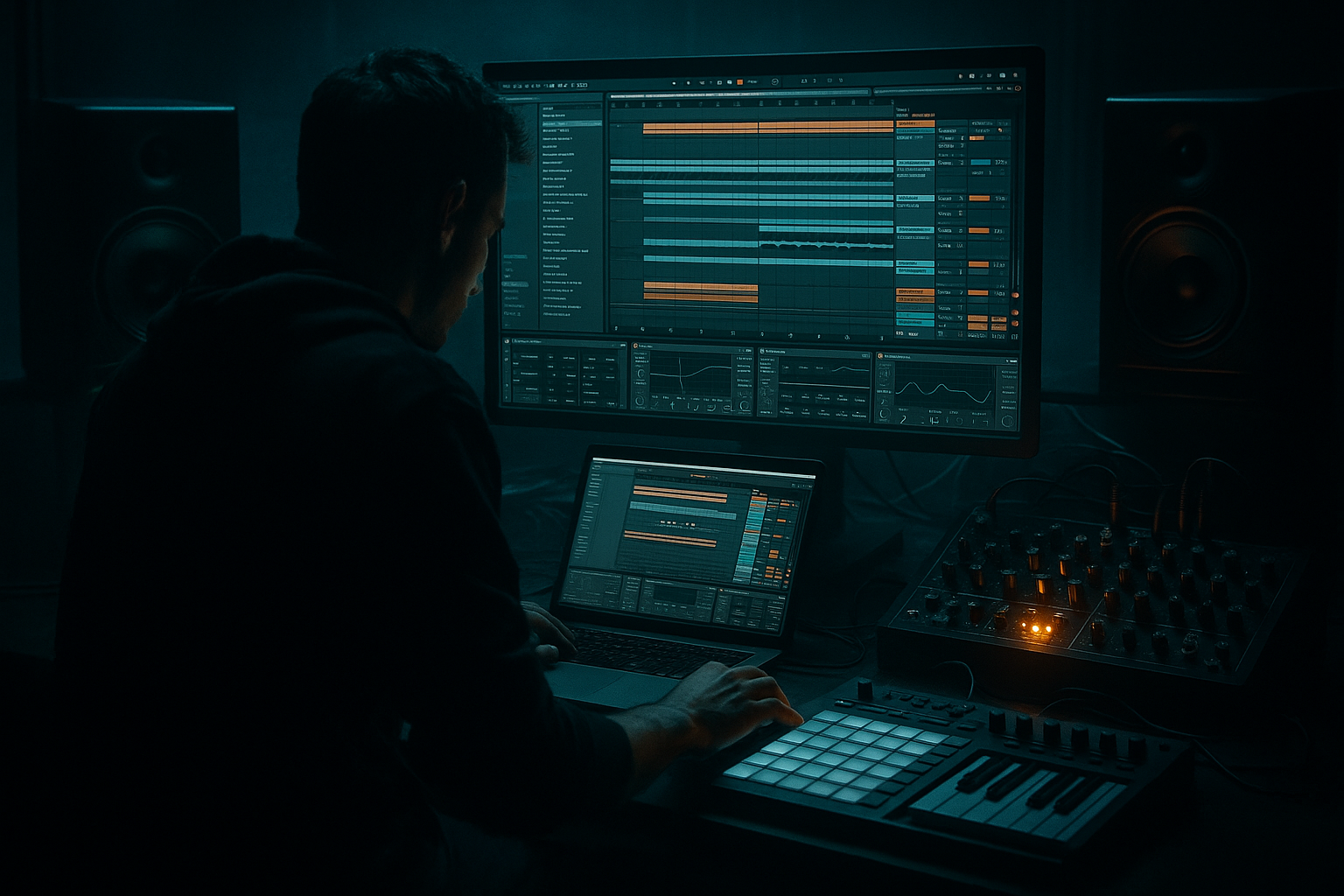
Main tutorial
Push an Amen-style ride groove for deep jungle atmosphere in Ableton Live 12
1. Lesson overview
In this lesson, you’ll build a dark, rolling Amen-based ride groove using resampling in Ableton Live 12. The goal is not just to loop a break, but to turn it into a deep jungle texture with movement, grime, and atmosphere.
We’ll focus on:
- slicing and reshaping an Amen break
- creating a ride-like top loop from break material
- resampling your own processing for more character
- building a groove that feels alive, not quantized-flat
- preparing the result for a deep jungle / half-steppy DnB arrangement
- a 16-bar Amen-derived ride loop
- a layered top-end texture that behaves like a ride but keeps jungle DNA
- a resampled audio file with grit, stereo movement, and contrast
- a groove that supports:
- riding hats/metallic top loop energy
- Amen ghost notes underneath
- slightly unstable timing
- crunchy top-end with air
- moody, immersive jungle atmosphere 🌒
- a clean Amen sample
- an old break loop with room tone
- a chopped break phrase from your library
- a recorded vinyl rip if you want extra attitude
- ride/hat-like ticks
- ghost snare fragments
- top of the kick transient
- cymbal bleed
- bright, brushed, metallic fragments
- tiny ride-like tail pieces
- open-top “air” slices
- snare/hat hybrids that can act like a ride pattern
- use 1/16s as a base
- add accents on the offbeats
- leave gaps for the bassline and snare
- place fragments on every 1/8 offbeat
- add occasional 1/16 syncopation
- vary velocity heavily
- short hat-like hits
- longer cymbal-ish tails
- noisy snare-overtones
- High-pass around 180–300 Hz
- Cut harshness around 4–7 kHz if needed
- Gentle shelf boost around 10–12 kHz if the top needs air
- Drive: 1–4 dB
- Soft Clip: ON
- Try the Analog Clip or Warmth style behavior by ear
- Drive: light, around 5–15%
- Crunch: subtle
- Boom: usually OFF for top loops
- Transients: slightly positive if the hits need more bite
- Use a high-pass or band-pass sweep
- Add movement with subtle automation over 4 or 8 bars
- Narrow the width slightly if the loop is too wide and messy
- Or keep it wide and let atmosphere live in the stereo field
- Redux for digital grit
- Erosion for high-end hiss and metallic texture
- Echo for dubby throw moments
- printed character
- imperfect bounce
- “machine-made” artifacts
- layered processing generations
- consolidate the best loop section
- warp if needed, but keep it subtle
- trim the tail carefully
- duplicate the clip across the arrangement
- duplicate the audio track
- add a different chain:
- print again to audio
- cut sub rumble below 150–250 Hz
- short decay: 0.4–1.2 s
- low cut in the reverb: raise it to avoid mud
- dry/wet: low, around 8–20%
- light glue, not pumping
- attack slower, release medium-fast
- Original break layer: low volume, maybe -18 to -24 dB
- Ride layer: primary top rhythmic element
- Atmos layer: tucked behind, spread wide
- Use Groove Pool with a swing template if it helps
- Or manually nudge selected hits late/early
- Vary velocities so not every ride fragment hits with the same intensity
- push some hits slightly late for drag
- pull ghost accents slightly early for excitement
- remove every 4th or 8th hit to create breathing space
- automate occasional velocity spikes for fills
- filtered ride loop
- minimal bass
- atmospheric pad or field recording
- open up high end
- introduce ghost snare texture
- add low Reese movement
- bring in full bassline
- introduce a new ride variation with extra slices
- add fill, reverse resample, or filtered break-down
- automate reverb send up for tension
- drop back into main groove or prepare a switch
- automate Auto Filter cutoff
- use Reverb throws on selected ride hits
- mute the main ride for half a bar before a drop
- use a reverse-resampled tail leading into the next section
- remove unnecessary sub
- tame harsh highs if resampling made the loop brittle
- mono below the low-mid region if needed
- slightly reduce width if the top is washing out the mix
- only if you need to catch peaks on the printed loop
- snare crack
- Reese midrange
- sub weight
- atmospheric pads
- EQ Eight with a band-pass around the top-mid range
- then saturate it
- then resample again
- Very subtle mix
- Focus on the high band
- Great for making the top loop feel ancient and worn-in
- Saturator for tone
- Drum Buss for density and transient push
- delay throws
- reverb tails
- filtered echoes
- drop the ride for 2 beats
- let the bass expose the groove
- reintroduce the resampled top with a fill
- 3–4 slice types
- one velocity range with strong variation
- EQ Eight
- Saturator
- Drum Buss
- one dry version
- one filtered/reverbed version
- one version with slight pitch shift or time stretch
- bars 1–2: dry and minimal
- bars 3–4: add filtered layer and a fill
- slice the Amen break into playable fragments
- program a ride-like pattern from break material
- process with stock Ableton devices
- print to audio
- resample again for deeper texture
- arrange with movement, gaps, and atmosphere
- a Live 12 project template
- a device chain preset recipe
- or a MIDI + resampling arrangement blueprint for a full 174 BPM jungle track.
This is an advanced workflow, so we’ll move quickly and think like producers: capture, process, resample, commit 🎛️
---
2. What you will build
By the end, you’ll have:
- dark Reese bass
- dubbed-out atmosphere
- chopped fills
- switch-ups for arrangement
Target sound
Think:
---
3. Step-by-step walkthrough
Step 1: Source a strong Amen phrase
Start with a break that already has good transient detail and natural swing.
Best source material
Use:
In Ableton
1. Drag the Amen loop into Arrangement View or a Drum Rack pad.
2. Open Clip View and enable:
- Warp: ON
- Warp mode: Complex Pro if you need pitch preservation, or Beats if you want punch
3. Set the loop to 2 bars or 4 bars so the phrasing feels musical.
Timing note
Do not make it too perfect. Jungle rides breathe because the break itself has microscopic timing variation. Preserve some of that.
---
Step 2: Slice the break into a playable drum rack
This is where the resampling workflow starts to get fun.
Method
1. Right-click the Amen clip.
2. Choose Slice to New MIDI Track.
3. In the slice settings:
- Slice by: Transient
- Create one-shot slices
- Use Drum Rack
Now you can trigger individual hits:
What to listen for
You’re hunting for:
---
Step 3: Build the ride groove from break fragments
Instead of programming a conventional ride sample, build one from Amen fragments.
MIDI pattern idea
Program a continuous off-grid top pattern:
A useful starting point:
Practical note
Use different slices for:
This creates the illusion of a ride while keeping the break identity.
---
Step 4: Shape it with a stock Ableton device chain
Now we make it feel like a proper DnB top loop.
Suggested chain for the drum rack track
1. EQ Eight
2. Saturator
3. Drum Buss
4. Auto Filter
5. Utility
Optional extras
---
Step 5: Resample the processed loop
This is the core of the lesson: commit the sound to audio.
Why resample?
Because jungle loves:
How to resample in Ableton Live 12
1. Create a new Audio Track.
2. Set Audio From to the processed break/Drum Rack track.
3. Set monitor to In or arm the track.
4. Record 4–8 bars while the groove plays.
Now you’ve got a fresh audio loop with your processing printed into it.
What to do with the resample
After recording:
This printed audio often feels more “real” than the MIDI version because it already contains the result of your chain.
---
Step 6: Make a second-generation resample for depth
For deeper jungle atmosphere, one pass is rarely enough.
Second-pass resampling workflow
Take your first resample and process it again:
- Auto Filter
- Saturator
- Reverb
- Gate or Glue Compressor
Example chain for the second generation
EQ Eight
Reverb
Compressor or Glue Compressor
Resample again
This creates a ghostly, atmospheric top layer that sits behind the original loop.
---
Step 7: Layer the ride with the original Amen ghosts
A jungle groove works best when it has multiple time layers.
Layer strategy
Use:
1. Main ride-like resample
This is the rhythmic driver.
2. Original break ghost layer
Very low in the mix, mostly transient texture.
3. Filtered ambience layer
High-passed and reverbed to glue the top end.
Mixing approach
This makes the beat feel deep and haunted instead of thin.
---
Step 8: Add swing and micro-variation
Jungle lives in the small offsets.
In Ableton
Good moves
Important
Do not over-grid the resampled loop after all this. If you flatten the timing, you kill the character.
---
Step 9: Build a 16-bar arrangement with evolution
A deep jungle loop should evolve enough to feel alive.
Simple arrangement map
Bars 1–4
Bars 5–8
Bars 9–12
Bars 13–16
Arrangement tricks
---
Step 10: Final polish on the resampled audio
Once the groove feels right, do a final clean-up pass.
Final chain suggestions
EQ Eight
Utility
Limiter
Check against the bass
In DnB, the top loop must not fight:
If the ride feels too forward, reduce its energy before adding more bass. Don’t brute-force it.
---
4. Common mistakes
1. Making the ride too clean
If it sounds like a polished EDM hat loop, it won’t feel like jungle.
Fix: resample with saturation, timing variation, and imperfect source material.
2. Over-high-passing the break
You may remove the body that gives the ride its identity.
Fix: keep enough mid texture so the fragment still sounds like a break, not a sterile cymbal loop.
3. Using one slice repeatedly
This makes the loop robotic and obvious.
Fix: rotate between multiple fragments and automate velocity.
4. Too much reverb
A deep jungle atmosphere is not the same as a washed-out mix.
Fix: use short, dark reverbs and resample them instead of leaving them permanently wet.
5. Ignoring the bass relationship
A ride groove that sounds great solo can clutter the mix with a Reese or sub.
Fix: check the loop with bass and snare in context at all times.
6. Resampling without committing
If you keep everything live, you’ll endlessly tweak instead of finishing.
Fix: print the audio. That’s the point of this workflow.
---
5. Pro tips for darker/heavier DnB
Use band-limited resampling
Try printing a version through:
This gives a “through-the-PA” jungle edge.
Abuse Erosion carefully
Erosion with a tiny amount of noise can make the ride sound like old tape or vinyl air.
Combine Drum Buss + Saturator
This combo is excellent on resampled breaks:
Use reverse prints
Print a section of the ride with heavy reverb, then reverse the audio clip and place it before a drop.
That creates classic jungle tension without resorting to generic risers.
Resample from the Return tracks too
Print a version that includes:
Then blend that underneath the dry resample. Very effective for deep, cinematic jungle 🌫️
Darker arrangement logic
Heavy DnB often works better when the top end is not constantly full:
Space = weight.
---
6. Mini practice exercise
Exercise: build a 4-bar jungle ride loop from one Amen break
#### Step A
Pick one Amen break phrase and slice it to a Drum Rack.
#### Step B
Create a MIDI pattern using only:
#### Step C
Process the rack with:
#### Step D
Resample 4 bars to audio.
#### Step E
Duplicate the resampled clip and create:
#### Step F
Arrange the 4 bars so the groove evolves:
Goal
Make it feel like a living jungle ride, not a loop from a sample pack.
---
7. Recap
You’ve now got the core workflow for building an Amen-style ride groove in Ableton Live 12 using resampling:
Main takeaway
In jungle and drum and bass, the magic is often in the printed history of the sound. Every resample adds age, weight, and identity.
If you want the groove to feel deep and dangerous, don’t just loop it—resample it, mutate it, and commit it 🔥
If you want, I can also turn this into:

