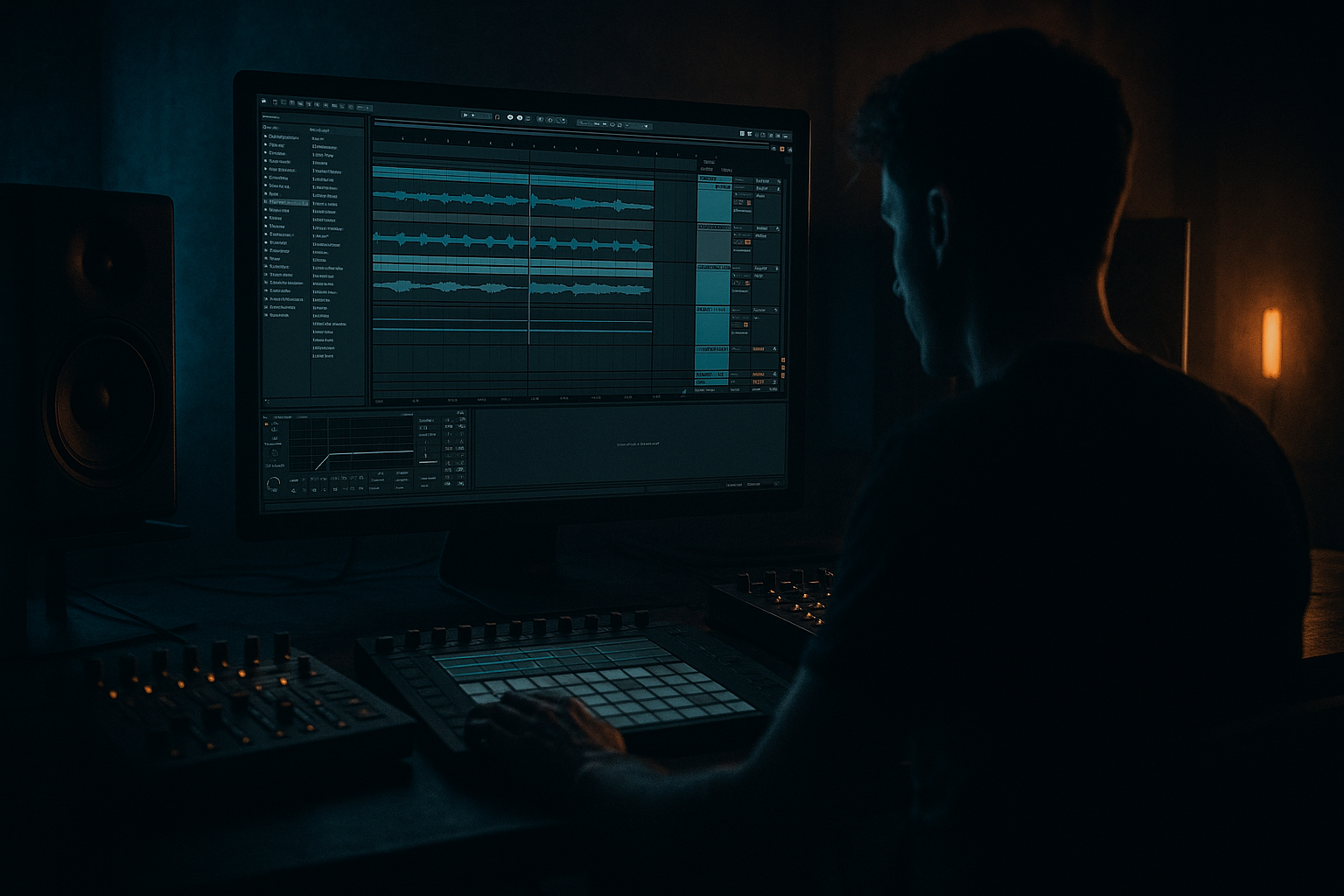
Main tutorial
Lesson Overview
Amen-style swing is one of the fastest ways to make a breakbeat section feel alive, rolling, and unmistakably jungle-leaning inside a modern DnB tune. In this lesson, you’re not just “swinging drums” — you’re learning how to push an Amen break so it carries pirate-radio energy: restless, slightly unstable, and forward-driving, but still tight enough for club translation.
This matters because in Drum & Bass, groove is often the difference between a loop that sounds programmed and a loop that sounds like it’s breathing. A hard-grid Amen can feel too square for rollers, jump-up hybrid cuts, darker half-time drops, or jungle-inflected intros. Push the swing correctly, and suddenly the break sits like it’s being played by a tense, hyperactive drummer locked to a bassline and a system-ready kick-sub foundation.
In Ableton Live 12, you can do this cleanly with stock tools: clip groove, warp markers, Groove Pool, Drum Buss, Saturator, EQ Eight, Compressor, and resampling for edits. We’ll build a break pattern that feels gritty and urgent, then shape the drum/bass relationship so the swing creates movement without destroying low-end impact.
What You Will Build
By the end, you’ll have a 4-bar Amen-style break pattern with:
- A pushed, syncopated swing feel that leans into pirate-radio energy
- Clean ghost-note detail and tighter transient control
- A layered kick/snare relationship that still hits hard in a DnB mix
- Optional reese or sub-bass phrasing that locks to the break’s movement
- A loop that can function as:
- Swinging everything equally
- Over-grooving the break
- Too much low end in the break sample
- Bassline fighting the snare
- Heavy saturation that kills transient detail
- Making the break too busy
- Split your break into layers: core kick/snare on one track, hats and ghosts on another. Swing the top layer harder than the core for controlled chaos.
- Use Simpler’s Warp or Slice mode to resample your edited break, then print it to audio. Resampling helps you commit to movement and keeps the groove sounding glued.
- Add subtle frequency movement to the break bus with Auto Filter or EQ Eight automation. A small high-shelf lift before a fill can create tension without making the mix harsh.
- For heavier rollers, layer a very short room reverb on only the ghost snare hits. Keep decay under 0.6s and filter the return heavily so the groove gains depth without washing out.
- On the bass bus, use Saturator or Overdrive very lightly before compression so the bass reads on smaller systems, but keep the sub itself clean and mono.
- If you want a more neuro-leaning edge, automate Filter cutoff or wavetable position on the mid bass in sync with the break’s off-grid accents. The interplay between drum swing and bass modulation creates that technical, restless feel.
- Check mono regularly with Utility. The swing should feel energetic even when collapsed, especially in club and pirate-radio playback scenarios.
- Amen-style swing works best when the snare stays solid and the ghost notes carry most of the motion.
- Use Groove Pool lightly and selectively; don’t over-shuffle the whole break.
- Shape the break with Drum Buss, EQ Eight, and smart transient control so it hits hard but still feels alive.
- Phrase bass around the break, not against it.
- Use automation and arrangement to turn a loop into a real DnB section with tension, release, and pirate-radio urgency.
- Keep the low end disciplined, the top end gritty, and the groove intentional.
- a jungle-style intro builder
- a drop loop for rollers
- a break section before a bass switch
- a DJ-friendly 16-bar arrangement segment
Musically, think: a 170 BPM break pattern where the snare is still the anchor, but the hats, ghost hits, and break accents dance ahead and behind the grid just enough to create motion and tension. This is very much the language of classic jungle, modern rollers, and darker bass music with breakbeat DNA.
Step-by-Step Walkthrough
1. Set up the project for a DnB swing test
Start a fresh Ableton Live 12 set at 170 BPM. If you want a more classic jungle feel, stay around 166–172 BPM; if you want a slightly more contemporary DnB pressure, 174–176 BPM also works, but 170 is a sweet spot for hearing swing clearly.
Create:
- One audio track for your Amen break
- One drum bus return or group for processing
- One bass track for a sub or reese
- Optional ambience/FX track for atmosphere and transitions
Drop in an Amen-style break loop or load a break slice into a Simpler/Drum Rack setup. If you’re using a full loop, set Warp to Complex Pro only if needed; for a more natural feel, try Beats mode and preserve transients. For a sliced break, use Slice to New MIDI Track and let the hits live on separate pads. This gives you control over kick, snare, hat, and ghost-note timing.
Why this works in DnB: the Amen is full of internal micro-groove. If you keep everything on a rigid grid, you flatten the personality. The goal is to expose the break’s natural lilt, then exaggerate it in a controlled way.
2. Find the core snare anchor and build around it
In the Amen, the snare is the spine. Keep the main backbeat firm on beats 2 and 4, or in a break-based DnB pattern, let the sampled snare hits carry that role. In the Clip View or MIDI editor, make sure the main snare hits land with intention, not randomly late.
Practical move:
- Leave the primary snare mostly on-grid or only slightly behind, about 5–15 ms late if it needs more laid-back weight
- Push ghost hits and hat notes slightly ahead or behind depending on energy
- Use velocity contrast aggressively: main snare around 110–127 velocity, ghost notes around 35–70
If your break sample already has a strong snare transient, you may not need extra layering. If it feels thin, layer a short snare one-shot underneath:
- Use Simpler or a Drum Rack pad
- High-pass the layer around 180–250 Hz
- Keep it mono and short
For darker DnB, a snare that is too polite will disappear once the bass comes in. Keep the snare punchy but not clicky.
3. Push the swing using Groove Pool, not just random timing edits
Open the Groove Pool and load an MPC-style or swing groove from Ableton’s library, then apply it lightly to the break clip. Start subtle. For Amen-style pirate energy, you usually want a groove that’s noticeable but not cartoonish.
Good starting range:
- Groove amount: 15–35%
- Timing shift feel: enough to hear lift, not enough to make the groove trip over itself
- Velocity influence: 20–40% if the groove adds useful dynamic shape
If the clip feels too stiff, apply groove to only the hat and ghost-note region rather than the main snare. You can duplicate the loop and split processing:
- One track for the core kick/snare
- One track for hats, shuffles, and ghosts
- Swing the upper layer harder while keeping the backbone tighter
This is a very DnB way to work because it preserves impact. The kick/snare foundation stays stable for the system, while the break top-end creates the restless motion people feel on the dancefloor.
4. Edit the break for syncopation and pirate-radio urgency
Now get surgical. Open the sliced break or audio clip and add a few intentional edits:
- Remove or shorten one kick near the end of bar 1 or 3 to create a gap before the snare
- Add a ghost snare pickup just before the main backbeat
- Repeat a tiny hat fragment or rim hit for a nervous shuffle
- Use one short reverse or stuttered slice before a new bar
Keep these edits musical. You’re aiming for that “the break is leaning forward” sensation, not random glitch spam.
A strong pattern idea:
- Bar 1: established groove
- Bar 2: extra hat ghost + tiny syncopated kick mute
- Bar 3: repeat the groove but add a quick snare drag
- Bar 4: fill or brake before the next phrase
In Ableton, you can do this with:
- Duplicate and consolidate clips for variation
- Warp markers to slightly nudge individual hits
- Envelopes for volume dips on specific slices
- A Utility on the break track if you want to automate width or gain by section
Musical context example: this works beautifully before a drop that introduces a Reese bass after a stripped intro. The break feels like it’s ratcheting pressure upward while the bass waits to land.
5. Shape the break with Drum Buss, EQ Eight, and transient control
Route your drum elements or break group into a Drum Buss. This is where the swing starts to feel physical.
Suggested starting settings:
- Drive: 5–15%
- Boom: only if you need extra low thump, around 10–25% with careful tuning
- Crunch: 5–20% for break texture
- Transients: slightly positive for snap, or negative if the break is too spiky
- Damp: adjust until the top end stops sounding brittle
Add EQ Eight after Drum Buss:
- High-pass only if the sample has unnecessary sub rumble, usually around 25–35 Hz
- Cut mud around 180–350 Hz if the break clashes with bass
- Tame harsh hat energy around 6–10 kHz if needed
If transients are too sharp and the groove feels nervous in a bad way, use Compressor or Glue Compressor with light control:
- Ratio: 2:1 or 4:1
- Attack: 10–30 ms to let the snap through
- Release: Auto or 50–150 ms depending on groove
- Aim for only a few dB of gain reduction
Why this works in DnB: breakbeats need enough texture to feel alive, but too much transient spike makes the loop tiring and can fight the bassline. Controlled saturation glues the swing together.
6. Lock the bassline to the break’s motion, not just the grid
Now bring in a bass element. For pirate-radio energy, a reese or sub-reese combo works well, but even a simple sub phrase can show the concept.
Build a bass line in MIDI using a Wavetable, Operator, or Analog patch:
- For sub weight, keep the lowest layer mono and simple
- For movement, add a mid layer with unison or detuned oscillators
- Use low-pass filtering and envelope motion so the bass breathes with the break
Practical settings:
- Sub layer: sine or triangle, mono, minimal glide
- Reese layer: unison or detuned oscillators, filter cutoff around 120–400 Hz depending on tone
- Saturator on the bass bus: 2–8 dB drive if needed, then level match
Phrase the bass around the snare. In DnB, a bassline that lands every beat can flatten a swung break. Try:
- Bass notes that leave space on the main snare
- Short stabs after ghost-note clusters
- Call-and-response between bass hits and break fills
For routing, keep sub and mid bass separate if possible:
- Sub in mono
- Mid bass can be widened slightly, but check mono compatibility
- Use Utility on the bass bus to control width and mono
This is especially effective in rollers and darker neuro-adjacent DnB, where the bass doesn’t just accompany the drums — it locks into them like a mechanism.
7. Add automation to make the swing feel intentional across the phrase
A loop with swing is good. A loop that evolves is better.
Automate:
- Drum Buss Drive up slightly in the last 2 bars of an 8-bar phrase
- Filter cutoff on the break’s top layer for opening tension
- Utility gain to create small drop-and-return moments
- Bass filter or wavetable position for movement into fills
- Reverb or delay sends on a single snare stab before a transition
Strong automation ideas:
- Open a band-pass or high-pass on the break in the last half of bar 4, then slam it back at the drop
- Automate a 1/8 delay throw on a ghost snare or rimshot
- Increase Saturator drive subtly before a switch-up, then drop it back for the main groove
This keeps the pirate-radio feel: a bit rough, a bit dangerous, constantly on the move. It also prevents the break from sounding like a static loop.
8. Arrange the loop like a real DnB track section
Don’t stop at the 4-bar loop. Turn it into something useable in a track.
A practical arrangement:
- Bars 1–8: intro with filtered break and atmosphere
- Bars 9–16: full break groove enters
- Bars 17–24: bassline introduced with partial drum variation
- Bars 25–32: fill, switch-up, or halftime brake before the drop
- Next 16 bars: return with heavier bass and fuller break energy
For DJ-friendliness, make sure you have:
- A clear intro with room for beatmatching
- A strong 16-bar phrase structure
- An outro or breakdown where the kick or sub can be stripped back
Add one transition element per phrase:
- Reverse cymbal
- Noise riser
- Snare fill
- Impact
- Short vocal chop or pirate-style FX phrase if it suits your track
This gives the swing context. In DnB, groove alone is not enough — it needs phrasing so the energy arrives at the right time.
Common Mistakes
- Fix: keep the snare anchor tighter and swing hats/ghost notes more than the backbone.
- Fix: reduce Groove Pool amount to 15–25% and compare against the unswung version.
- Fix: high-pass gently around 25–35 Hz, and cut muddiness around 200–300 Hz if it clashes with the bass.
- Fix: phrase the bass around the backbeat and leave small gaps where the snare needs impact.
- Fix: lower Drive, use parallel layering, or place Drum Buss before a gentler EQ cleanup.
- Fix: simplify by removing one or two ghost hits. In DnB, space is part of the groove.
Pro Tips for Darker / Heavier DnB
Mini Practice Exercise
Set a 15-minute timer and do this:
1. Load or slice one Amen break into Ableton Live 12.
2. Build a 2-bar loop with one main snare, one kick accent, and at least three ghost hits.
3. Apply Groove Pool swing at 20%, then compare against 35%.
4. Duplicate the loop and make one version more aggressive by nudging ghost notes slightly late.
5. Add Drum Buss with Drive around 8% and Transients slightly positive.
6. Program a simple 2-bar sub bass that leaves space on the snare.
7. Make one automation move: a filter open, a delay throw, or a brief volume dip before the loop repeats.
When you’re done, export a rough bounce and listen outside the project. Ask: does the break feel like it’s pulling forward, and does the bass leave room for the swing to speak?

