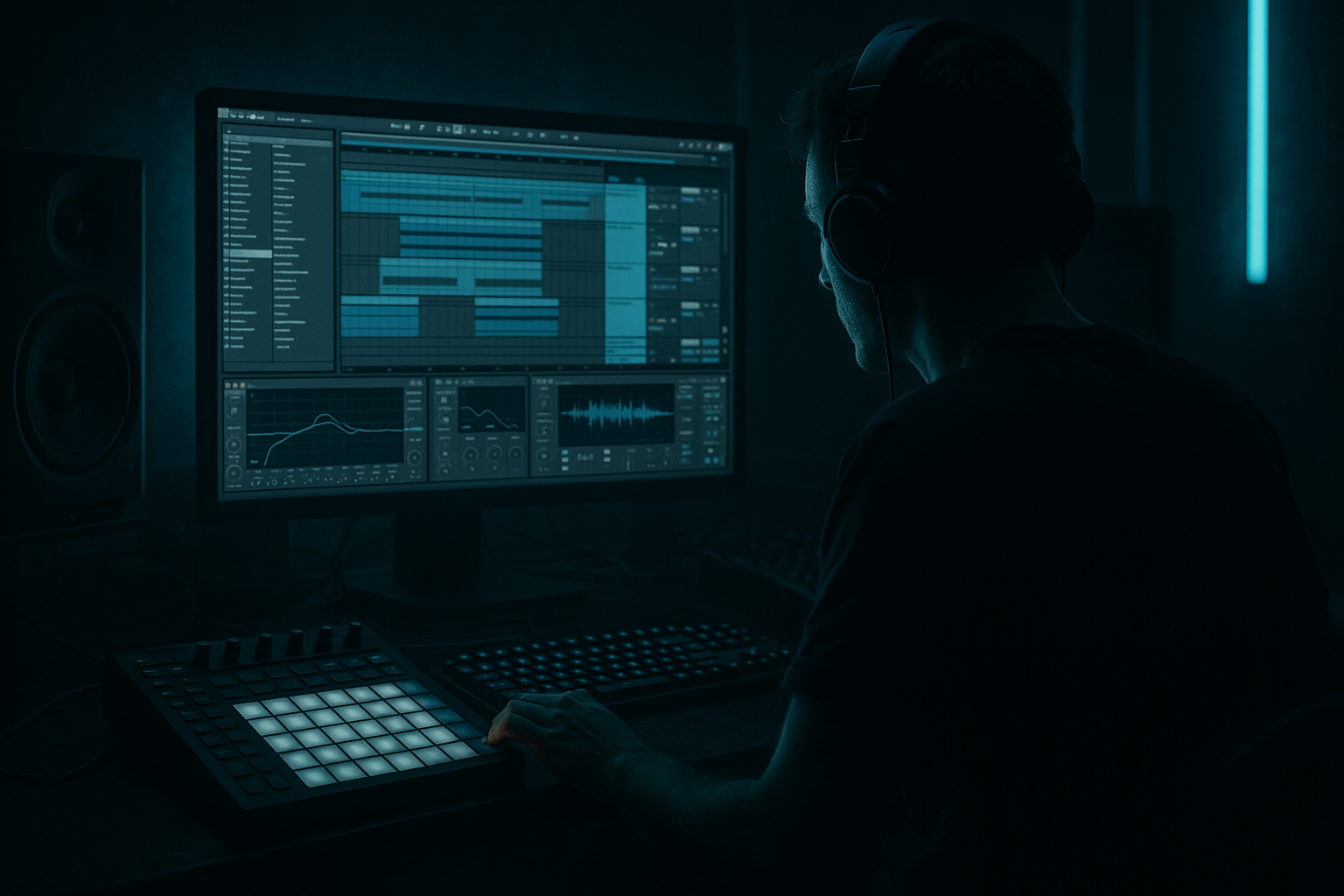
Main tutorial
```markdown
Push–Pull Timing Between Kicks and Breaks (DnB in Ableton Live) 🔥🥁
1) Lesson overview
Push–pull timing is the controlled micro-timing relationship between your grid-anchored kick and your human-feel break. In drum & bass—especially jungle, rollers, and techstep flavors—this is how you get that “forward drive” without changing BPM.
In this lesson you’ll learn how to:
- Keep the kick as the anchor (stable weight) while the break breathes around it (movement).
- Use Ableton Live tools to create intentional micro-shifts: Groove Pool, track delays, warp markers, and MIDI timing offsets.
- Lock the groove so it still hits hard on a big system. 😈
- A stable kick pattern (grid-locked).
- A break layer (Amen-style or any classic break) with controlled push/pull:
- A workflow that lets you A/B micro-timing choices quickly.
- Intro / breakdown: break slightly late (+8 to +12 ms) for lazy tension.
- Drop: snap break closer (+2 to +5 ms) for impact.
- Second 16: hats slightly earlier (-3 to -6 ms) to lift energy without adding sounds.
- Fill into drop: temporarily push break early (-8 ms) for a “rushing” effect, then reset on the 1.
- Make snares feel “heavier” by pulling them late (6–15 ms)
- Transient shaping on the break AFTER timing
- Parallel crush that doesn’t wreck timing
- Micro-timing contrast = perceived aggression
- Anchor your kick on the grid for weight and translation.
- Use warp markers for relative micro-timing inside the break (snare late, hats early).
- Use Track Delay for fast A/B timing states across sections.
- Use Groove Pool subtly; commit and refine with ms-level moves.
- Protect low-end punch by filtering/splitting break bands and keeping lows tighter than tops.
---
2) What you will build
A clean, heavy DnB drum bus with:
- hats slightly ahead for urgency,
- snares/claps slightly behind for weight,
- ghost notes shuffled for roll.
Target tempo: 172–176 BPM (examples at 174 BPM).
---
3) Step-by-step walkthrough
Step 0 — Session setup (so you can hear timing clearly)
1. Set tempo to 174 BPM.
2. Create these tracks:
- Kick (Audio or Drum Rack)
- Break (Audio)
- Snare/Clap Reinforcement (Drum Rack) (optional but recommended)
- Drum Bus (Group): group Kick + Break + Snare Reinforce
3. On Drum Bus group, add:
- Spectrum (for quick balance checks)
- Drum Buss (Ableton stock)
- Drive: 2–6 (taste)
- Boom: 10–25% around 50–70 Hz (depending on kick key)
- Transients: +5 to +15
- Glue Compressor
- Attack: 3 ms
- Release: Auto
- Ratio: 2:1
- Aim for 1–2 dB gain reduction (just “knitting”)
> Why: You need a consistent monitoring chain before making micro-timing calls.
---
Step 1 — Make the kick the “grid anchor” 🧱
Goal: Kick stays reliable; everything else negotiates around it.
1. Program a 2-step-ish DnB kick pattern (example for 1 bar at 174):
- Kick on 1.1.1
- Another kick on 1.3.1 (or 1.3.3 if you want more skip)
2. Do not apply Groove to the Kick track yet.
3. Freeze the kick’s timing:
- If MIDI: keep Global Quantize = 1 Bar while editing, then switch to 1/16.
- If audio: ensure warp is clean and no accidental transient drift.
Pro check: In Arrangement View, zoom in until you can see the transient peak. Your kick transients should be exactly on the grid.
---
Step 2 — Choose and prep your break layer (Warp like a pro)
1. Drop an Amen / Think / Funky Drummer-style break into Break (Audio).
2. Warp mode: usually Beats is best for classic breaks.
- Warp Mode: Beats
- Preserve: Transients
- Transient Loop Mode: Forward
- Envelope: ~20–40 (lower = tighter, higher = more smear)
3. Right-click the clip:
- Warp From Here (Straight) if needed
- Make sure 1.1.1 is correctly placed at the bar start.
4. Optional but useful: Consolidate (Cmd/Ctrl+J) a clean 1–2 bar loop.
> You want the break’s macro timing correct first. Push–pull is micro-timing after the loop is stable.
---
Step 3 — Create push/pull using clip-level warp markers (most “real” method)
This is the most surgical and DnB-authentic approach.
1. In the break clip, identify:
- Kick-ish hits (low thumps)
- Snare hits (typically on 2 and 4 in break language)
- Hat runs / ghost notes
2. Set warp markers only where needed:
- Put a warp marker on the main snare transient.
- Put another on the downbeat transient to keep the bar stable.
3. Now do controlled micro-moves:
- Pull the snare slightly late: move snare warp marker +6 to +15 ms (later)
- This makes the groove feel heavier and “laid back.”
- Push the hats slightly early: move key hat/ride transient markers -4 to -10 ms (earlier)
- This creates urgency and forward motion.
4. Keep the break from drifting:
- After moving a marker, check that the bar end still lines up.
- If the tail drifts, add a “safety marker” near the end of the bar and keep it on-grid.
Listening test: Toggle clip Warp on/off. If it gets messy or phasey, you moved too many markers.
---
Step 4 — Create push/pull with Track Delay (fast A/B method) ⏱️
Track Delay is insanely useful for auditioning timing relationships quickly.
1. In Session View (or Mixer section), show Track Delays:
- View → Mixer Section (ensure Delay is visible)
2. Try these starting points:
- Break track delay: +8 ms (late)
Kick stays on-grid; break sits back = weight.
- Then try -5 ms (early)
Break pushes into the kick = urgency.
3. Don’t go crazy:
- Typical useful range in DnB: -10 ms to +15 ms
- Beyond that it often feels “wrong” instead of groovy.
Workflow tip: Map track delay to a Macro using a Rack (via Max for Live is ideal, but if staying stock: just write down your favorite values and A/B manually).
---
Step 5 — Use Groove Pool intelligently (human feel without losing punch)
Groove Pool is great, but advanced DnB requires restraint.
1. Pick a groove:
- From Core Library: look for MPC or Swing 16 grooves.
- Or extract groove from a break you love:
- Right-click a clip → Extract Groove
2. Apply groove to the Break (not the Kick):
- In clip Groove chooser, select your groove.
- Start with:
- Timing: 10–25%
- Random: 0–5%
- Velocity: 0–10% (if you’re using Simpler/Drum Rack slices)
3. Keep the kick anchored:
- If you must groove the kick, do it tiny:
- Timing 5% max, or better: don’t.
4. Commit once it’s right:
- In Groove Pool, click Commit for the break once you’re happy.
- Then do fine ms tweaks with Track Delay or warp markers.
> Jungle feel often comes from tiny inconsistencies—but DnB impact comes from intentional anchors.
---
Step 6 — Tighten the low end while keeping the break “alive” (essential for systems)
When the break moves around, low-end clashes can happen.
1. On the Break track, insert EQ Eight:
- High-pass at ~120–180 Hz (depends on how much low you want in the break)
- If you want some body, try a gentler HP:
- 12 dB/oct at 120 Hz
- Otherwise:
- 24 dB/oct at 160–200 Hz for cleaner modern DnB
2. Consider splitting the break into bands:
- Duplicate the Break track:
- Break TOP: HP at 200 Hz
- Break LOW: LP at 200 Hz
- Keep Break LOW timing closer to the kick (less push/pull), while Break TOP gets the swing.
- This is a huge trick for keeping sub/kick clean while hats stay lively.
3. Add Saturator lightly on Break TOP:
- Drive: 1–4 dB
- Soft Clip: On
- This makes hats and snare texture read even when timing is subtle.
---
Step 7 — Arrangement ideas: where to use different push/pull “states”
Push–pull can be a section tool, not just a loop tweak.
Try automating timing across the track:
If you use Track Delay, you can automate it (Arrangement automation) for these transitions.
---
4) Common mistakes
1. Grooving the kick too much
- Your kick becomes unreliable; the whole track loses authority.
2. Over-warping the break
- Too many warp markers = phasey transients and unnatural swing.
3. Pushing/pulling the entire break equally
- Real feel comes from relative timing: hats vs snares vs ghosts, not everything shifting as one block.
4. Ignoring low-end timing
- A break with low content moved late can smear with the kick and ruin punch.
5. Randomizing timing without intention
- “Humanize” isn’t a vibe; controlled micro-timing is the vibe.
---
5) Pro tips for darker/heavier DnB 😈
- Then reinforce with a tight snare layer on-grid (Drum Rack) so you get both: weight + crack.
- Use Drum Buss on Break TOP:
- Transients +10
- Drive 2–4
- Or Saturator + EQ Eight to emphasize 2–5 kHz snap.
- Create a Return track “DRUM CRUSH”:
- Overdrive (Freq ~1–2 kHz, Drive 20–40%)
- Redux (light: Downsample 2–6, Bit 8–12)
- Glue Compressor (4:1, Attack 1 ms, Release Auto)
- Send mainly the break, not the kick.
- Grid-locked kick + slightly late snare + slightly early hats = “mechanical monster with human teeth.”
---
6) Mini practice exercise (15 minutes)
1. Load a classic break (Amen/Think) and a modern punchy kick.
2. Create a 2-bar loop with kick on-grid.
3. Do three versions of timing:
- Version A (Heavy): Break +10 ms, snare marker +12 ms
- Version B (Neutral): Break +3 ms, snare marker +6 ms
- Version C (Urgent): Break -5 ms, hats markers -6 ms, snare marker +6 ms
4. For each version, answer:
- Which one feels best at the drop?
- Which one works best for a darker roller?
- Does the kick still feel like the “boss” of the groove?
Export each loop and label them clearly. Build the habit of committing timing decisions like sound choices.
---
7) Recap
If you want, tell me the exact break you’re using (Amen, Think, etc.) and your kick placement (2-step, 4-on-the-floor halftime fakeout, etc.), and I’ll suggest specific ms offsets and warp-marker targets for that groove. 🥁
```

