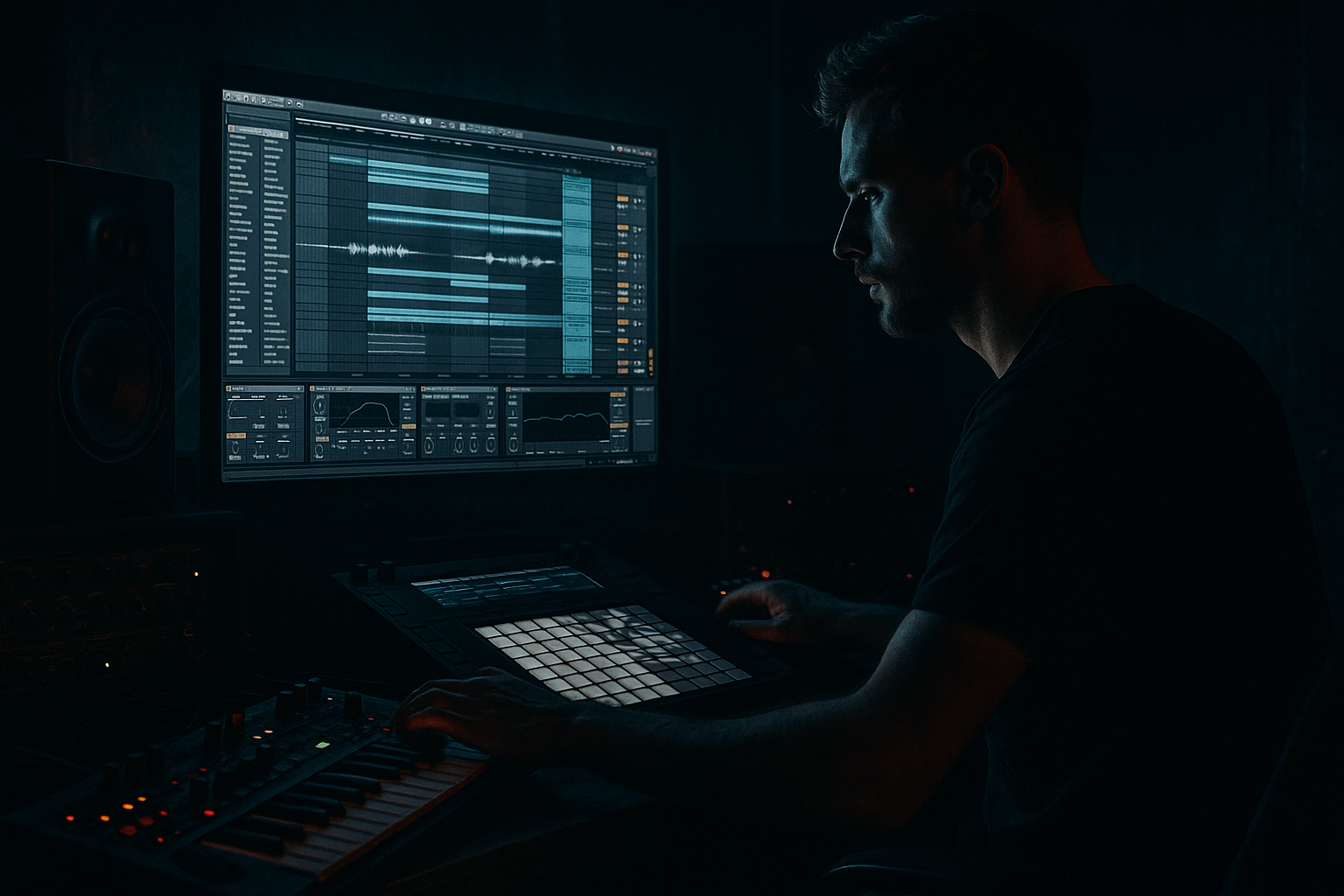
Main tutorial
```markdown
Quick bounce-and-reimport tricks (170 BPM) — Ableton Live Workflow for DnB 🚀
1) Lesson overview
At 170 BPM, drum & bass moves fast—so your workflow needs to be faster than your ideas. This lesson is all about quick bouncing (freezing/flattening/printing) and reimport tricks that let you:
- Commit to sound design decisions without losing flexibility
- Resample creative variations instantly
- Create “finished-sounding” drums, basses, and FX with less CPU and more vibe
- A printed drum bus you can slice, rearrange, and reprocess
- A reimported bass resample (sub + mid) turned into a playable “audio synth”
- Resampled fills, reverses, and impact FX generated from your own material
- A clean Ableton workflow template you can reuse every session 🔁
- Tape stop-ish: automate Transposition down over 1/4 bar (clip envelope).
- Reverse snare throw: duplicate snare hit → reverse clip → fade in → reverb printed.
- Ghost roll: take a snare transient slice and repeat at 1/32 just before beat 2 or 4.
- Bars 1–8: Drums + atmos tease (filtered)
- Bars 9–16: Add bass, keep mids restrained
- Bar 16: 1-beat silence / tape-stop / reverse verb into drop
- Bars 17–32: Full drop, rotate fills every 4 or 8 bars
- Printing too early with bad gain staging: If you’re clipping pre-print, you’re baking problems in. Keep headroom: peaks around -6 dB on groups is fine.
- Forgetting to disable unneeded devices after flattening: If you print drums, don’t leave the original heavy chain running in parallel.
- Warp artifacts on drums: Wrong Warp mode can blur transients. For drum audio: Beats is often safest.
- Resampling “everything” by accident: Using “Resampling” can accidentally include metronome, preview, or returns. Route explicitly when you can.
- No fades on chopped audio: Clicks kill. Add micro fades or enable auto-fades.
- Parallel distortion AFTER printing: Duplicate your printed bass mid, distort the duplicate hard (Pedal/Amp/Saturator), then low-pass it around 3–6 kHz and blend quietly.
- Mid/side control on printed drums: Use Utility:
- “Weaponize” room tone: Print tiny reverb tails from snare, then stretch them (Warp Complex/Texture) into eerie pads under the drop.
- Clip-based pitch moves: For printed bass shots, automate Transpose in clip envelopes for nasty dives into the snare.
- Print at key milestones: After you like:
- Fill at bar 4
- Fill at bar 8 (bigger)
- Transition FX into bar 9
- Freeze/Flatten = fastest commit for CPU + audio editing freedom.
- Resample → Slice to MIDI = turn bass phrases into playable, rearrangeable “audio synths.”
- Print verb/delay tails = controlled atmosphere and transitions that fit your track.
- At 170 BPM, audio-based micro-edits (1/16–1/32) make your groove feel pro.
- The mindset: design → print → chop → reprocess → arrange 🔁
We’ll stay rooted in DnB/jungle: breaks, tight kick/snare, rolling subs, neuro-ish mid layers, and gritty atmos.
---
2) What you will build
By the end, you’ll have a 170 BPM 32-bar loop sketch with:
---
3) Step-by-step walkthrough
Session setup (30 seconds)
1. Set BPM = 170.
2. Set grid to 1/16 (you’ll switch to 1/32 for micro-edits).
3. Create these tracks:
- DRUMS (Group): Kick, Snare, Hats/perc, Break
- BASS (Group): Sub, Mid
- FX/ATMOS
- PRINT (Audio track) (we’ll use this as a resample lane)
Ableton preference tip: Turn on Create Fades on Clip Edges for clean chops.
---
Trick A — Freeze/Flatten for instant “commit + move on” 🔒
This is the fastest bounce for CPU-heavy racks.
#### A1) Print a drum bus that already “hits”
1. Route all drum channels to a Drum Bus return track (or simply group your drums).
2. On the DRUMS Group, add a tight chain like:
- EQ Eight
- HP at 25–30 Hz (24 dB/oct)
- small dip 250–400 Hz if boxy
- Glue Compressor
- Attack 1 ms, Release Auto
- Ratio 2:1
- Aim for 1–3 dB GR on peaks
- Saturator
- Soft Clip ON
- Drive 2–6 dB (taste)
- Limiter (optional safety)
- Ceiling -0.3 dB
- Just catching stray hits
3. Right-click the DRUMS Group → Freeze Track.
4. Right-click again → Flatten.
Now you’ve got audio drums with your bus processing baked in—perfect for chops and fast arrangement.
DnB use case: Flatten your drum group once it’s 90% there, then do surgical edits and micro-fills with audio (faster than MIDI tweaking).
---
Trick B — Resampling bass into “audio synth” clips 🎛️➡️🎚️
This is the secret sauce for rolling bass variations and neuro-ish movement.
#### B1) Create a clean resample pipeline
1. On your PRINT audio track:
- Set Audio From: choose the BASS Group (or “Resampling” if you want everything).
- Set monitoring to Off (so it only records).
2. Arm PRINT.
#### B2) Make a 4-bar bass phrase and print it
1. In your bass group:
- Sub track: Operator (simple sine)
- Osc A: Sine
- Add Saturator lightly (Drive 1–2 dB) if needed
- Keep sub clean: low-pass around 120 Hz with EQ Eight if your mid bleeds down
- Mid track: Wavetable or Operator
- Add motion: Auto Filter with envelope or LFO
- Add Amp or Pedal for grit
- Optional: Corpus subtly for metallic edge (dark DnB flavor)
2. Record 4 bars into PRINT (Arrangement or Session).
#### B3) Chop into “notes” and play it like an instrument
1. Consolidate the printed clip (Cmd/Ctrl + J) to make it clean.
2. Right-click clip → Slice to New MIDI Track.
- Slice preset: Transient or 1/8 (DnB often loves 1/8 slices for bass rhythms)
- Choose Built-in slicing preset or “Warp” style if you want tighter slices
3. Now you’ve got a Drum Rack of bass slices.
4. Play new rhythms with MIDI—instant variation without touching the synth chain.
Key move at 170: Use 1/8 + 1/16 stutters to create rolling momentum. Try patterns that answer the snare on beat 2 & 4.
---
Trick C — Bounce tiny “one-shot” fills from your own drums 🥁✂️
Instead of hunting samples, generate fills from your loop so they match perfectly.
#### C1) Make a micro-fill lane
1. Duplicate your flattened drum audio to a new track called DRUM CUTS.
2. Pick the last 1 bar of an 8-bar phrase.
3. Chop into 1/16 or 1/32 segments:
- Turn Warp ON
- Warp Mode: Beats
- Preserve: Transients
- Envelope: ~20–40 (tight, punchy)
#### C2) Create classic DnB edits quickly
Then resample those edits into PRINT and build a “fills bank” on a new audio track.
---
Trick D — Print reverb and delay tails as audio FX 🌌
This is how you get cinematic jungle atmos without drowning your mix.
#### D1) FX send printing setup
1. Create a return track A: VERB:
- Hybrid Reverb
- Algorithmic: Hall
- Decay: 2.5–6s (depends on vibe)
- HP filter in device: 200–400 Hz
- EQ Eight after it:
- Cut lows below 250 Hz
- Soft dip around 2–4 kHz if harsh
2. Create return track B: DLY:
- Echo
- Time: 1/8 dotted or 1/4
- Filter: HP ~ 300 Hz, LP ~ 6–10 kHz
- Modulation small amount for width
#### D2) Print tails only (clean + controllable)
1. On PRINT track, set Audio From = A: VERB (or B: DLY).
2. Solo the send source briefly (like snare or vocal stab).
3. Record 1–2 bars of tails.
4. Warp it, reverse it, fade it, and place it as transitions into drops.
Arrangement idea: Print a snare verb tail, reverse it into bar 17 for a drop suck-in, then cut hard at the first kick.
---
Trick E — Turn bounced audio into “instant darkness” with a post-chain 🖤
Once you’ve printed drums/bass, you can do aggressive audio-only processing safely.
Create an AUDIO POST rack (on your printed channels):
1. EQ Eight
- HP 20–30 Hz (always)
- notch resonances as needed
2. Saturator (Soft Clip ON)
- Drive 3–8 dB depending on source
3. Drum Buss (on drums)
- Drive 5–20
- Crunch 0–10
- Boom OFF or very low for DnB (sub is handled elsewhere)
4. Redux (tiny amounts)
- Bit Reduction: 12–14 (subtle)
- Downsample: minimal (too much kills punch)
5. Glue Compressor
- Sidechain from kick (optional) for rhythmic pump
Then resample again (yes!) to keep moving forward with “final-ish” audio.
---
Quick 170 BPM arrangement moves (using your printed audio)
(Printed fills make this painless.)
---
4) Common mistakes
---
5) Pro tips for darker/heavier DnB 🖤
- On drum tops bus, widen slightly (120–140%), but keep kick/snare mono-focused.
1) Drum groove
2) Bass phrase
3) Drop 16 bars
…print each and start arranging with audio like a sampler mindset.
---
6) Mini practice exercise (15 minutes) ⏱️
Goal: Create a 16-bar drop with 3 unique fill moments using only bounce-and-reimport.
1. Build a basic 170 BPM beat (kick/snare + hats + break layer).
2. Put a drum bus chain on the group (EQ Eight → Glue → Saturator).
3. Freeze + Flatten the drum group.
4. Chop the last bar into a fill (1/16 + 1/32).
5. Build a bass phrase (sub + mid), then resample 4 bars into PRINT.
6. Slice the bass to a Drum Rack and write a new rhythm for bars 9–16.
7. Print one reverb tail from the snare and reverse it into bar 9.
Deliverable: 16 bars with:
---
7) Recap
If you want, tell me your preferred sub style (clean sine, reese, or distorted) and whether you’re going more rolling/liquid or dark/neuro, and I’ll tailor a bounce-and-reimport template rack for your exact sound.
```

