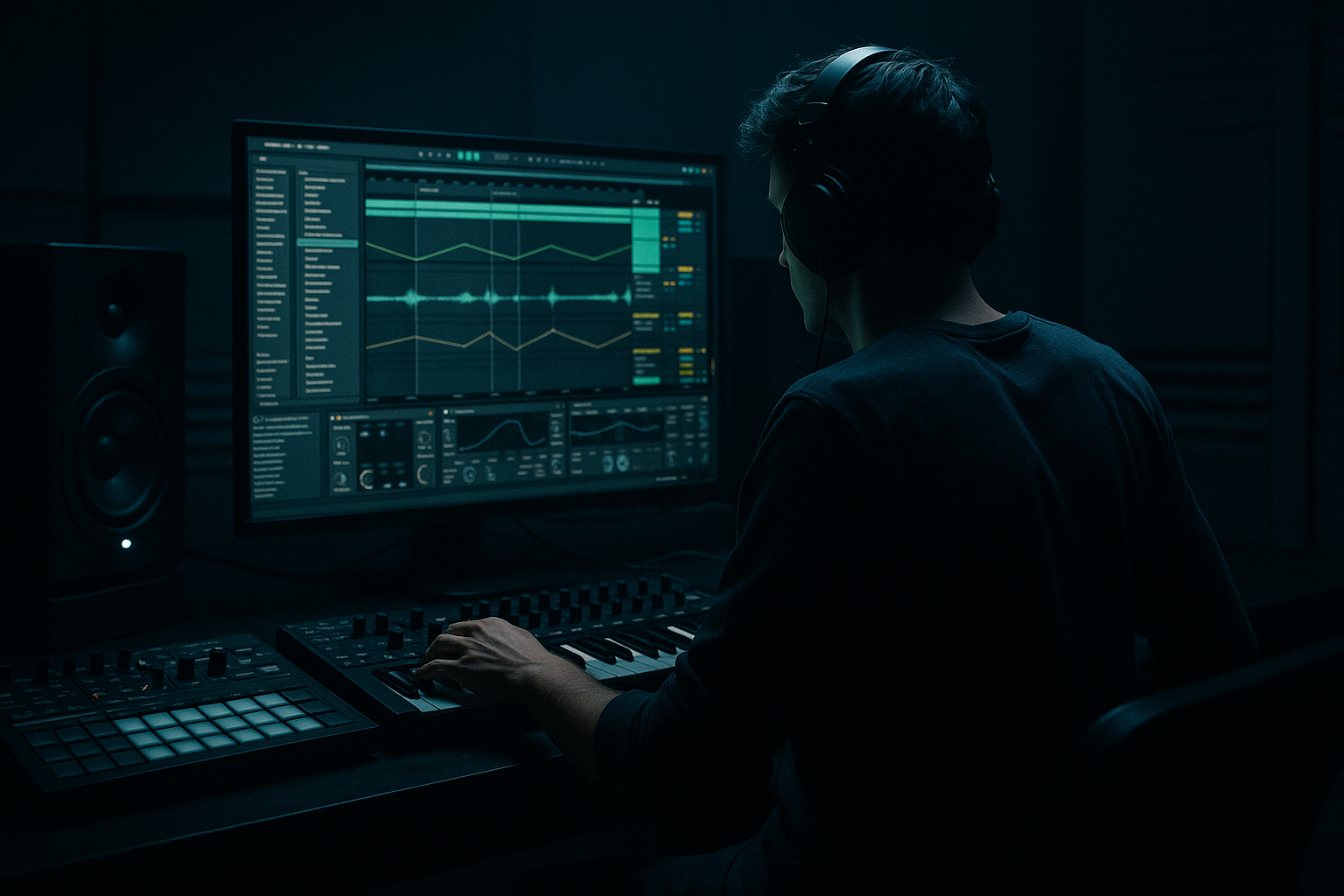
Main tutorial
Lesson Overview
Ragga vocal texture is one of the fastest ways to give a Drum & Bass track instant identity: that dubwise, patois-leaning edge that can make a roller feel raw, make a jungle cut feel vintage, or push a neuro-weighted tune into darker territory without overloading the mix. In Ableton Live 12, the goal is not to just “throw a vocal on top” — it’s to build a controlled, musical texture layer that behaves like an instrument: rhythmic, chopped, pitched, filtered, and arranged with intention.
In DnB, this matters because vocals often function as energy markers rather than full lyrical centers. A ragga stab, shouts, phrase tail, or processed “toasting” snippet can:
- reinforce the groove,
- lead transitions,
- add call-and-response with bass,
- and create that unmistakable sound-system character.
- a chopped vocal phrase with strong rhythmic placement,
- a pitched-down grimey support layer,
- a bright, filtered top texture for energy,
- a dub-style delay send for space and momentum,
- automation that opens and closes the vocal around drum/bass phrases,
- and a final arrangement-ready element that can work in intros, pre-drops, drop switch-ups, or 8-bar turnarounds.
- a DJ-friendly intro with vocal fragments teasing the drop,
- a roller drop where the vocal answers the bass,
- or a jungle-style break section where the voice becomes part of the percussion.
- Using a full vocal line as if it were a chorus lead
- Leaving too much low-mid energy in the vocal
- Over-widening the vocal
- Too much delay or reverb
- Quantizing every chop perfectly
- Clashing with the snare or reese
- Use pitch as character, not novelty: dropping a ragga chop down 3–7 semitones can turn it into a menace layer, especially under a distorted reese. Keep it subtle so it still reads as voice.
- Pair the vocal with bass answers: let the vocal hit on the off-beat after a bass stab, or mirror the bass rhythm in the drop. That call-and-response is classic sound-system language.
- Automate a narrow band-pass for tension: around 500 Hz–2.5 kHz can make the vocal feel trapped, urgent, and underground before widening again at the drop.
- Print distortion, then clean it up: if a processed vocal gets too wild, resample it and cut the best part. Resampling often sounds more intentional than endless live processing.
- Use break edits under the vocal: a chopped ragga phrase over an edited break feels much more authentic than over a static loop.
- Try ghost vocal notes: very low-volume vocal hits tucked between snares can add subconscious motion without sounding obvious.
- Keep sub and vocal separate: if the bass has strong mid harmonics, avoid placing vocal body in the same zone. Let the vocal live higher or narrower.
This lesson focuses on turning raw vocal material into color, not a lead vocal feature. We’ll build a groove-first ragga vocal texture using Ableton’s stock tools: slicing, warping, filtering, saturation, echo, modulation, and arrangement automation. The end result should feel like it belongs in a proper DnB record: edgy, shuffled, and tightly mixed 🥁
What You Will Build
You’ll create a ragga vocal texture rack for a DnB track that includes:
Musically, this should feel like:
By the end, you’ll have a repeatable Ableton workflow for making ragga textures that sit correctly in a dense DnB mix instead of cluttering it.
Step-by-Step Walkthrough
1. Choose or record a vocal source with strong consonants and movement
Start with a vocal sample that has attitude: short ragga phrases, shouts, toasting lines, crowd callouts, or even one or two words with strong rhythmic edges. You want plenty of transient detail: hard consonants, vowel movement, and natural micro-dynamics.
Good source types:
- vocal ad-libs from a sample pack,
- your own spoken phrase recorded into Ableton,
- a chopped acapella line,
- or a field-recorded voice phrase with room tone.
In Ableton Live 12, drop the sample into an audio track and immediately inspect the timing. For ragga texture, you do not need perfect phrasing — you need usable rhythm. If the sample has a lot of tail noise, keep it; that ambience can become part of the color.
Advanced choice: if you’re recording your own vocal, capture two versions:
- one close and dry,
- one more distant or turned slightly off-axis.
That gives you mix flexibility later when you build layers.
2. Warp the vocal to the grid, but keep the human bounce
Set Warp on and choose a warp mode that preserves vocal character. For most ragga phrases:
- start with Complex Pro if the phrase is long or pitched,
- use Beats for short chops with strong transients.
For Beats mode, try:
- Preserve: 1/16 or 1/8 depending on phrase length,
- Transients: around 60–80,
- Gain: adjust to match your session.
If the phrase is going to be chopped hard, don’t over-perfect it. Ragga texture works because it feels lived-in. Align the start of the key consonants, but let the tiny internal push-pull remain. That micro-uncertainty helps it sit against breakbeats and syncopated bass.
In a DnB context, this is especially useful because breakbeats already carry a lot of human movement. A vocal that is too rigid can feel glued-on. A slightly loose phrase can lock into the pocket and add a live-sounding layer over programmed drums.
3. Slice the vocal into playable hits for groove control
Right-click the vocal clip and choose Slice to New MIDI Track. Use:
- Transient slicing for vocal phrases with distinct syllables,
- or 1/8 / 1/16 if you want a more deliberate rhythmic grid.
Ableton will create a Drum Rack with each slice mapped to pads. This is where the vocal becomes playable. Trigger slices manually or sequence them in MIDI. Keep a few slices that work as:
- attack hits,
- tails,
- and phrase endings.
For advanced workflow, duplicate the Drum Rack and make two versions:
- one for primary rhythm chops,
- one for fills and callouts.
You can then layer them across different tracks or group them. This helps you avoid overfilling one rack with too many jobs.
Groove note: if your drums use a swing-heavy break edit, nudge the vocal chops so they respond to the same feel. Don’t place every chop on the straight grid. Let some land slightly behind the snare or just ahead of the kick to increase movement.
4. Build the main texture rack: filter, saturation, and tone shaping
Group the vocal chop track and start building a rack of stock devices. A very strong starting chain:
- EQ Eight
- Saturator
- Auto Filter
- Drum Buss or Glue Compressor depending on intensity
Suggested settings:
- EQ Eight: high-pass around 120–180 Hz to clear low-end clutter; dip harsh zones around 3–5 kHz if needed.
- Saturator: Drive around 2–6 dB, Soft Clip on if you want extra density.
- Auto Filter: low-pass sweep between 2.5–8 kHz for movement, or band-pass around 400 Hz–3 kHz for a narrow ragga-radio tone.
- Drum Buss: Drive 5–15%, Boom usually off for vocal textures, Crunch used lightly if you want grime.
If the vocal sounds too clean, use subtle Redux before Saturator for a rougher, older sound. Keep Reduction modest — enough to add grain, not digital damage that causes fatigue.
Why this works in DnB: ragga vocals often live in a crowded frequency space with hats, breaks, snare crack, and bass harmonics. Filtering and saturation make the vocal feel like it belongs inside the system rather than floating above it. You are sculpting a midrange object, not an isolated lead.
5. Create two layers: one low-mid grime layer and one bright cut layer
For advanced color, duplicate your vocal texture and split it into two roles:
Layer A: Low-mid grime
- Low-pass around 2–4 kHz
- Add Saturator or Overdrive lightly
- Use a short Echo or very small Convolution Reverb space
- Keep it mono or narrow
Layer B: Bright cut
- High-pass around 200–400 Hz
- Boost a bit around 6–9 kHz if the source supports it
- Use Auto Filter with moderate resonance for movement
- Pan slightly or use subtle Utility width adjustment if the part is only a texture accent
This creates separation inside the vocal itself. The low-mid layer gives body and menace; the bright layer gives articulation and rhythm. In a roller or neuro context, this keeps the vocal from fighting the bass while still giving you character.
If you want the vocal to function like a percussion element, shorten the clip envelopes and trim tails aggressively. Think of it as a voice hit, not a verse stem.
6. Lock the vocal to the drums using groove and micro-automation
Drag an MPC-style or break-derived groove from Ableton’s Groove Pool onto the vocal MIDI clips or chopped audio, depending on how you’re working. Use a subtle groove amount:
- 10–35% for light movement,
- 40–60% if the track is a swing-heavy jungle or oldschool roller.
Then automate tiny details:
- Clip gain drops on weaker syllables,
- Filter opens on phrase starts,
- Delay throws on line endings,
- reverb sends only on selected words.
Try a classic DnB phrase structure:
- bars 1–2: dry, short vocal chops,
- bar 3: one delay throw,
- bar 4: filter opens slightly into the next drum phrase.
This call-and-response approach is huge in DnB. The vocal answers the kick/snare pattern or the bass motif, making the arrangement feel conversational instead of looped.
7. Build a dub delay send for space without washing out the groove
Create a return track with Echo or Delay. For ragga texture, keep the delay rhythmic and controlled:
- time: 1/8, 1/8 dotted, or 1/4 depending on track pace,
- feedback: 15–35%,
- filter the delay heavily,
- use low cut around 200–400 Hz and high cut around 5–8 kHz.
If the track is dark or heavy, keep the delay mono or narrow. You want echoes to live behind the beat, not explode across the stereo image and interfere with the bass.
Automate send amounts only on selected vocal hits. In DnB, a delay throw is most effective when it arrives as a transition cue or a rhythmic answer to a snare fill. Avoid permanent delay wash; that smears the drop.
Advanced move: print the delay return to audio and chop the best echoes into a separate FX track. That gives you arrangement control and lets you reverse or fade specific repeats into fills.
8. Use resampling to make the vocal more “instrument-like”
Once the base texture is working, resample it. Route the vocal texture to a new audio track, arm it, and record 4–8 bars of performance or automation passes. Capture:
- filter movements,
- delay throws,
- pitch bumps,
- and clipped phrases.
Then treat the resampled audio like source material. Reverse one hit, trim another tightly, and layer a tiny pickup before the snare. This is where the vocal starts behaving like a custom percussion layer.
You can also use Simpler in Classic mode for resampled vocal chunks if you want more playable control. Then shape the envelope:
- Attack: 0–5 ms,
- Release: short to medium,
- and use Filter Envelope sparingly for bite.
This approach is extremely useful in DnB arrangement because it lets you write vocal texture like drum programming: concise, repeatable, and easy to automate.
9. Place the vocal in the arrangement with DJ logic
Don’t park the ragga texture everywhere. Put it where it carries narrative weight.
Strong DnB placements:
- 16-bar intro: sparse vocal chops with filtered drums
- 8 bars before the drop: phrase fragments and delay build
- first 8 bars of the drop: call-and-response with bass
- switch-up at bar 17 or 33: new vocal angle or reverse tail
- outro: strip the vocal back to one or two echoes for mixability
Example context:
In a 174 BPM roller, let the intro feature a high-passed ragga phrase over filtered breakbeats. At the drop, mute the long vocal tails and leave only short chopped syllables answering the bass riff every 2 bars. Then at bar 17, bring in a single delayed “yeah” or “selecta” style hit to refresh energy without changing the drum loop.
This keeps the track DJ-friendly and gives the drop clear phases instead of flat looping.
10. Mix the vocal like a supporting groove element, not a main feature
Final cleanup matters a lot in DnB. Use EQ Eight to carve space:
- HPF around 120–250 Hz depending on body,
- dip muddy areas around 250–500 Hz if the vocal clouds the snare,
- tame harshness around 2.5–4.5 kHz if it clashes with hats and snare crack.
If the vocal gets spiky, use Compressor or Glue Compressor with gentle control:
- Ratio: 2:1 to 4:1
- Attack: 10–30 ms
- Release: Auto or around 80–150 ms
Keep headroom. The vocal should add attitude without forcing the master to react. Check in mono to make sure your texture still reads, especially if you’ve widened the bright layer. In heavier DnB, mono compatibility is not optional — it’s part of the discipline.
Common Mistakes
- Fix: chop it into rhythmic fragments and treat it like percussion texture.
- Fix: high-pass more aggressively and cut muddy resonance before the bass takes over.
- Fix: keep the core in mono or narrow; reserve width for tiny accent layers only.
- Fix: filter the return hard and automate only selected throws.
- Fix: let some slices lean into the groove. DnB benefits from a human push-pull against the drums.
- Fix: carve 2–5 kHz intelligently and place the vocal in gaps between key drum hits.
Pro Tips for Darker / Heavier DnB
Mini Practice Exercise
Set a 15-minute timer and build a ragga texture for an 8-bar DnB loop at 174 BPM.
1. Find or record one vocal phrase with 3–5 usable syllables.
2. Warp it and slice it into a Drum Rack.
3. Program a 2-bar loop where the vocal answers the snare on bar 2 and bar 4.
4. Add EQ Eight, Saturator, and Auto Filter to make two versions: dry and filtered.
5. Create one Echo return and automate a single throw at the end of bar 4.
6. Resample the result for 4 bars.
7. Reverse one chop and place it as a pickup into the next phrase.
8. Check mono and remove any low-mid buildup.
Goal: make the vocal feel like part of the drum groove, not a separate layer.
Recap
Ragga vocal texture in DnB works best when it is rhythmic, filtered, and arranged like a groove element. Use Ableton’s slicing, warping, saturation, filtering, echo sends, and resampling to turn a vocal phrase into a playable texture. Keep the low end clean, automate with intention, and place vocal moments where they reinforce the drum/bass conversation. Done right, this adds instant sound-system attitude to rollers, jungle edits, and darker neuro-leaning cuts.

