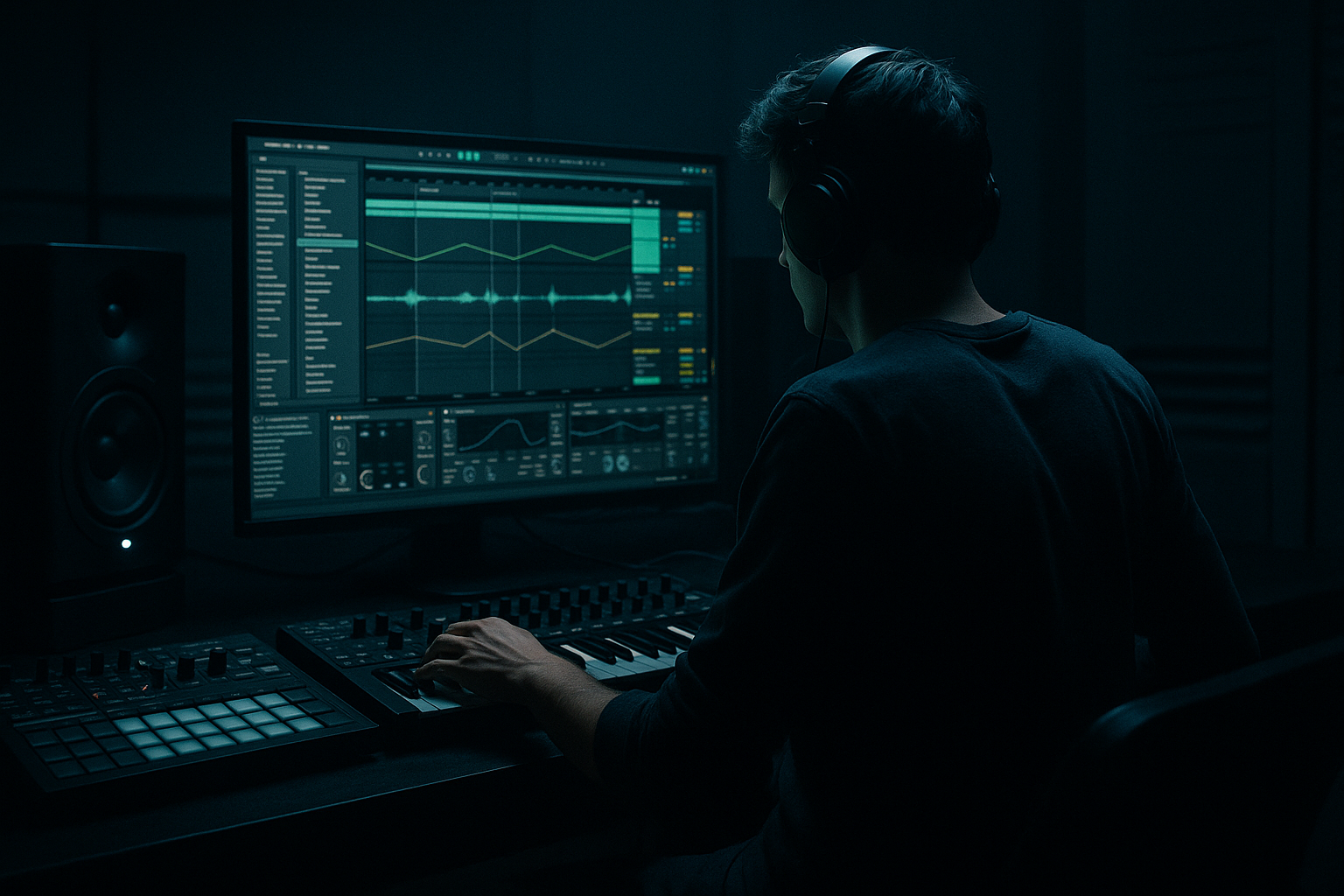
Main tutorial
Ragga Framework: Chop + Resample (Ableton Live 12) — Basslines for DnB/Jungle 🇯🇲⚡️
1) Lesson overview
In ragga/jungle and rolling DnB, the bassline and vocal chops often “talk” to each other: short phrases, call-and-response, quick fills, and gritty resampling. In this lesson you’ll learn a beginner-friendly Ableton Live 12 workflow to:
- Chop a ragga vocal (or any phrase) cleanly
- Build a simple but effective ragga-style bass framework
- Resample your bass into audio for tighter groove + heavier processing
- Arrange it like a proper DnB section (16–32 bar loop → drop-ready)
- A ragga vocal chop kit in Simpler/Drum Rack
- A sub + mid bassline that locks to the drums (half-time feel inside 174 BPM)
- A resampled bass audio track you can slice, pitch, distort, and automate
- A basic arrangement framework: intro → drop → variation
- In Drum Rack, click a pad → open Simpler.
- Set each slice:
- Instrument: Operator
- Add Utility after Operator:
- Wavetable (or Operator with saw/square)
- Saturator
- Auto Filter
- Redux (optional for grit)
- Use EQ Eight:
- Strong hits on beat 1 and beat 3
- Add syncopation around 1.2.3 / 1.3.3 / 1.4.2 etc.
- Compressor
- Right-click `BASS MIDI` → Freeze Track
- Right-click again → Flatten
- Drums + light vocal chops
- Bass: sub only, sparse
- Add resampled bass layer
- Slight filter opening
- Change one vocal chop rhythm
- Add a quick bass fill at end of bar 12
- Pull bass for 1 bar (bar 15)
- Add a vocal “shout” chop
- Slam back in bar 16
- Over-chopping the vocal: too many slices = clutter. Use fewer, stronger hits.
- Warping vocals badly: if it sounds watery, try different warp modes (Complex Pro vs. Complex) and correct markers.
- Sub not mono: always keep sub centered (Utility width 0%).
- Too much distortion on sub: distort mids, keep sub cleaner.
- No space for drums: if bass and chops fill every 16th, your groove will feel flat.
- Ignoring clip fades: clicks happen—use fades in Simpler or audio clips.
- Pitch the vocal chops down by -3 to -7 semitones for a nastier ragga vibe (and shorten tails).
- Use Roar (stock Live 12) on the mid bass only:
- Parallel distortion:
- Automate filter + reverb throws on vocal chops:
- Tension fills:
- Clip saturation safety:
- You warped a ragga vocal correctly and sliced it into a playable kit.
- You built a sub + mid bass that rolls at 174 BPM.
- You resampled the bass and chopped it like classic jungle/DnB workflows.
- You used stock tools (Simpler, Drum Rack, Operator/Wavetable, EQ Eight, Saturator, Drum Buss, Compressor, Utility) to shape it into a drop-ready framework.
We’ll stay stock-device friendly and very practical. ✅
---
2) What you will build
By the end you’ll have a 16-bar rolling DnB loop containing:
---
3) Step-by-step walkthrough
A. Project setup (DnB-friendly)
1. Tempo: set to 174 BPM (classic DnB range: 172–176).
2. Create tracks:
- 1× Audio track: `VOCAL SOURCE`
- 1× MIDI track: `VOCAL CHOPS` (Drum Rack)
- 1× MIDI track: `BASS MIDI`
- 1× Audio track: `BASS RESAMPLE`
3. Optional: load a simple Drum Loop or break (Amen-style) to keep you grounded rhythmically.
Tip: DnB bass grooves often feel half-time: you’ll place key bass hits around beat 1 and beat 3, but with 16th-note syncopation.
---
B. Find a vocal phrase + warp it properly
1. Drop a ragga vocal phrase into `VOCAL SOURCE`.
2. In Clip View:
- Turn Warp: ON
- Warp Mode:
- For vocals: Complex Pro
- Set Seg. BPM close to original if needed.
3. Set the phrase to loop:
- Loop brace around a 1–2 bar phrase that has clear words/energy.
4. Align timing:
- Right-click transient (or a clear syllable) → Set 1.1.1 Here
- Adjust Warp markers so syllables hit on-grid.
Good beginner goal: a clean phrase like “Run the track / Jungle / Original” etc.
---
C. Chop the vocal into playable hits (Slice to New MIDI Track)
1. Right-click the vocal clip → Slice to New MIDI Track.
2. Settings (great starting point):
- Slice by: Transients
- Create one slice per: Transient
- Warp Slices: ON
- Playback: Gate (tighter ragga stabs)
3. Ableton will create a Drum Rack with each chop on a pad.
Now go to the new `VOCAL CHOPS` track:
- Mode: One-Shot (or keep Gate for tight triggers)
- Fade In: 2–10 ms (prevents clicks)
- Fade Out: 10–30 ms (clean tail control)
DnB feel: keep chops short and punchy—don’t let every slice ring out.
---
D. Write a ragga “call-and-response” chop pattern
In a MIDI clip on `VOCAL CHOPS` (start with 2 bars loop):
1. Start simple with off-beat stabs:
- Place chops on 1.2, 1.4, 2.2, 2.4 (8th-note offbeats)
2. Add a couple 16th pick-ups into bar transitions:
- Try 1.3.4 and 2.3.4 (a quick lead-in)
3. Humanize slightly:
- Select notes → Groove Pool: try a subtle Swing 16 groove (very small amount, 5–15%)
- Or manually shift 1–2 notes late by 5–15 ms
Keep it sparse: in rolling DnB, the drums and bass need space—vocal chops should accent, not overwhelm. 🎛️
---
E. Build the bass framework (Sub + Mid, beginner-safe)
We’ll make a two-layer bass using stock devices.
#### 1) Sub layer (clean, mono)
On `BASS MIDI`, load:
- Osc A: Sine
- Envelope: short-ish release for tightness
- Attack 0 ms
- Decay ~300–600 ms (optional)
- Sustain -inf (if using decay) or 0 dB (if sustain-based)
- Release 80–180 ms
- Width: 0% (mono)
- Gain: adjust so it’s solid but not clipping
Sub notes: start around F–G (common DnB-friendly range).
Keep sub mostly root notes early on.
#### 2) Mid layer (character / “talk”)
Duplicate the bass chain (or create an Instrument Rack with two chains).
For the Mid chain, try:
- Wavetable: basic saw-ish wave is fine
- Drive: 3–8 dB
- Soft Clip: ON
- Mode: LP24
- Cutoff: start 200–800 Hz (you’ll automate later)
- Downsample: small amounts (keep it subtle)
Important: Put a high-pass on the mid so it doesn’t fight the sub:
- HP at 90–130 Hz, 24 dB/oct
---
F. Write a rolling bassline that fits ragga chops
Create a 2-bar MIDI clip on `BASS MIDI`:
Basic DnB framework (starter pattern):
Example approach:
1. Bar 1:
- Root note on 1.1 (length ~1/8 to 1/4)
- Short “answer” note on 1.2.3 (1/16 length)
- Another hit on 1.3 (1/8)
2. Bar 2:
- Similar, but change 1–2 notes for variation
- Add a tiny pickup into bar 3: 2.4.4 (1/16)
DnB trick: keep notes short and leave gaps—gaps make it roll.
---
G. Sidechain / ducking so the groove breathes
You want your kick/snare (or drum bus) to cut through.
On the bass group (or directly on `BASS MIDI`), add:
- Sidechain: ON
- Audio From: your Drum Bus (or Kick track)
- Ratio: 4:1
- Attack: 3–10 ms
- Release: 60–120 ms
- Threshold: adjust for ~2–5 dB of gain reduction
Beginner goal: subtle ducking, not pumping (unless you want it).
---
H. Resample the bass (the ragga/jungle secret sauce) 🔥
Resampling turns your “live synth bass” into audio you can chop like a classic jungle producer.
#### Option 1: Classic Resampling (quick)
1. Create an audio track: `BASS RESAMPLE`.
2. Set Audio From to:
- `BASS MIDI` (or the Bass Group)
3. Arm `BASS RESAMPLE`.
4. Record 8–16 bars while your loop plays.
Now you have a printed bass recording.
#### Option 2: Freeze/Flatten (clean + quick edits)
This converts to audio instantly.
---
I. Chop the resampled bass into playable “stabs”
1. Take the recorded bass audio clip.
2. Right-click → Slice to New MIDI Track
3. Slice settings:
- Slice by: Transients (or 1/8 if it’s too messy)
- Playback: Gate (tight control)
4. Now you can re-sequence bass stabs like a jungle sampler.
Make it ragga: use short bass answers right after vocal hits (call-and-response).
---
J. Process the resampled bass for weight
On the resampled bass audio (or the new bass slice rack), add a simple but effective chain:
1. EQ Eight
- Cut mud: gentle dip around 200–400 Hz if boxy
- Keep sub clean: consider low shelf control below 80 Hz (don’t destroy it)
2. Saturator
- Drive 2–6 dB, Soft Clip ON
3. Drum Buss (yes, on bass!)
- Drive: 5–15%
- Crunch: 0–10%
- Boom: 0–10% (careful—can get too subby)
4. Auto Filter (movement)
- Automate cutoff per 2–4 bars for energy
Rule: if it starts sounding huge but unclear, reduce mid distortion and check the sub is still steady.
---
K. Arrangement idea (16 bars → drop-ready)
Here’s a simple DnB structure you can follow:
Bars 1–4: Intro of the idea
Bars 5–8: Bring the mid bass
Bars 9–12: Variation
Bars 13–16: Pre-drop tension / mini switch
DnB/jungle vibe: small changes every 4–8 bars keep it rolling without losing the groove.
---
4) Common mistakes
---
5) Pro tips for darker/heavier DnB 🖤
- Try a multi-band setup: distort highs/mids, keep lows clean.
- Create an Audio Effect Rack on mid bass with Dry/Wet chains.
- Use Reverb (short, dark) and automate Dry/Wet just for end-of-phrase.
- At the end of every 8 bars, do a 1/2 bar bass mute or a stutter (slice and repeat 1/16).
- Put a Limiter on your bass group while learning so you don’t get fooled by loudness.
---
6) Mini practice exercise (20 minutes) ⏱️
1. Choose a 1-bar ragga phrase.
2. Slice it to Drum Rack and select only 6–10 good chops (delete/disable the rest).
3. Program a 2-bar chop loop with:
- 4 offbeat hits
- 2 quick 16th pickups
4. Write a 2-bar bassline with:
- 1 strong sub note on beat 1 each bar
- 3–5 extra short syncopated hits
5. Resample the bass to audio and slice it again.
6. Replace one bass hit per bar with a resampled slice for character.
Deliverable: a clean, rolling 16-bar loop that feels like a real drop section.
---
7) Recap
If you want, tell me what style you’re aiming for (classic jungle ragga, modern rollers, jump-up ragga) and what vocal phrase you’re using—I can suggest a matching bass rhythm template and a tight 8-bar arrangement.

