Main tutorial
Lesson Overview
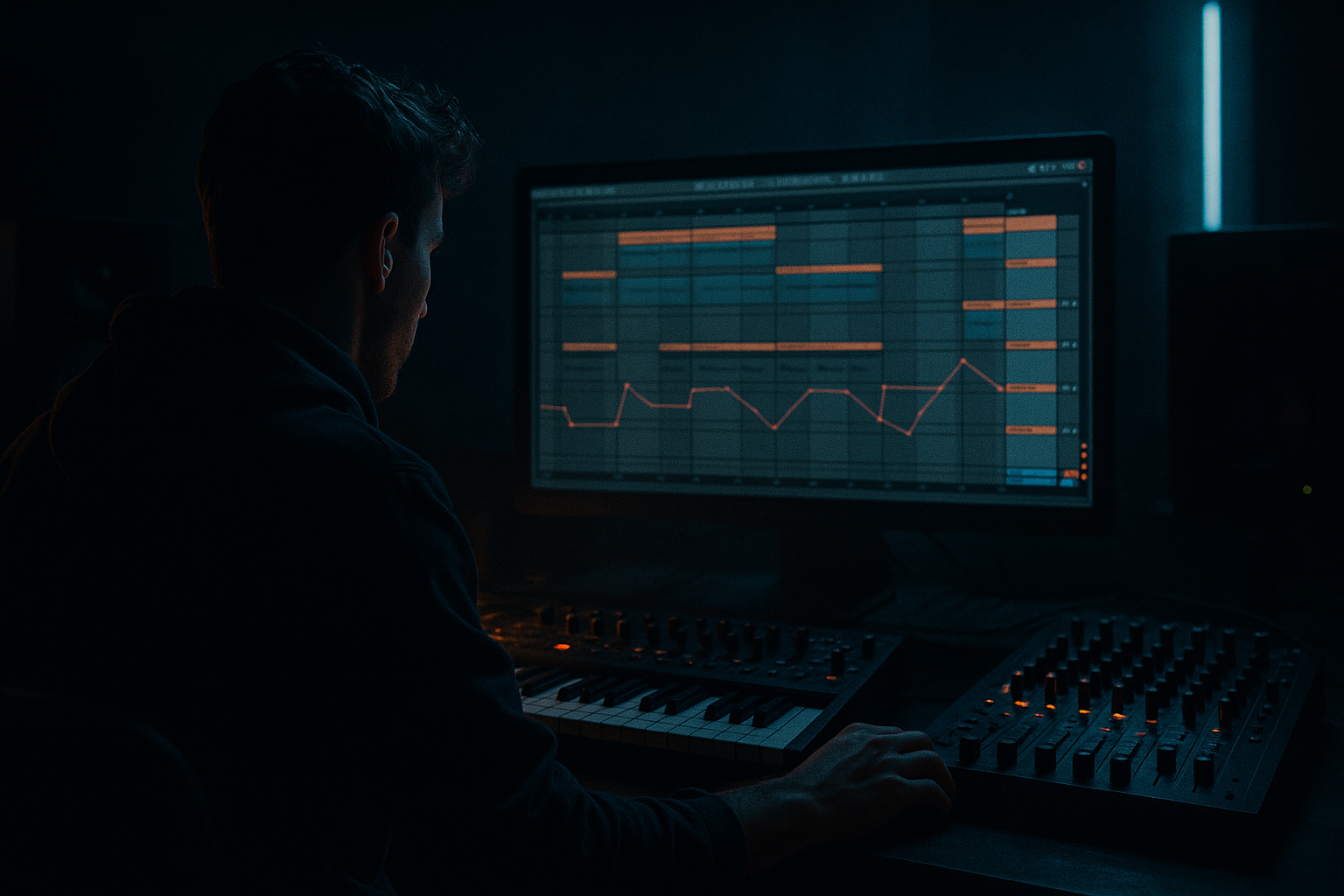
In this lesson, you’ll build a ragga ride ghost framework for heavyweight sub impact in Ableton Live 12 — a tight FX-driven method for making your drop feel like it has more bounce, swing, pressure, and physical low-end impact without just turning the bass up louder.
This technique sits right between the drum groove and the bass arrangement. In DnB, especially jungle, rollers, ragga-infused steppers, darker halftime sections, and neuro-adjacent pressure tunes, the most memorable drops often don’t rely on constant bass notes. Instead, they use:
- Ride patterns to create motion and urgency
- Ghost hits to imply a groove that the listener feels more than hears
- FX movement to shape the energy before each bass accent
- Sub impact moments that land harder because the groove around them is alive
- ride + ghost percussion tension
- sub impact emphasis
- bass call-and-response phrasing
- transition FX that reinforce, not distract from, the groove
- A ragga-style ride pulse with swing and offbeat pressure
- Ghost percussion hits that imply a rolling shuffle underneath the main drums
- A sub bass pattern that lands with more weight because it’s framed by motion
- A bass FX layer using saturation, filtered noise, and automated movement
- A drum/bass call-and-response loop that can expand into a full drop section
- A DJ-friendly arrangement block with tension build, impact point, and clean transition logic
- Kick/snare anchors stay clean and punchy
- Ride ghosts keep the top end in motion
- Low-end hits are spaced for maximum impact
- FX tails and filters make each bar feel like it’s breathing
- ragga jungle-inspired rollers
- dark steppers
- half-step bass sections inside a 174 track
- neuro-influenced DnB drops that still need groove
- break-heavy tunes where the bass must stay readable
- Making the ride too loud
- Overloading the ghost notes
- Letting FX wash into the sub range
- Using a sub that is too harmonically busy
- No contrast between sections
- Ignoring mono compatibility
- Use Drum Buss on the drum/ghost group very lightly to add density, but stop before it turns crispy and flattened.
- Layer a very low-level noise or vinyl texture under the ride group, then high-pass it aggressively so it adds atmosphere without clutter.
- If the bass needs more menace, duplicate the sub MIDI and create a very quiet distorted mid layer with Saturator or Overdrive, then high-pass it around 150–250 Hz.
- For neuro-leaning weight, automate a subtle band-pass sweep on a mid-bass layer while leaving the sub stable. The motion makes the bottom feel bigger.
- Use Return tracks for tiny fills: a short reverb throw on the last ghost hit before a section change can create serious tension without crowding the mix.
- Resample your groove once it feels good. Chopping the audio often gives you more control over DnB swing than MIDI alone.
- Keep the sub and kick relationship clean. If the kick needs more room, carve a little around the kick’s fundamental with EQ Eight, but don’t hollow the bass out.
- For a nastier underground edge, automate Saturator drive only on specific bass accents instead of the whole loop. That gives you selective aggression.
- Reference a strong rollers or ragga jungle track and compare the density of motion, not just the bass tone.
- Keep the ride rhythmic and controlled
- Use ghost notes to create unseen groove pressure
- Let the sub stay simple, centered, and timed hard
- Use FX as framing, not decoration
- Arrange the loop so the groove evolves every few bars
The goal here is not to clutter the track. It’s to build a ghost framework around the sub so every heavy note feels like it punches through a moving field of rhythm. That’s why this matters in DnB: when the drums are busy, your sub needs a clear rhythmic identity, and the FX must support the drop rather than smear it.
You’ll use Ableton stock devices to create a practical system for:
If your drops feel flat, too static, or too “just looped,” this is the fix. 🔥
What You Will Build
By the end, you’ll have a 2-bar DnB drop framework that includes:
Musically, think of it like this:
This is especially strong for:
Step-by-Step Walkthrough
1. Set up a clean 2-bar drop grid and choose the right source material
Start with a new Ableton Live 12 session at 174 BPM. Build a basic 2-bar loop before adding complexity. Put down a clean kick and snare foundation first, because the ghost framework only works if the main impact points are clear.
On one MIDI track, load Drum Rack or Simpler with a ride cymbal sample. Pick a ride that has a sharp but not brittle attack — think classic DnB top-end with enough body to cut through. If you have a full break, choose a section with relatively open cymbal content.
For the sub, use a separate MIDI track with Operator or Wavetable. Keep it simple: a clean sine-based patch or near-sine tone. The sub’s role here is impact, not texture.
For the FX layer, create an audio track and prepare to resample later. This keeps the workflow fast and lets you commit to a sound instead of endlessly tweaking.
Why this works in DnB: strong low-end impact depends on separation. If the ride and ghost motion are designed first, the sub can hit like a weapon instead of competing with the groove.
2. Program the ragga ride pulse with offbeat momentum
Put your ride on offbeats and use a slightly irregular repeating pattern. A classic starting point is hits on the “&” of each beat, then add extra notes before snare hits for extra lift.
In the MIDI clip, try:
- Bars 1–2: ride hits on the offbeats
- Add a short extra hit just before each snare in bar 2
- Vary velocity so not every hit is identical
Suggested parameter ranges:
- Velocity: 70–110 depending on how forward you want it
- Clip Groove: start with Swing 54–58% if the loop feels too square
- Note length: keep rides short, around 1/16 to 1/8, so they don’t wash over the snare
Add Auto Filter after the ride sample if it needs shaping. Try:
- High-pass around 250–500 Hz
- Resonance low, around 0.2–0.5
- Slight envelope or manual automation to brighten the ride in fills
This gives you that ragga-inflected ride motion without making the top end harsh. The ride becomes part of the groove, not just a cymbal layer.
3. Build ghost notes under the ride using muted percussion
Now create a second MIDI track for ghost percussion. Use a short conga, rim, woodblock, or chopped break hit inside Drum Rack. These should sit low in the mix and feel almost like “phantom” groove markers.
Place ghost hits:
- Just before the snare
- Between kick and sub accents
- On weak sixteenth subdivisions
- Occasionally mirroring the ride but lower in volume
Good starting settings:
- Velocity: 20–55
- Pan subtle variations if stereo source is available, but keep core hits centered
- Add a Utility device and keep bass-related ghost layers in mono if they contain low-mid energy
Then group your ride and ghost percussion into a Drum Group and add light bus processing:
- Drum Buss: Drive 5–15%, Crunch low to moderate
- Glue Compressor: Ratio 2:1, Attack 10–30 ms, Release Auto or 0.3–0.6 s
- Optional EQ Eight: high-pass the group if needed to keep low-end clean
The ghost notes are the framework. They create the illusion that the drop is constantly accelerating, even when the sub is holding back.
4. Design the sub pattern so every note lands into a pocket
Open your sub instrument and keep it pure. If using Operator, start with a sine wave, shorten the amp envelope slightly, and avoid unnecessary complexity. If using Wavetable, strip it back to a single clean oscillator or very mild harmonic support.
Program the bassline so it interacts with the ride/ghost groove instead of fighting it. A great DnB sub pattern often works as:
- sustained note into the snare
- short pickup note into the next bar
- silence where the groove needs room
- occasional octave or note change for call-and-response
Suggested approach:
- Bar 1: one long note + one short accent
- Bar 2: a slightly different rhythm, maybe with a syncopated pickup
- Leave at least one clear gap in the 2-bar loop for the drums to breathe
Keep the sub centered with Utility:
- Width: 0%
- Use Bass Mono style discipline conceptually, even though Utility is your practical stock tool
- Level-adjust so the sub peaks do not overpower the kick
Add Saturator after the synth very gently if the sub disappears on small speakers:
- Drive: 1–4 dB
- Soft Clip: On
- Output lowered to match level
This helps the bass translate without turning it into audible fuzz. In DnB, the sub’s perceived impact often comes from timing and harmonic visibility, not sheer volume.
5. Shape the call-and-response between bass and ghost framework
This is where the lesson becomes more than a loop. Your bass should answer the ride/ghost rhythm instead of sitting on top of it.
Use these principles:
- When ghost percussion gets busier, keep the sub simpler
- When the sub hits harder, thin out the ride density
- Let the snare remain the “truth” in the middle of the groove
A practical musical example:
- In a dark rollers drop, the first bar can have a held sub note under sparse ghost taps
- The second bar can add a short bass stab after the snare, responding to the ride pattern
- Every 4 or 8 bars, introduce a tiny fill so the loop feels arranged rather than repeated
Use automation:
- Automate Auto Filter cutoff on the bass for tension
- Automate Reverb send on ghost hits very subtly for fill moments only
- Automate a 1–2 dB rise in bass saturation before a drop variation
The point is to create a rhythmic conversation. In DnB, this makes the drop feel alive because the listener can hear forward motion even during repeated patterns.
6. Add FX that reinforce the groove instead of masking it
Now build your FX return tracks. Keep them selective and rhythmic.
Create two return tracks:
- Return A: Reverb
- Return B: Delay
On the reverb return, use Reverb or Hybrid Reverb:
- Decay: 0.8–1.8 s for tighter darkness
- Pre-delay: 10–25 ms
- High-pass the return around 300–600 Hz
- Low-pass if needed around 7–10 kHz
On the delay return, use Echo:
- Time: 1/8, 1/8D, or 1/16 depending on movement
- Feedback: 10–30%
- Filter to keep lows out
- Slight modulation only if you want a psychedelic edge
Send only the ghost percussion and selected ride accents into these returns. Avoid drenching the sub. For the sub impact moments, use short pitch or filter automation rather than a big reverb tail.
Add a Resampling audio track and record a few bars of your ride/ghost/FX blend. Then chop the resampled audio with Simpler or Slice to New MIDI Track if you want a more broken, jungle-leaning feel.
Why this works in DnB: FX should create anticipation and motion around the groove, not smear the low end. Tight, filtered ambience gives the drop size without sacrificing punch.
7. Automate impact moments for heavier sub perception
The heaviest sub hits often feel heavy because the build-up around them changes. Use automation to create contrast.
Good automation moves:
- Auto Filter on the ride group: close down slightly before the sub hits, then open on impact
- Saturator on the bass bus: automate Drive up by 1–3 dB for a pre-drop accent
- Utility gain on ghost FX sends: mute or reduce them for the exact moment the sub lands
- Echo freeze-style feel not literally freeze, but a short increase in feedback or send amount for a fill
A strong trick in Ableton Live 12:
- Put an EQ Eight on the Drum Group and automate a gentle dip around 3–5 kHz during the sub impact if the top end is distracting
- Bring it back immediately after the hit
Also try a very short pitch drop or filter sweep on the bass note leading into the drop. Even a subtle movement can make the next sub hit feel larger.
In dark DnB, impact is contrast. If the framework ducks away for a split second, the sub feels like it arrives with more force.
8. Arrange the framework into a proper drop section
Don’t leave this as a loop. Arrange it into a usable drop structure.
Try this 16-bar concept:
- Bars 1–4: sparse introduction of the ride/ghost framework
- Bars 5–8: sub enters with simple call-and-response
- Bars 9–12: add extra ghost layers, one FX rise, and a more active bass rhythm
- Bars 13–16: strip back one element and then return with a heavier variation
Use arrangement logic that works in real DnB sets:
- DJ-friendly intro/outro with drums only or filtered top layers
- Drop 1 establishes the groove
- Switch-up before the 2nd half of the drop
- Tiny fill or break edit at bar 8 or 16 to avoid sameness
If you’re making a rollers tune, keep the arrangement subtle and hypnotic. If you’re making a ragga jungle-inspired section, use more chopped percussion and more obvious ghost movement. Either way, the framework should support the bass weight, not compete with it.
Common Mistakes
- Fix: lower it and use EQ/velocity shaping. The ride should drive motion, not dominate the mix.
- Fix: keep ghost hits sparse and low velocity. If every subdivision is filled, the groove loses tension.
- Fix: high-pass returns and keep reverb/delay off the low end. Clean low frequencies are non-negotiable in DnB.
- Fix: simplify the oscillator, shorten the envelope, and only add gentle saturation if translation is poor.
- Fix: automate filter, send amounts, or note density so the drop evolves every 4 or 8 bars.
- Fix: keep the bass and sub centered. Check with Utility and avoid widening anything that carries low-end importance.
Pro Tips for Darker / Heavier DnB
Mini Practice Exercise
Spend 10–20 minutes building a two-bar drop loop using this framework:
1. Create a kick/snare skeleton at 174 BPM.
2. Add a ride pattern on the offbeats.
3. Add 3–5 ghost percussion hits with low velocity.
4. Program a sub line with only 2–4 notes across the loop.
5. Add Auto Filter to the ride and automate one small brightness change.
6. Add Saturator to the sub and set Soft Clip on.
7. Create a reverb return and send only the ghost notes into it lightly.
8. Duplicate the loop once and make one variation:
- either change one ghost hit
- or change one bass note
- or mute the ride for the first half of bar 2
Goal: make the second loop feel like it has more tension and impact even though it uses almost the same material.
If you want a stricter challenge, print the loop to audio and rearrange it using only clip edits and automation, no new notes.
Recap
The core idea is simple: ride motion + ghost percussion + selective FX = heavier sub impact.
Remember these essentials:
If the listener feels the bass more because the space around it is moving, you’ve nailed the technique. That’s the ragga ride ghost framework — built for heavyweight DnB impact in Ableton Live 12.

