Main tutorial
1. Lesson Overview
"Ratty blueprint: drive a snarling acid-bass line in Ableton Live 12 for sharp drum and bass edge" is an advanced, hands‑on lesson that walks you through designing and processing a classic snarling acid-style D&B bassline using only Ableton Live 12 stock devices. You'll build a two-layer bass (sub + snarling top) that combines a monophonic synth with aggressive resonance, filter modulation, and distortion chains, then glue it into a Drum & Bass mix with dynamics and sidechain control. The goal is a hard, cutting acid lead-bass that sits tight with fast D&B drums (think 170–176 BPM) and keeps the sub clean.
2. What You Will Build
- A two-track bass system:
- A Bass Bus with EQ, Multiband control and sidechain compression to the kick/snare.
- Clip-level modulation and macro controls so you can automate filter snarl and drive for energy transitions.
- Set project BPM to 174 (typical Ratty/D&B tempo).
- Create three audio return tracks for FX if needed (Delay, Reverb, Post Drive), but keep the bass mostly dry/stereo-tight for D&B punch.
- Use Automation/Macros: Map Macro knobs to Filter Cutoff, Saturator Drive, and Corpus Wet for quick performance tweaks and automation across arrangement.
- Keep sub mono, keep top centered with slight stereo spread if desired. Use high-pass on delays/reverbs to avoid smearing low end.
- Driving saturation before cleaning the sub: Distorting the full-range bass without high-pass filtering first will muddy the low end. Always HP the top layer and keep the sub mono and clean.
- Resonance overkill: Resonance values too high cause uncontrolled ringing and audible feedback that eats headroom. If you hear whistling or pitch-like artifacts, reduce resonance or automate it.
- Stereo widening the sub: Applying stereo widening to low frequencies kills mono compatibility and power on club systems. Keep below ~150 Hz mono (Utility width 0%).
- Too much release or slow envelopes: Long releases blur fast D&B rhythms — keep envelope times short to medium and use glue compression instead of long tails.
- Not separating the tonal roles: Trying to make one patch do both sub and snarl often fails. The two-layer approach keeps the sub clean and the top aggressive.
- Overdoing sidechain: If sidechain is too aggressive, the bass will pump unnaturally or lose perceived weight. Aim for musical ducking.
- Macro mapping is your performance friend: Map cutoff + filter envelope amount + Saturator Drive to one Macro for instant “open up” energy.
- Resample and print variations: Once you have a killer phrase, resample it and chop/reverse/warp to create fills and rideable variations without recreating modulation complexity.
- Use clip‑envelopes for micro motion: Clip automation for Filter Cutoff/Wavetable Position is CPU-light and easy to automate across many clips.
- Use Corpus creatively: A small corpus tube resonator can emulate the 303's body. Tweak frequency to emphasize the "snarling" partial.
- Parallel distortion: Duplicate the top track, overload the duplicate heavily with Saturator/Overdrive, low-pass it around 3–5 kHz and blend to taste — you get harmonics without ruining clarity.
- Dynamic EQ is your friend for loud systems: If a resonant peak is sometimes prominent, automate or use EQ Eight to reduce that narrow band in sections where it clashes.
- Limit the sub separately: Put a limiter or clipper on the sub track to avoid plugin overload and to preserve headroom for the top layer.
- Sub layer: clean, mono sine/sub from Operator with glide and tight envelope.
- Top snarling acid layer: monophonic Wavetable (or Analog if you prefer) with resonant filter, envelope/LFO modulation and an analog-style drive/distortion chain (Saturator → Overdrive/Pedal → Corpus/Erosion).
3. Step-by-Step Walkthrough
NOTE: The exact topic—"Ratty blueprint: drive a snarling acid-bass line in Ableton Live 12 for sharp drum and bass edge"—is what we build. Follow the steps exactly and tweak to taste.
A. Session prep
B. Sub layer (Operator)
1. Create a new MIDI track, load Operator.
2. Oscillator setup:
- Osc A: Sine, coarse tune to root (C2 or whatever key), level = -6 dB.
- Turn off Osc B/C/D (or keep very low for some partial if desired).
3. Voice/Mono/Glide:
- In the global section set Voices = 1 (mono), Portamento = 10–40 ms (experiment), Legato = ON.
4. Amp envelope:
- Attack 0 ms, Decay 150–250 ms, Sustain 0–0.2, Release 40–80 ms.
- This keeps sub tight but not clicky.
5. Processing chain on same track:
- EQ Eight: High-pass at 8–12 Hz to remove rumble; gentle low-shelf cut around 40 Hz if necessary.
- Saturator: Drive 2–4 dB, Curve = Soft Sine or Analog Clip (very subtle) — just to add harmonic alignment with top layer.
- Utility: Width = 0% (mono) — keep sub mono.
6. Level: -3 to -6 dB relative to the top layer so sub anchors but doesn’t overload.
C. Top snarling acid layer (Wavetable)
1. New MIDI track, load Wavetable.
2. Oscillator selection:
- Oscillator 1: choose a bright wavetable (Saw/Classic or a 'squelchy' table). Set Unison voices = 1–2 (we don’t want too wide).
- Oscillator 2: optionally enable for ring-mod or detune if you want more harmonic complexity; keep level moderate.
3. Filter:
- Use Wavetable internal filter: type = Ladder or State (12/24 dB) — choose the one that gives the fattest resonance in your pre-listen.
- Cutoff: start 400–900 Hz depending on the timbre.
- Resonance: 45–70% — this is the “snarl” driver. Raise until it’s prominent but not wildly self-oscillating.
4. Filter envelope:
- Envelope amount (filter env) = +60 to +120% depending on filter type.
- Attack 0–10 ms; Decay 150–350 ms; Sustain 0–10%; Release 50–120 ms.
- This gives that characteristic acid snap when a note is played.
5. Mono/Portamento:
- Set Voices = 1 (Mono), Portamento = 30–80 ms (to taste), Legato = ON — use legato slide between notes for 303-style slides.
6. Modulation:
- Assign LFO 1 (sync) to Wavetable Position or Oscillator WT Position with a small depth (5–15%) at rates like 1/16 or 1/8 to add micro movement.
- Assign an additional slow envelope or LFO to Filter Cutoff for rhythmic motion — consider mapping Macro 1 to filter cutoff + envelope amount for hands-on control.
7. MIDI clip:
- Program a bassline in a MIDI clip: use short to medium notes (e.g., 1/16 to 1/8 notes with occasional legato slides). Classic Ratty lines use staccato punctuations and occasional slides on transitions — aim for notes that emphasize syncopation against the drums.
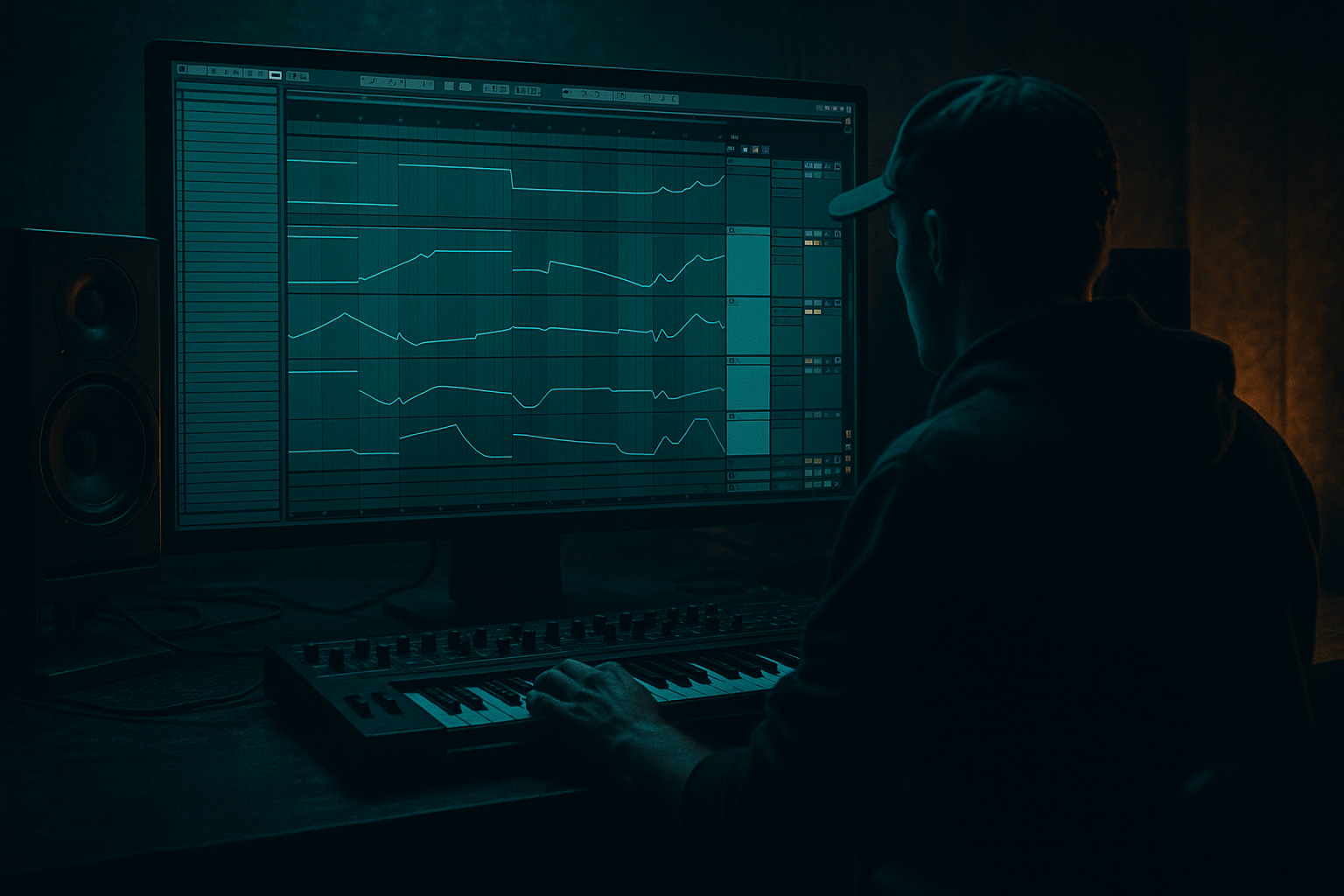
- Use clip automation (envelope) to automate Wavetable Filter Cutoff or WT Position for phrase variation. Try an automated cutoff climb over a 2-bar phrase.
8. Processing chain (order matters):
- EQ Eight (High-pass at 30–40 Hz to avoid colliding with sub; slight boost 200–800 Hz if you want presence).
- Saturator (Analog Clip): Drive = 4–8 dB, Dry/Wet = 60–80% — this is your main harmonic drive.
- Overdrive or Pedal: Type = Tube/Dist; Drive = 2–5 (taste); Tone dial towards brighter if need be.
- Corpus: Mode = Tube/Plate (or Metal), Frequency around the midrange resonant area (300–1000 Hz) to add resonant body — mix low (Dry/Wet 10–25%).
- Erosion (Noise = Off, Type = Downsample or Tiny S&H for subtle grit) — Amount 10–30% at low Wet to avoid harshness.
- EQ Eight: notch out any honky resonant spike (narrow Q) that fights the mix (use spectrum view).
- Utility: Width = 0–20% (keep majority centered but add slight stereo for the top if you want width).
9. Optional creative:
- Add Frequency Shifter (subtle) or Filter Delay on a return path for stereo ambience but keep returns low.
D. Bass Bus (group)
1. Route both Sub and Top to a Bass Group.
2. On the Bass Group:
- EQ Eight: Cleanly cut below 30–40 Hz, slight boost around 60–120 Hz if needed for weight, attenuate muddy 200–400 Hz if cluttered.
- Multiband Dynamics: Glue low band (below ~150 Hz) with gentle compression (Ratio 2:1–4:1, Attack 1–5 ms, Release 50–150 ms) to tighten sub.
- Glue Compressor (post): Fast attack ~1–3 ms, Release ~80–150 ms, Ratio 2:1–4:1, makeup to taste. Small gain reduction (~2–4 dB) to glue layers.
- Sidechain Compression: Use a Compressor with sidechain input set to a buss or the drum group (kick + snare). Threshold so that about 2–6 dB of gain reduction occurs on kicks/snare hits; Attack fast, Release set musically to recover before next hit. This creates the pump needed in D&B.
- Optional: Redux on a duplicate return for extra 1-bit grit on transitions.
E. Final mix positioning
4. Common Mistakes
5. Pro Tips
6. Mini Practice Exercise
Goal: In 45 minutes build a mix-ready acid D&B bassline using this blueprint.
Checklist:
1. Create two MIDI tracks (Operator + Wavetable). Set project to 174 BPM.
2. Program a 2-bar bassline in the Wavetable clip with at least two legato slides and one staccato pattern. Use portamento/legato.
3. Set Wavetable filter/resonance and envelope as described:
- Cutoff ~600 Hz, Resonance ~55%, Filter Env amount +80%.
4. Build the drive chain: EQ HP @ 35 Hz → Saturator Drive 6 dB → Overdrive Drive 3 → Corpus Wet 15% → Erosion Amount 15%.
5. Make Operator sub: mono, glide 20–40 ms, short decay, Utility width 0%.
6. Route both to Bass Group. On the group:
- Glue Compressor: small gain reduction 2–4 dB.
- Compressor sidechained to a kick/snare bus with 4–6 dB reduction on hits.
7. Final check:
- Solo bass group: sub mono, no clipping.
- With drums: switch sidechain on/off and note the groove improvement.
8. Export a 16-bar loop (or bounce resampled top) and A/B with a reference D&B track for tonal balance.
7. Recap
This lesson gave you the "Ratty blueprint: drive a snarling acid-bass line in Ableton Live 12 for sharp drum and bass edge." You built a two-layer bass: a clean, mono Operator sub plus a snarling, resonant Wavetable top with tight filter-envelope modulation and a stock-device distortion chain (Saturator → Overdrive/Pedal → Corpus → Erosion). You routed both into a Bass Bus with EQ, multiband dynamics and sidechain compression for punch and clarity. Important takeaways: separate sub and top responsibilities, use mono sub, control resonance and distortion order, and map macros/clip envelopes for expressive control. Apply these steps and parameters as a starting point and refine by ear to match your mix and creative intent.

