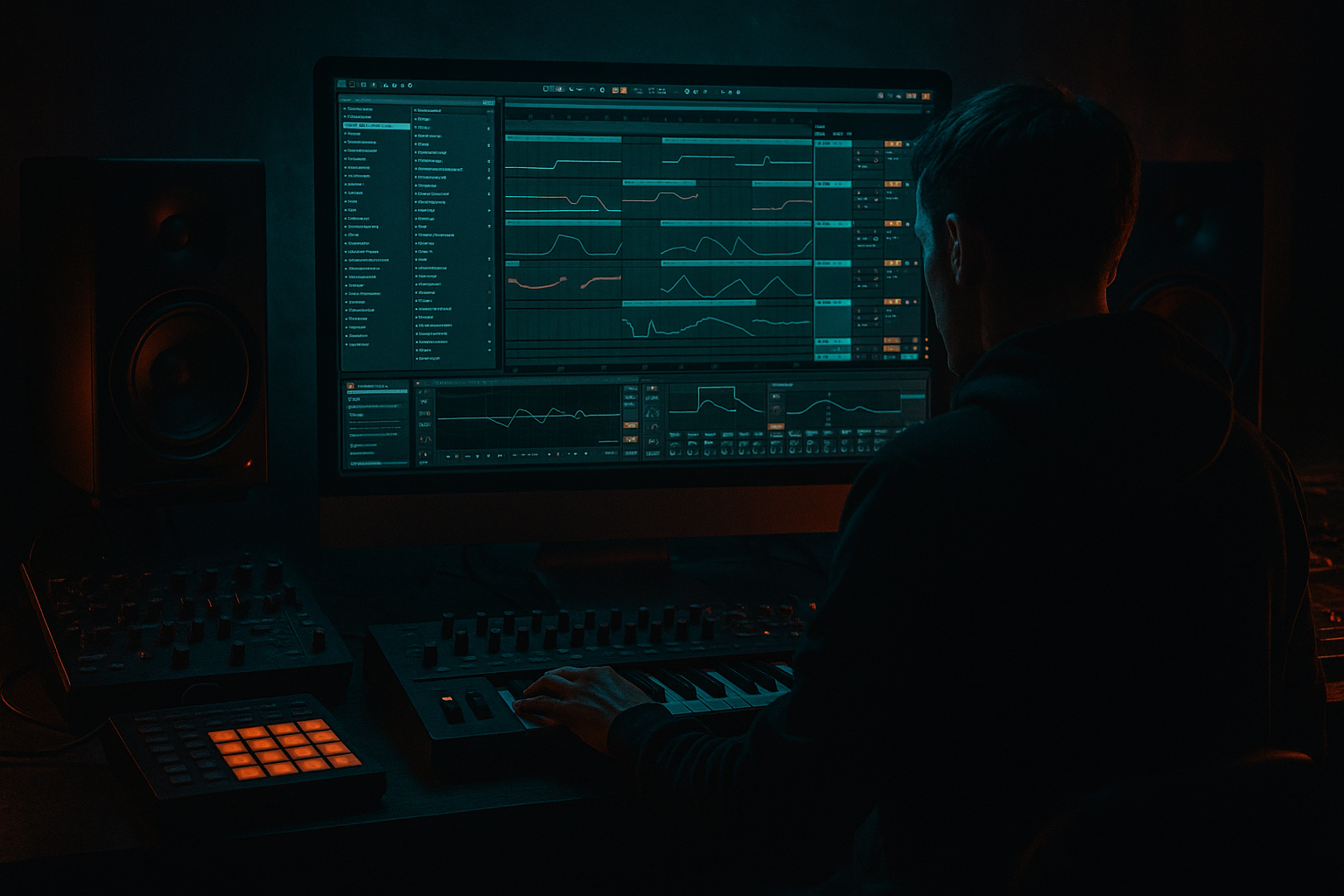
Main tutorial
Lesson Overview
This lesson is about building a rave-pressure amen variation in Ableton Live 12 that carries jungle swing and oldskool DnB character without losing modern track discipline. The core idea is simple: take a loopable amen phrase, then reshape it into a DJ-useful, movement-heavy variation that feels like it belongs in a real drop, not just a breakbeat sample pack demo.
This technique lives right in the engine room of a jungle/DnB track: between the main drum loop, the bass response, and the arrangement moments where you need the energy to lift without adding a whole new drum kit. In oldskool jungle and darker DnB, a great amen variation does three jobs at once:
- it keeps the groove human and unstable in a good way,
- it creates contrast against a rigid bassline or sub,
- and it gives the arrangement a sense of lift, tension, or “rave pressure” before the next phrase lands.
- oldskool jungle / modern jungle
- rollers with break edits
- dark, rave-leaning DnB
- intro-to-drop transition sections
- second-drop switch-ups where the drums need extra personality
- a strong kick/snare spine
- ghost-note movement and break texture
- subtle pitch or slice variation for tension
- controlled saturation and filtering
- enough punch to survive next to a bassline
- a mix-ready character that can sit in a drop, intro, or switch-up
- rude, dusty, and energetic
- slightly raw, but not messy
- punchy in the transients
- wide in the top texture if needed, but mono-safe in the important low-mid anchor
- oldskool in flavour, but not floppy or overcooked
- Keep the sub and the amen emotionally separate. The bass should own the physical low end; the break should own the motion and attitude. That separation makes the mix feel bigger, not smaller.
- Use controlled decay rather than endless reverb. If you want menace, a short, dark room shape on a texture layer often works better than a long wash. Long tails can blur the groove and steal punch.
- Print a “dirty” version and a “clean” version. One pass can be more rugged and filtered for transitions; another can be more direct and punchy for the main drop. This gives you arrangement flexibility without rebuilding the edit.
- Resample your best 2-bar phrase once it works. Then treat the audio like a performance recording. Chopping your own printed break often reveals new fills and accents that felt too small in MIDI.
- Use low-mid pressure carefully. A small lift around the break’s body zone can add weight, but too much in the 200–400 Hz region turns power into fog. In heavier DnB, fog is the enemy of threat.
- Let one element stay ugly. If the bass is very polished, keep the amen slightly raw. If the drums are tight and engineered, let the break texture be the unstable part. Contrast is part of the underground character.
- Check the phrase against the 16-bar DJ logic. A variation that sounds great for 4 bars but has no place in a 16-bar section is not finished. The best jungle edits still respect mixability and phrase structure.
- Use only one amen source.
- Use only stock Ableton devices.
- Make exactly one clear variation in bar 2.
- Keep the break high-passed enough that the sub can breathe.
- Check the result once with a bassline or sub placeholder.
- strong snare anchors
- at least one ghost-note movement
- one transition detail into bar 2
- a simple processing chain using stock devices
- one version printed or bounced to audio
- Does the snare still feel dominant?
- Can you hear the swing without the groove falling apart?
- Does the break stay readable when the bass is playing?
- If you mute the bass, does the break still feel like a finished jungle phrase?
Musically, this matters because straight looped breaks get stale fast. Technically, it matters because the amen is loaded with transient information, room tone, and midrange chaos; if you don’t shape it, it will fight the kick, mask the snare, or smear your low end. By the end, you should be able to hear a break that feels edited, swung, and intentional: it should bounce with jungle feel, hit hard enough for the club, and sit cleanly around your bassline instead of flooding the whole mix.
This best suits:
A successful result should sound like the amen is riding the groove with pressure and attitude, not just looping in the background. You want movement, grit, and a clear rhythmic identity that still leaves room for the sub.
What You Will Build
You will build a two-bar amen variation that feels like a proper jungle phrase: chopped, swung, slightly rearranged, and processed just enough to sound finished. It should have:
The sonic character should be:
Rhythmically, it should feel like the break is leaning forward against the grid with a bit of swing and human offset. The role in the track is to provide forward motion and scene change—the kind of drum phrase that makes the drop feel like it’s evolving, not repeating.
If it works, the listener should feel that classic jungle tension: the drums sound restless, the bass has something to push against, and the section feels ready for the MC, the rewinds, or the next switch-up.
Step-by-Step Walkthrough
1. Start with one strong amen source and commit to a tight loop
Drop an amen break into an audio track and trim a 2-bar loop that includes at least one solid snare and one useful ghost-note area. If the source is longer, don’t try to use all of it yet. First, identify the phrase that already has the best contrast between kick, snare, and hat detail.
In Ableton Live 12, open the sample in the Clip View and make sure Warp is on only if you need timing correction. For an oldskool feel, avoid over-warping the micro-timing unless the source is drifting badly. If the break already has character, preserve it.
What to listen for: a loop that has a strong snare character and enough room-tone texture between hits. If the break sounds thin or too polished, it will not generate enough jungle pressure later, even after processing.
Keep the loop at a manageable level. Aim to leave headroom; the break should not already be hitting your channel meter too hard.
2. Slice the break into playable pieces
Right-click the clip and use Slice to New MIDI Track if you want to perform the variation from MIDI, or manually cut the audio if you prefer direct editing. For this lesson, the MIDI slice route is the fastest way to make a true variation because it lets you rearrange hits like a drummer.
Choose a slicing mode that keeps the transient attack clear. After slicing, you should have separate pieces for:
- main snare
- kick/stomp portions
- ghost hits
- hat/noise tails
- the occasional room/drag detail
Build a simple 2-bar MIDI pattern first. Put the main snare anchors in place before anything else. The temptation is to fill every gap, but in DnB the negative space is part of the groove.
A good starting concept:
- bar 1: strong snare on 2 and 4, with a ghost or drag before 4
- bar 2: similar anchor, but one extra pickup or reversed slice before the next downbeat
This gives you a phrase that still feels like amen culture, but with enough edit identity to become your own loop.
3. Choose your swing direction: A versus B
Now decide whether this variation should lean more toward shuffle or push.
A — Loose jungle swing:
Nudge a few offbeat ghost slices slightly late, or use Ableton’s Groove Pool with a mild swing feel. This makes the break feel more human, more ragged, and more rooted in early jungle. Use this if the track needs warmth, shuffle, and “raver in the warehouse” movement.
B — Tighter rave pressure:
Keep the main hits more grid-locked, and only offset a handful of ghosts or fills. This gives a harder, more modern pressure where the break feels like it’s being driven by the bass and kick rather than dissolving into swing.
A practical range: try tiny manual nudges of about 5–20 ms on ghost hits, not on your core snare anchors. If you shift the main snare too much, the phrase can lose its spine fast.
What to listen for: the groove should feel like it is breathing, not falling over. If the snare stops feeling authoritative, back off the offsets.
4. Shape the drum hierarchy before adding effects
In a jungle break, not every slice deserves the same weight. The snare is usually the king, the kick is the engine, and the ghosts are the glue. Use clip gain or a simple Utility and Auto Filter approach to establish hierarchy before processing.
Suggested starting balances:
- main snare slices: full level
- kick slices: slightly below snare if they are too boxy
- ghost notes: around -6 to -12 dB lower than the main hits
- noisy hat tails: controlled, not dominant
If a ghost note is adding vibe, keep it. If it’s just cluttering the snare hit, reduce it or remove it.
Put the loop in context with your kick and sub now, even if the bassline is just a placeholder. This is where many people get fooled: the break sounds great solo, then destroys the drop because the low-mid energy is too wide or the transient balance is wrong.
5. Build the first processing chain: punch, grit, and control
A reliable stock chain for amen variation work is:
Drum Bus or Group track chain
- EQ Eight
- Drum Buss
- Saturator
- optional Glue Compressor very lightly
Start with EQ Eight to remove unusable lows. A common starting move is a high-pass somewhere around 80–120 Hz on the break layer, depending on how much kick body is already in the sample. Don’t blindly carve too high if the break is carrying useful low-mid weight, but keep the sub region clear for your bass.
Use Drum Buss for controlled punch. Useful starting points:
- Drive: modest, around 5–20%
- Crunch: light to moderate if you want grit
- Transients: positive for more snap, but don’t overdo it or the break gets spiky
- Boom: usually cautious here for jungle; too much will fight the bass
Then use Saturator for harmonic density. A small amount of drive can make the amen feel louder without being obviously compressed. Keep an eye on the output so you are not just fooling yourself with level.
If the break feels flat after this chain, the issue is often not lack of saturation; it’s that the edit itself is too static. Don’t solve an arrangement problem with more distortion.
6. Add swing and micro-shape with groove or manual timing
If you chose the looser jungle route, apply a subtle groove from Ableton’s Groove Pool, or nudge select slices by hand. Keep the groove concentrated on:
- ghost notes
- pick-up hats
- tiny drag hits before snare
- fill slices into bar transitions
Do not swing the main anchor hits so much that the phrase feels drunk. The best jungle swing usually comes from a contrast between stable core hits and slippery surrounding motion.
A useful workflow tip: once the core groove feels right, commit the MIDI or bounce the edited break to audio. This makes it easier to print the exact feel and stop endlessly adjusting tiny offsets.
Stop here if the break already locks with the bass and the snare feels strong. If it is doing the job, print it and move forward. Over-editing is one of the fastest ways to kill oldskool momentum.
7. Create variation with one deliberate change in the second bar
The second bar should not just repeat the first bar. Give it one clear difference so the listener feels progression. Good options:
- a reversed slice into the bar line
- a missing ghost hit for a moment of space
- a double-time hat flick
- a short snare drag into the next phrase
- a tiny pitch-down on one hit for dirtier pressure
Keep this as a single obvious move, not five tiny ones. In DnB, one strong edit often reads better on a system than a cluttered mess of micro-events.
Arrangement example: use bar 1 as the main statement, bar 2 as the “answer,” then repeat with a slight twist on the second 2-bar pass. That gives you a 4-bar phrase that can loop convincingly but still feel alive.
8. Automate filtering and texture for phrase energy
For rave pressure, automation is where the break starts to behave like an arrangement element instead of a static loop. Use Auto Filter on the break group or a duplicate texture layer.
Practical moves:
- open the filter slightly into the phrase for more brightness and urgency
- close it a little before a drop to create tension
- use a modest resonance if you want a more ravely top-end whistle, but don’t let it get piercing
- automate a small high-frequency lift on the final bar before a switch-up
A useful range:
- low-pass movement from roughly 8–12 kHz down to 5–8 kHz for tension moments
- high-pass tension sweeps only on texture layers, not the main break body
If you want a darker vibe, automate less brightness and more midrange density instead. Oldskool pressure often comes from the feeling that the room is tightening, not just the treble rising.
9. Check the break in context with bass and drums
Now bring in the bassline, even if it is rough. This is the reality check. The amen variation should sit against the bass like a conversation:
- if the bass is sub-heavy, the break needs cleaner low end
- if the bass is reese-heavy, the break may need more mid punch and less low-mid blur
- if the kick is distinct, the break can be slightly more ghosty
- if the kick is weak, the break must carry more of the rhythmic authority
Listen specifically for two things:
- Does the snare still hit through the bass?
- Does the low-mid area stay readable, or does the break become a wash?
If the bass is masking the break, cut a small pocket in the break around the bass’s strongest body region rather than just turning the break down. A gentle EQ dip around 180–350 Hz can often clear the fog, but use it only if that range is genuinely cluttered.
This is the moment where the variation becomes a track component, not a sample exercise.
10. Finish with a second layer or resample for impact
If you want the amen to feel more “rave-pressure,” duplicate the break and make a second layer with a different role:
- one layer for body and core groove
- one layer for texture, crackle, or impact
A clean stock-device chain for the texture layer:
- Auto Filter
- Redux or light Saturator
- Utility to keep level controlled
- optional Reverb with very short decay on a tiny send-like amount, if you want room smear without washing the hit
Keep the texture layer lower in the mix. Its job is not to replace the main break; it is to create the sense that the drums are louder, dirtier, and more energetic than they really are.
If the result starts sounding expensive in a bad way—too glossy, too processed, too clean—strip it back. Rave-pressure works best when the break still feels like it came from a sampler culture, not a sterile loop pack.
Common Mistakes
1. Making every slice equally loud
- Why it hurts: the break loses its natural hierarchy, so the snare stops feeling like the main statement.
- Fix in Ableton: use clip gain or Utility to keep ghost notes lower than anchors, then re-check in the full mix.
2. Over-swinging the main snare hits
- Why it hurts: the groove starts to collapse and the phrase stops feeling like a firm dancefloor cue.
- Fix in Ableton: leave the snare anchors close to grid; swing only ghosts, pickups, and fills.
3. Leaving too much low end in the amen
- Why it hurts: it fights the sub and muddies the kick/bass relationship.
- Fix in Ableton: high-pass the break group around 80–120 Hz as a starting point, then adjust by ear in context.
4. Distorting before the edit is right
- Why it hurts: saturation exaggerates a weak or messy arrangement and makes the loop harder to fix later.
- Fix in Ableton: get the slice pattern and drum hierarchy working first, then add Drum Buss or Saturator.
5. Using a loop with no phrase variation
- Why it hurts: the track feels like a copy-paste, especially after 8 or 16 bars.
- Fix in Ableton: add a one-bar change, a reversed slice, or a fill on the second pass.
6. Too much top-end brightness
- Why it hurts: oldskool jungle character turns harsh and fatiguing, especially on club systems.
- Fix in Ableton: tame with EQ Eight or Auto Filter; keep the top lively but not brittle.
7. Not checking mono compatibility
- Why it hurts: width tricks or layered ambience can erase impact in club playback.
- Fix in Ableton: use Utility to check mono on the break layer, and keep core snare/kick energy centered.
Pro Tips for Darker / Heavier DnB
Mini Practice Exercise
Goal: Build one 2-bar rave-pressure amen variation that swings like jungle and still leaves space for a sub.
Time box: 15 minutes.
Constraints:
Deliverable:
A looped 2-bar amen phrase with:
Quick self-check:
Recap
A strong rave-pressure amen variation is not just a chopped loop. It is a rhythmic performance: anchors first, ghosts second, variation third. Keep the snare authoritative, swing only what needs to breathe, and process the break just enough to add grit and density without destroying the groove. In a real DnB track, the win is when the amen feels alive, the bass stays clear, and the section has enough pressure to carry a crowd from one phrase to the next.

