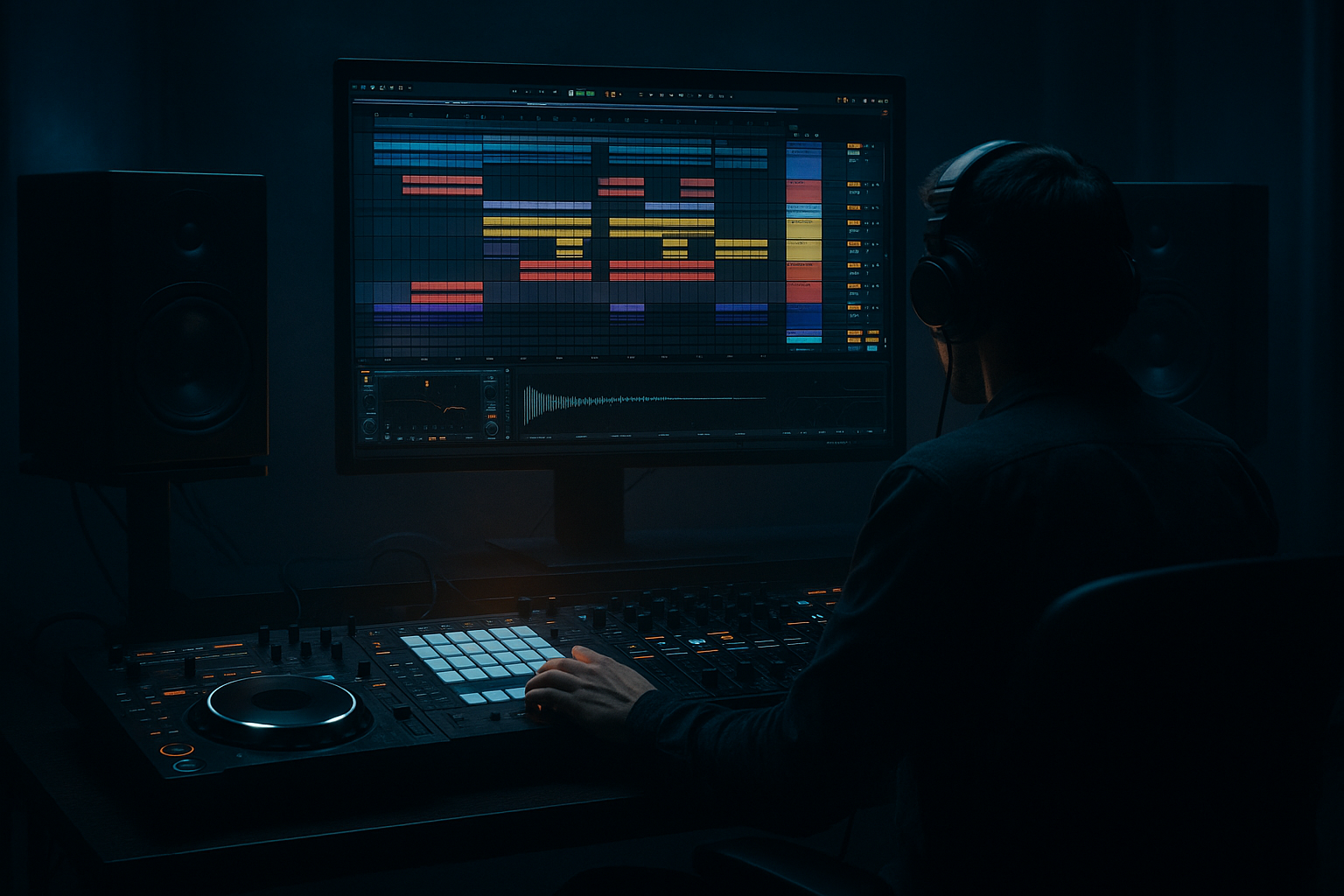
Main tutorial
Rave Stab Space Control Masterclass (Arrangement View) — Drum & Bass Mixing in Ableton Live 🎛️
1) Lesson overview
Rave stabs are supposed to feel big, nostalgic, and in-your-face — but in modern rolling DnB they can easily swallow your drums, smear your bass, and blur your groove. This masterclass is about space control using Arrangement View: precise automation, scene-by-scene contrast, and intentional depth (front/back), so your stab hits hard without wrecking the mix. ⚡
You’ll focus on:
- Depth design (early/late reflections, pre-delay, stereo width)
- Transient vs tail management (keep the punch, tame the wash)
- Mid/side and frequency zoning (stabs don’t own the sub or the snare crack)
- Arrangement automation that “mixes” your stab as the track evolves
- Dry stab track (punch + tone)
- Dedicated reverb return (controlled tail, tempo-shaped)
- Dedicated delay return (sync bounce, automated throws)
- Stab Group / Bus with glue + dynamic EQ + M/S management
- Arrangement automations for:
- Markers/Locators: `Intro (16) → Build (16) → Drop 1 (32) → Break (16) → Drop 2 (32) → Outro`
- Group your key elements:
- Kick+snare peak around -6 dBFS on the Drum Group (before master)
- Stab group peaking around -10 to -8 dBFS in the drop (it’s not the lead vocal—don’t crown it)
- Voices: 1 (mono playback keeps it solid)
- Filter: LP12 or LP24
- Amp Env:
- Layer A: warmer body (low-mid)
- Layer B: brighter click/edge (high-mid)
- High-pass: 150–250 Hz (12 or 24 dB/oct)
- Notch / dip around 170–220 Hz if it “box fights” the bass harmonics
- Dip around 2–4 kHz if it eats snare crack or hats presence
- Optional gentle shelf down: 8–12 kHz if it’s fizzy with reverb
- Raise Reverb Send (A) on stab: e.g. -6 to -3 dB
- Raise Delay Send (B) slightly: e.g. -12 to -8 dB
- Automate EQ Eight low-pass on the dry stab:
- Automate Hybrid Reverb Decay slightly longer in intro:
- Hard reduce Reverb Send (this is the money move):
- Keep a small room if needed, but no wash.
- Shorten reverb decay and/or increase sidechain depth on Return A
- Optional: automate Utility Width on stab group:
- Automate Delay Send (B) up just for the last stab hit(s)
- Immediately after the throw, automate a low-pass on Echo (or increase HP) to keep the delay from masking the next bar’s drums.
- Increase reverb send and width again
- Automate pre-delay up slightly (20 → 35 ms) so it stays punchy even when wet
- Consider automating Saturator drive down in the break so it feels less forward
- Automation ramp: open filter + increase send → then snap dry on the drop.
- Increase side brightness (M/S EQ) slightly
- Bring delay throws more aggressively
- Keep reverb short but louder early reflections (Hybrid Reverb can do this vibe) for “big room” without tail.
- Low band (up to ~250 Hz): compress harder (or just remove with EQ)
- Mid band: gentle
- High band: minimal
- Putting big reverb directly on the stab insert and then fighting it forever. Use Returns.
- No pre-delay → the reverb eats the transient and the stab becomes a pad.
- Reverb with low end (below ~250 Hz) → instant mud with rolling bass.
- Too wide in the low-mids → drums lose punch, mono compatibility suffers.
- Same space all track long → the ear gets tired; your drop won’t feel like a drop.
- Delay throws with no filtering → they mask the next snare and kill momentum.
- Make the stab mean without volume: use Saturator (Soft Clip) + a small notch around 300–500 Hz to remove “honky rave”.
- Use “short space” instead of “long space” in the drop: early reflections / short decay reads as big in a dense mix.
- Automate distortion into fills only: add a Roar (stock) or Saturator just on phrase ends to hype transitions, then return clean.
- M/S discipline: keep the core of the stab (mid) controlled; let “air + delay” live in the sides.
- Snare owns 200 Hz + 2–4 kHz moments: if your stab fights there, your groove loses authority.
- Make space with subtraction first: EQ before you add more reverb. Dark DnB loves less tail than you think.
- Space control is arrangement control: automate sends, decay, width, and tone across sections.
- Use Returns for reverb/delay so the stab stays punchy and the tail stays mixable.
- Pre-delay + filtering + snare-ducked reverb = rave stab bigness without DnB mud.
- In the drop: shorter, drier, tighter. In transitions: wider, wetter, expressive.
- Treat the stab like a featured supporting actor: hype the vibe, never steal the groove. 🥁
---
2) What you will build
A rave stab bus that behaves like a pro-mixed element across a full DnB arrangement:
- Intro haze → drop clarity
- Drop 1 tight → Drop 2 wider/meaner
- Fills with delay throws that don’t mask drums
The end result: a stab that feels huge in the intro, tight in the drop, and explosive in transitions — classic rave energy, modern DnB control. 🔥
---
3) Step-by-step walkthrough
Step 0 — Session prep (the boring part that makes it work)
Tempo: 172–176 BPM
Project structure in Arrangement View:
- `DRUMS (Group)`
- `BASS (Group)`
- `MUSIC (Group)` → put the stab in here
- `FX (Group)`
Gain staging target (rough):
---
Step 1 — Build the stab source for “punch then space”
You can use Simpler, Sampler, or an audio stab. The key is separating attack identity from reverb identity.
If using Simpler (Classic mode):
- Attack: 0–5 ms
- Decay: 250–600 ms
- Sustain: 0
- Release: 80–200 ms
This makes the stab stab, not pad. 🎯
Optional “DnB bite” layer:
Duplicate the stab track:
Then group them as STAB (Group).
---
Step 2 — Frequency zoning: make room for bass + snare immediately
On each stab layer (or on the stab group), start with EQ Eight:
EQ Eight (basic DnB-safe zones):
- If your bass is huge, go higher (up to ~300 Hz)
Important: Don’t blindly carve—loop the drop and A/B with drums+bass playing.
---
Step 3 — Make “space” with Returns, not inserts (control = sends)
Instead of slapping reverb on the stab channel, build two Returns so you can automate sends in Arrangement View.
#### Return A — Reverb (controlled, tempo-aware) 🌫️
Device chain on Return A:
1. EQ Eight
- HP at 250–400 Hz
- Optional dip at 2–3 kHz (reduces harsh bloom)
2. Hybrid Reverb (or Reverb if you prefer classic)
- Mode: Algorithmic (clean) or Hybrid blend (taste)
- Decay: 1.2–2.4 s (intro can be longer)
- Pre-delay: 15–35 ms (lets the dry stab punch first)
- Size: medium-large
- Low Cut / High Cut: keep lows out, tame top
3. Compressor (sidechain from snare, optional but powerful)
- Sidechain Input: Snare (or Drum Bus)
- Ratio: 2:1 to 4:1
- Attack: 3–10 ms
- Release: 80–180 ms (time it to groove)
- Aim for 2–5 dB GR when snare hits
This makes the reverb breathe around the drums. 🤝
#### Return B — Delay (sync throws) 🛰️
Device chain on Return B:
1. Echo
- Time: 1/8 or 1/4 dotted (DnB loves dotted movement)
- Feedback: 20–45%
- Filter: HP ~ 300 Hz, LP ~ 6–10 kHz
- Mod: low (avoid warble unless intentional)
2. Utility
- Width: 120–160% (widen delay, keep dry more centered)
3. Limiter (safety for feedback moments)
- Ceiling: -1 dB, just catching spikes
---
Step 4 — Stab Bus “Space Control” chain (glue + dynamics + M/S)
On the STAB Group, build this chain:
1. Utility
- Bass Mono: On, set around 120–200 Hz
Keeps low-mid from going wide and muddy.
2. Saturator (subtle)
- Mode: Soft Clip On
- Drive: 1–4 dB
- Output: compensate
Adds density so you can use less reverb for perceived size.
3. Glue Compressor (light control, not pumping)
- Attack: 10 ms
- Release: Auto or 0.3 s
- Ratio: 2:1
- GR: 1–2 dB on peaks
4. EQ Eight (M/S shaping)
- Set to M/S mode
- Mid channel: keep 1–4 kHz controlled so it doesn’t dominate the snare/vocal space
- Side channel: gently lift 4–8 kHz if you want width without volume
This is where you get “wide” without “loud”.
---
Step 5 — Arrangement View automation: the real masterclass 🎚️
This is where advanced mixing happens: space changes over time.
#### A) Intro: big rave atmosphere, but filtered
In the Intro (first 16 bars):
- Start at 1.2–2.5 kHz, open to 6–10 kHz approaching build
- e.g. 2.2 s → 1.4 s by the drop
#### B) Drop 1: tighten the tail, keep the punch
At the drop downbeat:
- e.g. -inf → -14 dB (or at least drop it by 8–12 dB)
- Drop 1: 90–110%
- Wider feels exciting, but too wide eats drum clarity.
#### C) 8-bar phrase endings: controlled delay throws
At the end of every 8 or 16 bars:
- e.g. jump from -inf → -6 dB for 1/2 bar, then back down
Pro move: duplicate the stab clip and remove the throw-hit from the dry (or reduce its dry volume) while letting the delay carry the energy—cleaner impact.
#### D) Break / breakdown: go wide and deep, then reset
In the break:
Then on the build into Drop 2:
#### E) Drop 2: heavier + wider (but controlled)
For Drop 2 contrast:
---
Step 6 — Make it drum-safe: dynamic ducking that doesn’t scream “sidechain”
Two effective options:
#### Option 1: Sidechain the reverb return from snare
Already covered. This is usually the cleanest.
#### Option 2: Multiband Dynamics on the stab group (careful)
Use Multiband Dynamics subtly to stop low-mid bloom:
But don’t overdo it—multiband can flatten the rave character fast.
---
4) Common mistakes
---
5) Pro tips for darker/heavier DnB 🖤
---
6) Mini practice exercise (20 minutes) ⏱️
1. Pick a rave stab sample and write a 2-bar riff that repeats through Drop 1 (32 bars).
2. Create Return A (Hybrid Reverb) and Return B (Echo) exactly as above.
3. In Arrangement View, add automation:
- Intro: Reverb Send high, filter closed
- Drop: Reverb Send down, width reduced slightly
- Every 8 bars: 1/2 bar delay throw with filtered Echo
4. Bounce a 16-bar drop loop and do two versions:
- Version 1: constant reverb send
- Version 2: automated “tight drop / wet transitions”
5. Compare on headphones + monitors: which one keeps the drums clearer while still feeling rave? Adjust pre-delay + sidechain on Return A until it’s obvious.
---
7) Recap
If you want, tell me your stab vibe (classic Hoover-rave, piano stab, or dark chord stab) and whether your bass is jump-up wobble or rolling reese, and I’ll suggest exact automation shapes for your arrangement.

