Main tutorial
Rebuild an edit with an automation-first workflow in Ableton Live 12 for jungle / oldskool DnB vibes 🚀
1. Lesson overview
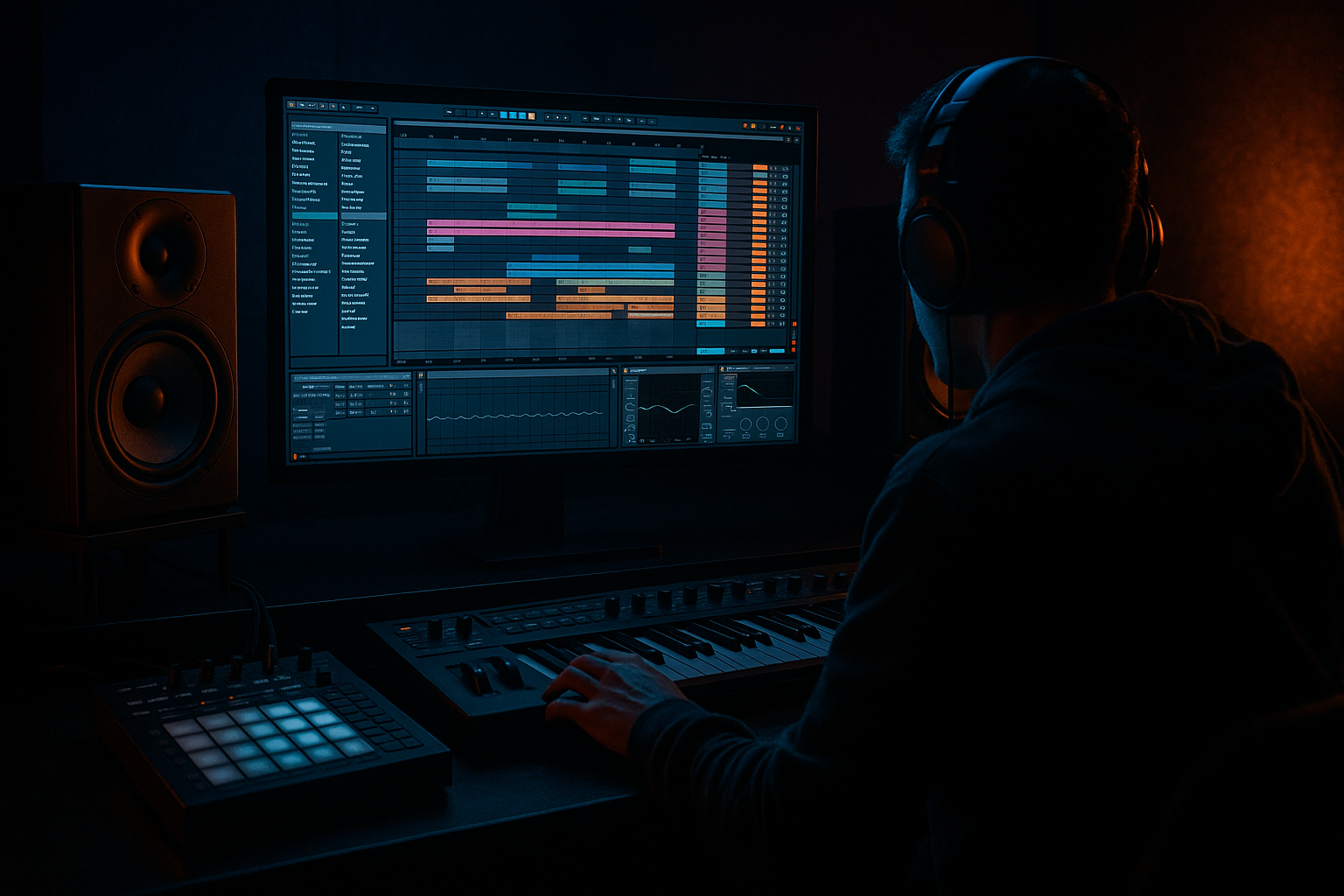
In this lesson, you’ll learn how to rebuild a simple edit in Ableton Live 12 using automation first, instead of starting with lots of new clips and sounds.
That means:
- you create the arrangement shape first
- then use automation to build tension
- then add riser, FX, filter sweeps, delay throws, and drum mutes
- then finish the edit so it feels like a proper jungle / oldskool DnB transition
- beginner producers
- anyone making breakbeat-heavy DnB
- people who want more movement and energy in their edits without overcomplicating the project
- building an edit section from a loop
- using automation lanes
- creating a riser from stock Ableton devices
- making the transition feel musical and heavy
- shaping tension for a drop back into drums + sub
- 4 bars of groove
- into 2 bars of tension
- into a short break / riser moment
- then back into full drums and bass
- classic jungle energy
- oldskool DnB swing
- rolling bass pressure
- chopped break transitions
- rough, energetic, and functional for the dancefloor
- drum break loop or chopped break
- sub bass
- mid bass or reese
- noise riser
- snare fill
- impact / crash
- optional vocal hit or dub siren-style accent
- Auto Filter
- EQ Eight
- Utility
- Operator or Wavetable
- Simpler
- Drum Buss
- Reverb
- Delay
- Saturator
- Compressor
- Glue Compressor
- Audio Effect Rack
- LFO (if you have Max for Live)
- Shaper or Envelope Follower if available
- an audio breakbeat loop
- or a chopped break in Simpler
- kick/snare break pattern
- ghost notes
- shuffled hats if possible
- Bars 1–4: groove
- Bars 5–6: tension starts
- Bars 7–8: full transition / riser / fill
- then drop back in
- Groove
- Build
- Edit / Riser
- Drop
- Filter type: Low-pass
- Frequency: start around 18–20 kHz or just fully open
- Resonance: low to moderate, around 0.20–0.35
- Drive: a little if the break feels too soft
- start the filter open
- slowly close it to around 200–800 Hz
- then open it slightly right before the drop
- volume
- or Utility gain
- or a filter cutoff
- Bars 1–4: bass full
- Bars 5–6: slightly reduce bass level by 1–3 dB
- Bars 7–8: automate a stronger dip or short mute before the drop
- set to low-pass
- automate cutoff down during the build
- open it hard on the drop
- avoid wild stereo effects
- keep it mono with Utility
- don’t overdo the riser under the sub region
- Use a noise oscillator
- Pitch irrelevant if pure noise, but you can still automate filter movement
- Add Auto Filter after Operator
- Add Reverb after Auto Filter
- Automate Auto Filter cutoff upward over 2 bars
- Increase Reverb Dry/Wet slightly during the rise
- Add Saturator Drive for more aggression in the last half bar
- Reverb Dry/Wet: start around 10–15%, rise to 25–35%
- Saturator Drive: 2–6 dB
- Filter resonance: moderate, not squeaky
- Put the snare on a MIDI track or audio track
- Duplicate it in shorter note values:
- Reverb Dry/Wet: automate up before the drop
- Compressor threshold: slightly lower for more urgency
- Volume: raise the snare build gradually
- Bars 5–6: snare hits on beats 2 and 4
- Bar 7: add 8th notes
- Bar 8: add 16th notes or a short roll
- snare hit before the drop
- vocal stab
- rim shot
- break chop
- Time: 1/4 or 1/8 dotted
- Feedback: 20–40%
- Dry/Wet: automate from 0% to 15–30%
- Filter the delay so it doesn’t muddy the low end
- mute the bass for 1/4 beat or 1 beat
- cut the drums for a split second
- leave only the riser tail or reverb wash
- crash
- sub hit
- reverse cymbal
- short noise burst
- High-pass around 30–40 Hz if needed
- reduce boxiness around 250–400 Hz
- keep upper presence if you want a sharp hit
- Filter cutoff
- Track volume
- Reverb dry/wet
- Delay dry/wet
- Utility width
- Saturator drive
- Bars 1–2: stable groove
- Bars 3–4: begin filtering and volume shaping
- Bars 5–6: add riser and snare build
- Bars 7–8: highest tension, then a short mute
- Drop: full drums, full bass, clean impact
- clashing tails
- too much reverb in the drop
- bass frequencies building up under the riser
- overlapping snare fills that blur the groove
- cut reverb tails where needed
- use fades on audio clips
- place Utility on FX tracks and automate gain down after the transition
- use EQ Eight to high-pass risers at around 150–300 Hz
- Drum Group
- Bass Group
- FX Group
- Drum Buss
- Glue Compressor
- Saturator
- EQ Eight
- Utility for mono control
- Reverb
- Auto Filter
- Compressor if the FX spike too hard
- Saturator on the riser
- Redux for a rough digital edge
- Auto Filter with resonance slightly pushed
- automate pitch upward a little
- automate filter cutoff upward
- add a short delay throw at the end
- Width: 0% on sub
- leave higher FX wider if you want depth
- Bars 1–4: full break + bass loop
- Bars 5–6: start low-pass filtering drums
- Bars 6–7: add a snare roll
- Bar 7: bring in a noise riser
- Last half bar of 8: cut bass and drums for a tiny gap
- Next bar: full drop with crash + bass return
- Drum track: Auto Filter
- Bass track: Utility and/or EQ Eight
- FX track: Operator, Reverb, Saturator
- Snare roll: Simpler or audio clip with Delay
- tension rises
- frequencies thin out slightly
- then the drop punches hard and clean
- start with a solid loop and shape the transition first
- automate filters, volume, reverb, and delay
- build risers using stock Ableton devices
- use snare rolls, impact hits, and short silence for drama
- protect the low end so the drop still hits hard
- a Live 12 session template
- a bar-by-bar automation map
- or a specific jungle riser chain with exact device settings
This workflow is ideal for:
In jungle and oldskool DnB, the transition is often more important than the individual sound. A well-placed riser, filter move, snare roll, or pitch automation can make a basic loop feel like a full arrangement. 🔥
What you’ll practice
---
2. What you will build
You will build a short 8-bar edit / transition that goes from:
Style target
Think:
Sound palette
Use:
Ableton stock devices you may use
---
3. Step-by-step walkthrough
Step 1: Load a basic jungle/DnB loop and keep it simple
Start with a project around 170–175 BPM.
For oldskool jungle, 172 BPM is a great sweet spot.
Build your core loop
Create 3 main tracks:
1. Drums
2. Bass
3. FX / Riser
For the drums, use either:
Good starting pattern
Keep a loop that already has movement:
If you’re using an audio break, don’t over-edit it yet. The lesson is about automation-first, so keep the groove intact and focus on transition energy.
---
Step 2: Decide where the edit happens
Choose an 8-bar section where you want energy to rise.
A common DnB arrangement shape:
Mark the arrangement
In Arrangement View, place locators:
This keeps your workflow clear and helps you think like an arranger, not just a loop maker.
---
Step 3: Create your automation-first framework
Before adding lots of new audio clips, automate the existing sounds.
Start with these 4 automation moves:
1. Low-pass filter on the drums or bass
2. Bass volume fade or mute
3. Reverb increase on snare/fill hit
4. Noise riser level increase
The goal is to make the edit feel like it’s opening up before the drop.
---
Step 4: Automate a filter sweep on the drum break
Put Auto Filter on your drum break track.
Suggested settings
Automation idea
Over bars 5 to 8:
This creates that classic “sucking in” tension.
#### DnB tip
If your break is already bright and busy, automate the filter only on the top end and leave the low mids strong. Jungle usually benefits from retaining punch while the highs get swept away.
---
Step 5: Automate the bass so the edit breathes
This is huge in jungle and oldskool DnB: bass space creates impact.
Simple method
On the bass track, automate:
Suggested move
If using Auto Filter on bass:
Keep the sub tidy
If you have a dedicated sub:
---
Step 6: Build a riser with stock Ableton devices
Now let’s create a practical riser using Ableton stock tools.
Option A: Noise riser with Operator
Create a MIDI track with Operator.
Settings
Chain
Operator → Auto Filter → Reverb → Saturator
#### Automation
Suggested values
This works well for a dirty jungle build because the riser becomes more unstable and intense, not just “pretty.”
---
Step 7: Make a snare build with reverb automation
Oldskool DnB loves a snare ramp.
How to do it
Use a snare sample in Simpler or Drum Rack.
Simple setup
- 1 bar: spaced hits
- last 2 bars: more frequent hits
- last half bar: fast roll
Add these devices
Saturator → Compressor → Reverb
Automation targets
Practical idea
If the roll gets too messy, keep it simple. Jungle tension often works best when the snare is clear and repetitive.
---
Step 8: Use delay throws on accents
A few well-placed delay throws can make the edit feel much bigger.
Best stock device
Delay or Echo
Use it on:
Suggested settings
For a DnB-style throw:
Tip
Use automation on the send rather than leaving delay on all the time.
That gives you a sharp, intentional transition.
---
Step 9: Add impact and silence before the drop
A great edit is often made by what you remove.
Use a short gap
Right before the drop:
This creates a “hole” the drop can slam into.
Add an impact
Layer:
Processing chain for impact
EQ Eight → Saturator → Reverb
#### Suggested EQ
---
Step 10: Use automation lanes like a timeline of energy
In Ableton Live 12, treat automation like your arrangement sketch.
Focus on these lanes:
Energy plan for an 8-bar edit
This is the automation-first mindset:
You’re not just placing sounds. You’re sculpting motion.
---
Step 11: Tighten the transition with arrangement editing
Now that your automation is doing the heavy lifting, clean up the arrangement.
Check for:
Easy cleanup moves
That keeps your low end strong, which is essential in jungle and DnB.
---
Step 12: Final polish with group processing
Group your elements:
Drum Group processing
Try:
- Drive: light to moderate
- Crunch: subtle
- Boom: only if needed, and keep it controlled
- gentle glue, not heavy pumping
Bass Group processing
Try:
FX Group processing
Try:
This helps the edit feel coherent instead of like separate pieces.
---
4. Common mistakes
1. Too much riser, not enough groove
If the build is huge but the loop has no weight, the drop won’t hit.
Fix: keep the drums and bass solid. The transition should enhance the groove, not replace it.
2. Over-filtering the low end
If you sweep everything out, the transition loses power.
Fix: keep sub and low bass under control, but don’t hollow out the entire mix.
3. Using too much reverb
Too much reverb can smear breakbeats and weaken the drop.
Fix: automate reverb only where needed, and cut it back before the drop.
4. No silence before the drop
A constant wall of sound makes the transition feel flat.
Fix: leave a small gap or strip elements away briefly.
5. Weak automation curves
Linear automation can feel robotic.
Fix: use curved automation where possible, and listen for how the energy changes over time.
6. Ignoring the bass
In DnB, the bass is often the emotional anchor.
Fix: automate bass level, cutoff, or mute moments to create tension.
---
5. Pro tips for darker/heavier DnB
Tip 1: Make the riser gritty, not glossy
For darker jungle/DnB, try:
This gives a more hostile, ravey feel.
Tip 2: Use pitch and filter together
If you’re using a synth riser in Operator or Wavetable:
This creates a more dramatic lift.
Tip 3: Keep the sub mono
Use Utility:
Heavy DnB needs a stable low end.
Tip 4: Recycle your own break slices
A chopped break snare, reversed hat, or tiny amen fragment can work better than a generic white noise riser.
Tip 5: Automate distortion slightly
Very small changes in Saturator Drive or Drum Buss Drive can add tension without obvious tonal change.
Tip 6: Use a “fake drop” before the real drop
Briefly strip the drums, then slam them back in.
Oldskool jungle loves that trick. 😈
---
6. Mini practice exercise
Try this in a new 8-bar arrangement:
Build
Use these devices
Goal
Make the transition feel like:
If you can make this work on a basic loop, you’re already thinking like a DnB arranger.
---
7. Recap
Automation-first workflow is perfect for jungle and oldskool DnB because these styles rely on motion, tension, and arrangement energy.
What you learned
Key takeaway
In DnB, a great edit is not just about adding more sounds — it’s about moving the energy with precision.
If your automation is smart, even a simple breakbeat loop can turn into a proper jungle moment. 🔥
If you want, I can also turn this into:

