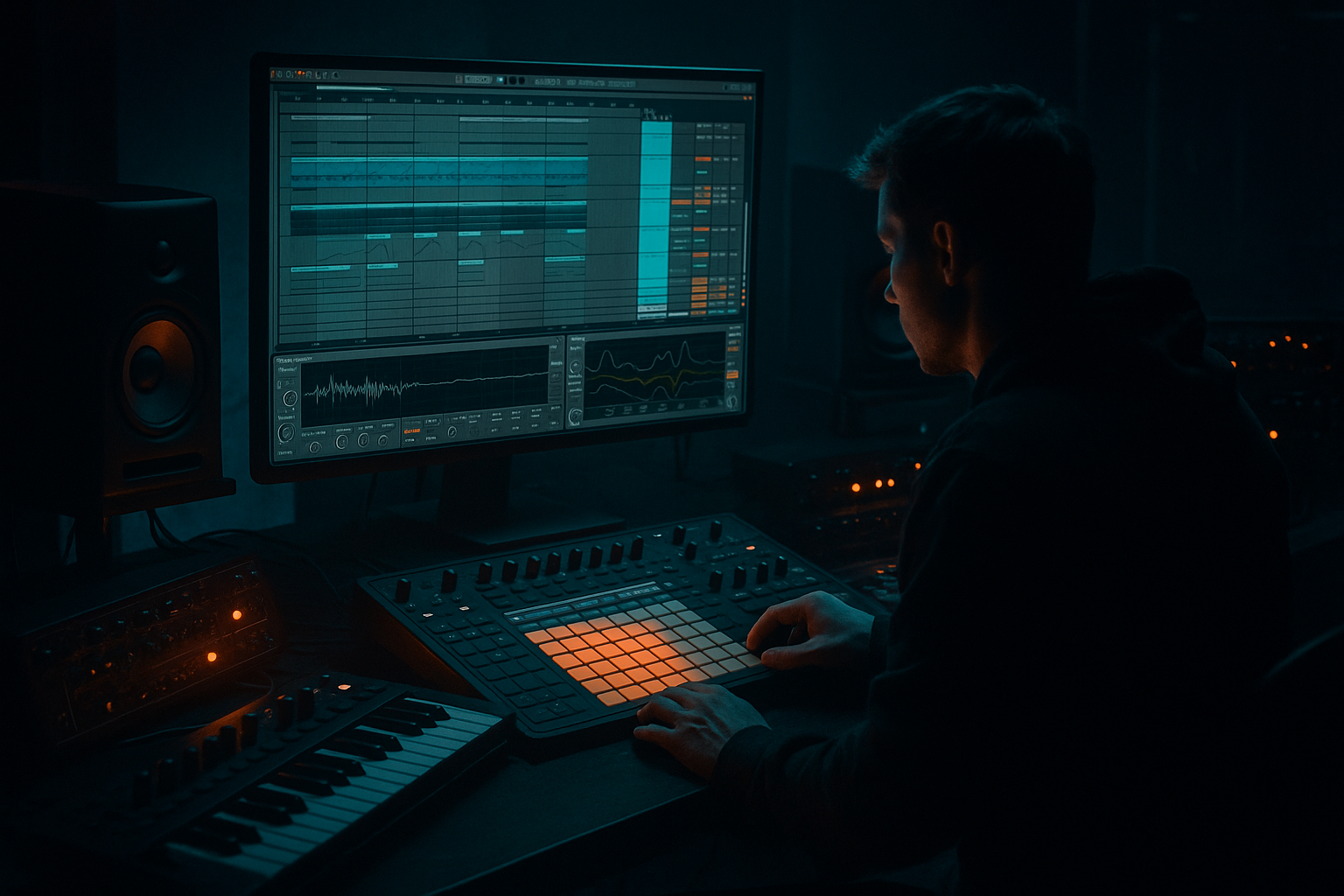
Main tutorial
Lesson Overview
In this lesson, you’ll rebuild a jungle bass wobble with chopped-vinyl character inside Ableton Live 12, using only stock tools and beginner-friendly automation moves. The aim is not to create a super-clean modern bass preset — it’s to make something that feels like it came from an old sampler, a worn record, and a dark basement sound system.
This technique sits right at the heart of oldskool jungle and early DnB: the bass has to be simple enough to leave room for breakbeats, but animated enough to keep the energy moving. That “wobble” is often less about huge synth design and more about filter movement, pitch texture, saturation, and timing. Add a chopped-vinyl feel and you get that imperfect, human, slightly unstable character that makes jungle feel alive.
Why it matters in DnB:
- The bass must lock with the drums without stepping on the kick and snare.
- Movement in the bass helps create call-and-response with the break.
- Vinyl-style chopping gives the drop a gritty, nostalgic identity that works especially well in oldskool jungle, rollers, and darker halftime-influenced DnB intros.
- a sub-solid low end
- a slightly detuned mid bass layer
- filter wobble automation
- vinyl-style chopping and pitch instability
- a dirty, sample-like texture that feels chopped from hardware or records
- a two-note or one-note riff
- with a wobble that opens and closes over time
- with sub weight in mono
- and a slightly worn, filtered, looped-sample vibe that suits oldskool DnB drops and breakdowns
- Making the wobble too wide or stereo-heavy
- Using too much filter sweep too fast
- Letting the bass overlap every drum hit
- Overdistorting the sub
- Ignoring the arrangement
- Too much high end in the wobble
- Automate filter cutoff in small moves rather than huge sweeps. Small changes feel more like vintage hardware and less like EDM movement.
- Resample your bass after automation so you can chop it like audio. This often sounds more authentic than endless MIDI tweaking.
- Duplicate the bass and process one copy for grit only: high-pass the dirty layer, distort it, and keep the sub clean underneath.
- Use slight pitch variation on select hits to mimic sampler instability and worn vinyl energy.
- Add very light chorus only to the mid layer if you want a wider reese-like texture, but never on the sub.
- Use call-and-response phrasing: one bass stab answers the snare, another answers a break fill, then leave space.
- Darker character tip: automate the filter to close slightly right before a drop hit, then open on the first bass note. That tiny tension-release move feels huge in DnB.
- If the bass feels too modern, remove polish before adding more movement. Less clean, more character usually wins in jungle.
- start with a simple bass tone
- keep the sub clean and centered
- use automation on filter cutoff, resonance, and grit
- write bass phrases that leave space for the breakbeat
- add chopped, sample-like character through resampling, short notes, and micro-timing
- arrange it in 4- and 8-bar DnB phrases so it feels like a real track
By the end, you’ll have a bassline you can place under a classic break, automate across 8 or 16 bars, and use as a building block for a full jungle arrangement.
What You Will Build
You’ll build a deep mono bass wobble with:
Musically, think of a bass pattern that sits under a classic Amen or Think break, with short note stabs and spaces between them. The bass should feel like it’s answering the drums, not constantly talking over them.
By the end, your result should sound like:
Step-by-Step Walkthrough
1. Set up a simple DnB-friendly MIDI track
Create a new MIDI track and load Wavetable or Operator. For beginners, Wavetable is easier for shaping movement, but Operator is great if you want a more direct sub-based result.
Start with a very simple patch:
- Oscillator: use a Saw or Square wave
- Turn Unison off for now
- Keep the sound mono if possible
- Lower the volume so you have headroom
If you use Wavetable:
- Set Osc 1 to a Basic Shapes wavetable
- Choose a saw or square
- Turn the filter on, but keep it mostly closed for now
If you use Operator:
- Use a single sine or saw-style source
- Keep envelope decay short enough for tight bass notes
- Don’t overcomplicate it yet
Why this works in DnB: oldskool jungle bass often starts simple. The movement comes from automation and phrasing, not from a complicated sound design chain.
2. Write a tiny bass phrase that leaves space for the break
In your MIDI clip, start with a 1-bar or 2-bar loop. Keep the notes short and repetitive. A strong beginner pattern could be:
- one root note
- one note a fifth up
- one octave variation
- lots of space between hits
Try this style:
- Hit on beat 1
- Another hit on the “and” of 2
- A final hit before bar 2 ends
Keep note lengths around 1/8 to 1/4 note at first. Jungle bass works better when it breathes around the breakbeat.
If you’re working in a classic DnB context, imagine this under:
- an Amen break
- a chopped Think break
- or a rolling two-step drum pattern with ghost hats
The bass should feel like it is dancing around the snare, not fighting it.
3. Shape the core tone with filter and amp controls
Add Auto Filter after the synth. This is the main tool for the wobble.
Suggested starting settings:
- Filter Type: Low-Pass 24
- Frequency: around 120 Hz to 300 Hz to start
- Resonance: 10% to 25%
- Drive: gently up, around 3 dB to 8 dB if it helps thicken the tone
Then shape the synth’s envelope:
- Keep attack very short
- Use a medium decay if you want a more “plucky” bass
- Set release short enough that notes don’t blur together
If the sound is too polite, add Saturator before or after the filter:
- Drive: 2 dB to 6 dB
- Soft Clip: On
This gives the bass the slightly crushed edge you’d expect from sampled or resampled jungle material.
4. Create the wobble with automation, not just LFO
Since this lesson is about automation, we’ll make the wobble feel intentional and musical.
In Ableton Live, press A to show automation lanes in Arrangement View. Automate the Auto Filter Frequency so it opens and closes over the phrase.
A simple beginner-friendly shape:
- Start more closed at the beginning of the bar
- Open up slightly on the second half of the bar
- Close again before the loop repeats
Good automation range:
- Closed section: around 120–200 Hz
- Open section: around 500 Hz–1.5 kHz depending on how bright you want it
Keep the motion rhythmic and not too extreme. You want wobble, not a synth lead.
You can also automate:
- Resonance slightly higher on the open parts
- Saturator Drive a touch more on accented notes
- Filter envelope amount if your synth supports it
If you want more classic wobble feel, try automating in a curved ramp, not hard steps. Jungle movement often sounds better when it feels a little looser and more organic.
5. Add chopped-vinyl character with Simpler or audio resampling
To get that chopped-vinyl feel, you have two beginner-friendly choices.
Option A: Use Simpler
- Drag your bass sound into Simpler
- Switch to Classic mode if needed
- Use the Filter and Volume Envelope to create sample-like motion
- Keep notes short and let each note feel like a chopped sample hit
Option B: Resample your bass
- Route the bass track to an audio track set to Resampling
- Record 4 or 8 bars of your automated bass
- Slice the recorded audio or use it as a loop
Resampling is especially effective in jungle because it makes the sound feel like a processed, bounced-down artifact, not a pristine synth patch.
Add small vinyl-style imperfections:
- Slight Pitch envelope movement if using Simpler
- Tiny Start offset changes
- Short sample chops with tiny gaps
- Very light Warp manipulation if you want micro-stutter texture
This creates that chopped record feel where the bass seems to be pulled from a worn break loop rather than generated cleanly.
6. Layer a controlled sub for weight
Keep the low end anchored with a separate sub layer. This is important in DnB because the wobble may get dirty in the mids, but the sub should stay stable.
Create a second MIDI track with Operator:
- Sine wave
- Mono
- No unison
- Very simple ADSR
Suggested settings:
- Attack: 0 ms
- Decay: short to medium
- Sustain: moderate to full depending on note length
- Release: short
Low-pass this layer if needed, but keep it clean. Then:
- Put Utility on the sub track
- Turn Bass Mono-style discipline on by keeping it centered
- Avoid stereo widening on the sub
For the bass wobble layer, high-pass it gently if it overlaps too much:
- Use EQ Eight
- Cut below roughly 60–90 Hz on the dirty layer if your sub is doing the foundation
This separation is a classic DnB workflow: dirty midbass above, steady sub below.
7. Use groove and micro-timing to make it feel oldskool
Jungle and early DnB feel alive because the bass often sits slightly differently against the drums than a rigid modern loop.
Try these beginner-safe moves:
- Nudge some bass notes slightly ahead or behind the grid
- Use Ableton’s Groove Pool with a swing groove if it helps
- Keep the kick/snare strong and let the bass “dance” around them
A useful approach:
- Keep the main bass hits tight
- Push one or two weaker notes a tiny bit late for a laid-back chop feel
- Use note velocity variation so every hit isn’t identical
If you’re using an Amen-style break, the bass can answer the snare hits with short stabs, or it can create a push-pull feeling by arriving just after the snare tail.
8. Add movement with frequency and grit automation
Once the main pattern is working, automate a few supporting parameters for extra life.
Good automation ideas:
- Auto Filter Frequency: main wobble movement
- Auto Filter Resonance: slightly up during transitions
- Saturator Drive: a little extra on the second half of a phrase
- Reverb Dry/Wet: tiny amount on fills only, then pull it back
- Delay feedback very lightly on transition notes if you want a dubby jungle edge
Keep these moves subtle. In DnB, automation should help the bass evolve across the phrase:
- closed and tense in the first half
- more open and aggressive before the drop repeats
- tighter again on the loop restart
Think in 4-bar and 8-bar phrases, not just one loop. That is how you make a beginner loop feel like a real jungle arrangement.
9. Arrange it like a DnB section, not just a loop
Put your bass in a basic arrangement:
- Bars 1–8: stripped intro with drums and filtered bass
- Bars 9–16: full wobble bass enters
- Bars 17–24: add extra automation or a slight variation
- Bars 25–32: drop the bass for a bar or use a fill
A practical arrangement example:
- Intro: only sub hint + break
- Drop: full chopped bass wobble
- Turnaround: one-bar filter close or stop
- Re-entry: bass returns wider in energy but still mono in the lows
For DJ-friendly jungle arrangement, leave room at the start and end for easy mixing. A short filtered intro and a clean outro help if you want to blend it into another DnB tune.
10. Check the mix like a bass music producer
Before calling it done, do a few fast checks:
- Put Utility on the master or bass bus and test mono
- Make sure the bass still works when collapsed to mono
- Use EQ Eight to control harsh upper mids if the wobble gets too nasal
- Leave headroom so the drums can hit hard
In darker DnB, the bass can sound huge in solo and still be wrong in context. Always check it against:
- kick
- snare
- break
- sub layer
If the bass masks the snare crack, reduce the 200–500 Hz area a little or shorten note lengths.
Common Mistakes
Fix: keep the low end mono and use width only on higher texture layers.
Fix: slow the automation down and keep the motion phrase-based, not random.
Fix: shorten MIDI notes and leave space around snares and key break accents.
Fix: split the sub and dirty bass into separate layers so the low end stays clean.
Fix: automate changes every 4 or 8 bars so the loop feels like a real jungle section.
Fix: low-pass or gently tame harsh frequencies with EQ Eight so it stays deep and underground.
Pro Tips for Darker / Heavier DnB
Mini Practice Exercise
Spend 10–20 minutes rebuilding the idea from scratch:
1. Load Wavetable or Operator on a MIDI track.
2. Write a 2-bar bass loop with only 3–5 notes.
3. Add Auto Filter and automate the cutoff across the 2 bars.
4. Add Saturator and push it only slightly until the tone feels warmer and dirtier.
5. Duplicate the bass into a clean sub layer if needed.
6. Record or resample 4 bars of the result.
7. Cut the audio into 4–8 small chops and place a few gaps.
8. Play it against a breakbeat loop and adjust note lengths until the bass and drums stop clashing.
9. Bounce a version with the filter more closed, then another with it more open.
10. Compare both and keep the one that feels more like oldskool jungle.
Goal: make two versions — one restrained, one more aggressive — so you can hear how automation changes the energy.
Recap
The key to a chopped-vinyl jungle wobble in Ableton Live 12 is:
If you remember one thing: in jungle, movement + space + texture = character. Keep it simple, automate with intention, and let the drums breathe.

