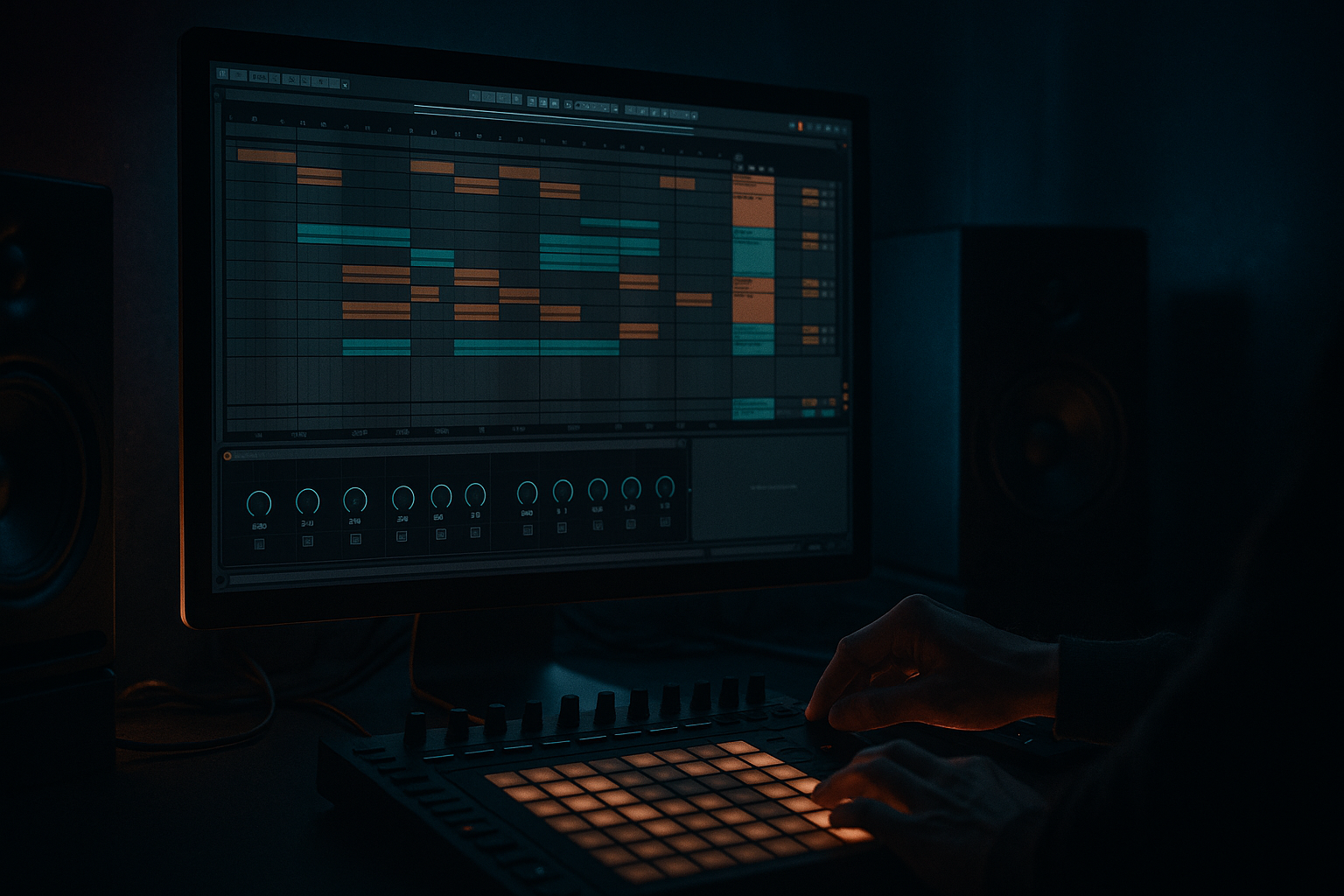
Main tutorial
Lesson Overview
This lesson is about rebuilding a warehouse-style intro for a jungle / oldskool DnB track in Ableton Live 12, with that chopped-vinyl, dusty, late-night club feel. The goal is to make an intro that sounds like it could open a DJ set: gritty, tense, atmospheric, and full of movement before the drop hits.
In Drum & Bass, the intro matters because it sets the world of the track. A good intro gives the DJ something usable, gives the listener a clear mood, and sets up the drop with tension. For oldskool jungle vibes, that usually means:
- chopped break energy
- vinyl crackle and room tone
- short FX hits and reverb throws
- filtered drums or bass teases
- dark atmosphere, not over-polished shine
- a dark warehouse room tone under the track
- chopped vinyl-style break fragments
- a filtered percussion loop with swing
- subtle reverb tails and delays
- a short bass tease or sub pulse hinting at the drop
- automation that makes the intro grow in tension over 8 or 16 bars
- Too much low-end in the intro
- Break loop sounds stiff and robotic
- Atmosphere is too bright and modern
- FX are too loud and distract from the drums
- Bass tease is too obvious too early
- Everything is wide and smeared
- Use Saturator or Drum Buss very lightly on the break and bass tease to add bite without destroying the groove.
- Automate a low-pass filter opening over 8 or 16 bars to create a proper warehouse lift.
- Keep sub elements mono with Utility so the intro still translates in clubs.
- Layer a quiet metallic hit or concrete-style impact under the last bar to make the drop feel physical.
- For a darker edge, let one chopped break hit remain slightly dirty or clipped. A tiny bit of roughness can make the whole intro feel more underground.
- If your intro needs more tension, remove drums for half a bar before the drop. That short gap makes the return hit harder.
- If you want a more neuro-leaning darker feel, add a small modulated texture using Auto Filter cutoff automation or subtle Echo movement, but keep the intro restrained and DJ-friendly.
- Use short call-and-response between chopped break hits and FX stabs so the intro feels alive, not looped.
- dark atmosphere
- chopped break character
- subtle swing and texture
- restrained FX movement
- a teased bass presence
- simple automation that builds tension
Why this technique matters: a warehouse intro creates space and identity. It helps your track feel like it belongs in a rave context, and it gives you an easy way to transition into the main drop without sounding too sudden or too empty. In DnB, that balance between DJ utility and emotional tension is everything.
We’ll use stock Ableton devices and keep it beginner-friendly, but the result will still feel authentic and useful in real production. 🎛️
What You Will Build
By the end of this lesson, you’ll have a short intro section that sounds like:
The final result should feel like the first part of a DJ-friendly DnB tune: moody, gritty, and ready to explode into a full break and bass drop.
Step-by-Step Walkthrough
1. Set up a simple intro section in Arrangement View
Start in Arrangement View and create an 8-bar or 16-bar intro region. For beginner workflow, keep it simple: one scene of atmosphere, one break loop, one FX layer, and one bass tease.
Good starting structure:
- Bars 1–4: atmosphere + vinyl noise + filtered break
- Bars 5–8: add extra chop hits and a rising FX cue
- Bars 9–16: increase tension, remove low-pass, or tease a bass note before the drop
In DnB, intros often need to work as DJ mix-in sections, so avoid overcrowding. Leave some space for the next track to blend.
2. Build a warehouse atmosphere with stock Ableton devices
Create a new audio track and load a long atmospheric sample: a field recording, room tone, crowd murmur, metal hit tail, or industrial ambience. If you don’t have one, use any dark noise-like sample and shape it.
Add these stock devices after the clip:
- EQ Eight: roll off low-end below about 150–250 Hz to keep the intro clean
- Reverb: use a decay around 3–6 seconds for space, with dry/wet around 10–25%
- Utility: reduce width slightly if the atmosphere feels too wide or disconnected
For a warehouse feel, the atmosphere should not be bright. Use a gentle high-cut with EQ Eight if needed, around 8–12 kHz. The idea is to make the room feel like a dark hall rather than a shiny ambient pad.
Why this works in DnB: the intro atmosphere gives the track a physical space, and DnB sounds stronger when the listener can feel a room around the drums and bass.
3. Create a vinyl character layer with crackle and texture
Add a second audio track for vinyl-style texture. Use a crackle sample, record a quiet room noise, or use a dusty break loop with the transients softened.
Shape it with:
- EQ Eight: cut some low rumble below 100–150 Hz
- Auto Filter: set to low-pass or band-pass and slowly automate the cutoff
- Saturator: add a small amount of drive, around 1–4 dB
- Utility: keep it low in the mix
Aim for this texture to be felt more than heard. It should suggest “old record, dark club, analog grit” without sounding like annoying hiss.
If you want extra authenticity, duplicate the texture clip and warp one copy slightly differently so the layers drift against each other. Keep the movement subtle.
4. Program a chopped break intro using drum edits
Now make the core jungle energy. Drop in a classic break or a break-style loop on an audio track. If you’re using a break sample, make sure Warp is enabled and try Beats mode so transients stay punchy.
Chop the break into small pieces by:
- slicing it into separate clips
- or using the sample editor to cut at transient points
- or duplicating short fragments on the grid
A beginner-friendly pattern:
- use 1-bar or 2-bar break fragments
- repeat a chopped snare/snare-rim/snare-tom figure
- leave gaps between hits for tension
Add these devices:
- Transient Shaper if needed to sharpen or soften the break
- Drum Buss lightly, with Drive around 5–15% and Boom very subtle
- EQ Eight to tame harsh highs if the break gets too crispy
Keep the groove human. Jungle and oldskool DnB sound better when the break feels slightly loose, not fully quantized into a sterile grid. If the chops sound stiff, try nudging some clips a tiny bit late or use groove settings.
5. Add swing and movement with Groove Pool or clip timing
Open the Groove Pool and try a swing from an old MPC-style groove or an Ableton groove preset. For beginner use, start subtle:
- Timing around 10–25%
- Random around 0–5%
- Velocity around 5–15%
Apply the groove to your break clips or percussion clips. This helps the intro feel more like a human drum edit and less like a loop pasted on the grid.
If you don’t want to use Groove Pool, you can manually shift a few ghost notes or chopped hits slightly off-grid. That tiny imperfection is a big part of chopped-vinyl character.
In DnB, swing and micro-timing give breaks their snap and bounce. Without it, oldskool jungle can lose its soul fast.
6. Create a filtered percussion layer for tension
Add a separate MIDI or audio track for a simple percussion loop: rim clicks, closed hats, small toms, or reversed hats. Keep it sparse.
Use stock devices:
- Drum Rack with one-shots if you want to sequence it
- Auto Filter to open the top end slowly
- Delay for tiny echo moments
- Compressor if the hits need to sit tighter
Try these settings:
- Auto Filter cutoff starting around 300–800 Hz and slowly rising
- Resonance low to moderate, around 5–20%
- Delay time synced to 1/8 or 1/16, with low feedback
Keep the percussion mostly in the mid and high range. The intro should suggest rhythm without stealing the attention from the main break. A good trick is to automate the filter so the percussion becomes brighter over the first 8 bars.
7. Tease the bass without giving away the drop
For a warehouse intro, you usually want a hint of bass, not the full drop bass. Use a simple sub pulse, reese fragment, or a single note tease.
Build a basic bass tease with:
- Operator for a sine or simple sub
- or Analog if you want a slightly rougher tone
- Saturator to add a touch of harmonics
- EQ Eight to keep it controlled
Keep the bass teaser short:
- one note every 2 bars
- a low pulse under the break
- or a filtered reese stab that appears only at the end of the intro
Suggested ranges:
- sub note level very low, just enough to feel it
- saturation low, around 1–3 dB
- low-pass filter cutoff around 100–300 Hz if you want it hidden until the last few bars
Use the bass tease to create anticipation. Don’t fully reveal the main bassline yet. In DnB, withholding the drop bass until the right moment makes the impact feel much bigger.
8. Use FX to transition between intro sections
Add one or two simple FX sounds that signal movement:
- reverse crash
- short riser
- downlifter
- snare reverb throw
- impact hit
Use stock devices to shape them:
- Reverb on a send or directly on the track
- Echo for space and movement
- Auto Filter automation for rise effects
- Utility to keep FX under control in the stereo field
A strong beginner arrangement move is to automate a reverb throw on the last snare hit before the drop. Make the reverb dry/wet jump from 0% to 30–50% just for that hit, then cut it back.
This adds the sense of a warehouse room expanding right before impact. It’s a classic DnB tension move.
9. Automate the intro so it grows instead of looping flat
Automation is what turns a loop into an intro. Focus on a few simple moves:
- open the Auto Filter cutoff on the atmosphere and percussion
- increase Reverb dry/wet slightly over time
- bring in the break layer more strongly near the end
- raise the bass tease volume or harmonic saturation slightly in the final bars
Good beginner automation shapes:
- slow and steady for atmosphere
- quick one-bar move for FX hits
- final-bar tension lift before the drop
Example arrangement context:
- Bars 1–4: very filtered, only room tone and a few break hits
- Bars 5–8: more snare chops and hat detail
- Bars 9–12: bass tease enters
- Bars 13–16: filter opens, reverb throw, then drop
This is effective in DnB because it gives DJs a clean phrasing grid and gives dancers a clear sense of lift before the main groove lands.
10. Finish with a simple mix check and headroom pass
Before you call it done, balance the intro so it doesn’t fight the drop. Use:
- Utility to lower loud layers
- EQ Eight to remove unnecessary low-end from atmospheres and FX
- Limiter only if needed very lightly on the master for checking, not for final loudness
Do a quick mono check with Utility set to mono on the master or on key layers. Make sure the intro still feels solid and the low-end tease doesn’t disappear.
A safe beginner rule:
- keep the intro lighter than the drop
- don’t let the atmosphere clog the low mids
- keep the kick/sub area clean for the main section
If the intro sounds too busy, remove one layer before you add another. In DnB, clarity is power.
Common Mistakes
Fix: High-pass atmosphere, vinyl noise, and FX with EQ Eight so the sub space stays open for the drop.
Fix: Add groove, nudge a few chops, or vary velocity. Oldskool jungle needs movement.
Fix: Use Auto Filter or EQ to darken it. Warehouse intros are usually shadowy, not glossy.
Fix: Keep risers, crashes, and echoes lower than you think. FX should support the rhythm, not overwrite it.
Fix: Filter it harder or delay it until the last 2–4 bars before the drop.
Fix: Use Utility to narrow some layers and keep the low-end centered.
Pro Tips for Darker / Heavier DnB
Mini Practice Exercise
Spend 10–20 minutes building a mini 8-bar intro from scratch:
1. Load one atmosphere sample and darken it with EQ and reverb.
2. Add one break loop and chop it into 4–8 short pieces.
3. Apply a subtle groove or manual timing shift.
4. Add one filtered percussion layer with a simple rising automation.
5. Add a bass tease that appears only in the last 2 bars.
6. Place one impact, reverse sound, or reverb throw before the drop point.
7. Listen in mono and remove one element if it feels crowded.
Goal: make it sound like a believable opening to an oldskool DnB tune, not just a loop stack.
Recap
A strong warehouse intro in Ableton Live 12 is built from:
The big idea is to leave space, then reveal energy. That’s what makes the intro feel authentic in jungle and oldskool DnB. Keep it gritty, keep it controlled, and let the drop earn its impact.

